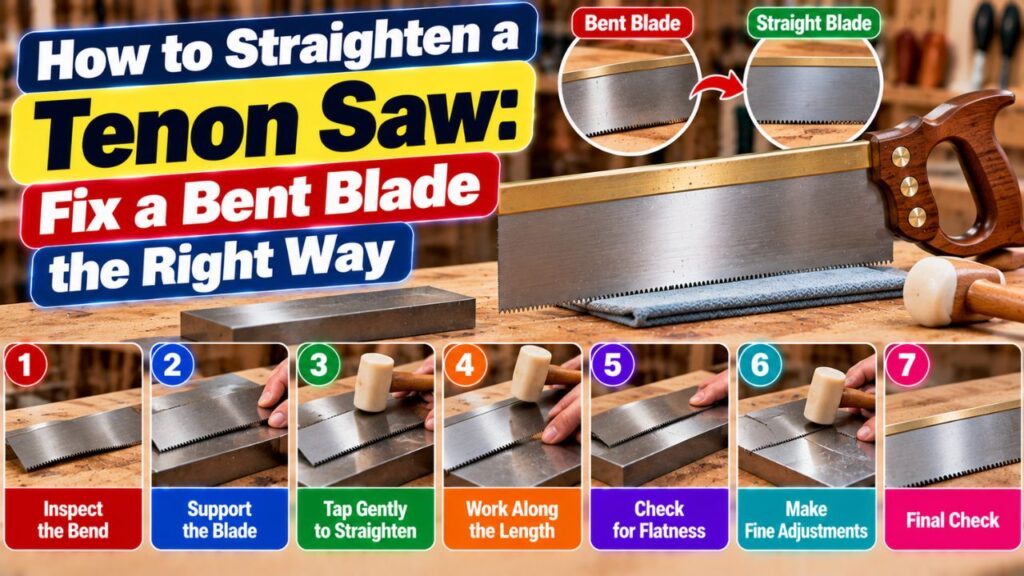
How to Straighten a Tenon Saw: Fix a Bent Blade the Right Way
If you want to know how to straighten a tenon saw, first determine whether the problem is actually in the saw plate, the rigid back, or the tooth set. A mild smooth bow in a traditional backed saw can often be corrected by carefully reseating or straightening the back, while a sharp kink, twisted spine, or badly damaged plate may require specialist repair or blade replacement. Avoid aggressively bending or hammering the thin saw plate before you know what caused the distortion.
A tenon saw is different from an ordinary handsaw because its relatively thin steel plate depends heavily on the rigid brass or steel back for support. If that back shifts, bends, twists, or places uneven compression on the plate, the toothline can curve even when the plate itself has not permanently stretched or kinked.
That is good news because many apparently “bent” tenon saws are repairable without major blade work. However, the wrong correction can make the saw worse. Hammering the plate unnecessarily, twisting a modern rigid back, or driving the back too far onto the plate can introduce new distortion.
There is another complication: a tenon saw can look perfectly straight and still cut to one side. Uneven tooth set, poor sharpening, excessive downward pressure, or incorrect technique can all make a straight saw wander.
In this guide, I’ll explain how to diagnose the problem, straighten a mildly bent tenon saw, deal with a shifted or bent back, recognize a kink that should not be treated casually, and determine whether the real problem is the blade, teeth, handle, or your sawing technique.
Why Does a Tenon Saw Become Bent or Crooked?
Tenon saw blades are deliberately thin so they can produce a narrow, accurate kerf. The heavy back stiffens that thin plate and helps keep it aligned during a cut.
Because the plate and back work together, damage to one part can affect the other.
A saw may develop a smooth bow after being twisted in a deep kerf. The blade may shift slightly inside a traditional folded back. A saw dropped onto the floor may bend or twist the spine. Improper storage can also apply pressure to the plate.
A genuine kink is different. A kink is a localized sharp bend where the steel has been deformed rather than merely pulled out of alignment by the back.
The first repair step is therefore diagnosis rather than bending.
Common Causes of a Crooked Tenon Saw
A smooth curve along much of the toothline often points toward back alignment or tension.
A curve close to the back can indicate that the back itself is bowed.
A blade that appears twisted when viewed from the heel toward the toe may be responding to a twisted spine.
A sharp localized crease usually indicates actual plate damage.
If the plate looks straight but every test cut drifts consistently left or right, the problem is more likely unequal tooth set, filing, or technique than a bent blade.
That distinction prevents a lot of unnecessary repair work.
How to Tell What Is Actually Bent
Before touching the saw with a mallet, vise, wrench, or other tool, inspect it carefully.
Clean enough rust and dirt from the plate that you can see its shape clearly. You do not need a full restoration, but heavy corrosion can hide subtle bends.
Hold the saw at eye level and sight along the toothline from the heel toward the toe. Then turn it over and sight along the back.
A properly aligned saw should not show obvious waves or twisting.
Check the Back With a Straightedge
Place a known straight rule or straightedge against each side of the saw back.
Look for daylight between the straightedge and the back.
If the back itself is bowed, straightening only the saw plate is unlikely to solve the problem because the back will continue pulling the plate out of alignment.
Check both faces because a back can appear straight from one angle while still having a slight lateral bend.
Check the Plate Near the Back
Place the straightedge against the saw plate just below the back.
A bend that follows the same shape as the back strongly suggests that the spine is controlling the distortion.
If the area near the back is straight but a localized kink appears farther down the plate, actual plate damage becomes more likely.
Check for Twist
Hold the saw vertically and look at the relationship between the back and toothline.
If one end appears rotated relative to the other, the back may be twisted.
A twisted saw can feel particularly frustrating because it may enter the kerf normally and then steer away from the line as the cut deepens.
Make a Test Cut
Use a straight-grained piece of scrap wood.
Mark a vertical line on the face and a square line across the top. Start the cut carefully and allow the saw to work with very little downward pressure.
If the plate visibly looks straight but the saw persistently pulls to one side, do not immediately start bending the blade.
Unequal tooth set is a much more likely possibility.
| Symptom | Likely Cause | Best First Action |
| Smooth bow along toothline | Back shifted on plate | Inspect and reseat back |
| Back visibly curved | Bent spine/back | Straighten back carefully |
| Blade twisted along length | Twisted back or plate | Diagnose spine before plate |
| Sharp local crease | Kinked plate | Specialist repair or replacement |
| Plate looks straight but saw pulls sideways | Uneven tooth set or technique | Test sharpening and set |
| Handle moves relative to plate | Loose saw nuts or handle fit | Repair handle attachment |
Key Takeaways:
- A curved toothline does not automatically mean the steel plate itself is permanently bent.
- Always inspect the back, plate, toothline, and cutting behavior before attempting a repair.
What You Need to Straighten a Tenon Saw
For a mild adjustment, you usually need very little equipment.
A padded bench vise is useful. Wood jaw liners or soft protective material keep brass, steel, and the saw plate from being marred.
A small wooden or rubber mallet is preferable to a hard steel hammer for reseating a traditional back because it reduces the chance of mushrooming, denting, or spreading the spine.
A reliable straightedge and a piece of scrap hardwood are also useful.
More severe repairs may involve specialty saw-straightening techniques, but I do not recommend treating those as beginner procedures. Hammer-tensioning a thin saw plate is a skilled operation, and careless blows can introduce additional tension problems that are harder to remove than the original bend.
Before handling the saw, protect your hands from the toothline and wear eye protection if you will be striking or clamping anything.
How to Straighten a Tenon Saw With a Mild Smooth Bow
If the toothline has a gentle continuous bow rather than a sharp kink, the most likely problem on a traditional folded-back tenon saw is that the relationship between the plate and back has shifted.
This type of repair should be incremental.
1. Confirm That the Back Is Basically Straight
Do not start reseating a clearly bent spine.
Run a straightedge along it first.
If the back itself has a pronounced bow or twist, correct that problem before attempting to change how it grips the saw plate.
2. Protect the Toothline
Place a piece of softwood or other protective material where the saw will be supported.
Do not place the teeth directly against a hard steel bench surface.
Tenon-saw teeth can be damaged surprisingly easily.
3. Support the Saw Securely
The exact support method depends on the saw design.
For a traditional folded back, the objective is to make very small adjustments to the back’s position on the plate rather than flexing the exposed plate by force.
Keep the saw controlled so a light tap moves the back rather than causing the entire saw to jump.
4. Reseat the Back Very Gently
Using a wooden or rubber mallet, apply very light taps to the back where adjustment is required.
Think in terms of thousandths of an inch rather than visible movement.
After one or two light taps, stop.
Sight down the toothline again.
If the bow becomes smaller, continue gradually.
If it becomes worse, stop rather than striking harder. The back may need adjustment in the opposite direction, or the problem may not be back seating at all.
5. Work Along the Back as Needed
If the plate has slipped unevenly along the spine, one isolated strike is rarely the best approach.
Small controlled adjustments along the back can redistribute the tension more evenly.
Do not pound the spine downward until it visibly moves a large distance. Excessive compression can actually buckle the plate.
6. Recheck the Saw Frequently
After every small correction, check three things:
the straightness of the back, the straightness of the toothline, and the flatness of the plate.
Then make another scrap cut.
It is much easier to add another tiny adjustment than to undo an excessive one.
7. Stop When It Cuts Straight
A woodworking saw does not need to satisfy a laboratory measuring instrument.
If the plate looks straight, the back is aligned, and the saw tracks predictably through a test cut, the repair is successful.
Continuing to manipulate the saw in pursuit of invisible perfection can create a new problem.
Why Tapping the Back Can Straighten the Blade
On many traditional backsaws, the folded brass or steel back grips the upper edge of the saw plate by friction.
That back does more than add weight and rigidity. Its position affects how tension is distributed through the thin plate.
If one area shifts, the spine may begin compressing the plate longitudinally rather than holding it evenly.
The toothline then bows or waves.
A tiny change in back position can release that uneven compression and allow the spring-steel plate to return toward its natural flat shape.
This explains why an apparently dramatic curve can sometimes disappear after surprisingly little adjustment.
It also explains why hammering the exposed blade first is often the wrong choice.
The visible bend may be a symptom of back position rather than permanent plate deformation.
Key Takeaways:
- On a traditional folded-back saw, small changes in the spine’s position can significantly change plate straightness.
- Use light adjustments and inspect after every correction; aggressive hammering can make a mild problem much worse.
How to Straighten a Bent Tenon Saw Back
If a straightedge confirms that the spine itself is curved, you need to address the spine rather than the toothline.
A mild bend in a traditional steel or brass back can sometimes be corrected in a padded vise.
Clamp only enough of the back to control it, using wood or soft jaw liners to protect the surface.
Apply slow, controlled pressure in the opposite direction of the bend.
Do not make a dramatic correction in one attempt.
Release the pressure, remove the saw, and check it with the straightedge.
Several small corrections are safer than one large bend.
Why You Need to Be Careful With Brass
Brass is workable but does not behave exactly like spring steel.
Repeatedly bending the spine backward and forward can damage it, especially if the deformation is severe.
If the back has a sharp crease, crack, badly distorted folded edge, or significant twist, professional restoration may be the wiser choice.
What About a Twisted Back?
Twist is more difficult than a simple side-to-side bow.
Experienced saw restorers may use a padded vise and controlled leverage to correct a twisted traditional back, but it is easy to overcorrect the spine or create another distortion.
For a valuable vintage saw, I would not learn this technique on the saw itself.
Practice on an inexpensive damaged backsaw or use a saw specialist.
Can You Straighten a Kinked Tenon Saw Blade?
Sometimes, but this is where straightforward DIY repair becomes much less predictable.
A kink is not the same as a gentle bow.
When spring-steel saw plate is sharply kinked, stresses become concentrated around the damaged area. Simply bending the blade backward with your hands may move the crease somewhere else rather than making the plate flat.
Traditional saw doctors straighten plates through controlled hammering and tensioning on a suitable anvil.
That work depends on understanding how each hammer blow stretches and redistributes stress in the steel.
Randomly hammering a saw plate between two pieces of wood is not the same thing.
Mild Kink vs. Severe Kink
A very slight local distortion may be repairable by an experienced hand.
A pronounced crease that remains obvious when the plate is relaxed is much more troublesome.
Replacement may make more sense if the blade is inexpensive, modern, or readily available.
For a valuable antique saw, a specialist can assess whether the original plate is worth preserving.
Do Not Heat the Saw Blade to Straighten It
Heating the plate with a torch is not a good shortcut.
Tenon-saw plates are hardened and tempered spring steel. Excessive heat can alter the temper, change hardness, cause scaling, and permanently damage the plate.
Keep routine straightening work cold.
Traditional Folded Backs vs. Modern Milled Backs
This distinction is important because advice that works perfectly on an old saw may damage a modern one.
Traditional backs often use a folded brass or steel spine that grips the plate through spring pressure and friction.
These backs can frequently be adjusted by experienced users because the plate can shift slightly within the fold.
Modern backsaws may instead use a solid milled brass back with a narrow slot.
Depending on the maker, the blade may be held by friction, adhesive, screws, pins, or another method.
If the blade is permanently bonded into a modern back, striking the spine in an attempt to reseat it may accomplish nothing except damaging the saw.
Before attempting significant adjustment to a modern premium tenon saw, check how the manufacturer constructs and services the saw.
If replacement blades or factory repairs are offered, that is often the safer route.
What If the Tenon Saw Is Straight but Cuts Crooked?
This is one of the most important parts of diagnosing a tenon saw.
A saw can be mechanically straight yet consistently steer left or right.
That usually points toward the teeth rather than the plate.
Uneven Tooth Set
Saw teeth are alternately bent slightly to each side. This is called set.
The set makes the kerf a little wider than the saw plate so the blade can move through wood without binding.
If the teeth on one side project farther than those on the other side, the saw may steer.
For example, excessive set on the right can influence the cut differently than balanced set.
An experienced sharpener may carefully reduce the stronger side by lightly stoning the teeth.
This is a fine adjustment, not something to attack aggressively.
Too much stoning can remove all useful set from one side and create another problem.
Uneven Sharpening
If teeth on one side were filed differently, the saw may also pull.
A complete sharpening and resetting may be required.
This is particularly common on old saws whose previous sharpening history is unknown.
Your Technique Can Also Steer the Saw
Before modifying the teeth, let another competent user test the saw if possible.
Use a relaxed grip.
Keep your index finger pointed along the back and avoid squeezing the handle excessively.
Allow the weight of the saw to do most of the work.
Heavy downward pressure makes it harder for the blade to correct itself and can cause you to steer with your arm.
Use long, smooth strokes through as much of the toothline as practical.
If the saw tracks straight for another user, sharpening may not be the problem.
Should You Remove the Back From the Blade?
Usually, no.
Removing the back is a much larger repair than making a small alignment adjustment.
On an old folded-back saw, complete removal may be justified if the joint contains corrosion, the plate needs major straightening, or the back has to be restored separately.
But once removed, the spine must be reinstalled evenly and with the correct tension.
The handle may also need to come off first.
For a mild bow, that amount of disassembly is unnecessary.
For a modern saw with a bonded or mechanically secured back, removal may damage components or complicate reassembly.
I would treat back removal as restoration work rather than routine tuning.
How to Straighten the Handle Alignment
Sometimes the blade and back are straight, but the saw still feels crooked because the handle is loose or misaligned.
Check the saw nuts or bolts.
The handle should sit securely against the plate without movement.
On older saws, wood shrinkage, cracked cheeks, worn bolt holes, or previous repairs can allow the handle to shift.
Tighten hardware only enough to make the handle secure.
Overtightening can crack an old wooden tote.
If the handle slot itself has been damaged or widened, a proper woodworking repair may be necessary rather than simply tightening the nuts harder.
Handle alignment matters because the grip determines how your hand transfers force into the saw.
A crooked handle can make a straight blade feel as if it constantly wants to turn.
A Safe Step-by-Step Tenon Saw Straightening Process
When I approach a crooked tenon saw, I recommend working in this order.
- Clean and inspect the saw. Remove enough grime to see the plate, toothline, and back clearly.
- Check the spine with a straightedge. Do not adjust the plate until you know whether the back is straight.
- Sight along the plate and toothline. Determine whether you have a smooth bow, twist, or localized kink.
- Check the handle. Make sure movement in the tote is not creating the impression of a bent saw.
- Make a controlled test cut. Determine whether the saw actually tracks crooked or merely looks imperfect.
- For a mild bow in a traditional folded-back saw, make tiny back adjustments. Use light taps and inspect after every change.
- For a mildly bent back, correct the spine gradually in a padded vise. Avoid repeated aggressive bending.
- Do not hammer a kinked plate unless you understand saw tensioning. Use a specialist for a valuable saw.
- If the saw is straight but pulls, investigate tooth set and sharpening.
- Make another test cut before making additional changes.
This order prevents you from correcting the wrong component.
How to Prevent a Tenon Saw From Bending Again
Tenon saws are robust tools, but their thin plates do not tolerate sideways force well.
The easiest way to protect one is to avoid twisting it when the blade binds in a kerf.
If the saw becomes stuck, stop pushing.
Move it gently backward along the kerf instead of levering the handle sideways.
When starting a cut, use very light pressure until the kerf is established.
A tenon saw is designed to cut efficiently with its own weight and sharp teeth. Forcing it downward makes buckling more likely.
Store the saw so nothing presses against the plate.
A saw till, protective rack, or dedicated storage slot is much better than dropping it into a drawer under heavier tools.
Keep the saw plate clean and lightly protected against corrosion. Rust increases friction in the cut and can make binding more likely.
A little appropriate saw lubricant or paraffin on the plate can also help it move smoothly through difficult timber.
Key Takeaways:
- Avoid twisting or levering a tenon saw sideways when it binds.
- Proper storage, sharp teeth, light cutting pressure, and a clean plate reduce the chance of future bending.
When Should You Replace the Blade Instead?
Repair is not always the best economic choice.
A replacement blade may make more sense when a modern plate has a severe crease, extensive pitting near the toothline, cracks, missing sections of teeth, or multiple areas of permanent deformation.
Replacement can also be attractive if the manufacturer supplies a compatible blade and the rest of the saw is in good condition.
A vintage or historically significant saw is different.
Original components may be worth preserving, and a professional saw restorer may be able to save a plate that appears unusable to a beginner.
The decision should consider the saw’s value, replacement-part availability, and the severity of the damage.
Common Tenon Saw Straightening Mistakes
One of the biggest mistakes is hammering the plate before checking the back.
Because the spine controls so much of a backsaw’s alignment, adjusting the plate while the back remains bent can waste time and introduce additional stress.
Another mistake is striking the brass or steel back hard with a metal hammer. Heavy blows can dent, spread, loosen, or deform the spine.
Overcorrecting is equally common. If a tiny adjustment improves the saw, repeating the same adjustment ten times does not necessarily make it ten times better.
Users also sometimes confuse tooth-set problems with blade distortion. If the saw looks straight but consistently pulls during a cut, inspect the teeth before bending anything.
Finally, avoid treating every vintage saw exactly like a modern saw. Construction methods vary, particularly in how the plate is attached to the back.
FAQs about How to Straighten a Tenon Saw
Can you straighten a bent tenon saw?
Yes, many bent tenon saws can be straightened, especially when the apparent bend is caused by a shifted, bowed, or twisted back rather than a severe kink in the steel plate.
Why is my tenon saw blade curved?
A smooth curve can occur when the blade shifts inside a traditional folded back or when the back itself bends. The spine can place uneven compression on the thin saw plate and create a curved toothline.
Can I bend a tenon saw blade straight by hand?
I do not recommend repeatedly bending the plate by hand. It may temporarily move the distortion while creating new stresses elsewhere. Diagnose the back first.
Should I hammer a bent saw blade?
Not unless you understand saw-plate tensioning. Controlled hammering is a traditional professional repair technique, but random hammer blows can make a plate more distorted.
Can I tap the back of a tenon saw?
On a traditional folded-back saw, very light, controlled taps can sometimes reseat the spine and straighten a smooth bow. This technique is not appropriate for every modern saw, particularly backs that are bonded or mechanically fixed.
How do I know whether the saw back is bent?
Place a reliable straightedge against both faces of the back and look for gaps. Also sight along the spine from heel to toe.
Why does my tenon saw cut to one side even though the blade is straight?
Unequal tooth set, uneven sharpening, excessive downward pressure, grip, or sawing technique may be responsible.
Can uneven saw teeth make the saw cut crooked?
Yes. Uneven tooth set can make a saw consistently steer to one side even when the plate and back are perfectly straight.
Can a kinked tenon saw be repaired?
A minor kink may be repairable by an experienced saw restorer. Severe localized creases are more difficult, and replacement may be more practical for an inexpensive modern blade.
Should I remove the brass back to straighten the blade?
Usually not for a minor bow. Back removal is a more advanced restoration procedure and may be unnecessary unless the plate or spine requires extensive work.
Can a brass saw back be straightened?
A mild bend can sometimes be corrected carefully, but brass should be adjusted gradually. A severely creased, cracked, or twisted back may require specialist repair or replacement.
How do I tell a bow from a kink?
A bow is a smooth gradual curve extending over a relatively large part of the blade. A kink is a sharp, localized change in direction or crease.
Can I heat the saw blade to straighten it?
No. Applying significant heat can change the temper of the spring-steel plate and permanently alter its properties.
How can I check whether the repair worked?
Sight along the blade and back, check them with a straightedge, and make several test cuts in straight-grained scrap wood using light pressure.
Why does my tenon saw keep binding?
Possible causes include excessive tooth set problems, insufficient set, dull teeth, a warped blade, misaligned back, damaged toothline, or forcing the saw sideways during the cut.
Is an old bent tenon saw worth restoring?
Often, yes. Many vintage backsaws have excellent steel and can become very effective woodworking tools after back alignment, handle repair, cleaning, sharpening, and proper setting.
Conclusion
Learning how to straighten a tenon saw starts with understanding that the visible blade is not always the real source of the problem. On a backsaw, the rigid brass or steel spine has a major influence on the thin plate below it.
If the toothline has a smooth bow, I recommend inspecting the back first. On a traditional folded-back saw, a small shift between the back and plate can often be corrected with very light, controlled reseating adjustments. If the back itself is mildly bowed, gradual straightening in a padded vise may restore the entire saw.
A sharp localized kink is different. That represents actual plate deformation and requires more specialized straightening skill. For a valuable saw, professional repair is usually safer than experimenting with hammer tensioning.
Also remember that a saw that cuts crooked is not necessarily bent. If the plate and spine look straight, investigate uneven tooth set, sharpening, handle alignment, and sawing technique before changing the shape of the blade.
My recommendation is to make the smallest possible correction, inspect frequently, and test the saw after every meaningful adjustment. Tenon saws are precision hand tools, and a gentle correction to the real problem is far more effective than aggressively trying to force the entire blade straight.