Jab Saw vs Keyhole Saw vs Drywall Saw: What’s the Difference?
If you are shopping for a small hand saw for drywall, remodeling, or light cutting work, you may quickly run into three similar-looking tools: the jab saw, keyhole saw, and drywall saw.
At first glance, they can look almost identical. All three may have a narrow blade, pointed tip, and compact handle. Some product listings even use the names interchangeably.
So what is the real difference?
The biggest thing to understand is that a jab saw and a drywall saw are often essentially the same tool, especially when the saw has a pointed blade and aggressive teeth designed for gypsum board. A keyhole saw belongs to the same general family, but it is traditionally more versatile and may be designed for drywall, thin wood, plastic, paneling, and curved interior cuts.
In other words, the difference is often less about three completely separate tools and more about blade shape, tooth design, intended material, and how the manufacturer labels the saw.
This guide compares jab saw vs keyhole saw vs drywall saw in detail so you can understand what each one does, where they overlap, and which type makes the most sense for your project.
Jab Saw vs Keyhole Saw vs Drywall Saw: Quick Comparison
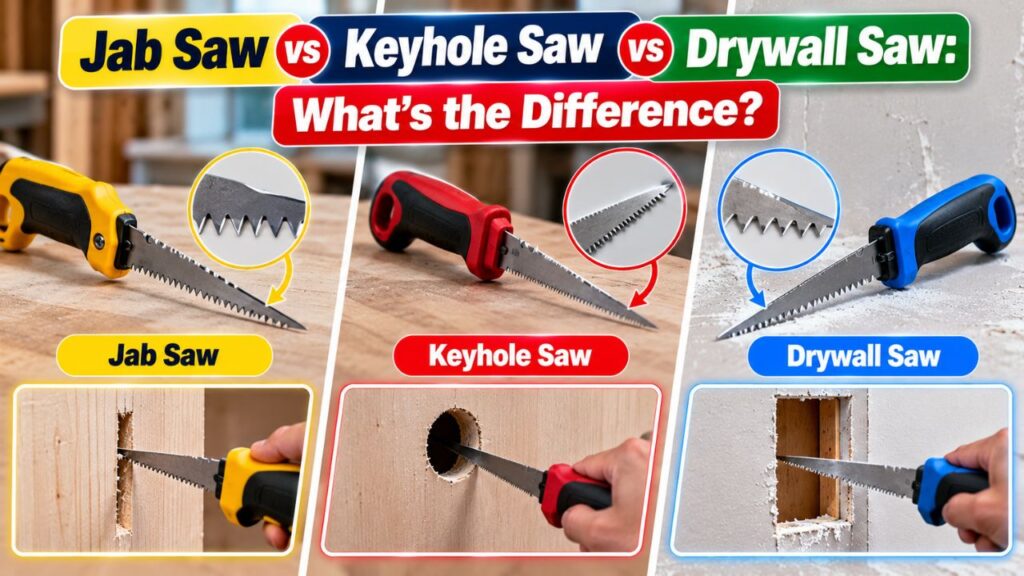
Here is the simplest way to compare the three.
| Feature | Jab Saw | Keyhole Saw | Drywall Saw |
| Main purpose | Interior cutouts | Small, curved, and interior cuts | Drywall cutouts |
| Best material | Drywall | Drywall, thin wood, plastic, paneling | Drywall |
| Blade shape | Narrow and pointed | Narrow and tapered | Narrow and pointed |
| Teeth | Usually coarse/aggressive | Varies by material | Usually coarse/aggressive |
| Good for drywall | Excellent | Good to excellent | Excellent |
| Good for wood | Limited | Better | Limited |
| Good for curves | Moderate | Good | Moderate |
| Can start inside drywall | Yes | Usually | Yes |
| Best for outlet cutouts | Yes | Yes | Yes |
| Commonly interchangeable name | Drywall saw | Sometimes | Jab saw |
The most important takeaway is simple:
Jab saw and drywall saw are usually the closest match. Keyhole saw is similar but generally broader in use.
What Is a Jab Saw?
A jab saw is a small hand saw with a narrow, pointed blade designed for making openings in drywall and other relatively soft building materials.
The pointed end is one of the tool’s defining features.
It allows the user to create a starter opening directly in drywall without first drilling a large hole.
That is where the word “jab” comes from. The tip can be pushed into the drywall, and the toothed blade can then be used to cut along a marked line.
Typical jab saw features include:
- A short, narrow blade
- A pointed tip
- Coarse cutting teeth
- A one-handed grip
- A relatively rigid blade
Jab saws are commonly used by:
- Drywall installers
- Electricians
- Plumbers
- Remodelers
- Maintenance workers
- DIY homeowners
What Is a Keyhole Saw?
A keyhole saw is a narrow-bladed hand saw designed for making small openings, curved cuts, irregular shapes, and interior cuts.
The blade is often thinner and more tapered than the blade on a heavy-duty drywall jab saw.
Keyhole saws may be used on:
- Drywall
- Thin wood
- Plywood
- Plastic
- Paneling
- Fiberboard
- Wallboard
Because of that, the term keyhole saw often describes a broader category of narrow hand saw.
Some keyhole saws have removable or replaceable blades, allowing the user to choose different tooth patterns for different materials.
Others are fixed-blade tools.
The important difference is that a keyhole saw is not always made specifically for drywall.
What Is a Drywall Saw?
A drywall saw is a hand saw designed specifically for cutting drywall, gypsum board, wallboard, and similar materials.
In many cases, a drywall saw looks and works exactly like a jab saw.
It usually has:
- A pointed nose
- Aggressive teeth
- A narrow blade
- A sturdy handle
Manufacturers may label the same general tool as:
- Drywall saw
- Jab saw
- Drywall jab saw
- Wallboard saw
- Plasterboard saw
That is why people often become confused when comparing jab saw vs drywall saw.
In practical use, there is often very little difference.
Jab Saw vs Keyhole Saw: What’s the Difference?
The main difference between a jab saw and keyhole saw is usually their intended application.
A jab saw is commonly designed specifically for drywall and wallboard.
A keyhole saw may be designed for a wider variety of materials and is often better suited for curved or irregular cuts.
Jab Saw Advantages
A jab saw usually has:
- More aggressive teeth
- A stronger pointed tip
- Better drywall penetration
- Faster cutting in gypsum board
Keyhole Saw Advantages
A keyhole saw may offer:
- Better curve control
- A thinner blade
- More material options
- Greater precision in small cutouts
For drywall only, a jab saw is generally the more straightforward choice.
For multiple materials and curved cuts, a keyhole saw can be more versatile.
Jab Saw vs Drywall Saw: Are They the Same?
In many cases, yes.
A jab saw and drywall saw are often two names for the same style of tool.
The difference is mostly in how the name describes the saw.
Jab saw describes the action.
The pointed blade can be jabbed or pushed through drywall to start a hole.
Drywall saw describes the material.
The saw is designed for cutting drywall.
So a product labeled drywall jab saw is perfectly normal.
Is There Ever a Difference?
Sometimes.
A tool marketed specifically as a drywall saw may have:
- Coarser teeth
- A thicker blade
- A stronger tip
- A larger handle
A more general jab saw may be designed for other soft materials too.
But for most household and DIY drywall jobs, the difference is minor.
Keyhole Saw vs Drywall Saw: What’s the Difference?
The difference between a keyhole saw and drywall saw is more noticeable.
A drywall saw is optimized for gypsum board.
A keyhole saw is usually a more general-purpose narrow hand saw.
Drywall Saw
Best for:
- Gypsum board
- Wallboard
- Outlet holes
- Switch openings
- Plumbing cutouts
- Access panels
Keyhole Saw
Best for:
- Drywall
- Thin wood
- Paneling
- Plastic
- Curves
- Small internal openings
If most of your work involves drywall, a drywall saw makes sense.
If you need one small saw for several thin materials, a keyhole saw may offer better versatility.
Blade Design: Where the Real Difference Begins
The blade is one of the most important differences between these tools.
Jab Saw Blade
A jab saw blade is normally:
- Narrow
- Relatively rigid
- Pointed
- Coarsely toothed
The coarse teeth remove gypsum quickly.
The rigid blade helps prevent excessive flexing while pushing through drywall.
Drywall Saw Blade
A drywall saw blade follows nearly the same design.
It is usually optimized for:
- Fast drywall cutting
- Dusty materials
- Small openings
Some models may have teeth arranged to cut effectively in both directions.
Keyhole Saw Blade
A keyhole saw blade may be:
- Narrower
- More tapered
- More flexible
- Finer toothed
That makes it easier to turn during a cut.
However, blade design varies significantly between models.
A keyhole saw made for wood may look quite different from one intended for drywall.
Tooth Design and Cutting Speed
Saw teeth determine how aggressively the blade removes material.
Drywall saws and jab saws usually have coarse teeth because drywall is soft.
Coarse teeth provide:
- Fast cutting
- Efficient gypsum removal
- Good performance in wallboard
The downside is that the cut may look rougher.
Keyhole saws can have different tooth patterns.
A fine-tooth keyhole blade may produce a cleaner cut in thin wood or plastic.
That makes the keyhole saw more versatile, but not always faster in drywall.
Which Saw Is Best for Cutting Drywall?
For most people, the best choice is a jab saw or drywall saw.
These tools are specifically designed for drywall and are easy for beginners to use.
They are particularly good for:
- Electrical box openings
- Switch cutouts
- Vent openings
- Pipe openings
- Small access holes
- Drywall repairs
If your main material is drywall, there is little reason to choose a keyhole saw unless you already own one.
Which Saw Is Best for Cutting Into Installed Drywall?
For installed drywall, a jab saw or drywall saw is usually the better manual option.
The pointed blade lets you create a starter hole without beginning from an exposed edge.
However, installed walls require additional caution.
Behind drywall there may be:
- Electrical wiring
- Plumbing pipes
- Gas lines
- Data cables
- HVAC components
- Wall studs
Do not drive the blade deeply into an unknown wall cavity.
Use short, controlled strokes.
Which Saw Is Better for Wood?
A keyhole saw is generally better for thin wood than a drywall saw.
That does not mean every keyhole saw is ideal for woodworking.
Blade selection still matters.
A fine-tooth keyhole saw may work for:
- Thin plywood
- Wood paneling
- Soft wood
- Small interior cutouts
A coarse drywall saw may cut wood, but the result may be rough.
If the project requires clean or precise wood cutting, use a blade designed specifically for wood.
Which Saw Is Better for Curved Cuts?
For curves, the keyhole saw usually has the advantage.
Its blade is often narrower and more tapered.
A narrow blade can turn more easily while following a curved line.
That makes keyhole saws useful for:
- Rounded openings
- Irregular shapes
- Decorative cutouts
- Small interior curves
A jab saw can make some curved cuts, but its thicker, more aggressive blade may not turn as smoothly.
Which Saw Is Better for Straight Cuts?
For short straight openings in drywall, a jab saw or drywall saw works well.
For long straight cuts across an entire drywall sheet, none of these tools is ideal.
A utility knife and straightedge are usually better.
Drywall can be scored along a line and snapped cleanly.
This is faster and creates much less dust than sawing through the full gypsum core.
Which Saw Is Best for Electrical Box Openings?
For small outlet or switch openings, a jab saw or drywall saw is usually the most practical choice.
The process is simple:
- Mark the box location.
- Carefully penetrate the drywall.
- Follow the outline.
- Remove the cut piece.
A keyhole saw can also work.
If the keyhole saw has a pointed blade suitable for drywall, the results may be nearly identical.
Which Saw Is Best for Plumbing Openings?
For small plumbing cutouts, any of the three may work.
A jab saw is good for irregular shapes.
A keyhole saw is useful if the opening includes curves.
For perfectly round pipe holes, a hole saw may be easier and cleaner.
The best choice depends on the required shape.
Which Saw Is Best for Ceiling Drywall?
A jab saw or drywall saw works well for ceiling openings such as:
- Recessed lights
- Speakers
- Vents
- Electrical fixtures
Keyhole saws can also work.
When cutting overhead, always expect falling dust and debris.
Wear appropriate eye protection.
Which Saw Is Better for DIY Beginners?
For a beginner whose main goal is drywall work, choose a jab saw or drywall saw.
Why?
Because it is:
- Easy to understand
- Easy to control
- Inexpensive
- Designed for drywall
- Good for common household projects
A keyhole saw is a good second option if you want more versatility.
Which Saw Is More Versatile?
The keyhole saw is usually the most versatile of the three.
A suitable keyhole saw can handle:
- Drywall
- Thin wood
- Plastic
- Paneling
- Curved shapes
A jab saw and drywall saw are more specialized.
Their main strength is cutting gypsum board quickly.
Which Saw Makes the Cleanest Cut?
The answer depends on the material.
In drywall, all three can produce acceptable results if used carefully.
A finer-tooth keyhole blade may produce a cleaner edge.
However, drywall edges are often hidden behind:
- Outlet covers
- Trim
- Fixtures
- Patch compound
For most drywall openings, speed and control matter more than perfect edge quality.
Which Saw Cuts Faster?
In drywall, a jab saw or drywall saw usually cuts faster because of its aggressive teeth.
A keyhole saw with fine teeth may require more strokes.
However, cutting speed should not be the only concern.
Control matters, especially when working in installed walls.
Jab Saw vs Keyhole Saw vs Drywall Saw for Different Materials
Here is a broader material comparison.
| Material | Jab Saw | Keyhole Saw | Drywall Saw |
| Drywall | Excellent | Good to excellent | Excellent |
| Thin wood | Fair | Good | Fair |
| Plywood | Limited | Good with correct blade | Limited |
| Plastic | Limited | Good with correct blade | Limited |
| Paneling | Fair | Good | Fair |
| Metal | Not recommended | Only with suitable blade | Not recommended |
| Plaster | Limited | Depends on blade | Limited |
Always match the blade to the material.
Do not assume a saw designed for drywall is safe or efficient for metal or hard materials.
Jab Saw vs Keyhole Saw vs Drywall Saw for Precision
If precision is your priority, blade width and tooth design matter.
Jab Saw
Good control, but coarse teeth can create rough edges.
Drywall Saw
Very similar to a jab saw.
Best for practical drywall cutouts rather than fine finish work.
Keyhole Saw
Can provide better control around curves and small details.
For delicate cuts, the keyhole saw often has the edge.
Do You Need All Three Saws?
For most homeowners, no.
You usually do not need separate jab, drywall, and keyhole saws.
If you mainly cut drywall, buy a good drywall jab saw.
If you want a more versatile narrow hand saw, consider a keyhole saw.
Buying all three only makes sense if you regularly work with multiple materials and different cut types.
When Should You Choose a Jab Saw?
Choose a jab saw if:
- You mainly cut drywall
- You make outlet or switch openings
- You need a pointed starter tip
- You want aggressive drywall teeth
- You prefer a simple manual tool
A jab saw is one of the most practical tools for basic drywall work.
When Should You Choose a Drywall Saw?
Choose a drywall saw if:
- Drywall is your main material
- You want a tool designed specifically for gypsum board
- You need small cutouts
- You need to work inside finished walls
- You want a low-cost hand tool
In most cases, this is functionally the same decision as choosing a jab saw.
When Should You Choose a Keyhole Saw?
Choose a keyhole saw if:
- You cut multiple thin materials
- You need curved cuts
- You work with paneling or thin wood
- You want a more versatile hand saw
- You prefer narrow, maneuverable blades
A keyhole saw is especially useful when the job extends beyond drywall.
Jab Saw vs Utility Knife
A jab saw is better for:
- Internal openings
- Small irregular cutouts
- Outlet boxes
- Pipe openings
A utility knife is better for:
- Long straight drywall cuts
- Scoring drywall
- Snap cutting
- Reducing dust
Both tools serve different purposes.
Most drywall toolkits benefit from having both.
Jab Saw vs Jigsaw
A jab saw is manual.
A jigsaw is powered.
A jigsaw is better for:
- Faster cutting
- Large curves
- Larger cutouts
- Repeated cutting
A jab saw is better for:
- Small drywall openings
- Quick manual cuts
- Confined spaces
- Simple DIY work
For one outlet opening, a jab saw is usually easier.
Keyhole Saw vs Jigsaw
A keyhole saw is ideal for occasional manual work.
A jigsaw is faster and better for larger cuts.
Choose a keyhole saw when:
- You need a small cut
- You do not want to use power tools
- You need fine manual control
Choose a jigsaw when:
- The cut is long
- The material is thicker
- You need to work faster
- Multiple cuts are required
Jab Saw vs Oscillating Multi-Tool
An oscillating multi-tool can also cut drywall.
Compared with a jab saw, it offers:
- Better controlled powered cutting
- More blade options
- Easier cutting near edges
However, it costs more and requires power.
For a beginner or occasional drywall user, a jab saw is often enough.
Is a Jab Saw the Same as a Keyhole Saw?
Not exactly.
They are closely related tools, but the names usually imply different intended uses.
A jab saw is typically optimized for drywall.
A keyhole saw is often more general purpose.
Some manufacturers blur the distinction, so two tools sold under different names may look almost identical.
Is a Keyhole Saw the Same as a Drywall Saw?
Not necessarily.
A keyhole saw can cut drywall, but it may also be designed for other materials.
A drywall saw is specifically optimized for gypsum board.
Their shapes may be similar, but their tooth patterns and blade stiffness may differ.
Is a Jab Saw the Same as a Drywall Saw?
Usually, yes.
For most practical purposes, jab saw and drywall saw are interchangeable terms.
When shopping, compare the actual tool rather than focusing only on the name.
What Should You Look for When Buying One?
When choosing any of these saws, look at:
Blade Quality
The blade should feel rigid enough for controlled cutting.
Tooth Design
Choose coarse teeth for drywall.
Choose a more appropriate tooth pattern for wood or plastic.
Handle Comfort
A comfortable, non-slip grip improves control.
Blade Length
Longer is not always better.
For installed drywall, excessive blade length can be risky.
Folding Design
A folding model protects the teeth during storage.
Replaceable Blade
Replaceable blades can make the tool more economical over time.
Safety Tips
These are simple hand tools, but safety still matters.
When cutting installed drywall:
- Wear eye protection
- Expect drywall dust
- Keep your free hand away from the blade
- Do not push deeply into unknown wall cavities
- Check for wiring and plumbing
- Use slow strokes near corners
- Do not force the blade sideways
- Replace bent or damaged blades
The hidden space behind drywall is often a greater concern than the drywall itself.
Common Mistakes to Avoid
Choosing Based Only on the Tool Name
Names overlap.
Check the actual blade design and intended materials.
Using a Drywall Blade on Every Material
A drywall saw may cut wood, but that does not mean it is the best choice.
Forcing Tight Curves
A thick jab saw blade may not turn smoothly.
Use a keyhole saw or another suitable tool for sharp curves.
Cutting Too Deep Into a Wall
This can damage wiring or pipes.
Using a Dull Blade
A dull blade requires more force and reduces control.
Frequently Asked Questions About Jab Saw vs Keyhole Saw vs Drywall Saw
What is the main difference between a jab saw and keyhole saw?
A jab saw is usually designed specifically for drywall, while a keyhole saw is generally more versatile and can be used for curved cuts and different thin materials.
What is the difference between a jab saw and drywall saw?
There is often very little difference. The terms are commonly used interchangeably.
What is the difference between a keyhole saw and drywall saw?
A keyhole saw may be used for drywall, thin wood, plastic, and paneling. A drywall saw is primarily designed for gypsum board.
Which is better, jab saw or keyhole saw?
For drywall, a jab saw is usually the better choice. For curves and multiple materials, a keyhole saw may be more versatile.
Which is better, keyhole saw or drywall saw?
Choose a drywall saw for dedicated drywall work. Choose a keyhole saw when you need a narrow saw for different materials.
Which saw is best for drywall?
A jab saw or drywall saw is usually the best simple manual option.
Is a jab saw good for outlet holes?
Yes. Electrical box and switch openings are among the most common uses for a jab saw.
Can a keyhole saw cut drywall?
Yes. Many keyhole saws can cut drywall effectively.
Can a drywall saw cut wood?
It may cut thin wood, but it is not normally the best tool. A keyhole saw with the proper blade is usually better.
Can you use a jab saw for wood?
You can cut some thin wood with certain jab saws, but the coarse drywall teeth may leave a rough edge.
Is a keyhole saw better for curved cuts?
Usually yes. Its narrow blade makes it easier to follow curves.
Do I need both a jab saw and drywall saw?
Usually not. They are often the same basic type of tool.
Do I need a keyhole saw if I already have a jab saw?
Only if you need greater versatility, tighter curves, or cutting capability for materials beyond drywall.
Final Thoughts
When comparing jab saw vs keyhole saw vs drywall saw, the biggest mistake is assuming they are three completely different tools.
A jab saw and drywall saw are usually nearly identical, and the two names are often used for the same pointed, narrow-bladed hand saw designed for gypsum board.
A keyhole saw follows the same general concept but is typically more versatile. Depending on the blade, it may cut drywall, thin wood, paneling, plastic, and other light materials. Its narrow profile also makes it particularly useful for curved and irregular cuts.
If your main job is cutting drywall openings, a jab saw or drywall saw is the most straightforward choice.
If you need a hand saw for curves and multiple thin materials, a keyhole saw may be more useful.
For most DIY users, there is no need to own all three. Focus on the blade design, tooth pattern, material compatibility, and type of cut rather than the label printed on the handle.