Best Tool for Cutting Drywall: What to Use for Every Cut
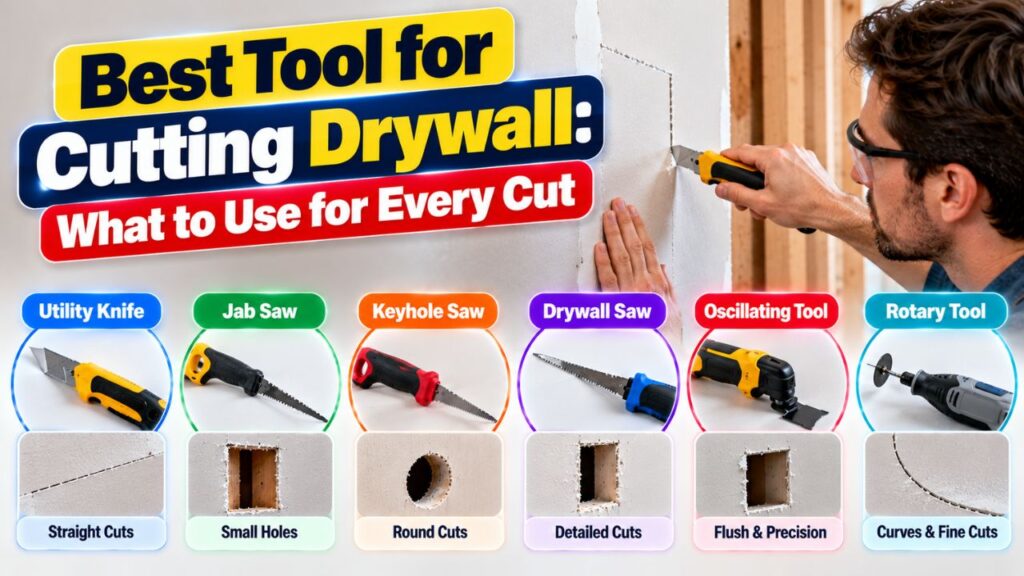
Choosing the best tool for cutting drywall depends less on finding one perfect tool and more on understanding the type of cut you need to make. Drywall is relatively soft, so many knives, hand saws, and power tools can cut through it. However, a tool that works perfectly for a long straight cut may be a poor choice for making an electrical outlet opening or cutting into an existing wall.
For example, a utility knife is usually the simplest choice for straight cuts across new drywall sheets because the board can be scored and snapped rather than completely sawn through. A jab saw or drywall saw is more useful for small holes and openings. An oscillating multi-tool gives better control when cutting installed drywall, while a rotary cut-out tool can save considerable time when making many electrical box or fixture openings.
The location of the drywall matters too. Cutting a loose sheet on a work surface is very different from cutting drywall on a wall or ceiling where electrical wires, pipes, framing, and other components may be hidden behind the board.
This guide explains the best drywall cutting tools for each situation, how they compare, and which tools make the most sense for beginners.
What Is the Best Tool for Cutting Drywall?
The best tool for cutting drywall for most long, straight cuts is a sharp utility knife paired with a straightedge. Instead of sawing completely through the board, you score the paper surface, snap the gypsum core along the line, and cut through the backing paper.
However, different jobs call for different tools.
For small holes and interior openings, a jab saw is usually more practical. For installed drywall where depth control matters, an oscillating multi-tool can be an excellent choice. A rotary cut-out tool becomes useful when making many openings quickly.
Here is a quick overview:
| Drywall Job | Best Tool |
| Straight cut across a drywall sheet | Utility knife |
| Small hole or opening | Jab saw / drywall saw |
| Electrical box opening | Jab saw or rotary cut-out tool |
| Cutting installed drywall | Oscillating multi-tool |
| Curved cut | Jigsaw or keyhole saw |
| Round hole | Hole saw |
| Ceiling opening | Jab saw or oscillating tool |
| Removing drywall during demolition | Oscillating or reciprocating saw |
| Many repetitive drywall cutouts | Rotary cut-out tool |
No single tool is best for every situation.
The most useful approach is to match the cutting tool to the shape, location, and size of the cut.
Best Tool for Cutting Drywall Straight
For most straight drywall cuts, a utility knife is the best tool.
Drywall does not need to be sawn all the way through like plywood. Its gypsum core breaks cleanly after the paper face has been scored.
How the Score-and-Snap Method Works
Place the drywall sheet on a stable surface and mark the required measurement.
Hold a T-square or straightedge against the line and score the face paper with a sharp utility knife.
You do not need to cut deeply through the gypsum.
Once the paper has been scored:
- Lift or bend the drywall along the line.
- Snap the gypsum core.
- Fold the board backward.
- Cut through the rear paper.
- Smooth the edge with a drywall rasp if necessary.
This method is fast, simple, and produces very little airborne dust.
Why a Utility Knife Is Better Than a Saw for Straight Cuts
Using a saw means the teeth must grind through the gypsum core.
That creates much more drywall dust.
A utility knife also gives you a cleaner straight line when used with a proper drywall T-square.
For beginners cutting full drywall sheets, the combination of a utility knife, T-square, and drywall rasp is often more useful than any power saw.
Best Tool for Cutting Drywall Sheets
The best tool for cutting drywall sheets is also usually a utility knife.
This applies when you need to:
- Shorten a drywall sheet
- Reduce its width
- Cut a sheet to fit a wall
- Trim drywall before installation
- Divide a full sheet into smaller sections
For standard rectangular cuts, the score-and-snap technique is difficult to beat.
You may also want:
Drywall T-square: Helps mark accurate 90-degree lines.
Tape measure: Provides precise dimensions.
Drywall rasp: Smooths slightly rough or uneven cut edges.
Utility knife: Scores both the front and rear paper.
A power saw is generally unnecessary for basic sheet sizing.
Best Tool for Cutting Drywall Openings
For most drywall openings, a jab saw, also known as a drywall saw, is one of the simplest options.
Unlike a utility knife, a jab saw can start a cut in the middle of a panel.
Its blade is narrow and usually ends in a sharp point.
That makes it ideal for cutting openings for:
- Electrical boxes
- Light switches
- Plumbing pipes
- Access panels
- Recessed lighting
- Speakers
- HVAC vents
- Cable openings
Why a Jab Saw Works Well
The teeth are designed to cut through gypsum board quickly, while the narrow blade allows you to change direction.
For a beginner who only needs to make a few openings, there is usually no need for an expensive power tool.
A quality manual drywall saw can handle the job.
Best Tool for Cutting Drywall Holes
The best tool for cutting drywall holes depends heavily on the shape of the hole.
For rectangular or irregular holes, use a jab saw or drywall saw.
For round holes, a hole saw may provide a cleaner result.
For example, a hole saw can be useful when cutting openings for certain:
- Pipes
- Light fixtures
- Cable pass-throughs
- Ceiling fixtures
A rotary cut-out tool can also handle irregular holes efficiently.
Small Irregular Hole
Use a jab saw.
Precise Circular Hole
Use a hole saw of the correct diameter.
Large or Complex Opening
Consider an oscillating tool, jigsaw, or rotary cut-out tool, depending on whether the drywall is installed.
Best Tool for Cutting Drywall Around Outlets
For one or two electrical outlet openings, a jab saw is usually the easiest tool.
Mark the dimensions of the electrical box and carefully cut along the outline.
For larger drywall installation projects, a rotary cut-out tool can be much faster.
Drywall installers often use rotary tools because the cutting bit can follow the outer edge of an electrical box.
However, rotary tools require more practice.
A beginner can accidentally move outside the box and make the opening too large.
Jab Saw vs Rotary Tool for Outlets
A jab saw offers:
- Better beginner control
- No battery or power cord
- Low cost
- Simple operation
A rotary tool offers:
- Faster cutting
- Easier repetitive work
- Quick trimming around boxes
- Better efficiency on large projects
For occasional DIY work, the jab saw is usually sufficient.
Best Tool for Cutting Drywall on Wall
Choosing the best tool for cutting drywall on wall surfaces requires extra care because you cannot always see what is behind the drywall.
The wall cavity may contain:
- Electrical cables
- Plumbing pipes
- Gas lines
- Insulation
- HVAC components
- Wood or metal studs
- Low-voltage wiring
For installed drywall, an oscillating multi-tool is often one of the most controllable powered options.
A manual jab saw is also useful if you keep the blade shallow.
Why Depth Control Matters
Drywall itself may only require a relatively shallow cut.
If several inches of saw blade enter the wall cavity, the blade may reach something you did not intend to cut.
An oscillating tool makes it easier to control how deeply the blade penetrates.
A jab saw can also be safe when used carefully because you control each stroke manually.
Best Tool for Cutting Installed Drywall
For installed drywall, three tools stand out:
Oscillating multi-tool
Jab saw
Rotary cut-out tool
The right one depends on the job.
Oscillating Multi-Tool
Best for controlled cuts around:
- Trim
- Existing fixtures
- Damaged drywall sections
- Remodel openings
Jab Saw
Best for:
- Small openings
- Simple DIY repairs
- Electrical box cutouts
- Access holes
Rotary Cut-Out Tool
Best for:
- Repetitive fixture openings
- Electrical boxes
- New drywall installation
If you are uncertain about what is behind the drywall, investigate before cutting.
Best Tool for Cutting Drywall Ceiling
The best tool for cutting drywall ceiling openings is usually a jab saw, oscillating tool, or rotary cut-out tool.
The correct tool depends on the opening.
A jab saw is suitable for small openings such as:
- Recessed lighting
- Speakers
- Small vents
- Electrical fixtures
An oscillating tool can provide more controlled cuts in existing ceilings.
A rotary cut-out tool works well when the drywall is being installed and many fixture openings are needed.
Cutting Ceiling Drywall Safely
Ceiling work has a few extra challenges.
Dust and gypsum debris naturally fall toward you.
Use appropriate eye protection, and avoid placing your face directly below the cutting area.
You should also determine whether plumbing, electrical wiring, insulation, or ductwork is located above the ceiling board.
Best Tool for Cutting Drywall Out of an Existing Wall
If you are searching for the best tool for cutting drywall out, you are usually dealing with repair, renovation, or demolition rather than installing new drywall.
An oscillating multi-tool is an excellent choice when you want to remove a controlled rectangular or square section.
For example, you might need to remove drywall to:
- Repair plumbing
- Access wiring
- Fix water damage
- Replace damaged wallboard
- Inspect the wall cavity
The oscillating blade can follow a marked line and gives better depth control than many larger saws.
What About a Reciprocating Saw?
A reciprocating saw can remove drywall very quickly.
However, its long blade makes it better suited to demolition than careful repairs.
If the wall is being torn apart and hidden utilities have already been identified, it may be useful.
For a small repair opening, it is often unnecessarily aggressive.
Best Tool to Cut Drywall Without Dust
No drywall cutting method is completely mess-free, but the utility knife and score-and-snap method usually produce the least airborne dust.
Why?
Because the knife only cuts the paper surface.
The gypsum core then breaks rather than being ground into powder by saw teeth.
For interior cuts where a knife cannot be used effectively, a manual jab saw generally creates less airborne dust than high-speed power saws.
Tools That Tend to Create More Dust
High-speed tools such as:
- Circular saws
- Rotary cut-out tools
- Jigsaws
- Some power cutting tools
can produce considerably more fine gypsum dust.
For that reason, using the simplest effective tool often makes drywall work cleaner.
Best Hand Tool for Cutting Drywall
If you want one inexpensive hand tool specifically for drywall openings, choose a jab saw or drywall saw.
For straight cuts across a full sheet, choose a utility knife.
So ideally, a basic drywall toolkit should contain both.
A simple beginner setup might include:
- Utility knife
- Jab saw
- Drywall T-square
- Tape measure
- Pencil
- Drywall rasp
Those tools can handle a large percentage of common drywall cutting jobs.
Best Saw for Cutting Drywall
If you specifically want a saw for cutting drywall, a jab saw or drywall saw is the most straightforward option for most people.
It is designed specifically for gypsum board.
A keyhole saw is another option and can be useful for tight curves.
Power saws such as jigsaws and reciprocating saws have their place, but neither is necessary for most ordinary drywall cuts.
Utility Knife for Cutting Drywall
A utility knife is one of the most important drywall tools because it provides a clean, predictable way to cut large sheets.
Choose a knife that:
- Feels secure in your hand
- Has a sharp replaceable blade
- Locks firmly
- Provides good control
A dull blade may tear the paper rather than scoring it cleanly.
Replacing the blade regularly can improve both accuracy and safety.
Jab Saw for Cutting Drywall
A jab saw has a narrow blade, aggressive teeth, and usually a pointed end.
The point allows you to carefully create a starter opening in drywall.
This makes the tool particularly useful when the cut begins away from the edge of the board.
Common jobs include:
- Outlet boxes
- Switches
- Vents
- Plumbing openings
- Access holes
Because it is manually operated, you can also feel how the blade is moving through the material.
Keyhole Saw for Cutting Drywall
A keyhole saw is another narrow hand saw that can work well for drywall.
Compared with a heavy-duty jab saw, some keyhole saws have narrower blades that turn more easily.
That makes them useful for:
- Curved cuts
- Rounded openings
- Small irregular shapes
Some keyhole saws can also cut thin wood, paneling, or plastic when fitted with an appropriate blade.
If your work involves more than drywall, this additional versatility may be useful.
Oscillating Multi-Tool for Cutting Drywall
An oscillating multi-tool moves its blade through a very small side-to-side arc.
This makes it particularly useful for controlled remodeling work.
It can cut:
- Square openings
- Repair sections
- Drywall near trim
- Drywall near framing
- Small access panels
Its greatest advantage is control.
Compared with a reciprocating saw, an oscillating tool can make a much more deliberate cut.
Different blades are available for drywall, wood, metal, and mixed building materials.
Rotary Cut-Out Tool for Drywall
A rotary cut-out tool uses a small bit spinning at high speed.
It is especially popular for new drywall installation.
Rather than carefully sawing around every electrical box, an experienced installer can use the bit to locate the edge of the box and follow its perimeter.
Best Uses
Rotary cut-out tools are useful for:
- Electrical boxes
- Light fixtures
- Outlet openings
- Irregular cutouts
- Repetitive drywall work
Their speed is a major advantage on large jobs.
Their disadvantage is that mistakes can also happen quickly.
For occasional home repairs, a jab saw may still be easier.
Jigsaw for Cutting Drywall
A jigsaw can cut drywall, especially when you need larger curves or irregular openings in loose sheets.
A jigsaw is much faster than a manual keyhole saw.
However, it also:
- Creates more dust
- Requires power
- Extends a blade behind the drywall
- Can damage hidden utilities in installed walls
For this reason, it makes more sense when the drywall sheet is not yet attached to the wall.
Reciprocating Saw for Drywall
A reciprocating saw is powerful and fast.
For demolition, that can be useful.
For precision drywall work, it can be excessive.
The blade may extend deeply into a wall cavity, increasing the risk of contacting:
- Wires
- Water pipes
- Gas lines
- Framing
- Ductwork
Think of the reciprocating saw primarily as a demolition tool, not a precision drywall cutter.
Circular Saw for Cutting Drywall
A circular saw can physically cut drywall, but it is rarely the best choice.
Its high-speed rotating blade can create a cloud of very fine gypsum dust.
This creates unnecessary:
- Dust
- Cleanup
- Noise
- Tool contamination
For a straight cut, a utility knife is much simpler.
For an opening, use a jab saw or another drywall-specific cutting tool.
Dremel or Rotary Tool for Cutting Drywall
A Dremel-style rotary tool can cut drywall when fitted with an appropriate bit.
It may work well for:
- Small detailed openings
- Curved cutouts
- Outlet openings
- Minor trimming
A dedicated drywall rotary cut-out tool is generally faster for repeated work, but a compact rotary tool can be useful for occasional projects.
Expect more fine dust than you would get from a manual saw.
Hole Saw for Drywall
A hole saw is useful when you need a clean circular opening.
It attaches to a drill and removes a round section of material.
This can be convenient for certain:
- Pipes
- Ceiling fixtures
- Cable openings
- Small round vents
Select the diameter carefully because once the hole is cut, making it smaller is not possible.
Drywall Rasp: A Useful Finishing Tool
A drywall rasp does not make the main cut, but it is extremely helpful afterward.
Freshly cut drywall edges are not always perfectly smooth.
A rasp removes small amounts of gypsum so that you can:
- Straighten an edge
- Adjust a tight fit
- Smooth rough sections
- Fine-tune an opening
For beginners, a drywall rasp can make imperfect cuts much easier to correct.
What Tool Do You Use to Cut Drywall?
The answer depends on the job.
Use a utility knife for straight cuts.
Use a jab saw for small internal openings.
Use an oscillating multi-tool for controlled cutting in installed drywall.
Use a rotary cut-out tool for repeated electrical box and fixture openings.
Use a hole saw for clean round holes.
Use a jigsaw when you need larger curves in loose drywall.
That approach is more useful than trying to find one tool that performs every drywall cut equally well.
Best Way to Cut Drywall
The best way to cut drywall is to use the least aggressive tool that can make the required cut efficiently.
For a straight line, score and snap.
For a small opening, use a jab saw.
For precise work on an existing wall, use an oscillating tool.
For repetitive professional-style cutouts, use a rotary tool.
This approach helps improve:
- Control
- Accuracy
- Safety
- Dust management
- Cleanup
More power does not automatically produce a better drywall cut.
How to Cut Drywall Straight With a Utility Knife
Beginners can usually learn the score-and-snap technique quickly.
Step 1: Measure
Measure the drywall carefully and place marks at the required dimensions.
Step 2: Position a Straightedge
Align a drywall T-square or another suitable straightedge with your marks.
Step 3: Score the Face Paper
Run a sharp utility knife along the line.
The goal is to cut the surface paper rather than drive the blade completely through the sheet.
Step 4: Snap the Board
Lift and bend the drywall away from the scored line.
The gypsum core should break along the score.
Step 5: Cut the Back Paper
Fold the broken section backward and slice the remaining paper.
Step 6: Smooth the Edge
Use a drywall rasp if the edge needs minor correction.
How to Cut a Hole in Drywall With a Jab Saw
First, carefully mark the outline.
Before cutting installed drywall, consider what may be located behind the wall.
Place the pointed end of the jab saw inside the waste area and carefully create a starter opening.
Do not force the entire blade deeply into the cavity.
Once the blade has entered the drywall:
- Make short sawing strokes.
- Follow your marked line.
- Slow down near corners.
- Keep the blade depth controlled.
- Remove the waste section when the cut is complete.
The goal is controlled cutting rather than maximum speed.
How to Choose a Drywall Cutting Tool
Before choosing a tool, ask yourself four questions.
Is the Drywall Installed?
Loose drywall gives you much better access and visibility.
Installed drywall requires more attention to hidden utilities.
Is the Cut Straight or Curved?
For straight cuts, a utility knife works well.
For curves, consider a keyhole saw or jigsaw.
Is the Opening Internal?
If the cut starts in the middle of the sheet, you need a tool capable of making an interior opening.
A jab saw or rotary cut-out tool is useful here.
How Many Cuts Are You Making?
For one or two openings, a manual tool may be faster overall.
For dozens of electrical boxes, a rotary tool can save considerable time.
Which Drywall Cutting Tools Should Beginners Own?
You do not need a large collection of power tools to begin working with drywall.
A useful starter set consists of:
Utility knife: For straight score-and-snap cuts.
Drywall T-square: For measuring and guiding straight cuts.
Jab saw: For internal openings.
Drywall rasp: For adjusting edges.
Tape measure and pencil: For layout.
These tools are enough for many basic installation and repair jobs.
Later, you can add an oscillating or rotary tool if your projects justify it.
Drywall Cutting Safety
Drywall itself is fairly easy to cut, but the surrounding work environment can introduce hazards.
The most important concern when cutting an existing wall is what lies behind the surface.
Electrical wiring, water pipes, and other building systems may be only a short distance behind the drywall.
Keep these basic principles in mind:
- Identify likely utilities before cutting.
- Do not blindly insert long blades into walls.
- Keep saw strokes shallow.
- Wear eye protection.
- Manage drywall dust appropriately.
- Use sharp, undamaged tools.
- Support loose drywall sheets properly.
- Keep your free hand away from the blade.
- Use the right blade for the material.
If you are unsure what is behind a section of wall, investigate before making a deep cut.
How to Reduce Drywall Dust
Drywall dust is one of the main reasons to avoid unnecessarily aggressive power tools.
Whenever possible, use the score-and-snap method instead of sawing through an entire sheet.
For interior openings:
- Cut slowly
- Avoid oversized power saws
- Cover nearby furniture
- Manage dust close to the cutting area
- Clean the workspace after cutting
A manual jab saw still creates gypsum debris, but usually much less airborne dust than a high-speed circular or rotary saw.
Common Drywall Cutting Mistakes
Using a Saw for Every Cut
Straight sheet cuts usually do not require a saw.
Cutting Too Deep Into an Existing Wall
More blade depth means more risk to hidden utilities.
Measuring Only Once
An opening that is too large can be difficult to hide.
Using a Dull Utility Blade
A sharp blade produces a cleaner score and requires less force.
Using a Large Power Saw for a Small Opening
A powerful tool may create more dust and reduce control without saving meaningful time.
Forgetting About the Drywall Paper
Tearing the face paper can leave a rough edge even if the gypsum itself was cut accurately.
Frequently Asked Questions About the Best Tool for Cutting Drywall
What is the best tool for cutting drywall?
For straight cuts on new drywall, a utility knife is usually best. For small interior openings, a jab saw or drywall saw is one of the easiest choices.
What is the best tool for cutting drywall openings?
A jab saw works well for most small openings. A rotary cut-out tool is faster when many openings need to be made.
What is the best tool for cutting drywall straight?
Use a utility knife and straightedge, then snap the drywall along the scored line.
What is the best tool for cutting drywall ceiling openings?
A jab saw works well for small openings. An oscillating multi-tool can provide greater control on an existing ceiling.
What is the best tool for cutting drywall on a wall?
For installed wallboard, a jab saw or oscillating multi-tool is usually practical because both allow relatively controlled cutting.
What is the best tool for cutting drywall holes?
For irregular holes, use a jab saw. For clean circular holes, use an appropriately sized hole saw.
What is the best tool for cutting drywall sheets?
A utility knife and T-square are usually the best combination for sizing full drywall sheets.
What is the best tool for cutting drywall out?
For removing a controlled section from an existing wall, an oscillating multi-tool is a strong option. A reciprocating saw is generally better suited to demolition.
What is the best saw for cutting drywall?
For normal hand cutting, a jab saw or drywall saw is specifically designed for the job.
What tool cuts drywall with the least dust?
A utility knife produces very little airborne dust when drywall can be scored and snapped.
Can you cut drywall without a power tool?
Yes. A utility knife and jab saw can handle many common drywall cuts without electricity or batteries.
Should I use a saw or utility knife for drywall?
Use a utility knife for long straight cuts and a saw for interior openings or irregular shapes.
Can I use an oscillating tool to cut drywall?
Yes. It is particularly useful for controlled cuts in installed drywall and repair work.
Is a Dremel good for cutting drywall?
A Dremel-style rotary tool can make small or detailed cuts with the appropriate attachment, although a dedicated drywall cut-out tool is better suited to repeated drywall work.
What is the easiest drywall cutting tool for beginners?
For straight cuts, a utility knife is easiest. For openings, a basic jab saw is simple, inexpensive, and easy to control.
Final Thoughts
Finding the best tool for cutting drywall becomes much easier once you match the tool to the type of cut rather than trying to use one tool for everything.
For straight cuts and drywall sheets, start with a sharp utility knife, a straightedge, and the score-and-snap method. It is fast, produces minimal dust, and requires very little equipment.
For drywall openings and holes, a jab saw or drywall saw is one of the most beginner-friendly choices. A keyhole saw can be useful for tighter curves, while a hole saw is convenient for round openings.
When cutting drywall on a wall or ceiling, an oscillating multi-tool can provide excellent control, especially when you need to remove an existing section without making an unnecessarily large opening.
For repetitive electrical box and fixture cutouts, a rotary cut-out tool offers greater speed. Reciprocating saws are better reserved for demolition, while circular and table saws are generally unnecessary for ordinary drywall work.
For most homeowners, you do not need a large collection of specialized equipment. A utility knife, drywall T-square, jab saw, tape measure, and drywall rasp can handle a surprisingly wide range of drywall installation and repair projects.
The best drywall cutting tool is ultimately the one that gives you the right combination of accuracy, control, low dust, and safety for the specific cut you need to make.