What Materials Can a Fret Saw Cut? Wood, Plastic, Metal & More
If you are wondering what materials can a fret saw cut, the short answer is that a fret saw is best for thin wood, plywood, MDF, hardboard, veneer, laminates, and some plastics, while suitable specialty blades can also cut thin soft metals and certain other non-wood materials. The exact capability depends heavily on the blade, material thickness, and whether you are using a traditional hand fret saw or a powered fret/scroll saw.
A fret saw is primarily an intricate-cutting tool, not a heavy stock-removal saw. Its extremely thin blade can turn through tight curves and enter small starter holes, making it particularly useful for decorative patterns, internal cutouts, model making, marquetry, craft work, and fine woodworking.
The fact that the blade is thin also creates limitations. A fret saw is not designed to rip thick construction lumber, cut masonry, or force its way through hard structural metal. Selecting the correct blade is therefore just as important as selecting the correct material.
In this guide, I’ll explain which materials a fret saw can cut, which blade characteristics work best for different materials, how material thickness affects performance, and which jobs are better handled with another type of saw.
What Materials Can a Fret Saw Cut?
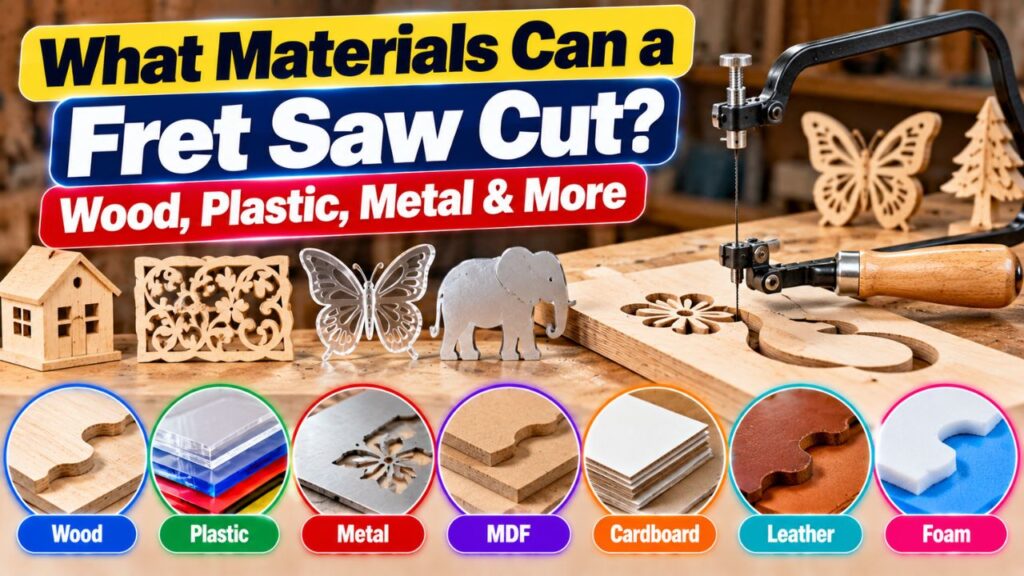
A fret saw is most commonly used on wood and wood-based sheet materials, but its capability is broader than many beginners realize.
Depending on the blade fitted to the saw, you can use one for thin:
| Material | Can a Fret Saw Cut It? | Practical Suitability |
| Softwood | Yes | Excellent |
| Hardwood | Yes | Very good when reasonably thin |
| Plywood | Yes | Excellent |
| MDF | Yes | Very good |
| Hardboard | Yes | Very good |
| Veneer | Yes | Excellent |
| Laminate | Yes | Good with a fine blade |
| Acrylic | Yes | Good with correct speed and blade |
| PVC and similar plastics | Often | Good when thin |
| Aluminum | Yes, with appropriate blade | Best on thin stock |
| Brass | Yes, with appropriate blade | Good for thin pieces |
| Copper | Yes, with appropriate blade | Good for thin pieces |
| Thin mild steel | Sometimes | Requires a metal-cutting blade |
| Hardened steel | Generally impractical | Use a metal-specific tool |
| Glass | No | Not a normal fret-saw material |
| Ceramic tile | No | Use a tile-cutting tool |
| Brick/concrete | No | Use masonry equipment |
The most important word here is thin.
A fret saw becomes more difficult to control as material thickness and hardness increase. Even if the blade technically cuts the material, the process may become so slow or blade-breaking-prone that another tool is more sensible.
Hand Fret Saw vs. Powered Fret Saw
Before discussing individual materials, it helps to distinguish between two tools that are sometimes described using similar names.
A traditional hand fret saw has a deep U-shaped frame and an extremely thin removable blade. You move the saw manually through the workpiece.
A powered machine commonly called a scroll saw in the United States performs a similar style of cutting with a vertically reciprocating blade. In some regions, it may also be described as an electric fret saw.
Both tools can make detailed cuts, but a powered scroll saw generally handles thicker materials and extended projects more efficiently.
The basic material principles are similar: softer and thinner materials are easier, while harder or thicker materials need appropriate blades and slower, more controlled cutting.
Key Takeaways:
- Fret saws are especially good for thin wood and wood-based sheet materials.
- With the right blade, they can also cut some plastics and thin nonferrous metals.
- Material thickness, hardness, and blade selection matter more than the material name alone.
Can a Fret Saw Cut Wood?
Yes. Wood is the primary material a fret saw is designed to cut.
The tool excels where a normal handsaw, jigsaw, or circular saw would be too coarse for the required detail.
The narrow blade can follow extremely tight curves, which makes a fret saw particularly useful for decorative fretwork and complex shapes.
Softwood
Softwoods such as pine, cedar, spruce, and fir are generally easy to cut with a fret saw.
Because these woods are comparatively soft, the blade moves through them without requiring excessive pressure.
They are a good choice for beginners learning to:
- Follow curved lines
- Control blade direction
- Make internal cutouts
For very soft wood, avoid forcing the blade. Excessive pressure can make it wander away from your line rather than cutting faster.
Hardwood
A fret saw can also cut hardwoods such as oak, maple, walnut, cherry, and mahogany.
Hardwoods simply require more patience.
A fine blade can produce precise edges, but cutting becomes slower as the wood gets harder and thicker.
For particularly dense hardwood, choosing a slightly coarser or stronger blade can reduce blade breakage and improve cutting speed.
The goal is not to push aggressively. Let the teeth perform the cutting.
Can a Fret Saw Cut Plywood?
Yes. Plywood is one of the best materials for fret-saw work.
It is especially popular for:
- Decorative fretwork
- Ornaments
- Model parts
- Signs
- Toys
- Small furniture details
- Pattern cutting
Plywood offers one major advantage over solid wood: its cross-laminated construction makes it more dimensionally stable and less likely to split along the grain.
That stability is useful when patterns contain narrow bridges or delicate sections.
Why Thin Plywood Works So Well
Thin plywood gives the blade relatively little material to remove while still providing enough strength to support intricate shapes.
High-quality plywood made for craft or scroll-saw work tends to produce cleaner results than inexpensive construction plywood.
Construction plywood can contain voids, knots, uneven glue layers, and splinter-prone veneers that make very detailed fretwork harder.
Preventing Plywood Splintering
Use a sharp, fine-tooth blade and cut without excessive pressure.
If the top veneer is especially delicate, painter’s tape over the cutting line can sometimes help reduce minor splintering while also making your pattern easier to see.
The quality of the blade usually makes a bigger difference than trying to force the saw through quickly.
Can a Fret Saw Cut MDF?
Yes. A fret saw can cut medium-density fiberboard, or MDF, particularly when the sheet is relatively thin.
MDF is uniform and has no natural grain direction, so the blade behaves consistently whether you are cutting straight lines or curves.
That makes MDF attractive for:
- Templates
- Decorative shapes
- Prototypes
- Craft projects
- Pattern practice
However, MDF creates very fine dust.
Hand cutting produces less airborne dust than many powered cutting methods, but dust control and respiratory protection can still be appropriate, especially when using a powered scroll saw.
MDF edges can also be somewhat fragile. Extremely narrow decorative sections may break more easily than similar shapes cut from high-quality plywood.
For intricate work requiring good strength, I generally prefer plywood over MDF.
Can a Fret Saw Cut Hardboard?
Yes. Thin hardboard is usually well suited to a fret saw.
Its uniform structure makes it useful for templates, backing pieces, prototypes, and decorative projects.
Because hardboard can be dense for its thickness, a sharp blade is important.
If you notice yourself pushing hard on the frame to make progress, the blade may be dull or too fine for the material.
Using excessive force increases the likelihood of bending or snapping the blade.
Can a Fret Saw Cut Veneer?
Yes, and a fret saw is particularly useful for delicate veneer work when properly supported.
Veneer is extremely thin, so the main problem is not whether the blade can cut it. The problem is preventing the material from splitting, lifting, or breaking.
For very thin veneer, it can help to sandwich the material between sacrificial sheets or attach it temporarily to a backing material.
This provides support as the blade passes through.
Fret saws are commonly associated with detailed decorative woodworking because their fine blades can create tight shapes that would be difficult with larger saws.
Can a Fret Saw Cut Laminate?
Yes, depending on the type and thickness.
Thin decorative laminates can generally be cut using a fine blade.
Laminates can chip if the tooth spacing is too coarse, so choose a blade that keeps several teeth engaged in the material at one time.
Cutting slowly also improves control.
A fret saw is useful when the laminate needs an irregular or detailed opening rather than a long straight cut.
For long straight cuts through large laminate sheets, other tools are normally faster and easier to guide.
Key Takeaways:
- Wood, plywood, MDF, hardboard, veneer, and thin laminates are all realistic fret-saw materials.
- Plywood is particularly good for intricate patterns because it is stable and resists splitting.
- Hardwood can be cut successfully, but thicker or denser pieces require more patience.
Can a Fret Saw Cut Plastic?
Yes. Many plastics can be cut with a fret saw, provided you choose an appropriate blade and work carefully.
Common possibilities include:
- Acrylic
- PVC sheet
- Polystyrene
- ABS
- Other relatively thin thermoplastics
The challenge with plastic is heat.
A powered blade moving too rapidly can generate enough friction to soften or melt thermoplastic around the cut. Melted plastic can then stick behind the blade and partially close the kerf.
Hand fret saws are less likely to generate extreme heat because the cutting speed is naturally slower.
Cutting Acrylic With a Fret Saw
Acrylic can be cut with a fine-tooth blade.
Support the sheet close to the cutting area because acrylic can crack if it flexes excessively.
Move steadily rather than aggressively.
If using a powered saw, excessive speed can heat the plastic. A suitable blade and controlled feed rate help keep the cut cleaner.
Acrylic also scratches easily, so leave protective film in place when possible until the cutting is complete.
Cutting PVC
Thin PVC sheet and some PVC components can also be cut.
Again, avoid excessive friction.
PVC may soften around the blade when cut too aggressively with a powered machine.
For thick PVC pipe or larger construction materials, a fret saw would rarely be the most practical tool. A hacksaw, reciprocating saw, PVC cutter, or another suitable tool will usually be quicker.
How to Choose a Blade for Plastic
A medium-to-fine blade is normally preferable.
The teeth should be fine enough that multiple teeth remain engaged in the material.
Very coarse teeth can catch thin plastic and crack or chip it.
Extremely fine teeth can sometimes cut too slowly and create excessive heat on powered machines.
The best blade depends on the exact plastic and thickness.
Can a Fret Saw Cut Metal?
Yes—but only with the right blade, and generally only when the metal is relatively thin.
Standard wood-cutting fret-saw blades should not automatically be used for metal.
Metal-cutting blades have tooth geometry and tooth counts suited to harder material.
A fret saw can be particularly useful for detailed metal shapes because its thin blade can turn through tight curves.
However, there is significant overlap between fret saws and jeweler’s saws, which are specifically designed for very fine metal cutting. If metalwork is your primary purpose, a jeweler’s saw is often the better choice.
Can a Fret Saw Cut Aluminum?
Yes.
Thin aluminum is one of the easier metals to cut with a suitable fine-tooth metal blade.
Because aluminum is relatively soft, it can sometimes clog fine teeth. Cutting at a controlled pace and using an appropriate blade helps.
For intricate aluminum shapes, a fret-style saw can provide more control than larger power tools.
For thick aluminum stock or long straight cuts, however, another metal-cutting tool will usually be more efficient.
Can a Fret Saw Cut Brass?
Yes.
Brass sheet is a common material for detailed craft, model-making, and decorative metalwork.
Use a blade specifically intended for metal.
Because brass is harder than many plastics and softwoods, progress will be slower.
A fine blade can nevertheless produce accurate curved cuts and small internal openings.
Can a Fret Saw Cut Copper?
Yes.
Thin copper sheet is another suitable material when paired with a metal-cutting blade.
Copper is relatively soft but can bend easily, so support thin sheet carefully while cutting.
For intricate shapes, the narrow kerf of the fret saw can be an advantage because it removes very little material.
Can a Fret Saw Cut Steel?
Some thin mild steel can be cut using an appropriate metal blade, but this is close to the practical limit of what many general-purpose fret saws handle comfortably.
Steel creates much more resistance than wood, plastic, aluminum, or copper.
The process can therefore be:
Slower, harder on blades, and more likely to cause blade breakage.
If steel cutting will be a regular task, a jeweler’s saw, hacksaw, bandsaw, jigsaw with a metal blade, or dedicated metal-cutting machine is usually more practical.
I would not choose a conventional fret saw for thick or hardened steel.
Blade Selection Matters More Than Many Beginners Expect
A fret saw frame itself does not determine what the tool can cut. The blade performs the actual cutting.
Selecting the wrong blade can make an easy material feel nearly impossible.
Fine-Tooth Blades
Fine blades work well for:
Thin wood, veneer, thin plywood, detailed patterns, thin plastic, and some metal applications when the blade is designed for metal.
They leave a smoother edge and can turn very tight curves.
The drawback is slower cutting and greater fragility.
Coarser Blades
Coarser blades remove material more quickly and are often more practical for somewhat thicker wood.
They are usually stronger than extremely fine blades.
However, their larger teeth can leave a rougher edge and may not follow extremely tight curves as well.
Blade Tooth Direction
On a hand fret saw, the blade is normally installed so the teeth cut on the pull stroke.
Correct installation allows the frame to keep the blade under tension while you cut.
If the blade is installed backward, cutting becomes awkward and inefficient.
Keep Enough Teeth in the Material
As a general principle, several teeth should remain engaged with the material while cutting.
If the workpiece is so thin that only one tooth is engaging at a time, the blade can grab aggressively.
That can damage thin materials and break delicate blades.
Pro Tip: Match blade size to both the material and its thickness. The finest blade is not automatically the best blade; it should still be strong and coarse enough to remove material efficiently.
How Thick Can a Fret Saw Cut?
There is no single maximum thickness that applies to every fret saw.
The practical limit depends on:
- Blade length
- Blade strength
- Frame clearance
- Material hardness
- Tooth size
- Hand versus powered operation
A hand fret saw is at its best on relatively thin stock.
Cutting a thick block of hardwood may technically be possible, but progress will be slow and keeping the blade perpendicular becomes more difficult.
Powered scroll saws can generally handle thicker stock more comfortably, although their practical performance still depends heavily on motor power and blade choice.
Why Thick Material Is Difficult
As thickness increases, more blade teeth remain buried in the kerf.
That increases friction and resistance.
The blade can heat up, wander, or twist while turning.
Tight internal curves also become harder because the blade has more material resisting the change in direction.
For intricate fretwork, thinner material generally produces cleaner and easier results.
What Materials Should You Not Cut With a Fret Saw?
A fret saw is versatile, but it is not universal.
Concrete and Brick
Do not use a conventional fret saw for concrete, brick, stone, or masonry.
These abrasive materials require purpose-built masonry cutting equipment.
Ceramic and Porcelain Tile
A normal fret-saw blade is not appropriate for ceramic tile.
Tile requires tools such as a tile saw, tile nippers, carbide or diamond cutting equipment, depending on the cut.
Glass
Standard fret saws are not designed to cut ordinary glass.
Glass cutting requires completely different techniques and tools.
Thick Structural Steel
A fret saw is inefficient and unsuitable for substantial steel bars, plates, or structural sections.
Use a metal-cutting bandsaw, cutoff saw, hacksaw, angle grinder, or other appropriate equipment.
Hardened Metal
Hardened tool steel and similar alloys can quickly destroy ordinary fine saw blades.
Specialized metalworking equipment is a much better choice.
Very Thick Construction Lumber
Even though wood is a suitable material, a fret saw is not a practical replacement for a handsaw, jigsaw, circular saw, or bandsaw when cutting thick lumber.
Use the fret saw when detail is more important than speed.
Why Use a Fret Saw Instead of Another Saw?
The main advantage of a fret saw is maneuverability.
Its blade is extremely narrow, allowing you to change direction quickly and follow fine curves.
It also has a deep frame, or throat, which allows the blade to reach much farther into a panel than a typical coping saw.
Excellent for Internal Cutouts
One of its strongest features is that the blade can be removed from the frame.
You can drill a small starter hole inside your design, disconnect one end of the blade, pass it through the hole, and reconnect it to the frame.
You can then cut the internal shape without cutting through the outside edge of the workpiece.
This is why fret saws are so useful for decorative fretwork.
Fret Saw vs. Coping Saw
A coping saw has a similar thin blade but normally has a much shallower frame.
It works extremely well for trim work and smaller curved cuts near the edge of a board.
A fret saw’s deeper frame gives it better access to internal areas of larger panels.
Fret Saw vs. Jigsaw
A jigsaw is much faster and can cut considerably thicker materials.
However, its blade is wider and more aggressive.
For very fine patterns and tiny internal cutouts, a fret saw provides much greater control.
Fret Saw vs. Scroll Saw
A scroll saw is essentially the powered option for many of the same types of projects.
If you make detailed cutouts regularly, a scroll saw is faster and reduces hand fatigue.
A manual fret saw remains inexpensive, portable, quiet, and capable of extremely precise work.
Key Takeaways:
- Use a fret saw when precision and tight curves matter more than cutting speed.
- Its removable blade makes internal cutouts especially easy.
- Thick stock and long straight cuts are usually better handled with larger saws.
How to Get Cleaner Cuts in Different Materials
Good results depend on more than simply choosing a blade that can cut the material.
Let the Blade Do the Work
Pushing aggressively causes several problems.
The blade can bend, wander away from the line, or break.
Use steady strokes and moderate pressure.
Keep the Blade Properly Tensioned
A loose blade twists easily and produces inaccurate cuts.
The blade should be held firmly enough that it remains straight while cutting.
Avoid excessive tension because a very fine blade can snap.
Support the Workpiece
Keep the material supported close to the cutting area.
This is particularly important with:
Thin plywood, acrylic, veneer, sheet metal, and other flexible materials.
Poor support encourages vibration, which makes the cut rougher and increases the chance of breaking delicate material.
Turn the Workpiece Gradually
For a tight curve, rotate the workpiece around the blade rather than forcing the blade sideways.
The blade should continue its cutting motion while the material changes direction.
Extreme sideways pressure is one of the easiest ways to snap a fine fret-saw blade.
Replace Dull Blades
Because fret-saw blades are small, they can lose useful sharpness relatively quickly when cutting dense or abrasive materials.
If cutting speed suddenly decreases or you find yourself pushing harder, inspect the blade.
A fresh inexpensive blade is often better than struggling with a dull one.
Safety When Cutting Different Materials
A manual fret saw is relatively simple, but safe working habits still matter.
Secure or adequately support your workpiece so it does not unexpectedly move.
Keep your free hand away from the blade path.
When cutting metal or brittle plastic, eye protection is particularly important because small chips and broken blades can become projectiles.
Powered scroll saws add electrical and moving-machine hazards. Follow the manufacturer’s blade-installation, guard, hold-down, and speed recommendations.
Material dust is another consideration.
MDF produces very fine dust, while some plastics and composite materials can produce irritating particles.
Use appropriate dust collection and respiratory protection when the project generates airborne dust.
For unfamiliar plastics, composites, or laminates, also confirm that mechanical cutting is appropriate for the specific material.
Choosing the Best Material for Beginner Fret-Saw Projects
For someone learning to use a fret saw, I recommend starting with thin, good-quality plywood or a relatively soft solid wood.
These materials are easy enough to cut while still allowing you to practice blade control.
Plywood is particularly forgiving because it does not have one dominant grain direction that encourages delicate sections to split.
Avoid beginning with thick oak, sheet steel, or fragile acrylic.
Those materials introduce extra difficulties that can make it hard to tell whether a problem comes from technique, blade choice, or the material itself.
Once you are comfortable making straight sections, gentle curves, and internal cutouts in plywood, move toward tighter patterns and harder materials.
Common Fret-Saw Cutting Mistakes
The first common mistake is choosing a blade only according to how fine the pattern looks.
An extremely fine blade may follow a tiny curve beautifully, but it may also be too fragile for thick hardwood.
Another mistake is forcing the saw forward.
A fret saw cuts slowly by design. Increasing hand pressure rarely improves the cut and often bends the blade.
Beginners also sometimes try to turn the saw frame sharply while the blade is buried in the material. Instead, keep the blade cutting while gradually rotating the workpiece.
Finally, do not assume that because a fret saw technically cuts a material, it is the best tool for the job. A five-minute jigsaw cut should not become a half-hour fret-saw job unless the extra precision is actually needed.
FAQs About What Materials Can a Fret Saw Cut
What materials can a fret saw cut besides wood?
With the correct blade, a fret saw can cut plywood, MDF, hardboard, veneer, laminate, acrylic, PVC, aluminum, brass, copper, and some thin mild steel.
Can a fret saw cut plywood?
Yes. Plywood is one of the best materials for fret-saw projects because it is strong, stable, and suitable for intricate internal cutouts.
Can a fret saw cut hardwood?
Yes. Oak, maple, walnut, cherry, and other hardwoods can be cut, although dense and thick material takes longer and may require a stronger blade.
Can a fret saw cut MDF?
Yes. Thin MDF cuts cleanly because it has no grain direction. However, it produces fine dust and delicate narrow sections can break relatively easily.
Can a fret saw cut plastic?
Yes. Acrylic, PVC, ABS, and several other plastics can be cut when relatively thin. Choose a suitable blade and avoid excessive heat that can melt thermoplastics.
Can a fret saw cut acrylic?
Yes. Use a fine blade, support the sheet properly, and cut at a controlled speed to minimize cracking and heat buildup.
Can a fret saw cut aluminum?
Yes. Thin aluminum can be cut with a suitable metal-cutting blade. A fret saw is especially useful when the shape contains detailed curves.
Can a fret saw cut brass?
Yes. Thin brass sheet is suitable for intricate cutting with a fine metal blade.
Can a fret saw cut copper?
Yes. Thin copper sheet can be cut effectively, although flexible pieces should be well supported.
Can a fret saw cut steel?
A fret saw can cut some thin mild steel with an appropriate blade, but it is slow. Thick or hardened steel is better handled with dedicated metal-cutting tools.
Can a fret saw cut metal with a wood blade?
It is better to use a blade designed for metal. Wood and metal blades use different tooth sizes and configurations, and the wrong blade may cut poorly or fail quickly.
Can a fret saw cut thick wood?
It can cut moderately thick wood, but a fret saw becomes slower and harder to control as thickness increases. A jigsaw or bandsaw is usually more practical for thick stock unless the pattern requires exceptional detail.
Can a fret saw cut straight lines?
Yes, but straight cutting is not its main advantage. The thin blade can wander more easily than a wider saw blade, so other saws are generally better for long straight cuts.
Can a fret saw make internal cuts?
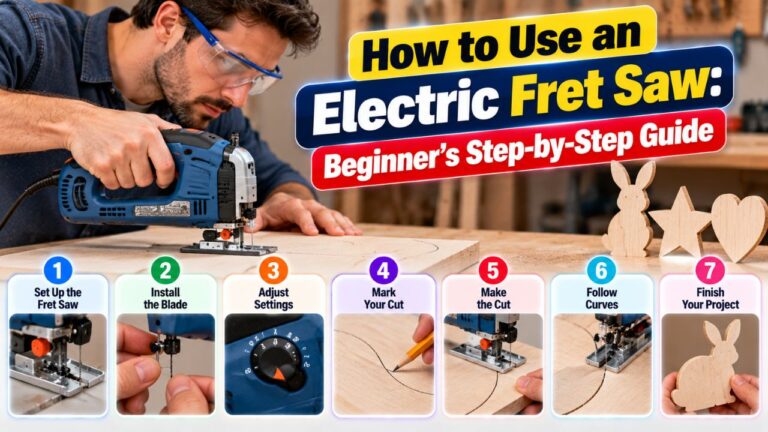
Yes. This is one of its greatest strengths. Drill a starter hole, disconnect one end of the blade, pass it through the hole, reconnect and tension the blade, and cut the internal shape.
Is a fret saw good for model making?
Yes. Its narrow blade and ability to make detailed curves make it excellent for many wooden models, craft components, templates, and decorative pieces.
What is the best material for practicing with a fret saw?
Thin plywood is one of the best beginner materials. It is easy to cut, relatively strong, inexpensive, and less likely than solid wood to split along the grain.
What should you not cut with a fret saw?
Avoid conventional fret-saw cutting on concrete, brick, stone, ceramic tile, glass, thick structural metal, hardened steel, and very thick construction lumber.
Is a fret saw the same as a coping saw?
No. They are similar, but a fret saw normally has a much deeper frame and uses especially fine blades, making it better suited to intricate work farther from the edge of a panel.
Is a fret saw the same as a scroll saw?
Not exactly. A traditional fret saw is manually operated. A scroll saw is powered and moves a similarly narrow blade rapidly up and down, making repeated intricate cutting faster.
Conclusion
So, what materials can a fret saw cut? Its strongest applications are wood, plywood, MDF, hardboard, veneer, and similar thin woodworking materials, but the right blade can expand its capabilities to acrylic, PVC, aluminum, brass, copper, and even some thin mild steel.
I would consider plywood one of the best all-around materials for fret-saw work because it combines easy cutting with good strength around detailed patterns. Solid softwood is another excellent choice for beginners, while hardwood is perfectly workable when it is not excessively thick.
Plastic and metal require more careful blade selection. Thermoplastics need controlled cutting to avoid melting, while metals should be cut using blades specifically intended for metal rather than ordinary wood blades.
The biggest limitation is thickness. A fret saw is designed for fine, controlled, intricate cutting, not rapid removal of large amounts of material. Even when it can technically cut thick wood or steel, another saw may perform the job faster and more accurately.
My recommendation is to choose a fret saw when your project involves tight curves, delicate details, or internal cutouts. Match the blade to both the material and thickness, keep the workpiece supported, and avoid forcing the blade. Used for the jobs it was designed for, a fret saw is one of the most versatile hand tools for intricate cutting.