What Saw to Cut Engineered Vinyl Flooring? Best Saws Explained
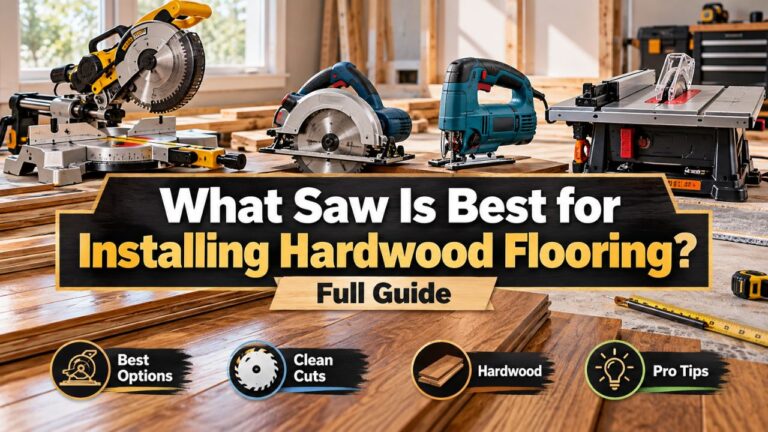
If you are wondering what saw to cut engineered vinyl flooring, the best choice depends on the cut: use a miter saw for fast straight crosscuts, a table saw or guided circular saw for long rip cuts, and a jigsaw for curves and notches. For many rigid-core engineered vinyl planks, a sharp carbide blade gives clean results, while some thinner products can be scored and snapped without a saw at all.
Engineered vinyl flooring is often sold as rigid-core vinyl plank, EVP, SPC, or WPC flooring. Unlike flexible sheet vinyl, these planks may contain a dense composite core beneath the decorative vinyl and wear layers. That construction makes them stable and durable, but it also affects how they should be cut.
No single saw is perfect for every part of an installation. A miter saw is extremely fast when shortening dozens of planks, but it cannot safely rip a 5- or 6-foot plank lengthwise. A table saw excels at those long rips but is inconvenient for curved cutouts. A jigsaw can handle almost any shape, but it is slower for repetitive straight cuts.
In this guide, I’ll explain which saw works best for engineered vinyl flooring, how miter saws, table saws, circular saws, and jigsaws compare, which blade to use, how to reduce chipping, and which tool makes the most sense for each type of flooring cut.
What Saw to Cut Engineered Vinyl Flooring for Most Jobs?
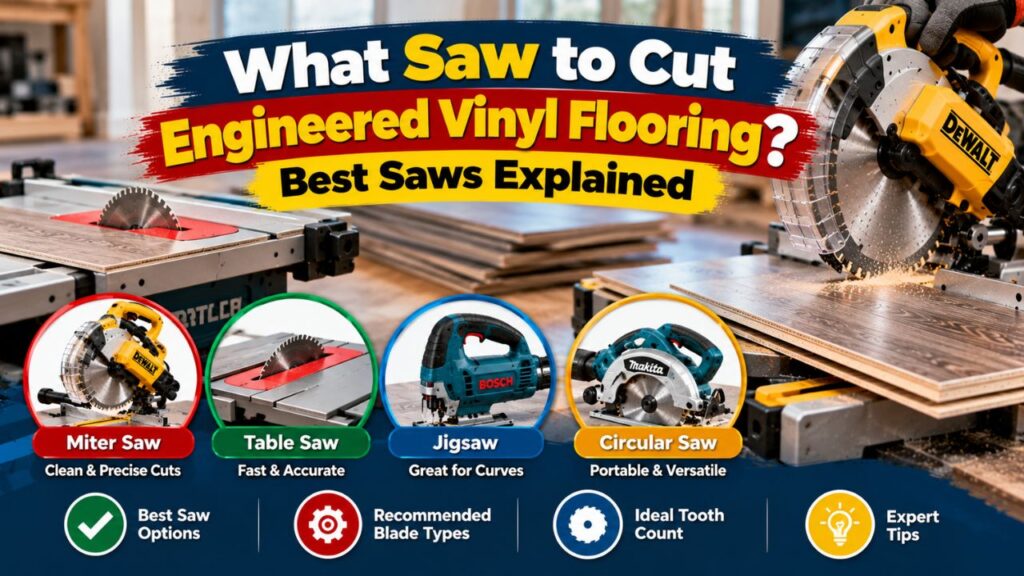
For a complete engineered vinyl flooring installation, I recommend thinking in terms of cut type rather than choosing one saw for everything.
A typical installation includes straight crosscuts at the ends of rows, lengthwise cuts along the first or final row, and irregular cuts around doorways, vents, cabinets, or pipes.
The best tool changes with each job.
| Type of Cut | Best Tool | Why |
| Straight crosscut | Miter saw | Fast and repeatable |
| Long lengthwise rip | Table saw | Straight, consistent width |
| Portable rip cut | Circular saw with guide | Easy to use on long planks |
| Curves and notches | Jigsaw | Easy to steer around shapes |
| Small trim or jamb cuts | Oscillating multi-tool | Precise in tight spaces |
| Thin score-and-snap flooring | Utility knife | Quiet and dust-free when manufacturer allows |
If I had to choose only one powered saw for occasional DIY flooring work, a jigsaw is the most versatile, because it can make both straight and irregular cuts. However, it is not the fastest or cleanest option for long repetitive cuts.
For an entire room or house, a miter saw combined with a jigsaw or rip-cutting tool is much more efficient.
Key Takeaways:
- Use a miter saw for repetitive crosscuts and a table or circular saw for long rips.
- A jigsaw is the most versatile single saw but is slower for straight production cuts.
- Some engineered vinyl products can be scored and snapped, so check the flooring instructions before using a saw.
What Is Engineered Vinyl Flooring?
Engineered vinyl flooring is a layered flooring product designed to combine the appearance of wood or stone with the water resistance and dimensional stability of vinyl-based materials.
The exact construction varies.
Many modern products fall into rigid-core categories such as SPC or WPC.
SPC typically refers to stone-plastic or stone-polymer composite flooring. It has a dense, relatively rigid core.
WPC generally refers to wood-plastic or wood-polymer composite flooring. It often has a somewhat softer or more resilient core.
Both can have a printed decorative layer and protective wear surface above the core.
Some products also include attached underlayment.
Why Core Construction Matters When Cutting
A softer vinyl product may be easy to score with a knife and snap along the line.
A thick rigid-core SPC plank can be much less cooperative.
Trying to force a score-and-snap method on flooring designed to be sawn can break the locking system or leave a ragged edge.
Likewise, using a large power saw on a product that can be cleanly scored may simply create unnecessary noise and dust.
I recommend checking the installation instructions for your exact flooring first. If the manufacturer permits score-and-snap cutting, use it where convenient. If the core is too rigid or the cut is complicated, choose the appropriate saw.
Is a Miter Saw Good for Engineered Vinyl Flooring?
Yes. A miter saw is one of the best tools for crosscutting engineered vinyl flooring.
Crosscuts are the cuts you make across the width of a plank to shorten it.
During a normal flooring installation, you make these cuts constantly as you reach the end of each row.
A miter saw makes that process fast because the flooring rests against a fence and the blade travels through it at a controlled angle.
Why a Miter Saw Works So Well
The saw gives you repeatability.
You can mark the plank, place it against the fence, align the blade, and make a straight cut within seconds.
It is also excellent for angle cuts when walls or transitions do not meet at exactly 90 degrees.
A sliding miter saw is particularly helpful with wide engineered vinyl planks because its blade can travel across a larger width.
What Size Miter Saw Do You Need?
For most residential flooring, a 10-inch sliding miter saw is more than adequate.
A 12-inch saw also works but is often larger and heavier than necessary for flooring alone.
A compact 7 1/4-inch sliding miter saw may also have enough crosscut capacity for many vinyl planks.
The important specification is not simply blade diameter. Compare the plank width with the saw’s maximum crosscut capacity.
What a Miter Saw Cannot Do Well
A miter saw is not designed to rip a long flooring plank lengthwise.
Do not rotate a full-length plank and try to feed it along the blade as though the saw were a table saw.
Use a table saw, track saw, or guided circular saw for long rip cuts.
Is a Table Saw Good for Engineered Vinyl Flooring?
A table saw is probably the best tool when you need to make long, straight rip cuts.
A rip cut runs parallel with the length of the plank and makes the flooring narrower.
You commonly need this for the first or last row of flooring.
Why the Table Saw Is Useful
The rip fence keeps the cut parallel to the plank edge.
Once the fence is set, several planks can be cut to exactly the same width quickly.
This is particularly valuable when a final flooring row runs along a straight wall and every plank requires the same width.
Use Proper Support
Engineered vinyl planks can be long.
A small jobsite table saw may not provide enough table area to support the entire board.
Use appropriate infeed or outfeed support so the plank stays level.
Do not allow the far end to drop and pull the workpiece upward or sideways while it passes through the blade.
Keep the Plank Against the Fence
The edge being used as the reference needs to stay firmly against the rip fence.
Do not try to correct a wandering cut by twisting the plank.
If a board becomes misaligned, stop the operation safely and reset rather than forcing the material sideways against the rotating blade.
Can You Cut Engineered Vinyl Flooring With a Circular Saw?
Yes. A circular saw is an excellent alternative to a table saw, particularly when portability matters.
It can handle both crosscuts and lengthwise rips.
The main difference is that the flooring remains stationary while the saw moves across it.
Use a Straightedge for Long Cuts
For ripping a plank lengthwise, clamp a straightedge or compatible guide to the flooring.
Measure the offset between the circular-saw blade and the edge of the saw base.
Position the guide so the blade follows the desired cut line.
Then move the saw steadily along the guide.
A track saw can make the same operation even easier because the saw is designed specifically to ride on its guide rail.
Circular Saw vs. Table Saw
A table saw is faster when several planks need exactly the same rip width.
A circular saw is easier when you are working in a small installation area and do not want to set up a larger stationary saw.
For one room, a circular saw with a good guide can be all you need for straight cuts.
Can You Use a Jigsaw for Engineered Vinyl Plank?
Yes, and a jigsaw is one of the most useful tools in the entire flooring installation.
It excels where straight saws struggle.
Use a jigsaw for:
- Notches around cabinets.
- Curved wall profiles.
- Pipe cutouts.
- Floor vents.
- Irregular corners.
- Detailed fitting around obstacles.
For a homeowner who wants to purchase only one saw for a small flooring project, the jigsaw is probably the most flexible choice.
What Blade Should You Use?
Use a sharp fine-tooth blade intended for laminate, plastic, or finished wood products, depending on the exact flooring material.
Some jigsaw blades cut on the upward stroke, while others are reverse-tooth blades that cut on the downward stroke.
That affects which face experiences more tear-out.
Test the blade on an offcut before cutting an important plank.
Why a Jigsaw Is Not Ideal for Every Cut
A jigsaw blade is long and relatively thin.
It can wander slightly through thick rigid-core flooring, particularly if you force the tool or use a worn blade.
That makes it less ideal than a miter saw for repeated straight crosscuts or a table saw for long rips.
Use it where its ability to turn and follow shapes provides a real advantage.
Key Takeaways:
- A miter saw is best for fast crosscuts, while a table saw or guided circular saw is better for rips.
- A jigsaw is the right choice for curves, notches, and detailed fitting.
- Trying to make every flooring cut with one saw usually makes the installation slower and less accurate.
Can You Cut Engineered Vinyl Flooring Without a Saw?
Sometimes.
Many vinyl flooring products are designed so you can score the top surface with a utility knife and snap the plank along the line.
This method is clean, quiet, inexpensive, and creates very little dust.
However, it does not work equally well on every engineered vinyl product.
How the Score-and-Snap Method Works
Mark the cut.
Place a straightedge along the line.
Run a sharp utility knife firmly along the surface several times.
Bend the plank at the scored line until it snaps.
Depending on the flooring construction, you may need to cut through attached backing after snapping the rigid portion.
When I Would Use a Saw Instead
Use a saw when the flooring is too thick or rigid to snap cleanly, when you need a narrow rip strip, or when the cut contains curves or irregular shapes.
The manufacturer’s instructions should be your final guide.
If the flooring specifically recommends a saw for certain cuts, follow that recommendation instead of repeatedly scoring a plank that refuses to break correctly.
What Saw Blade Is Best for Engineered Vinyl Flooring?
A sharp carbide-tipped fine-finish blade is usually the safest starting point for miter saws, table saws, and circular saws.
Engineered vinyl flooring can contain mineral-filled or dense composite cores, particularly with SPC products.
These materials can be abrasive.
A low-quality or dull blade may chip the decorative surface and wear quickly.
For a 10-Inch Miter or Table Saw
A fine-finish blade in roughly the 60- to 80-tooth range can work very well for crosscuts.
For long ripping on a table saw, an excessively fine blade may cut more slowly and produce more heat, so a sharp general-purpose or flooring-compatible carbide blade can be more practical.
For a 7 1/4-Inch Circular Saw
A fine-finish carbide blade with approximately 40 to 60 teeth is a useful range for many vinyl flooring products.
Again, blade design matters more than chasing the highest possible tooth count.
For a Jigsaw
Use a fine blade suitable for laminate, plastic, or similar finished materials.
A narrow blade is useful for tight curves, while a wider blade generally tracks straighter.
Make a Test Cut
Flooring products vary enough that I strongly recommend cutting a leftover piece before beginning the finished installation.
Check for chipping, melting, rough edges, and excessive heat.
If the cut looks poor, changing blades is usually more productive than pushing the saw harder.
Which Side Should Face Up When Cutting Engineered Vinyl Flooring?
The correct orientation depends on the saw.
Miter Saw and Table Saw
With most miter saws and table saws, the blade teeth enter the top face first during the cut.
That often means placing the finished decorative side up gives the cleaner visible surface.
Circular Saw
A typical handheld circular saw cuts upward through the workpiece.
The teeth generally enter from below and exit through the top.
For that reason, placing the finished side down often reduces visible surface chipping.
Jigsaw
This depends on the blade.
A conventional upward-cutting jigsaw blade can chip the top surface more than the underside.
A reverse-tooth blade behaves differently.
Always test the exact blade and flooring combination rather than relying entirely on a general rule.
How to Cut Engineered Vinyl Flooring Cleanly
Clean cuts begin with accurate marking and good support.
Measure the required length or width and use a square for crosscuts.
For long rips, mark both ends and connect the marks with a straightedge.
Identify the waste side before cutting.
The saw blade removes material equal to the kerf width, so position the teeth on the waste side of the finished line.
Support the Flooring Properly
Do not hold a long plank in one hand while cutting close to your fingers.
Place it on a stable work surface.
For a miter saw, keep the plank flat against both the table and fence.
For a circular saw or jigsaw, support the plank so the waste can separate without closing the kerf around the blade.
Let the Blade Reach Full Speed
With a power saw, start the motor before the blade contacts the flooring.
Allow it to reach full speed.
Then move through the plank with a smooth feed.
Do not force the blade.
If the saw slows dramatically, you may be feeding too quickly or using the wrong blade.
How to Prevent Chipping
Engineered vinyl can chip along the decorative surface, particularly when it has a rigid SPC-style core.
The first solution is a sharp blade.
A dull blade tends to fracture material rather than cutting cleanly.
Painter’s Tape Can Help
Apply painter’s tape over the cut line and mark on top of it.
The tape can provide some support to the surface while the blade passes through.
This technique is most useful when the cut edge will remain visible.
Support Both Sides
Vibration contributes to poor edges.
Keep the plank flat and stable.
The cut should not cause the flooring to bounce or flex.
Do Not Rush
A controlled feed rate generally gives cleaner results than pushing through the material as quickly as possible.
The correct speed depends on the blade and flooring.
If you smell excessive heat or see melted material around the cut, reduce friction and check the blade.
What Saw Is Best for Cutting the Final Row?
For the final row, you usually need to make a lengthwise rip.
I would choose a table saw if the wall is straight and several planks need the same width.
Set the fence once and make consistent cuts.
A guided circular saw or track saw is also excellent, particularly when working with long planks.
If the wall is noticeably crooked, the final row may need to follow that irregular shape.
A jigsaw is better for a curved or scribed cut because a table saw fence is designed to make straight cuts.
Remember the Expansion Gap
Do not cut the final row tight against the wall.
Floating engineered vinyl flooring generally requires a perimeter expansion gap, although the required dimension depends on the specific product.
Measure the space, subtract the required clearance, and cut the plank to the remaining width.
What Saw Is Best for Doorways and Floor Vents?
Use a jigsaw for most detailed flooring cuts.
For a rectangular floor vent, drill starter holes where necessary and use the jigsaw to cut along the layout lines.
For a doorway, the flooring plank may require an L-shaped notch or another irregular profile.
A jigsaw gives you much better control than trying to stop a circular saw exactly at an inside corner.
Undercutting Door Jambs
Often, the cleaner approach is to undercut the door casing or jamb and slide the flooring underneath it.
An oscillating multi-tool is excellent for this.
Place a scrap piece of flooring and underlayment against the jamb to establish the correct cutting height.
Then use the oscillating tool to trim the casing.
This usually produces a more professional appearance than attempting to shape the flooring perfectly around every section of trim.
Miter Saw vs. Flooring Cutter
A manual or powered flooring cutter can be extremely useful for engineered vinyl.
A flooring cutter is designed specifically for flooring materials and can often make crosscuts without creating the dust generated by a spinning saw blade.
For an installer working inside an occupied house, that can be a major advantage.
However, a flooring cutter may have limits on plank width, thickness, or material type.
Some rigid SPC products may also require a cutter specifically rated for that material.
A miter saw is more versatile because it can later be used for baseboard, trim, and many other woodworking projects.
If you are purchasing one general-purpose tool, I would choose the saw.
If you install flooring regularly, a dedicated cutter can save considerable cleanup time.
Can You Use a Reciprocating Saw?
Technically, a reciprocating saw can cut vinyl flooring, but I would not use it for normal plank installation.
The long unsupported blade and aggressive reciprocating motion make precision difficult.
It is better suited to demolition.
If you are removing installed flooring or cutting material that will be discarded, it may have a role.
For accurately fitting new planks, use a miter saw, jigsaw, table saw, or circular saw instead.
Can You Use an Oscillating Tool to Cut Engineered Vinyl?
Yes, but it is a specialty tool rather than the main flooring saw.
An oscillating multi-tool is excellent for short plunge cuts and difficult areas where another saw cannot reach.
Examples include trimming around a door jamb, finishing the corner of a notch, cutting a small installed section, or making a precise repair cut.
It is much slower than a miter saw for ordinary crosscuts and inefficient for ripping entire planks.
Think of it as a problem-solving tool.
Engineered Vinyl Flooring Cutting Safety
Vinyl flooring may look less intimidating than lumber, but power-saw safety does not change.
Wear eye and hearing protection when using powered saws.
Cutting rigid-core flooring can also create fine dust, so use dust extraction and suitable respiratory protection where needed.
Keep Hands Away From the Blade
Do not hold a short offcut directly next to a miter-saw blade.
Do not reach toward a table-saw blade while it is moving.
Use push sticks or other appropriate workholding methods for narrow table-saw cuts.
Control Dust
Whenever practical, cut flooring outside or in a dedicated work area.
If you cut indoors, connect dust collection when the saw supports it and prevent dust from spreading through HVAC systems or finished rooms.
Check for Hidden Material When Cutting Installed Flooring
If you need to cut flooring that is already installed, determine what is underneath it first.
Subfloor fasteners, radiant heating components, concrete, underlayment, or other hidden materials can affect the cutting method.
Set blade depth carefully.
Do not plunge deeply into an unknown floor assembly.
Key Takeaways:
- Use a sharp, material-appropriate blade and adequate dust control.
- Keep narrow pieces and hands away from moving blades, especially on table and miter saws.
- Installed flooring requires extra caution because hidden fasteners or heating systems may be underneath.
Common Mistakes When Cutting Engineered Vinyl Flooring
One common mistake is assuming that because the flooring is “vinyl,” it will cut easily with any blade.
Rigid-core flooring can be surprisingly hard and abrasive.
Another mistake is using the miter saw for a job that requires ripping.
Miter saws are crosscutting machines, not lengthwise ripping tools.
Using the wrong tool creates an awkward and potentially unsafe setup.
A third mistake is cutting away the locking edge needed for installation.
Before ripping a first or final row, determine which tongue or groove must remain.
Once the click-lock profile is removed, the board may no longer connect correctly.
Finally, do not ignore the expansion gap.
Cutting a floating floor tightly between walls can restrict natural movement and contribute to buckling or joint problems.
Which Saw Would I Choose?
For a typical DIY engineered vinyl floor, my preferred setup would be a 10-inch sliding miter saw plus a jigsaw.
The miter saw handles the majority of end cuts quickly.
The jigsaw handles doorways, vents, pipes, and odd shapes.
For the first and final rows, I would use a table saw if one is available. Otherwise, a circular saw with a straight guide works extremely well.
If I were trying to complete a small room with only one inexpensive powered saw, I would choose a jigsaw because of its versatility, but I would expect the work to take longer.
If the flooring manufacturer says the planks can be scored and snapped, I would also use that method whenever it makes the job easier.
FAQs about What Saw to Cut Engineered Vinyl Flooring
What is the best saw to cut engineered vinyl flooring?
For straight crosscuts, a miter saw is usually the best choice. For lengthwise ripping, use a table saw or guided circular saw. For curved and irregular cuts, use a jigsaw.
Can you cut engineered vinyl flooring with a miter saw?
Yes. A miter saw is excellent for shortening vinyl planks and making repeated straight or angled crosscuts.
Can you cut engineered vinyl flooring with a table saw?
Yes. A table saw is particularly useful for ripping the first and final flooring rows lengthwise.
Can you cut engineered vinyl flooring with a circular saw?
Yes. A circular saw with a straightedge guide can make clean crosscuts and long rip cuts.
Can you use a jigsaw for engineered vinyl flooring?
Yes. A jigsaw is one of the best tools for irregular shapes, vents, pipes, and doorway notches.
What blade should I use for engineered vinyl flooring?
Use a sharp carbide-tipped fine-finish blade on circular, table, and miter saws. For a jigsaw, choose a fine blade suited to laminate, plastic, or the specific flooring material.
How many teeth should a miter-saw blade have?
For a typical 10-inch miter saw, roughly 60 to 80 teeth is a practical range for clean engineered vinyl crosscuts.
The blade’s design and sharpness matter as much as tooth count.
Can engineered vinyl flooring be scored and snapped?
Some products can.
Rigid-core construction varies considerably, so follow the installation instructions for your exact flooring.
Which side should face up on a miter saw?
With most conventional miter saws, placing the finished decorative surface up generally produces the cleaner visible edge.
Test on scrap first.
Which side should face up with a circular saw?
With a typical handheld circular saw, placing the finished side down often gives a cleaner decorative surface because the blade enters from underneath.
What saw should I use for the final row?
Use a table saw, track saw, or guided circular saw for a straight lengthwise rip.
If the wall is irregular, use a jigsaw to follow the scribed shape.
Can I use a flooring cutter instead of a saw?
Yes, if the cutter is rated for the thickness and core material of your engineered vinyl flooring.
A flooring cutter can reduce dust and noise considerably.
Does vinyl flooring dull saw blades?
Rigid-core engineered vinyl can be abrasive and may dull cutting edges faster than ordinary softwood.
Using carbide blades helps improve blade life.
Can I use a wood blade on engineered vinyl flooring?
Many fine-finish carbide woodworking blades can cut engineered vinyl successfully, but check the blade manufacturer’s material recommendations and test it on scrap.
Is SPC flooring harder to cut than ordinary vinyl plank?
Often, yes.
SPC has a dense mineral-filled core that is typically more rigid and abrasive than flexible vinyl flooring.
Do I need a special saw just for vinyl flooring?
No.
Standard woodworking saws work well when equipped with the correct blade. A dedicated flooring cutter is optional rather than essential.
Conclusion
If you are trying to decide what saw to cut engineered vinyl flooring, there is no single tool that is best for every cut. A miter saw is the best choice for fast, repetitive crosscuts, a table saw or guided circular saw is better for long lengthwise rips, and a jigsaw is the most practical tool for curves, vents, pipes, and irregular notches.
For a typical full-room installation, I would use a 10-inch sliding miter saw for most plank-end cuts and keep a jigsaw nearby for detailed work. If the first or final row needs to be narrowed, I would switch to a table saw or guided circular saw rather than trying to rip flooring on the miter saw.
Use a sharp fine-finish blade appropriate for the material, and make a test cut before cutting expensive planks. Rigid-core SPC and WPC flooring can behave differently, so the manufacturer’s cutting instructions should always take priority.
Also check whether your particular flooring can be scored and snapped. When it can, that method is often faster, quieter, and cleaner than using a power saw.
The practical bottom line is simple: miter saw for crosscuts, table or circular saw for rips, and jigsaw for shapes. Matching the saw to the cut gives you cleaner edges, faster installation, and a much safer workflow.