What Saw Blade for Vinyl Plank Flooring? Best Types Explained
If you are wondering what saw blade for vinyl plank flooring works best, use a sharp fine-tooth carbide blade designed for laminate, plastics, or finish cutting when using a circular saw, miter saw, or table saw. For most saw-cuttable rigid-core vinyl planks, a higher tooth count produces a cleaner edge than a coarse framing or ripping blade. If you are using a jigsaw, choose a fine-tooth blade designed for plastics, laminates, or clean cuts.
However, not every vinyl plank needs to be sawed. Many flexible LVP and some rigid SPC or WPC flooring products are designed to be scored with a utility knife and snapped. In those cases, using a saw can create unnecessary dust and mess.
The correct blade therefore depends on both the flooring construction and the saw you plan to use. Flexible glue-down vinyl behaves very differently from thick stone-polymer-composite click flooring, and a blade that works well in a miter saw is not the same blade you would install in a jigsaw.
In this guide, I’ll explain the best saw blades for vinyl plank flooring, ideal tooth counts, blade types for circular saws, miter saws, table saws, and jigsaws, when a saw is actually necessary, and how to minimize chipping, melting, and rough edges.
What Saw Blade Is Best for Vinyl Plank Flooring?
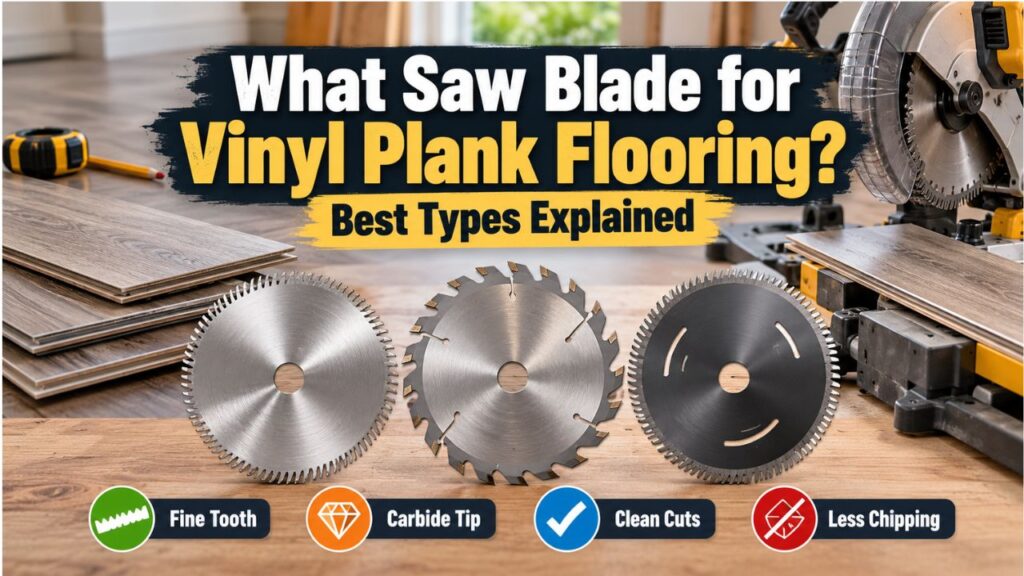
For most rigid vinyl plank flooring that is approved for saw cutting, I recommend a fine-tooth carbide-tipped finish blade.
The blade should be designed for one or more of the following materials:
Laminate
Plastic
Composite materials
Fine-finish wood cutting
Nonferrous or specialty synthetic materials when specifically approved
For a conventional circular, miter, or table saw, the best blade normally has considerably more teeth than a coarse construction blade.
For example, a 7-1/4-inch circular saw blade with approximately 40 to 60 teeth is often a practical range for cleaner flooring cuts.
A 10-inch miter or table saw may work well with approximately 60 to 80 teeth when exceptionally clean crosscuts are desired.
These numbers are guidelines rather than hard rules.
Blade diameter affects tooth spacing, so you should not compare a 40-tooth 5-1/2-inch blade directly with a 40-tooth 10-inch blade.
Tooth geometry, blade quality, sharpness, and manufacturer material recommendations matter just as much as tooth count.
Why Fine Teeth Work Better
A coarse blade removes larger chunks of material with each tooth.
That is excellent when ripping framing lumber quickly.
Vinyl plank flooring needs a different approach.
Fine teeth take smaller bites, reducing the likelihood that the wear layer, decorative film, or rigid core breaks unevenly along the edge.
A finer blade can also reduce vibration while cutting a thin plank.
The result is generally a smoother edge that requires less cleanup.
Key Takeaways:
- A fine-tooth carbide finish blade is usually best for saw-cuttable rigid vinyl flooring.
- Blade material compatibility matters more than simply choosing the highest tooth count.
- Many flexible vinyl products do not require a saw at all.
Do You Actually Need a Saw for Vinyl Plank Flooring?
Often, no.
This is one of the most important differences between vinyl plank and laminate flooring.
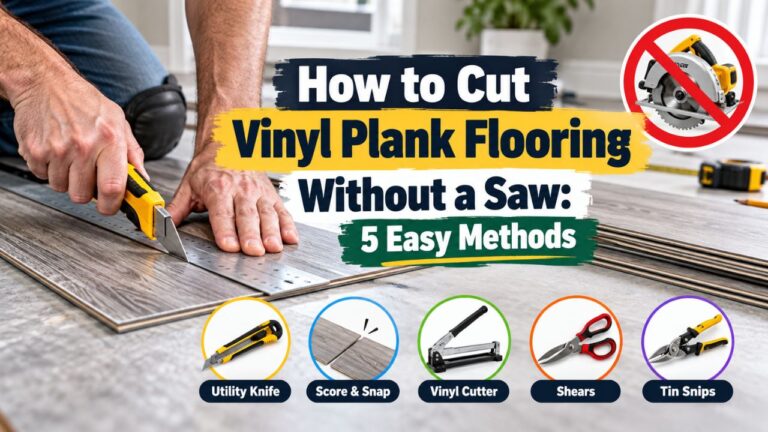
Many vinyl products can be cut using a utility knife and score-and-snap method.
You mark the line, score the finished surface deeply, bend the plank along the score, and cut through any remaining backing.
This method creates almost no sawdust and can be faster for ordinary straight end cuts.
Flexible LVP
Flexible luxury vinyl plank is usually easy to cut with a utility knife.
A saw is rarely necessary for normal crosscuts.
You might still use a jigsaw or another appropriate tool for complicated openings, but the majority of cuts can often be performed by hand.
SPC Vinyl Plank
Stone-polymer-composite flooring has a rigid core.
Many SPC planks can still be scored and snapped, although the process may require more effort.
Some thicker products are easier to saw.
Check the instructions supplied with your exact flooring before deciding.
WPC Vinyl Flooring
Wood-polymer-composite flooring also has a rigid core, but its cutting behavior varies.
Some products score and snap cleanly, while others are easier to cut with a saw.
Again, the manufacturer’s installation instructions should determine the method.
Why Saw Cutting Is Sometimes Better
Even when score-and-snap is possible, a saw can be helpful for:
Long rip cuts
Angled cuts
Complicated notches
Very rigid cores
Repeated crosscuts
Thick flooring
Precision fitting around obstacles
For a whole-room installation, many people use a utility knife for routine cuts and a power saw only where necessary.
Best Circular Saw Blade for Vinyl Plank Flooring
A circular saw is useful when you need long straight rip cuts or fast crosscuts.
For a common 7-1/4-inch circular saw, I would generally choose a 40- to 60-tooth carbide finish blade that is approved for plastics, laminate, or composite materials.
A dedicated laminate or plastic-cutting blade can be even better.
Can You Use a 24-Tooth Circular Saw Blade?
Technically, yes.
It will cut many rigid vinyl planks.
However, it would not be my preferred blade.
A 24-tooth construction blade is designed for fast cuts in lumber. The larger tooth spacing can leave a rougher edge and may increase surface chipping.
If the cut will be hidden under baseboard, the result may still be acceptable.
For exposed or precise cuts, use a finer blade.
Can You Use a 60-Tooth Blade?
Yes, assuming the blade diameter, arbor, and RPM rating match your saw.
A 60-tooth 7-1/4-inch finish blade can produce very clean cuts in many rigid flooring products.
However, more teeth also create more friction.
Feed the saw steadily rather than moving extremely slowly, which can generate unnecessary heat.
Best Miter Saw Blade for Vinyl Plank Flooring
A miter saw is especially convenient for cutting planks to length.
If you are installing a large room and need hundreds of crosscuts, the miter saw can be considerably faster than using a circular saw.
For a 10-inch miter saw, a 60- to 80-tooth fine-finish carbide blade is generally a good starting point.
For a 12-inch miter saw, a similarly fine crosscut-style blade can work well.
The blade should explicitly be suitable for the flooring material whenever possible.
Why Miter Saws Work Well for Vinyl
The plank rests against the fence and table.
This provides excellent support.
You simply mark the cut, align the blade, lower it through the material, and allow it to return before removing the plank.
A miter saw also makes angled cuts straightforward.
This can be useful around doorways and irregular room edges.
Avoid Excessively Aggressive Blades
A coarse framing blade may grab or fracture thin vinyl more aggressively.
That does not mean it cannot cut the material.
It simply means a finish blade provides better control and edge quality.
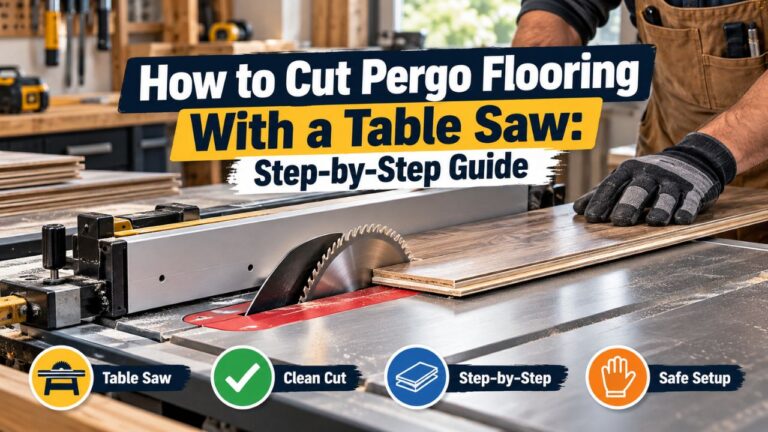
Best Table Saw Blade for Vinyl Plank Flooring
A table saw becomes especially useful when you need to rip vinyl plank flooring lengthwise.
The saw’s fence allows you to produce a straight, parallel strip quickly.
For a 10-inch table saw, I would generally use a 60- to 80-tooth fine-finish or laminate-compatible carbide blade when clean edges matter.
A good 40- or 50-tooth general-purpose blade can also perform well.
Why You Usually Do Not Need a Rip Blade
In solid lumber, a low-tooth-count ripping blade is normally ideal for lengthwise cuts.
Vinyl flooring is different.
The plank is relatively thin, so chip clearance is not nearly as demanding as ripping thick hardwood.
Edge quality usually matters more than maximum material-removal speed.
That makes a finer general-purpose or finish blade a better choice than an aggressive 24-tooth rip blade.
Use the Rip Fence Correctly
When ripping vinyl plank, keep the factory edge against the fence whenever practical.
Feed the plank smoothly and use proper push tools as your hands approach the blade.
Do not use the fence to trap a cutoff during a crosscut.
For short crosscuts, use a miter gauge or sled instead.
Best Jigsaw Blade for Vinyl Plank Flooring
A jigsaw is the best saw for many irregular flooring cuts.
It is particularly useful for:
Curves
Door-frame notches
Heating-register openings
Pipe cutouts
Irregular wall shapes
Small detailed cuts
For vinyl flooring, choose a fine-tooth jigsaw blade designed for plastics, laminates, or clean cutting.
A medium-to-fine tooth pitch generally produces a cleaner cut than an aggressive demolition or fast-wood blade.
T-Shank vs. U-Shank
Most modern jigsaws use T-shank blades.
However, blade mounting style depends on your tool.
Always select the blade style specified by the jigsaw manufacturer.
Reverse-Tooth Jigsaw Blades
Some jigsaw blades have teeth that cut on the downward stroke rather than the normal upward stroke.
These can help reduce chipping on the visible top surface.
However, reverse-tooth blades can also push the tool upward from the workpiece, so you need to maintain firm control.
Another option is simply to orient the plank according to the blade’s cutting direction.
Make a test cut on scrap before deciding which setup gives you the cleanest result.
Key Takeaways:
- Use a fine-tooth blade in circular, miter, and table saws.
- For jigsaws, choose a blade specifically intended for clean cuts in plastic or laminate.
- A table saw is particularly useful for long rips, while a jigsaw is better for curved and irregular cuts.
How Many Teeth Should a Vinyl Flooring Blade Have?
There is no universal tooth count because blade diameter changes the relationship between tooth number and tooth spacing.
Still, the following ranges are useful starting points:
| Saw Type | Common Blade Size | Useful Starting Tooth Count |
| Small circular saw | 5-1/2 in. | Around 30–40T fine-finish |
| Circular saw | 7-1/4 in. | Around 40–60T |
| Miter saw | 10 in. | Around 60–80T |
| Table saw | 10 in. | Around 50–80T |
| Miter saw | 12 in. | Around 80T or similar fine finish |
| Jigsaw | Varies | Fine tooth plastic/laminate blade |
These are not mandatory specifications.
A high-quality 40-tooth specialty laminate blade can outperform a cheap 80-tooth general blade.
Read the blade manufacturer’s recommended materials instead of choosing solely based on the printed tooth count.
What Tooth Grind Is Best for Vinyl Flooring?
Most general fine-finish woodworking blades use ATB, or Alternate Top Bevel, teeth.
ATB blades slice across the material cleanly and are very common for fine crosscutting.
Some specialty laminate blades use different grinds designed to handle abrasive coatings and composite surfaces.
You may also find blades using triple-chip-grind-style geometry.
TCG blades are often used for materials such as plastics, laminates, aluminum, and other composites because the alternating tooth design can withstand abrasive materials and produce controlled cuts.
That does not mean you must buy a TCG blade for a small flooring project.
A quality ATB fine-finish carbide blade can work very well.
For a large professional installation where blade life and edge quality matter, a dedicated laminate or composite blade is worth considering.
Can You Use a Wood Saw Blade for Vinyl Plank Flooring?
Yes, in many cases.
A carbide-tipped woodworking blade can cut rigid vinyl flooring successfully.
The important part is choosing a fine-finish blade, not an aggressive construction blade.
Avoid assuming every wood blade is equally suitable.
A 24-tooth framing blade and an 80-tooth finish blade are both technically wood blades, but they produce very different cuts.
For vinyl plank, the finer blade is normally preferable.
If the flooring contains a highly abrasive mineral-filled SPC core, a blade specifically rated for composites may retain sharpness longer.
Can You Use a Laminate Blade on Vinyl Flooring?
Often, yes.
Laminate-cutting blades are designed to handle abrasive manufactured flooring and produce clean edges.
They can be a very good choice for rigid vinyl as well, provided the blade manufacturer lists plastics, composites, vinyl, or similar materials as acceptable.
Do not assume compatibility based only on the word “laminate.”
Always check the blade packaging or specifications.
Should Vinyl Flooring Face Up or Down When Sawing?
This depends on the saw.
Circular Saw
A conventional handheld circular saw typically cuts upward through the material.
Most chip-out occurs on the upper exit surface.
For that reason, placing the decorative side down often gives the cleaner visible edge.
Table Saw
A table saw blade rotates upward through the plank.
The cleaner side is generally the upper surface, so the finished face is commonly placed up.
Miter Saw
A miter saw blade usually enters the top surface first.
Placing the finished face up often gives the cleanest top edge.
Jigsaw
Most conventional jigsaw blades cut on the upstroke.
That means they tend to create more tear-out on the top.
For standard blades, placing the decorative side down can help.
Reverse-tooth blades change this behavior.
Because vinyl construction and blade geometry vary, making a scrap test is always the safest way to confirm orientation.
How to Prevent Melting When Cutting Vinyl Flooring
Vinyl and other polymers can soften if excessive heat builds up during sawing.
This is more likely when:
The blade is dull.
The blade has too many inappropriate teeth for the application.
You feed the material extremely slowly.
The blade is dirty.
The plank pinches the blade.
The cutting edge is unsuitable for plastic.
The solution is not to rush the cut.
Instead, use a sharp blade and maintain a smooth, moderate feed rate.
Allow the teeth to remove material efficiently.
If melted material begins accumulating on the blade or cut edge, stop and investigate before continuing.
Do not touch a hot blade immediately after cutting.
Why Does My Vinyl Plank Chip When I Saw It?
Rigid vinyl flooring can chip, particularly at the corners or locking edges.
A coarse blade is one possible cause.
A dull blade is another.
Poor workpiece support can also cause the plank to vibrate.
For crosscuts, support both sides so the waste section does not fall before the blade finishes.
If the locking profile is fragile, make sure it is not carrying the plank’s weight during cutting.
Blade orientation also matters.
Place the finished surface on the side where your particular saw produces the cleanest edge.
Painter’s tape over the cut line may help support brittle decorative surfaces, although the blade itself remains the most important factor.
Does Vinyl Flooring Dull Saw Blades?
It can.
Rigid-core vinyl flooring often contains fillers and composite materials that are more abrasive than ordinary softwood.
SPC in particular contains a mineral-heavy core that can accelerate blade wear.
If you are installing one small room, the effect may be minor.
For a whole-house project, you may notice the blade becoming dull.
Signs include:
More feed pressure.
Increased chipping.
Slower cutting.
Rougher edges.
Heat buildup.
Do not compensate for a dull blade by forcing material through the saw.
Replace or sharpen the blade as appropriate.
Is a Carbide Blade Necessary?
I strongly recommend carbide for power-saw cutting.
Carbide cutting edges retain sharpness much longer than basic steel teeth when working with abrasive synthetic flooring.
A cheap plain-steel blade may work temporarily but can dull rapidly.
For repeated flooring work, carbide is worth the small additional cost.
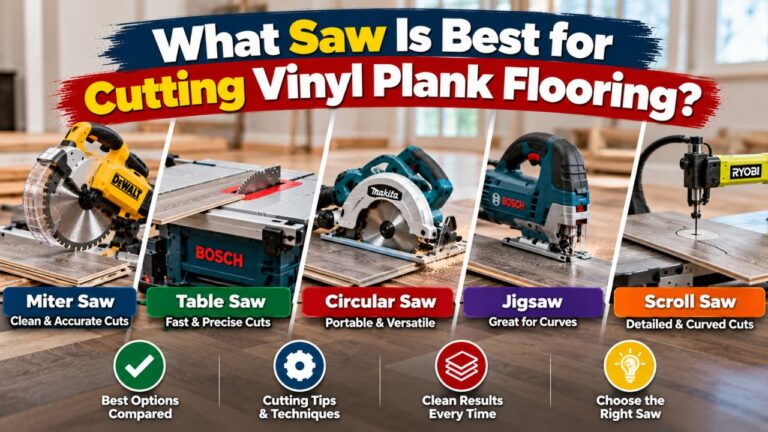
Circular Saw vs. Miter Saw vs. Jigsaw for Vinyl Flooring
You do not necessarily need all three.
A circular saw is the most versatile straight-cutting tool.
It handles both crosscuts and long rips.
A miter saw is faster for repeated end cuts.
A jigsaw handles curves and notches.
For a DIY installation, a good combination might be a utility knife plus a jigsaw or circular saw.
Use the knife for easy score-and-snap cuts and the saw only when the cut shape requires it.
For professional or whole-house installation, having a miter or flooring saw nearby can save considerable time.
When Is a Flooring Cutter Better Than a Saw?
A manual flooring cutter can be an excellent alternative.
It produces much less dust, is quieter, and requires no electrical power.
For repetitive straight crosscuts in compatible vinyl flooring, it may actually be more convenient than a saw.
However, most flooring cutters are not as versatile for long rips and irregular shapes.
If you only need straight end cuts, consider a cutter.
If you need many different cut types, power saws provide more flexibility.
Common Mistakes When Choosing a Vinyl Flooring Saw Blade
One mistake is automatically choosing the blade with the most teeth.
An extremely fine blade that is not designed for plastic or composite material may create unnecessary heat.
Another mistake is using a dull framing blade simply because it is already installed.
The saw may get through the plank, but cut quality can be poor.
Do not use an incorrect blade diameter or arbor.
Never remove blade guards or modify a saw to fit a blade that was not designed for it.
Also remember that some vinyl flooring does not need to be sawed at all.
If your product is designed for score-and-snap cutting, using a utility knife may be cleaner and faster than searching for the perfect saw blade.
Key Takeaways:
- Match blade diameter, arbor, RPM rating, and material compatibility to your saw.
- A sharp carbide blade is more important than chasing the highest possible tooth count.
- If the flooring manufacturer recommends score-and-snap, a saw may be unnecessary.
Safety Tips for Sawing Vinyl Plank Flooring
Power-saw safety does not change just because vinyl is thin.
Wear eye protection because small pieces of flooring can be thrown from the cut.
Hearing protection is appropriate when using circular, table, or miter saws repeatedly.
Sawing rigid vinyl can create fine dust. Work outdoors or use effective dust extraction when practical, and wear appropriate respiratory protection.
Support the plank securely.
Never hold a small piece near a moving blade simply because the flooring is lightweight.
Disconnect the saw from power or remove its battery before installing or changing a blade.
Make sure the blade is mounted in the correct rotation direction.
Use push sticks and appropriate guards on a table saw.
With a miter saw, keep your hand away from the blade path and allow the blade to stop before lifting it through small loose offcuts.
If the manufacturer specifically warns against saw cutting your flooring product, follow those instructions.
FAQs about What Saw Blade for Vinyl Plank Flooring
What type of saw blade is best for vinyl plank flooring?
A fine-tooth carbide blade designed for laminate, plastic, composite, or finish cutting is usually the best option for rigid vinyl plank flooring.
How many teeth should a circular saw blade have for vinyl flooring?
For a 7-1/4-inch circular saw, approximately 40 to 60 teeth is a useful general starting range.
Blade design and material rating are more important than tooth count alone.
Can I use a 24-tooth blade for vinyl plank flooring?
Yes, but the cut may be rougher.
A 24-tooth framing blade is optimized for speed rather than fine edge quality.
Use a finer blade when appearance matters.
Can I use a 60-tooth blade for vinyl plank?
Yes, provided it fits your saw and is rated for the material and tool speed.
A 60-tooth circular saw blade can produce very clean cuts in many rigid vinyl products.
What miter saw blade is best for vinyl flooring?
For a 10-inch miter saw, a quality 60- to 80-tooth fine-finish carbide blade is a practical choice.
A dedicated laminate or plastic blade may provide even better results.
What table saw blade should I use for vinyl plank?
Use a sharp general-purpose or fine-finish carbide blade, commonly around 50 to 80 teeth on a 10-inch table saw.
A specialty laminate or composite blade is also excellent.
What jigsaw blade should I use for vinyl plank flooring?
Choose a fine-tooth blade rated for plastics, laminate, or clean cutting.
Use the correct shank style for your jigsaw.
Can I cut vinyl plank flooring with a wood blade?
Yes.
A fine-tooth carbide woodworking blade can cut many rigid vinyl planks successfully.
Avoid coarse framing blades when you want a clean edge.
Can I use a laminate blade for vinyl flooring?
Usually, if the blade manufacturer approves it for plastic, vinyl, or composite material.
Check the blade specifications rather than assuming compatibility.
Can I use an aluminum blade for vinyl flooring?
Some triple-chip-grind blades designed for nonferrous metals and plastics may cut rigid vinyl very well.
However, use one only when its manufacturer specifically approves the relevant material and the blade is compatible with your saw.
Does vinyl flooring melt when cut with a saw?
It can soften or melt if excessive heat builds up.
A sharp, suitable blade and steady feed rate reduce this problem.
Why is my saw blade melting vinyl?
The blade may be dull, dirty, inappropriate for plastic, or moving too slowly through the material.
Binding can also generate excess heat.
Does SPC flooring dull saw blades?
Yes, SPC can be abrasive because its rigid core contains mineral filler.
A carbide blade is preferable when making many cuts.
Can vinyl plank flooring be cut without a saw?
Yes.
Many vinyl planks can be scored with a utility knife and snapped.
This is often the easiest method for ordinary straight cuts.
Is a utility knife better than a saw for vinyl plank?
For products designed to score and snap, yes.
It creates less dust, noise, and mess.
A saw is more useful for thick rigid material, long rips, and complicated shapes.
Which side of vinyl plank should face up on a table saw?
The decorative face is generally placed up on a table saw because the blade enters from below.
Make a test cut if edge quality is critical.
Which side should face up on a circular saw?
With a conventional handheld circular saw, decorative side down usually produces the cleaner finished surface.
Can I cut vinyl flooring with a miter saw?
Yes, when the flooring is approved for saw cutting and you use a suitable fine-tooth blade.
A miter saw is especially convenient for repeated crosscuts.
Can I rip vinyl plank flooring on a table saw?
Yes.
A table saw with a properly adjusted rip fence is one of the easiest ways to create straight lengthwise cuts in rigid vinyl.
Use push tools and all applicable table-saw safety equipment.
Conclusion
So, what saw blade for vinyl plank flooring should you use? For most rigid vinyl flooring, the best choice is a sharp fine-tooth carbide blade designed for laminate, plastic, composite, or finish cutting.
For a 7-1/4-inch circular saw, roughly 40 to 60 teeth is a practical starting point. On a 10-inch miter or table saw, approximately 60 to 80 teeth can provide very clean results, although a good 40- or 50-tooth specialty blade may perform just as well depending on its geometry.
For a jigsaw, use a fine-tooth plastic or laminate blade rather than a fast-cutting construction blade.
Do not assume that more teeth always mean a better cut. The blade’s material rating, tooth geometry, carbide quality, sharpness, and compatibility with your saw all matter.
Also confirm whether you need a saw at all. Many flexible LVP and some rigid-core products can be scored and snapped with a utility knife, eliminating sawdust and simplifying the installation.
My recommendation is simple: use score-and-snap whenever the flooring manufacturer allows it, and when a power saw is necessary, choose a sharp fine-tooth carbide blade specifically suitable for synthetic or laminated materials. That combination gives you cleaner edges, less chipping, and a much easier vinyl flooring installation.