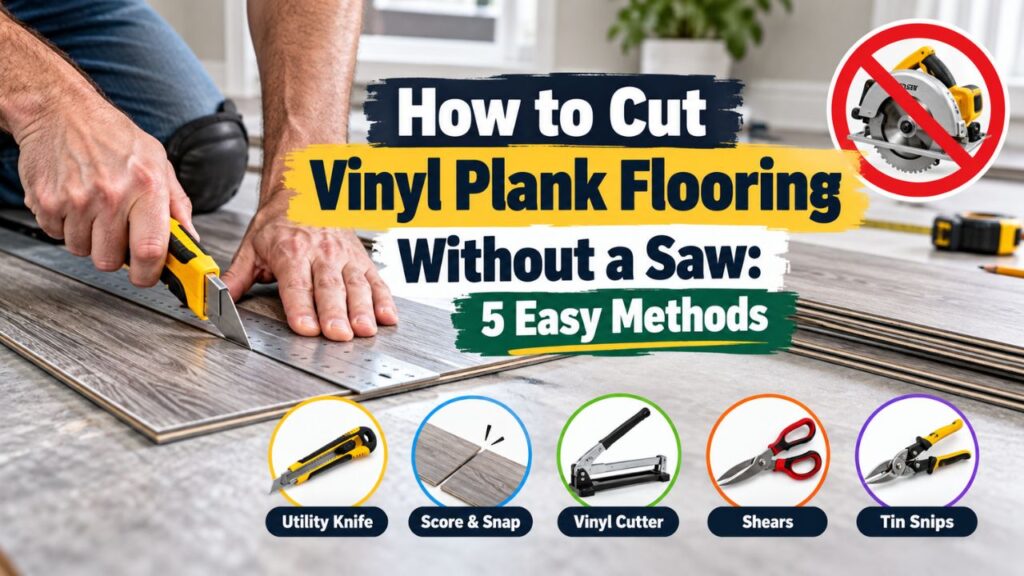
How to Cut Vinyl Plank Flooring Without a Saw: 5 Easy Methods
If you want to know how to cut vinyl plank flooring without a saw, the easiest method for many vinyl planks is to mark the cut, score the finished surface several times with a sharp utility knife and straightedge, then bend or snap the plank along the scored line. You can also use a manual vinyl flooring cutter for fast straight cuts, while a utility knife, heavy-duty shears, or snips can handle certain notches and irregular cuts depending on the flooring type.
The important qualification is that not every vinyl plank cuts the same way. Thin flexible luxury vinyl plank, or LVP, is generally very easy to score and cut with a knife. Many rigid-core SPC and WPC click-lock products can also be scored and snapped, but some thicker or tougher products are much harder to break cleanly. Always check the installation instructions for your specific flooring before assuming score-and-snap is suitable.
Cutting without a power saw has several advantages. It creates little or no airborne sawdust, is quieter, requires less equipment, and can be convenient when installing flooring inside an occupied home. For ordinary end cuts, a sharp utility knife may be all you need.
In this guide, I’ll explain how to cut vinyl plank flooring without a saw using several practical methods, which approach works best for different types of vinyl, how to make straight and lengthwise cuts, how to handle notches, and how to prevent damaged edges or broken locking joints.
Can You Cut Vinyl Plank Flooring Without a Saw?
Yes. Many vinyl plank flooring products are specifically designed so they can be scored and snapped with a utility knife.
This works because vinyl flooring is much thinner than hardwood or laminate and often has a relatively brittle or flexible core that separates cleanly once the top layer has been deeply scored.
For a typical straight end cut, the process is simple:
Measure the plank.
Mark the cut.
Hold a straightedge firmly against the mark.
Score the finished surface with a sharp utility knife.
Bend the plank along the cut.
Snap it apart.
If the plank has an attached underlayment pad, you may need to cut through that remaining backing after snapping the rigid portion.
This method is particularly convenient when installing the last plank at the end of each flooring row.
However, the material matters.
Flexible Luxury Vinyl Plank
Flexible LVP is usually the easiest type to cut without a saw.
A utility knife can often cut through it completely after several passes, or you can score deeply and bend the plank until it separates.
This material is also easier to trim around irregular obstacles.
SPC Rigid-Core Vinyl
SPC stands for stone polymer composite or stone-plastic composite.
The core is relatively hard and dense.
Many SPC products can still be scored and snapped, but they generally require more pressure and a deeper score than flexible vinyl.
Some rigid planks break very cleanly. Others can fracture irregularly if the score is too shallow or the plank is too cold.
WPC Vinyl Flooring
WPC, or wood polymer composite flooring, has a somewhat different rigid core.
Many WPC products can also be score-and-snapped, particularly for simple end cuts.
Again, product construction varies. Manufacturer instructions should take priority.
Glue-Down Vinyl Planks
Thin glue-down LVP is generally very easy to cut with a utility knife.
Because there is no thick click-lock core, you may be able to cut completely through rather than snapping the material.
Key Takeaways:
- Many vinyl planks can be cut with nothing more than a sharp utility knife and straightedge.
- Flexible LVP is generally easier to knife-cut than thick rigid-core flooring.
- SPC and WPC planks may be score-and-snapped when their manufacturer permits it.
- Test your cutting method on a scrap plank before cutting an important piece.
Best Tools for Cutting Vinyl Plank Flooring Without a Saw
You do not need an extensive tool collection.
For most installations, a utility knife and a manual flooring cutter can perform the majority of straight cuts.
| Tool | Best Use | Best Flooring Type |
| Utility knife | Score-and-snap, trimming | Most LVP and many rigid planks |
| Straightedge or square | Guiding knife cuts | All plank types |
| Manual vinyl flooring cutter | Fast straight end cuts | LVP, SPC, WPC depending on cutter |
| Heavy-duty shears | Small trims and flexible vinyl | Thin flexible LVP |
| Aviation/tin snips | Small notches and irregular trimming | Flexible or thinner vinyl |
| Hook blade | Controlled vinyl trimming | Flexible vinyl and edge trimming |
The correct tool depends on the cut rather than just the flooring.
A manual cutter is excellent for repetitive straight crosscuts but may not handle long lengthwise rips.
A utility knife is slower but far more versatile.
Method 1: Score and Snap With a Utility Knife
For most DIY installations, score and snap is the best no-saw method.
It is clean, inexpensive, and easy to perform directly in the room where you are installing the flooring.
Step 1: Measure the Plank
Measure the space where the plank will be installed.
For an end-of-row piece, measure from the previous plank to the wall while accounting for the expansion gap required by the flooring manufacturer.
Do not cut a floating vinyl floor tightly against a wall simply because the material appears dimensionally stable.
Click-lock flooring systems generally require perimeter clearance so the floor can move normally.
Measure twice before marking.
Step 2: Mark the Cut
Transfer the measurement to the vinyl plank with a pencil or another removable marking tool.
Use a carpenter’s square or straightedge to make the line accurately perpendicular to the plank when making an end cut.
For an angled wall, transfer the actual angle rather than automatically making a square cut.
Step 3: Place the Plank on a Stable Surface
Set the flooring on a firm, flat work surface.
Keep the decorative surface facing upward for scoring unless your flooring instructions specify another method.
The plank should not move while you pull the utility knife across it.
Do not attempt to hold a plank in the air while scoring it.
Step 4: Hold a Straightedge on the Cut Line
Place a metal square, level, or sturdy straightedge directly beside the marked line.
A metal guide is preferable to a plastic one because a utility knife can accidentally cut into a soft plastic ruler.
Keep your fingers away from the path of the blade.
Step 5: Score the Finished Surface
Using a fresh utility-knife blade, draw the knife firmly along the straightedge.
You usually do not need to cut completely through a rigid plank.
The objective is to create a deep, continuous groove that weakens the finished surface and core exactly where you want it to break.
Rather than trying to make one extremely forceful cut, I prefer several controlled passes.
Allow every pass to follow the same groove.
A sharp blade is much safer and easier to control than a dull one that requires excessive force.
Step 6: Snap the Plank
Move the scored line near the edge of your work surface or hold the plank securely according to the product’s recommended technique.
Bend the plank sharply at the score.
It should break along the cut line.
Some rigid-core planks snap with very little effort. Others need substantially more bending pressure.
If the plank bends without breaking, stop and deepen the score rather than twisting it aggressively.
Step 7: Cut the Attached Pad
Some click-lock vinyl flooring has an attached foam or cork-style backing.
After the core snaps, this pad may still connect the two pieces.
Fold the pieces slightly apart and slice through the remaining pad with the utility knife.
The cut piece should then separate cleanly.
Why Score-and-Snap Works So Well
The method concentrates stress along one weakened line.
Instead of trying to slice through every layer of a thick plank, the utility knife creates a controlled fracture point.
This is faster than making repeated full-depth knife cuts and produces almost no dust.
For standard end cuts during a flooring installation, I would use this method whenever the flooring manufacturer allows it.
Method 2: Use a Manual Vinyl Flooring Cutter
If you need to cut many planks without a saw, a manual flooring cutter can be a worthwhile tool.
These cutters use a long lever and a hardened blade to shear through the plank.
You place the vinyl beneath the blade, align the cutting mark, and pull the handle downward.
The result is similar to a paper cutter, but the machine is much heavier and designed for flooring materials.
Why a Manual Cutter Is Useful
The biggest advantage is speed.
Instead of scoring each plank repeatedly and snapping it by hand, you can make many end cuts quickly.
A manual cutter also produces very little dust and requires no electricity.
That makes it particularly useful in apartments, finished houses, and indoor renovation projects where controlling debris is important.
Check Cutter Compatibility
Not every manual flooring cutter is designed for every product.
Some are intended for laminate as well as vinyl. Others work with LVP, SPC, engineered flooring, or fiber-cement products within specified thickness limits.
Before renting or buying one, verify that the cutter is rated for the thickness and construction of your flooring.
A cutter that works beautifully on flexible vinyl may struggle with thick rigid SPC.
Limitations of a Flooring Cutter
Most manual cutters excel at crosscuts.
They may also make angled cuts, depending on the design.
Long rip cuts are a different matter.
Many guillotine-style cutters do not have the geometry needed to feed a full plank lengthwise through the blade.
For long rips, the utility-knife score-and-snap method is often more practical.
Key Takeaways:
- Score-and-snap is the cheapest and most versatile no-saw method.
- A manual flooring cutter is faster when you have many repetitive straight cuts.
- Confirm that a cutter is rated for your specific LVP, SPC, or WPC thickness before using it.
Method 3: Cut Flexible Vinyl With Heavy-Duty Shears
Thin flexible vinyl plank can sometimes be cut with strong shears.
This technique is useful for short cuts and small areas that are difficult to score and snap.
For example, you may need to remove a small section around a door casing or irregular corner.
A quality pair of heavy-duty flooring shears can give you more directional control than a straight utility-knife score.
However, I would not use ordinary household scissors.
Vinyl flooring can be surprisingly tough, and forcing weak scissors can damage the tool or cause your hand to slip.
Shears are also less useful on rigid SPC and thick click-lock products.
When the plank does not flex easily, score-and-snap or a flooring cutter is usually the better no-saw choice.
Method 4: Use Aviation Snips for Small Notches
Aviation snips, sometimes called tin snips, can be useful for certain small irregular cuts in flexible vinyl.
They are particularly helpful when you need to remove a narrow piece that would be difficult to snap.
For example, suppose a plank must fit around the edge of a door casing.
You can make controlled cuts into a flexible plank and remove the waste with snips.
The limitation is edge quality.
Snips can slightly distort flexible flooring as they cut, and they are not intended to produce a perfectly straight six-foot rip.
They are a problem-solving tool rather than the primary cutting method.
For thick rigid-core flooring, they may not work at all.
Method 5: Make Multiple Utility-Knife Cuts for Notches
A utility knife can do more than simple crosscuts.
It is also possible to create rectangular notches without using a saw.
Mark the complete notch first.
Then score both sides repeatedly, followed by the horizontal connecting line.
Continue deepening the cuts until the waste section can be carefully flexed and removed.
For flexible vinyl, you may be able to cut through completely.
Rigid-core flooring is more difficult because intersecting score lines do not always snap predictably.
For a complicated cut in rigid SPC, using an appropriate power tool may ultimately be safer and produce a better fit. “Without a saw” is practical for many cuts, but it should not become a rule that forces you into an unsafe cutting method.
How to Make Straight Cuts Without a Saw
Straightness comes primarily from the guide, not from the knife.
Always use a rigid straightedge when appearance or fit matters.
Position the straightedge exactly on your measurement and hold or clamp it securely.
Keep the utility knife against the same edge during every scoring pass.
Do not freehand a long line and expect the plank to snap perfectly.
For a square end cut, a speed square or framing square is convenient.
For a long rip, use a long level, metal straightedge, or another accurately straight guide.
The first scoring pass is the most important because it establishes the path for all subsequent cuts.
Use moderate pressure and prioritize control.
Once the groove exists, later passes naturally follow it.
How to Cut Vinyl Plank Flooring Lengthwise Without a Saw
Lengthwise cuts, also called rip cuts, are commonly required for the first or final flooring row.
You can make a long rip with a utility knife, but it takes more care than a short end cut.
First, measure the required width at several points along the wall.
Do not assume the wall is perfectly straight.
Transfer those measurements to the plank and connect the marks using a long straightedge.
Then score the plank repeatedly along the entire length.
Keep each pass in exactly the same groove.
Once the score is sufficiently deep, support one side of the plank and gradually bend it along the cut.
A flexible LVP plank may separate easily.
Rigid flooring may require working the snap gradually from one end toward the other.
Do not twist the plank sideways. Twisting can cause the fracture to leave the score line or damage the click-lock edge.
What If a Long Rigid Plank Will Not Snap?
Deepen the score.
If that still does not work, check the installation instructions.
Some vinyl products are designed for easy end-cut score-and-snap but are much more difficult to rip lengthwise.
A manufacturer may recommend a table saw, circular saw, or another cutting tool for long rip cuts.
If your goal is specifically to avoid a power saw, a compatible manual flooring cutter that supports ripping may be another option, but not all cutters can perform this operation.
How to Cut the Last Row Without a Saw
The final row frequently needs to be narrowed along its entire length.
Start by measuring the distance between the installed flooring and wall.
Subtract the required expansion space.
Take measurements in several locations because walls can bow or run out of parallel.
Mark each final-row plank accordingly.
Then use a long straightedge to score the plank lengthwise.
Snap it carefully and install the cut edge toward the wall so the factory click-lock edge remains available to connect with the previous row.
This last point is important.
Do not accidentally remove the tongue or groove required to connect the final row.
Before cutting, confirm which side of the plank needs to remain intact.
The cut perimeter edge will normally be hidden later by baseboard, shoe molding, or quarter-round.
How to Cut Vinyl Around Door Frames Without a Saw
Doorways often require more complicated shapes than normal end cuts.
The cleanest flooring installation usually involves undercutting the door casing so the vinyl can slide underneath, but if the casing is already appropriately prepared, you still need to shape the plank to fit the opening.
Measure carefully and transfer the shape to the plank.
For flexible vinyl, a utility knife and heavy-duty shears can handle many of these notches.
For rigid-core vinyl, score each straight line separately.
Work slowly around the locking edges because breaking off a tongue or groove can make the plank unusable.
When a doorway requires several tight curves or highly irregular cuts, a jigsaw or another appropriate cutting tool can be much more practical than forcing the entire job with a knife.
How to Cut Around Pipes Without a Saw
Round plumbing penetrations are more challenging without any type of saw.
If the pipe location falls near the edge of a plank, you may be able to create an open notch using a utility knife on flexible flooring.
For rigid-core flooring, drilling the appropriate hole may be easier, provided the flooring instructions permit the method and you have the correct drill setup.
The opening should allow the required clearance around fixed objects rather than gripping the pipe tightly.
After installation, trim or an escutcheon can conceal the expansion space.
If cutting around multiple pipes or complex plumbing, precision becomes more important than avoiding a saw at all costs.
How to Prevent the Plank From Cracking in the Wrong Place
A clean snap requires a continuous, adequately deep score.
A shallow or interrupted line is much more likely to create an uncontrolled fracture.
Cold flooring can also be harder and more brittle.
Install and handle the product within the environmental conditions specified by its manufacturer rather than bringing extremely cold planks into the room and immediately trying to snap them.
Support the plank evenly.
When snapping, apply force along the scored line rather than pulling one corner sideways.
If you feel the fracture starting away from the score, stop.
Deepen the cut and try again.
Key Takeaways:
- Long rip cuts require a deeper, more consistent score than short end cuts.
- Preserve the factory locking edge that needs to connect with the adjacent plank.
- If a rigid plank refuses to snap cleanly, verify that its manufacturer approves score-and-snap rather than forcing it.
Do You Cut Vinyl Plank Flooring Face Up or Face Down?
When using the utility-knife score-and-snap method, you generally score the finished wear surface from the top.
That is the layer you want to weaken first so the plank breaks exactly along your line.
This differs from some saw-cutting techniques where plank orientation is chosen according to blade rotation and chip-out.
With a knife there is almost no saw-type chipping, so cutting orientation is simpler.
Place the finished side up where you can see the mark and guide.
Use a protective cutting surface underneath whenever you are cutting all the way through flexible material.
How Many Times Should You Score Vinyl Flooring?
There is no universal number.
A thin flexible plank may need only one or two firm passes.
A thicker rigid-core product may require several passes.
The goal is not to count strokes. It is to create a sufficiently deep, continuous score without losing control of the knife.
I prefer repeated moderate-pressure passes over one extremely aggressive pass.
The first pass establishes the line.
The next passes deepen it.
If you are pushing so hard that the straightedge is moving or the knife is difficult to control, reduce pressure and use additional strokes.
Should You Use a Hook Blade or Straight Utility Blade?
A standard straight utility blade works well for most score-and-snap cuts.
A hook blade can be useful for some flexible vinyl because its curved shape pulls through the material and can reduce the tendency for the knife to wander.
However, hook blades are not necessary for most rigid planks.
The more important factor is sharpness.
Vinyl dulls knife blades over time.
Replace the blade when cutting begins to require noticeably more pressure or the scored line becomes rough.
Utility blades are inexpensive compared with the cost of damaging flooring or slipping because you are forcing a dull blade.
Why Is My Vinyl Plank Not Snapping Cleanly?
The most common cause is an insufficient score.
The decorative wear layer and rigid core must be weakened enough for the fracture to follow your line.
Another possibility is that your flooring construction simply does not respond well to score-and-snap.
Very thick rigid-core products can behave differently from flexible LVP.
Temperature can also affect how easily a plank bends or fractures.
Finally, technique matters.
Bending the plank evenly across a straight score is much more reliable than twisting from one corner.
If you repeatedly get ragged breaks, test a different method on scrap rather than ruining more planks.
Utility Knife vs. Flooring Cutter: Which Is Better?
For a small DIY room, I would usually choose the utility knife.
It costs very little, requires no special storage space, and handles crosscuts, rips, trimming, and many small notches.
For a whole-house flooring project, a manual cutter becomes more appealing.
It can make repetitive end cuts much faster and requires less physical effort.
The biggest difference is versatility.
The knife can go almost anywhere.
The cutter is excellent at the types of straight cuts its design allows but cannot necessarily make every long rip or detailed notch.
For many installers, the ideal no-saw setup is therefore both tools: a manual cutter for routine end cuts and a sharp utility knife for custom fitting.
Common Mistakes When Cutting Vinyl Without a Saw
One common mistake is using a dull knife.
It forces you to apply much more pressure and increases the chance that the blade slips away from the straightedge.
Another is making the score too shallow and immediately trying to break a rigid plank.
Measure carefully as well. A beautifully cut plank is useless if it is 1/2 inch too short.
Do not forget the flooring’s expansion requirements when measuring perimeter pieces.
Also avoid damaging factory locking edges.
A plank can look perfect on the visible surface but become unusable if the tongue or groove breaks during cutting.
Finally, do not assume every vinyl product can be cut identically. Flooring construction varies significantly, so the installation guide for your exact product should always override a generic technique.
Safety Tips for Cutting Vinyl Plank Flooring Without a Saw
Avoiding a power saw removes blade rotation and much of the airborne cutting dust, but utility knives still require care.
Always cut away from your body.
Keep your free hand behind the blade path rather than directly in front of it.
Use a stable surface and a straightedge that gives your fingers enough clearance from the knife.
Wear appropriate work gloves if they do not interfere with your grip and control.
Retract the utility blade whenever you put the knife down.
Dispose of used blades safely rather than leaving them loose in the work area.
When using a manual flooring cutter, keep fingers outside the blade area and follow the cutter manufacturer’s instructions.
Do not put your hand beneath a plank while pulling down the cutting lever.
Important Tip: If you need extreme force to make a cut, stop and reconsider the tool or technique. Cutting vinyl should be controlled. Excessive force usually means the blade is dull, the score is inadequate, or the material is not suitable for that method.
FAQs about How to Cut Vinyl Plank Flooring Without a Saw
Can you cut vinyl plank flooring with a utility knife?
Yes. Many vinyl flooring products can be scored with a sharp utility knife and snapped along the line. Thin flexible LVP may even be cut completely through with the knife.
What is the easiest way to cut vinyl plank flooring without a saw?
For most straight cuts, the easiest method is score and snap. Mark the cut, hold a straightedge on the line, score the finished surface several times, and bend the plank until it separates.
Can rigid vinyl plank flooring be cut with a utility knife?
Many rigid-core vinyl products can be score-and-snapped, including some SPC and WPC flooring.
However, rigid-core construction varies. Check your specific flooring instructions before relying on this method.
Can you cut SPC flooring without a saw?
Often, yes.
Many SPC planks can be scored with a utility knife and snapped. Thicker or particularly dense products can require substantially more effort or a different cutting method.
Can you cut LVP with scissors?
Thin flexible LVP may be cut with strong flooring shears or heavy-duty scissors.
Ordinary household scissors are generally not appropriate for thick flooring or rigid-core planks.
Can you cut vinyl plank flooring with tin snips?
Aviation or tin snips can work for small notches and irregular trimming in flexible vinyl.
They are not a good tool for long straight cuts or thick rigid-core flooring.
Can you use a box cutter on vinyl flooring?
Yes, provided it uses a sharp, secure utility blade.
A retractable utility knife is commonly used for score-and-snap cuts.
Keep the blade sharp and use a solid straightedge.
How do you cut vinyl planks straight without a saw?
Use a rigid straightedge or square.
Make the first scoring pass carefully, then run each additional knife pass through the same groove before snapping the plank.
Can you cut vinyl flooring lengthwise with a utility knife?
Yes, many products can be ripped lengthwise using repeated score-and-snap cuts.
A long straightedge is particularly important for keeping the cut straight.
Can a manual flooring cutter cut vinyl planks?
Yes, when the cutter is rated for your flooring type and thickness.
Manual cutters are particularly useful for fast repetitive crosscuts without electricity or sawdust.
Does a vinyl flooring cutter create dust?
Very little compared with a power saw.
A manual cutter shears the material instead of grinding through it at high speed, which is one reason it is popular for indoor flooring projects.
Which side do you score vinyl plank flooring?
For score-and-snap cutting, score the finished top surface unless the flooring manufacturer instructs otherwise.
Why won’t my vinyl plank snap?
The score may not be deep enough, the flooring may be particularly thick or rigid, or the product may not be intended for easy score-and-snap cutting.
Deepen the score and check the product instructions before applying excessive force.
Do I need to cut through the entire plank with a utility knife?
Usually not for rigid click-lock vinyl.
You generally need to score deeply enough for the plank to break along the line.
Flexible vinyl may be cut completely through.
How do you cut the backing after snapping vinyl flooring?
Fold the two pieces apart and carefully slice through the attached pad or remaining flexible backing with a utility knife.
Can I cut the final row of vinyl flooring without a saw?
Yes.
Measure the required width, maintain the specified expansion gap, mark the plank lengthwise, and use repeated utility-knife passes to score and snap it.
What can I use if my vinyl flooring will not score and snap?
A compatible manual flooring cutter may work.
If the product is too hard for both methods, use whatever cutting tool the flooring manufacturer recommends rather than forcing an inappropriate no-saw technique.
Is cutting vinyl flooring without a saw better?
For ordinary straight cuts, it often is.
Score-and-snap is quiet, inexpensive, and produces virtually no sawdust.
A saw becomes more useful when dealing with thick rigid material, difficult rip cuts, or complicated shapes.
Conclusion
Learning how to cut vinyl plank flooring without a saw is surprisingly easy for many modern flooring products. In most cases, a sharp utility knife, sturdy straightedge, and the score-and-snap method are all you need for ordinary end cuts.
Measure the plank carefully, allow the required perimeter expansion space, mark the cut, score the finished surface several times, and bend the plank directly along that groove. If an attached pad remains connected, simply cut through it with the knife after the core snaps.
For larger installations, a manual flooring cutter can make repetitive crosscuts faster while still avoiding electricity, noise, and sawdust. Heavy-duty shears or aviation snips can also help with smaller irregular cuts when you are working with flexible vinyl.
Long rip cuts and rigid SPC flooring require more patience. Use a long straightedge, deepen the score evenly from end to end, and avoid twisting the plank while snapping it. If your particular product refuses to break cleanly, check its installation instructions rather than forcing it.
My preferred no-saw setup is simple: a fresh utility-knife blade for custom cuts and a compatible manual flooring cutter when there are many repetitive cuts to make. For most DIY vinyl plank installations, those tools can handle a large portion of the project without producing the dust and noise of a power saw.