What Saw Blade Is Best for Cutting Drywall? Types, Teeth & Bits
Choosing the best saw blade for cutting drywall depends on the tool you are using and the type of cut you need to make. Drywall is much softer than wood or metal, so it does not require an extremely fine or heavy-duty blade. In most cases, a coarse, sharp blade with relatively few teeth per inch cuts gypsum board quickly without clogging.
For a traditional drywall or jab saw, an aggressive blade around 6–8 TPI is a good general choice. Drywall-specific reciprocating saw blades are also commonly available around 6–8 TPI, while a jigsaw works well with a coarse or carbide-edged blade designed for drywall, plaster, or abrasive building materials.
If you are using a spiral saw or rotary cut-out tool, you do not use a conventional saw blade at all. A small guidepoint drywall bit, commonly around 1/8 inch, is designed to follow electrical boxes and fixture openings.
Circular saws require a different approach because their blades are rated by total tooth count instead of TPI. They can cut drywall, but they are rarely the best option because a high-speed circular blade produces a large amount of fine gypsum dust.
This guide explains what saw blade is best for cutting drywall, how many teeth you need, which jigsaw and reciprocating blades work well, what spiral saw bit to use, and how drywall-saw teeth differ from ordinary wood-cutting teeth.
What Saw Blade Is Best for Cutting Drywall?
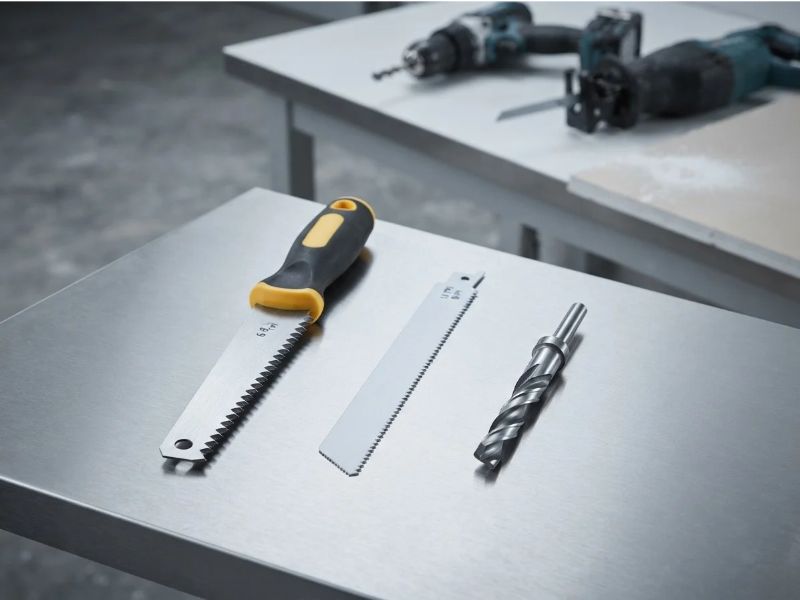
For most drywall sawing, the best blade is a coarse drywall-specific blade with approximately 6–8 teeth per inch (TPI).
A blade with relatively large teeth cuts the soft gypsum core efficiently and clears debris quickly. You generally do not need the very fine tooth patterns used for metal or finish woodworking.
The exact blade depends on your tool:
| Tool | Good Blade or Bit for Drywall |
| Hand drywall/jab saw | 6–8 TPI aggressive drywall blade |
| Jigsaw | Drywall/plaster blade, preferably carbide-edged, around 5–8 TPI |
| Reciprocating saw | 6–8 TPI drywall/plaster blade |
| Reciprocating saw for drywall + wood | 6–10 TPI bi-metal demolition/wood blade |
| Circular saw | Carbide-tipped general-purpose blade; circular saw usually not preferred |
| Spiral saw | 1/8-inch guidepoint drywall bit |
| Heavy-duty spiral cutting | 5/32-inch drywall guidepoint bit |
The important principle is that drywall benefits from relatively coarse cutting teeth, while abrasive materials such as cement board require different blades entirely.
Why Blade Choice Matters When Cutting Drywall
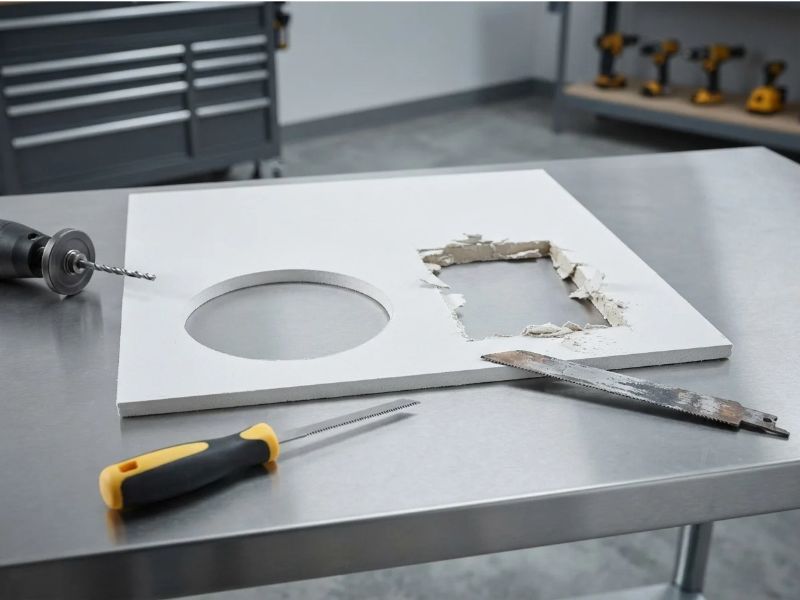
Drywall appears simple because it is easy to cut, but the material has two very different layers.
The center is a soft gypsum core, while the outside has a paper facing.
A good drywall blade needs to cut the paper without tearing it excessively while removing the soft gypsum efficiently.
If the teeth are too fine, the blade may cut slowly and load up with gypsum dust. If the blade is excessively aggressive, it may tear the paper facing and leave rough edges.
Fortunately, drywall openings are usually covered by trim, outlet plates, fixtures, or joint compound, so the cut does not have to resemble a finished furniture edge.
For most drywall work, speed and control are more important than an ultra-smooth saw cut.
What Does TPI Mean on a Drywall Saw Blade?
TPI means teeth per inch.
If a blade is rated at 8 TPI, there are approximately eight cutting teeth along each inch of the blade.
Lower TPI generally means:
Larger teeth, faster cutting, and a rougher finish.
Higher TPI generally means:
Smaller teeth, slower cutting, and a smoother finish.
Drywall is soft, so it normally works well with a relatively low TPI.
For comparison, a fine metal-cutting reciprocating blade might use 14–24 TPI, while a drywall-specific blade may be closer to 6–8 TPI.
Do not confuse TPI with the total tooth count used for circular saw blades. A circular blade might be described as 24T, meaning 24 teeth around the entire circular blade.
What Kind of Teeth Does a Drywall Saw Have?
A drywall saw normally has coarse, aggressive, sharpened teeth designed for fast cutting in gypsum board.
Many quality drywall saws use teeth sharpened on multiple surfaces. You may see terms such as:
Triple-ground teeth, tri-ground teeth, or fleam-ground teeth.
These tooth designs help the blade cut efficiently as it moves through drywall.
For example, Bosch lists an 8 TPI drywall hand saw with triple-ground teeth, while Milwaukee uses an 8 TPI drywall blade with fleam-ground teeth designed for smooth cutting.
This is different from the very fine, closely spaced teeth commonly found on blades intended for sheet metal.
How Many Teeth Does a Drywall Saw Need?
There is no rule saying every drywall saw must have exactly the same TPI.
However, about 6–8 TPI is a very common useful range for dedicated drywall cutting.
An 8 TPI blade provides a good balance of:
Fast material removal, reasonable control, and an edge that is clean enough for typical wallboard openings.
You may find drywall saws outside that range, so the manufacturer’s material rating is more important than choosing a blade based on one exact TPI number.
What Jigsaw Blade Is Best for Drywall?
The best jigsaw blade for drywall is a coarse blade specifically rated for drywall, plaster, or abrasive building materials.
A carbide-edged blade is particularly useful because gypsum and plaster can be abrasive compared with ordinary softwood.
A blade around 5–8 TPI works well for many drywall applications.
Bosch, for example, offers a 6 TPI carbide-edged jigsaw blade for fiberglass and plaster, with drywall also listed among suitable building materials in its specialty blade range.
Why Use a Coarse Jigsaw Blade?
Drywall does not need a high tooth count.
Larger teeth remove gypsum quickly and leave more room between the teeth for dust and debris to escape.
Very fine woodworking or metal blades usually provide little advantage.
In fact, using an unnecessarily fine blade can slow the cut.
Carbide vs High-Carbon Steel Jigsaw Blades
A standard high-carbon steel blade can cut drywall, particularly for occasional use.
However, a carbide-edged or carbide-grit style blade generally offers better durability when repeatedly cutting abrasive materials such as plaster or gypsum products.
For one small DIY project, you do not necessarily need the most expensive specialty blade.
For frequent drywall work, a drywall- or plaster-rated carbide blade makes more sense.
Can You Use a Wood Jigsaw Blade on Drywall?
Yes, a coarse wood jigsaw blade can physically cut drywall.
A blade around 6–10 TPI will usually move through the material without much difficulty.
However, a drywall-specific or carbide specialty blade is preferable when you expect to make many cuts.
Gypsum dust can wear ordinary cutting edges, and a wood blade is designed around the behavior of wood fibers rather than gypsum and paper.
For a single opening in a loose sheet, an ordinary coarse wood blade may be adequate.
For regular drywall work, use a blade specifically rated for the material.
Is a Jigsaw Good for Cutting Drywall?
A jigsaw can be useful when making curved or irregular cuts, particularly before the drywall has been installed.
It can handle larger openings faster than a manual jab saw.
However, the blade extends below the drywall sheet. That becomes important when cutting an existing wall because electrical wiring, pipes, insulation, or framing may be hidden immediately behind the board.
For installed drywall, an oscillating multi-tool or manual drywall saw often provides better depth control.
What Reciprocating Saw Blade Cuts Drywall?
For drywall alone, use a drywall or plaster reciprocating saw blade with coarse teeth, typically around 6–8 TPI.
Milwaukee produces a dedicated 6-inch 8 TPI drywall reciprocating blade with a piercing tip, while DEWALT offers a 6 TPI bi-metal plaster-cutting blade suitable for this type of building material.
These blades cut faster than fine metal blades because their large teeth remove gypsum efficiently.
A drywall-specific reciprocating blade may also have a pointed or piercing tip, making it easier to start an interior opening.
Is 6 TPI or 8 TPI Better for Drywall?
Both can work well.
A 6 TPI blade will generally cut more aggressively.
An 8 TPI blade provides slightly more teeth in contact with the material and may feel a little smoother while still cutting quickly.
For ordinary drywall, the difference is relatively small compared with using the correct blade style and maintaining good control.
What Reciprocating Saw Blade Cuts Drywall and Wood?
If you need to cut drywall and wood with the same reciprocating saw blade, look for a bi-metal wood/demolition blade around 6–10 TPI.
This type of blade is better suited to situations where the cut may pass through drywall and then encounter:
- Wood lath
- Plywood
- Wood blocking
- Non-structural wood backing
A 6 TPI demolition or wood blade cuts very aggressively. A blade around 8–10 TPI provides somewhat more control while still being coarse enough for wood and drywall.
DEWALT, for example, offers 6 TPI demolition blades optimized for wood applications and 10 TPI bi-metal general-purpose reciprocating blades for wood and other construction materials.
What If There Are Nails in the Wood?
If the wood may contain nails or screws, choose a bi-metal demolition blade rated for wood with nails rather than a basic high-carbon wood blade.
The tougher tooth construction is better suited to occasional metal contact.
Do not intentionally cut structural framing simply because the blade is capable of doing so. Wall studs, blocking, and other framing members may be structurally important.
Should You Use a Reciprocating Saw on Installed Drywall?
A reciprocating saw can cut drywall extremely quickly, but it is usually better for demolition than precise drywall work.
The main issue is not the drywall. It is the blade length.
A reciprocating saw blade can extend several inches into a wall cavity, potentially reaching electrical wiring, water pipes, gas lines, or other hidden components.
When using one on an existing wall, a short blade and carefully controlled depth are preferable.
For a small outlet or access opening, a jab saw or oscillating tool is normally easier to control.
How Many Teeth Should a Circular Saw Blade Have for Drywall?
There is no universal drywall-specific circular saw tooth count, mainly because a circular saw is not the preferred tool for normal drywall cutting.
If you must use one on loose drywall, a carbide-tipped general-purpose blade around 24 teeth can cut the material. Carbide circular blades in this tooth range are commonly used for general construction materials.
However, tooth count is not the biggest problem when using a circular saw on drywall.
The real issue is dust.
A circular saw spins at high speed and can turn the gypsum core into a large cloud of fine powder. A utility knife can make most straight drywall cuts with almost no airborne dust.
Is a Higher-Tooth Circular Saw Blade Better?
A blade with more teeth may produce a somewhat cleaner paper edge, but it does not eliminate the dust problem.
For normal drywall installation, using a 40-, 60-, or 80-tooth finish blade simply to cut gypsum board is generally unnecessary.
If your goal is a long straight cut, use a utility knife and score-and-snap method instead.
24-Tooth vs Fine-Finish Blade for Drywall
A 24-tooth carbide blade is aggressive and cuts quickly.
A fine-finish blade uses smaller, more numerous teeth and can reduce tearing along the paper facing.
But drywall edges are usually taped, covered, or hidden. The extra finish quality generally does not justify turning a simple score-and-snap job into a dusty circular-saw operation.
Therefore, if you are searching for how many teeth a circular saw blade should have for drywall, the practical answer is:
A 24T carbide blade can cut it, but a circular saw usually should not be your first choice for drywall.
What Spiral Saw Bit Is Best for Drywall?
For most drywall cutouts, a 1/8-inch guidepoint drywall bit is an excellent spiral saw bit.
A guidepoint bit is designed so the tip can follow the edge of an electrical box or fixture while the cutting flutes remove drywall around it.
RotoZip’s 1/8-inch Guidepoint bit is specifically designed for controlled drywall cuts and tracing around outlet boxes and can lights.
This makes it useful for:
Electrical boxes, light openings, fixture cutouts, and irregular drywall shapes.
1/8-Inch vs 5/32-Inch Drywall Bit
A 1/8-inch bit is a common choice for standard outlet and fixture cutouts. Its smaller diameter makes it easy to maneuver around corners.
A 5/32-inch drywall bit is slightly heavier and can be useful for faster or larger cutouts. RotoZip also offers a 5/32-inch drywall guidepoint bit intended for openings such as outlets, windows, and doors.
For basic drywall installation, start with the 1/8-inch guidepoint bit unless the tool or bit manufacturer recommends something different.
What Is a Guidepoint Drywall Bit?
A guidepoint bit has a tip designed to ride against the edge of a box or fixture without aggressively cutting into it.
Imagine installing a sheet of drywall over an electrical box.
Instead of measuring and hand-sawing the entire rectangle, you can plunge the spiral bit inside the box area, move toward the box edge, and then guide the bit around its perimeter.
This is one reason spiral saws are popular among professional drywall installers.
However, technique matters. Moving in the wrong direction or losing contact with the box can cause the bit to wander and create an oversized opening.
Spiral Saw Bit vs Jigsaw Blade for Drywall
A spiral saw and jigsaw both cut drywall, but they solve different problems.
A spiral saw bit is especially useful for small interior cutouts and following electrical boxes.
A jigsaw blade is more useful for larger curved openings or shapes that have already been clearly marked.
For many repetitive outlet cutouts, the spiral saw is faster.
For a large curved section in a loose drywall sheet, the jigsaw may be easier to guide.
Drywall Saw Blade vs Wood Saw Blade
Drywall blades and wood blades may both have coarse teeth, but they are optimized differently.
A drywall blade focuses on rapidly cutting paper-faced gypsum. Its teeth are often aggressively ground and may be hardened for durability.
A wood blade is shaped to cut wood fibers and clear wood chips.
You can often use a coarse wood blade for occasional drywall cutting, but a dedicated drywall blade generally performs better if drywall is the main material.
Likewise, a drywall saw can cut thin wood, but it is not necessarily the best choice for woodworking.
Drywall Blade vs Metal Blade
A metal-cutting blade usually has many small teeth, often much higher TPI than a drywall blade.
That fine tooth spacing is necessary because thin metal requires several teeth to remain engaged in the material at once.
Drywall does not have that requirement.
Using an 18 or 24 TPI metal blade on gypsum board will usually work, but it cuts unnecessarily slowly.
For drywall, coarser teeth are normally better.
Does Blade Material Matter for Drywall?
Yes, particularly when you make many cuts.
High-Carbon Steel
High-carbon steel (HCS) blades are inexpensive and work well for occasional drywall cutting.
They can wear faster when exposed to abrasive building materials.
Bi-Metal
A bi-metal blade combines a flexible blade body with harder cutting teeth.
This is particularly useful for reciprocating saws where the blade may also encounter wood or occasional nails.
Carbide
Carbide-edged blades offer greater wear resistance and are a good choice for jigsaws cutting drywall, plaster, fiberglass, or similar abrasive materials.
For occasional hand cutting, carbide is not necessary.
For repeated powered cutting, increased durability can be worthwhile.
What Blade Is Best for Clean Drywall Cuts?
The cleanest tool is not always a saw blade.
For a long straight cut, a sharp utility knife typically provides the cleanest and least dusty method.
Score the face paper, snap the gypsum core, and cut through the backing paper.
For interior openings where a saw is necessary, use a sharp 6–8 TPI drywall blade and make controlled strokes.
A finer blade may slightly improve the edge, but it can also slow the cut without providing a meaningful advantage once the drywall is finished.
What Blade Is Best for Fast Drywall Cuts?
For manual cutting, an aggressive 6–8 TPI drywall saw blade is a good choice.
For powered demolition cutting, a 6–8 TPI reciprocating blade moves quickly through drywall.
For repetitive outlet cutouts during installation, a spiral saw with a 1/8-inch guidepoint bit can be even faster because it does not require sawing each side individually.
Speed should not come at the expense of control, particularly on installed walls.
What Blade Should You Use for Drywall and Plaster?
Drywall and plaster are related applications, but plaster is usually harder and more abrasive.
For a reciprocating saw, choose a plaster/drywall-specific blade, often around 6–8 TPI.
For a jigsaw, a carbide-edged plaster blade provides better wear resistance.
For a hand saw, an aggressive drywall blade can handle some plaster, but traditional plaster-and-lath walls may require a different tool once you reach the backing material.
What Blade Should You Use for Drywall and Cement Board?
Do not assume that a good drywall blade is also suitable for cement board.
Cement backer board is much harder and more abrasive than drywall.
For cement board, choose a carbide-grit, carbide-tooth, or manufacturer-recommended cement-board blade.
A basic drywall saw blade may cut a small amount, but it will wear much more quickly.
Should You Use Fewer or More Teeth for Drywall?
For most drywall saws, fewer, larger teeth are better than many fine teeth.
Drywall is soft, and the coarse tooth spacing lets gypsum debris escape easily.
That is why drywall-specific hand and reciprocating blades commonly fall around the 6–8 TPI range.
More teeth become useful when cutting harder or thinner materials where a smooth cut and continuous tooth contact are more important.
How to Choose the Right Drywall Blade
Rather than focusing only on one TPI number, look at four things.
First, make sure the blade manufacturer lists drywall, gypsum board, or plaster as a suitable material.
Second, match the blade to your tool. A jigsaw blade, reciprocating blade, and hand drywall blade are not interchangeable.
Third, consider what else the blade may encounter. If drywall is backed by wood, a bi-metal construction blade may be useful. If you are cutting plaster, carbide can provide greater wear resistance.
Finally, consider blade length. For installed drywall, a very long blade can extend unnecessarily far into the wall cavity.
Safety When Using Powered Blades on Drywall
Drywall is easy to cut, but installed walls may conceal things that are much less forgiving.
A blade can contact electrical wiring, plumbing pipes, gas lines, framing, or ductwork if it reaches too far into the cavity.
Keep blade penetration as shallow as practical.
Powered saws also create more airborne gypsum dust than manual scoring. Use suitable eye protection and respiratory protection, and control dust at the source whenever possible.
A circular saw or rotary tool may complete a cut faster, but if a utility knife or manual drywall saw can perform the same job safely, the simpler tool is often the better choice.
Frequently Asked Questions About Drywall Saw Blades
What saw blade is best for cutting drywall?
For a hand saw or reciprocating saw, a drywall-specific blade around 6–8 TPI is an excellent general choice. Jigsaws work well with coarse carbide drywall or plaster blades.
What TPI is best for drywall?
About 6–8 TPI is common for dedicated drywall blades because the coarse teeth cut gypsum quickly and clear debris well.
What kind of teeth does a drywall saw have?
Drywall saws typically have coarse, aggressive teeth, often with triple-ground, tri-ground, or fleam-ground sharpening.
What jigsaw blade is best for drywall?
Choose a coarse drywall/plaster blade, ideally with a carbide edge. A blade around 5–8 TPI works well for many applications.
What reciprocating saw blade cuts drywall?
A 6–8 TPI drywall or plaster blade is a good choice.
What reciprocating saw blade cuts drywall and wood?
Use a 6–10 TPI bi-metal wood or demolition blade when the cut needs to pass through both drywall and wood.
How many teeth should a circular saw blade have for drywall?
There is no universal drywall circular-saw tooth count. A 24-tooth carbide general-purpose blade can cut drywall, but a utility knife is usually a better tool for long straight drywall cuts.
Is a fine-tooth blade better for drywall?
Usually not. Fine teeth cut more slowly and offer little advantage for most gypsum-board cuts.
What spiral saw bit is best for drywall?
A 1/8-inch guidepoint drywall bit is a strong general-purpose choice for outlets, lights, and fixture openings. A 5/32-inch drywall bit can be useful for heavier or faster cutting.
Can I use a wood blade to cut drywall?
Yes. A coarse wood blade can cut drywall, but a drywall-specific blade is generally better for repeated work.
Can I use a metal blade on drywall?
It will cut drywall, but its high TPI makes it unnecessarily slow compared with a coarse drywall blade.
Are carbide blades better for drywall?
Carbide is particularly useful for powered jigsaw blades and abrasive materials because it lasts longer. A standard steel drywall hand saw is perfectly adequate for normal manual cutting.
Final Thoughts
So, what saw blade is best for cutting drywall? For most hand-saw and reciprocating-saw applications, look for a coarse drywall-specific blade around 6–8 TPI. The large, aggressive teeth cut the soft gypsum core quickly while clearing debris effectively.
For a jigsaw, a coarse carbide-edged drywall or plaster blade around 5–8 TPI provides a useful combination of cutting speed and durability.
For a reciprocating saw, a 6–8 TPI drywall or plaster blade works well when cutting gypsum alone. If the job involves both drywall and wood, a 6–10 TPI bi-metal wood or demolition blade is usually more versatile.
If you are wondering how many teeth a circular saw blade should have for drywall, a 24-tooth carbide blade can make the cut, but a circular saw is generally unnecessary and creates far more drywall dust than simpler methods.
For a spiral saw, a 1/8-inch guidepoint drywall bit is one of the most useful choices for electrical boxes and fixture cutouts, with 5/32-inch drywall bits available when a slightly heavier cutting bit is desirable.
Ultimately, the best blade is not simply the one with the most teeth. For drywall, a sharp, coarse blade designed for gypsum board and matched to the tool you are using usually provides the fastest, easiest, and most controllable cut.