Can a 5.5 Inch Circular Saw Cut Laminate Flooring? Full Guide
SEO Meta Description: Can a 5.5 inch circular saw cut laminate flooring? Learn about blade size, cutting depth, clean cuts, and the best setup.
Yes, a 5.5 inch circular saw can cut laminate flooring easily, provided you use a sharp blade suitable for laminate and set the cutting depth correctly. A 5.5-inch saw has far more cutting depth than is necessary for a typical laminate plank, so the smaller blade diameter is not a limitation for standard flooring installation.
In fact, a compact 5.5-inch circular saw can be particularly convenient for laminate because it is lightweight, easy to control, and portable enough to use close to the installation area. Current 5.5-inch circular saws commonly provide well over 1-1/2 inches of cutting depth at 90 degrees, which is considerably more than a laminate plank requires.
The more important question is not whether the blade is large enough. It is whether you have the right blade tooth configuration, correct plank orientation, proper support, and a straight cutting guide. A coarse construction blade can chip the decorative surface even though the saw itself has plenty of capacity.
In this guide, I’ll explain whether a 5.5-inch circular saw is suitable for laminate flooring, what blade works best, how to make crosscuts and rip cuts, which side of the plank should face up or down, how to reduce chipping, and when a larger saw or another flooring tool makes more sense.
Is a 5.5 Inch Circular Saw Big Enough for Laminate Flooring?
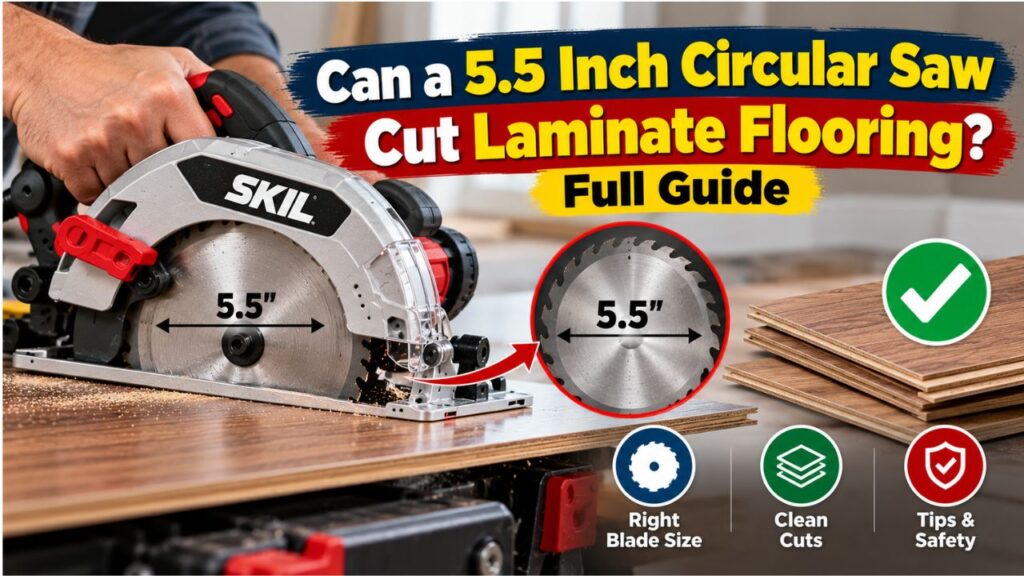
Yes. A 5.5-inch circular saw is more than large enough to cut normal laminate flooring.
Blade diameter determines, among other things, the saw’s maximum cutting depth. A smaller blade does not automatically mean the saw cannot handle flooring.
Modern 5.5-inch cordless circular saws often provide approximately 1-9/16 to 1-11/16 inches of maximum cutting depth at 90 degrees, depending on the model.
Laminate flooring is much thinner than that.
Even relatively thick laminate with attached underlayment does not require anything close to the full cutting capacity of a 5.5-inch circular saw.
That means the blade can pass completely through the flooring in a single normal cut without approaching the tool’s maximum capacity.
Why a Small Circular Saw Can Actually Be Convenient
A 7-1/4-inch circular saw is more common for general construction, but its additional depth is unnecessary when cutting thin laminate planks.
A compact 5.5-inch saw may offer several practical advantages.
It usually weighs less, is easier to maneuver over narrow flooring planks, and can be more convenient when you are making dozens of cuts during installation.
If you already own one, I would not buy a larger circular saw simply to install laminate flooring.
The money would be better spent on a good fine-tooth blade compatible with the 5.5-inch saw.
Key Takeaways:
- A 5.5-inch circular saw has plenty of cutting depth for laminate flooring.
- Blade quality matters more than upgrading to a larger saw.
- The compact size can actually make a 5.5-inch saw easier to control for flooring work.
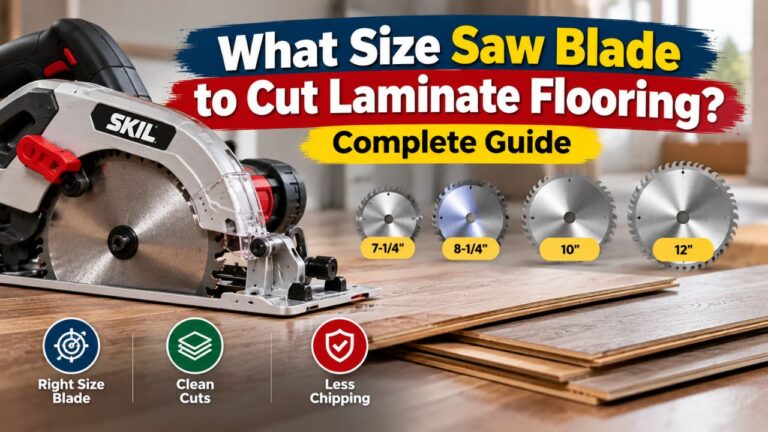
What Blade Should You Use on a 5.5 Inch Circular Saw for Laminate?
The blade is the most important part of the setup.
Laminate flooring has a hard decorative wear surface bonded to a dense fiberboard core. That surface is considerably more abrasive than ordinary softwood and can chip when a large, aggressive saw tooth exits the material.
For that reason, I recommend a sharp carbide-tipped flooring, laminate, or fine-finish blade that is specifically compatible with your saw.
Do not install a blade simply because its outside diameter is 5.5 inches.
You also need to verify:
Blade arbor size
Maximum RPM rating
Kerf compatibility
Rotation direction
Saw manufacturer requirements
A blade with the wrong arbor cannot be installed properly, and a blade that is not rated for the saw’s speed should never be used.
Is the Standard Blade That Comes With the Saw Good Enough?
Sometimes, but it depends on the blade.
Many small cordless circular saws ship with low-tooth-count blades intended for fast cuts in construction lumber. For example, current 5.5-inch models may include an 18-tooth wood-cutting blade, while flooring-specific 5.5-inch blades with higher tooth counts are also available.
An 18-tooth blade can physically cut laminate.
The problem is finish quality.
Large teeth take relatively aggressive bites and may leave more chips along the decorative surface.
If all of your cut edges will disappear beneath baseboard, that may be acceptable.
For cleaner work, I would install a blade intended for flooring or fine cutting.
Do You Need 60 Teeth on a 5.5-Inch Blade?
Not necessarily.
You cannot compare tooth count directly between different blade diameters.
A 60-tooth 7-1/4-inch blade and a 60-tooth 5.5-inch blade do not have identical tooth spacing.
For a compact saw, a good 24-, 30-, 36-, or similarly fine flooring-specific carbide blade can produce very good results depending on its tooth geometry.
The correct blade design matters more than choosing the largest tooth count you can find.
Dedicated laminated-panel blades are specifically designed to reduce chipping in coated and laminated materials.
Which Side of Laminate Should Face Up With a Circular Saw?
With a conventional handheld circular saw, I generally recommend placing the laminate decorative side down.
That is because a typical circular saw blade rotates upward through the workpiece.
The teeth enter through the bottom face and exit through the top.
Most visible chip-out tends to occur where the teeth leave the material.
Putting the decorative side down therefore allows the teeth to enter the finished surface cleanly before exiting through the back.
Pergo’s current laminate installation instructions similarly recommend placing the pattern side down when using a hand-held circular saw.
However, blade designs vary.
For an important visible cut, make one test cut on scrap first.
Compare both sides.
If your particular blade produces a cleaner surface using another orientation, use the result of the test rather than blindly following a general rule.
Does Orientation Matter if the Cut Is Hidden?
Not nearly as much.
Most perimeter cuts are concealed by:
Baseboard
Shoe molding
Quarter-round
Transition profiles
In that situation, dimensional accuracy matters more than a completely chip-free wall-facing edge.
Still, minimizing chipping reduces the chance that damage extends beyond the area the trim will cover.
How to Cut Laminate Flooring With a 5.5 Inch Circular Saw
The process is essentially the same as using a full-size circular saw.
The smaller blade does not require a special laminate-cutting technique.
1. Measure the Flooring Carefully
Measure the space where the plank will fit.
For an end-of-row cut, remember to maintain the expansion gap specified by your flooring manufacturer.
Floating laminate should not normally be cut tightly between two fixed walls.
Different flooring systems have different expansion requirements, so use the instructions supplied with your product rather than assuming one universal gap.
If you are cutting along a wall, take several measurements because walls are often slightly out of square.
2. Mark the Cut
Transfer the measurement onto the back or visible side of the plank according to your cutting orientation.
For a normal square crosscut, use a speed square or framing square to draw a line perpendicular to the plank.
For a long rip cut, mark several points along the length and connect them with a long straightedge.
Clearly identify the waste side.
The saw blade removes material equal to the width of its kerf, so position the blade on the waste side of your layout line.
3. Support the Plank Properly
Place the flooring on a stable cutting surface.
A sheet of rigid foam insulation is particularly useful for circular-saw flooring cuts because the plank can remain supported across its entire length while the blade penetrates slightly into the sacrificial foam.
You can also use sawhorses and sacrificial boards.
Whatever setup you choose, make sure the finished piece and offcut cannot fall or twist into the blade.
A poorly supported plank can pinch the blade near the end of the cut.
4. Adjust the Blade Depth
Do not leave the circular saw set to maximum cutting depth.
Lower the base until the blade extends only slightly beyond the bottom of the laminate.
A common circular-saw safety principle is to minimize unnecessary blade projection beneath the workpiece; manufacturer guidance also recommends shallow, appropriate blade depth for cleaner and safer cutting.
Because laminate is thin, you need very little blade exposed below it.
Make sure the blade cannot hit the floor, workbench, clamps, or sawhorse.
5. Use a Guide for Long Cuts
For a crosscut, a square can sometimes provide enough visual guidance.
For a rip cut running the full length of the plank, use a straightedge.
Clamp the guide in place at the correct offset from your cut line.
The required offset is the distance from the circular saw blade to the edge of the saw’s base plate that will ride against the guide.
Measure this distance with the saw disconnected from power or with the battery removed.
Then position the straightedge accordingly.
6. Bring the Blade to Full Speed
Position the saw with the blade clear of the flooring.
Start the saw.
Allow it to reach operating speed.
Then move smoothly into the material.
Do not start the motor with the blade already resting against the laminate.
7. Keep the Base Flat
Maintain full contact between the saw base and flooring.
Do not tilt the tool while cutting.
Move at a steady pace and allow the blade to do the work.
If you have to push unusually hard, stop and investigate. The blade may be dull, inappropriate for laminate, or binding.
8. Finish the Cut Smoothly
Continue through the end of the plank without twisting the saw.
Support the offcut so it does not break away prematurely.
After the blade exits, release the trigger and maintain control of the saw until the blade stops completely.
Key Takeaways:
- Set the blade only slightly deeper than the laminate.
- Support both sides of the cut so the blade cannot become pinched.
- Use a straightedge for long rip cuts.
- Let the blade reach full speed before entering the flooring.
Can a 5.5 Inch Circular Saw Make Crosscuts in Laminate?
Absolutely.
Crosscuts are probably the most common cuts during a laminate installation.
Each time you reach the end of a flooring row, you usually need to shorten a plank.
A 5.5-inch circular saw has significantly more than enough depth for this.
For repeated crosscuts, however, the main inconvenience is setup.
You need to support the plank and guide the saw squarely each time.
A flooring saw, miter saw, or laminate cutter may be faster when you have hundreds of identical end cuts.
But for a DIY room, a compact circular saw is perfectly capable.
How to Keep Crosscuts Square
Use a speed square as a marking guide.
You can also use it as a physical saw guide if your saw and setup allow enough room.
Position the square so the circular saw’s base plate follows its edge while the blade travels exactly along your waste-side line.
Always check that any guide is securely held or clamped and cannot move into the blade.
Can a 5.5 Inch Circular Saw Rip Laminate Flooring?
Yes, and it works very well when paired with a straightedge.
A rip cut runs along the plank’s length and is most commonly required for the first or last flooring row.
The saw’s cutting depth is irrelevant to the difficulty of this operation because the flooring remains thin.
The challenge is keeping a six- or seven-foot cut straight.
Use a Straightedge Instead of Cutting Freehand
You can follow a pencil line by eye, but even a small steering error can produce a noticeably wavy edge.
A straightedge eliminates most of that problem.
Measure the required finished plank width, subtract the required expansion gap, mark the line, and then clamp your guide at the appropriate saw-base offset.
Slide the unpowered saw along the guide once before cutting to make sure:
The blade follows the correct side of the line.
The motor clears the clamps.
The guide extends far enough.
The plank remains fully supported.
Then make the cut in one continuous pass.
Can You Use the Circular Saw’s Rip Fence?
If your 5.5-inch saw accepts an edge guide, yes.
A rip fence rides along the factory edge of the plank and holds the blade a fixed distance away.
This can be convenient for parallel cuts.
A clamped straightedge is generally more flexible, especially when the cut width is outside the small rip fence’s adjustment range.
Is a 5.5 Inch Saw Powerful Enough for Laminate?
In almost every normal case, yes.
Laminate is relatively thin, so the saw is not making a deep cut.
Even a cordless 5.5-inch saw designed for general wood cutting can normally pass through a laminate plank without significant motor load when equipped with a sharp blade.
Power becomes more relevant when cutting thick construction lumber.
For laminate, blade sharpness and battery condition matter more.
If a cordless saw is struggling badly through laminate, I would check:
Blade sharpness
Blade direction
Material compatibility
Battery charge
Whether the plank is pinching the blade
Rather than assuming the small blade diameter is the problem.
5.5 Inch vs. 7.25 Inch Circular Saw for Laminate Flooring
Both can do the job easily.
The larger 7-1/4-inch saw provides greater cutting depth, but laminate does not need it.
| Feature | 5.5-Inch Circular Saw | 7.25-Inch Circular Saw |
| Laminate cutting depth | More than enough | Far more than needed |
| Weight | Usually lighter | Usually heavier |
| Portability | Excellent | Good |
| Blade selection | More limited | Much wider |
| Flooring control | Excellent | Excellent |
| General construction use | More limited | More versatile |
| Best reason to choose | Compact flooring work | Broader workshop use |
If you already own a 7-1/4-inch saw, use it.
If you already own a 5.5-inch saw, use that.
I would not buy another saw simply because you are worried that 5.5 inches is too small for laminate.
The main advantage of the larger format is its wider selection of replacement blades and greater versatility for future construction projects.
Does a 5.5 Inch Circular Saw Cut Thick Laminate?
Yes, within normal laminate-flooring thicknesses.
Even if the plank includes an attached pad, the total thickness remains far below the normal 90-degree cutting capacity of a 5.5-inch saw.
Where you need to pay more attention is bevel cutting.
Tilting a circular saw reduces its maximum cutting depth.
Current 5.5-inch saws, for example, may provide roughly 1-1/8 to 1-3/16 inches of depth around a 45-degree bevel, still substantially more than normal laminate flooring requires.
So even angled flooring cuts are generally well within the tool’s capacity.
How to Reduce Chipping With a 5.5 Inch Circular Saw
The size of the saw has very little to do with chip-out.
Blade selection and technique matter much more.
Start with a clean, sharp carbide blade suitable for laminate.
Then place the decorative surface on the cleaner entry side of the blade—normally face down with a conventional handheld circular saw.
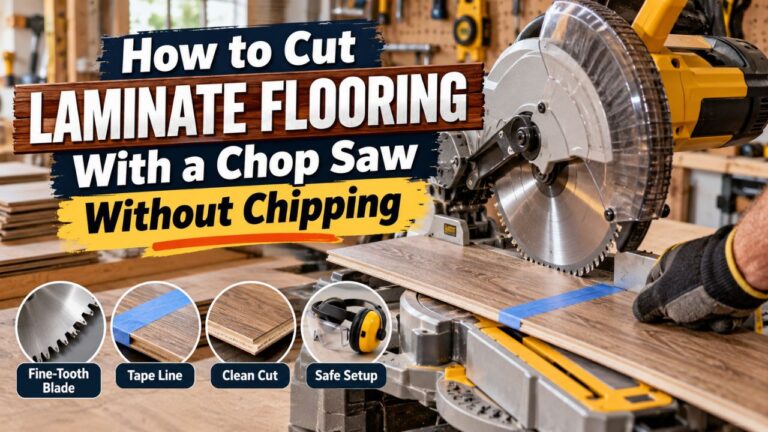
Painter’s tape can be applied across the cutting line when the edge will remain visible.
The tape provides some surface support and also makes pencil marks easier to see on dark flooring.
Keep the plank stable throughout the cut.
Vibration can damage the decorative surface.
Finally, do not force a dull blade. Excessive feed pressure makes the tool harder to control and can produce rougher edges.
Does Laminate Flooring Dull a Small Circular Saw Blade?
Laminate can dull saw blades faster than ordinary softwood.
The wear layer is designed to resist abrasion during years of foot traffic, and the dense core also places demands on cutting edges.
This applies whether the blade is 5.5 inches or 7-1/4 inches.
A smaller blade is not inherently more vulnerable.
The main factor is carbide quality and how much flooring you cut.
If you are installing one small room, a good blade may remain usable afterward.
If you are flooring an entire house, expect considerably more blade wear.
Signs that the blade is becoming dull include increased feed force, more chipping, burning, slower cutting, and a rougher edge.
Do not compensate for a dull blade by pushing the saw harder.
Replace or professionally sharpen the blade when appropriate.
Key Takeaways:
- Laminate’s abrasive wear layer can dull blades faster than ordinary softwood.
- Saw diameter does not determine blade life; carbide quality and material volume matter more.
- Increased chipping or feed resistance can indicate a dull blade.
Can You Use an 18-Tooth 5.5 Inch Blade on Laminate?
You can, but I would consider it a rough-cut option.
An 18-tooth blade is usually intended for efficient cutting in lumber rather than exceptionally clean laminate edges.
If the cut will be completely covered by baseboard, the result may be acceptable.
Before committing, test the blade on a scrap piece.
If chipping stays within the area your trim will conceal, you may not need another blade.
If you want clean visible cuts, switch to a finer flooring or finish blade.
Is a 5.5 Inch Circular Saw Better Than a Jigsaw for Laminate?
Neither is universally better.
I prefer the circular saw for long straight cuts.
That includes:
Straight crosscuts
Long rip cuts
Cutting multiple planks to width
The jigsaw is better for:
Curves
Door-jamb notches
Heating pipe openings
Irregular walls
Small detailed cutouts
For a complete laminate installation, having both tools is convenient.
If you own only the 5.5-inch circular saw, it can handle most straight cuts without difficulty.
Is a 5.5 Inch Circular Saw Better Than a Flooring Cutter?
A manual laminate cutter is cleaner indoors because it produces little or no airborne sawdust.
It is also quiet and quick for simple end cuts.
A circular saw is much more versatile.
It can make:
Crosscuts
Rip cuts
Angled cuts
Bevel cuts
Custom straight cuts
A flooring cutter is primarily useful for repetitive plank shortening.
If I had to choose only one cutting tool for a complicated flooring installation, I would prefer the circular saw because it handles a wider range of straight-cut situations.
Common Mistakes When Using a Small Circular Saw on Laminate
The first mistake is assuming the stock blade is automatically ideal.
A supplied construction blade may cut quickly but leave unnecessary chips.
Another common problem is using maximum blade depth.
Laminate does not need it. Excessive blade exposure adds unnecessary risk without improving the cut.
Poor plank support is another issue.
If the offcut bends downward before the cut is complete, it can tear the last part of the decorative layer or pinch the blade.
Do not try to correct a wandering cut by twisting the saw while the blade is inside the plank.
Stop the tool, wait for the blade to stop completely, and reset the guide.
Finally, remember the flooring expansion gap.
A perfectly cut plank that fits tightly between two walls can still create installation problems later.
Safety When Cutting Laminate With a 5.5 Inch Circular Saw
A smaller circular saw still deserves the same safety precautions as a larger model.
Wear eye protection because laminate chips can be ejected rapidly.
Hearing protection is appropriate for repeated cuts.
Sawing laminate can also create fine airborne dust. Pergo’s installation instructions call for respiratory protection during sawing, and working outdoors or using effective dust collection can significantly reduce indoor dust.
Place the workpiece on a stable surface and keep your hands completely out of the blade path.
Never hold a flooring plank across your leg while operating the saw.
Disconnect the power cord or remove the battery before changing blades or adjusting components near the blade.
Check that the lower blade guard moves freely before every cutting session.
Keep the saw’s base flat on the workpiece and avoid reaching beneath the flooring while the saw is connected to power.
After completing the cut, remember that the blade continues spinning briefly after you release the trigger.
Keep control of the tool until it stops completely.
FAQs about Can a 5.5 Inch Circular Saw Cut Laminate Flooring
Is a 5.5 inch circular saw large enough for laminate flooring?
Yes. Its normal cutting depth is far greater than the thickness of standard laminate flooring, so it can cut a plank completely through in one pass.
What blade should I use on a 5.5 inch circular saw for laminate?
Use a sharp carbide-tipped blade designed for flooring, laminate, or fine-finish cutting and make sure its diameter, arbor, RPM rating, and other specifications match your saw.
Can I use the blade that came with my 5.5 inch circular saw?
Possibly.
Many included blades are coarse general-purpose wood blades. They can cut laminate but may produce more chip-out than a flooring-specific or fine-finish blade.
Is an 18-tooth blade enough for laminate flooring?
It will cut laminate, but it is not my preferred choice when a clean edge matters.
Test it on scrap first. For cleaner cuts, use a finer flooring blade.
Can a 5.5 inch circular saw rip laminate flooring?
Yes.
Clamp a straightedge guide to the plank and move the circular saw steadily along it for an accurate lengthwise rip.
Can a 5.5 inch circular saw make crosscuts in laminate?
Yes. Crosscutting laminate is an easy task for a 5.5-inch saw because the material is much thinner than the saw’s cutting capacity.
Should laminate face up or down with a circular saw?
For a conventional handheld circular saw, the decorative face should generally be down because the blade enters from the underside and most chip-out occurs on the exit side.
Test on scrap when appearance is critical.
How deep should I set a circular saw for laminate?
Set the blade slightly deeper than the plank thickness.
There is no reason to use the saw’s maximum depth for thin flooring.
Will a 5.5 inch circular saw chip laminate?
Any circular saw can chip laminate if the blade is coarse, dull, or used incorrectly.
A sharp fine-tooth blade, stable work support, proper orientation, and smooth feed significantly reduce chipping.
Is a 5.5 inch saw better than a 7.25 inch saw for laminate?
Neither is inherently better for cut quality.
The 5.5-inch saw is usually lighter, while the 7-1/4-inch saw provides greater cutting depth and a wider selection of blades.
Both have far more depth than laminate requires.
Can a cordless 5.5 inch circular saw cut laminate?
Yes.
Laminate is thin, so a healthy cordless saw with a charged battery and sharp blade should cut it easily.
Can I cut engineered wood flooring with a 5.5 inch saw?
Usually, yes, provided the flooring thickness is within the saw’s rated capacity and the blade is appropriate for the material.
Check the saw and flooring manufacturers’ requirements first.
Can I cut vinyl plank with a 5.5 inch circular saw?
Some rigid vinyl products can be saw-cut, but many vinyl planks are easier to score and snap with a utility knife.
Follow the flooring manufacturer’s specified cutting method.
Do I need a larger saw for thick laminate?
Normal laminate flooring is well within the capacity of a 5.5-inch saw.
A larger saw would provide extra depth that generally serves no purpose for this particular job.
Can I use a 5.5 inch circular saw for an entire laminate flooring installation?
Yes.
It can make most straight crosscuts and rip cuts required during the project.
A jigsaw is still useful for curved openings and irregular notches.
Why is my circular saw burning the laminate?
A dull or dirty blade, extremely slow feed, binding, or an inappropriate blade can cause excessive heat.
Inspect the blade and workpiece support rather than simply pushing harder.
Why does my laminate break at the end of the cut?
The offcut may be unsupported.
Support both sections so the waste piece cannot fall and tear the last section before the blade finishes cutting.
Is a small circular saw safer than a full-size saw?
Its lower weight may make it easier to handle, but it is still a high-speed power saw.
Use the same blade-guard, work-support, eye-protection, dust-control, and hand-position precautions you would use with a larger circular saw.
Conclusion
So, can a 5.5 inch circular saw cut laminate flooring? Yes—very easily. A 5.5-inch circular saw provides far more cutting depth than standard laminate flooring requires, making it fully capable of both normal crosscuts and long rip cuts.
I would not upgrade to a 7-1/4-inch saw simply for a laminate flooring project if you already own a good 5.5-inch model. The larger saw’s extra cutting depth offers little benefit when the workpiece is only a thin flooring plank.
Instead, focus on the blade. A sharp carbide flooring or fine-finish blade compatible with your specific 5.5-inch saw will have a much greater effect on the finished cut than blade diameter alone.
For a conventional handheld circular saw, place the laminate decorative side down when that gives you the cleanest cut, support the plank completely, and set the blade only slightly deeper than the material. Use a square for crosscuts and a clamped straightedge for long rips.
A compact 5.5-inch circular saw can therefore be an excellent laminate-flooring tool: it is lightweight, easy to control, sufficiently powerful, and capable of making virtually every straight cut required during a typical installation. Add a jigsaw for curves and detailed notches, and you have a very practical cutting setup for an entire laminate flooring project.