Can a Saw Cut SPC Flooring? Best Saws, Blades & Cutting Methods
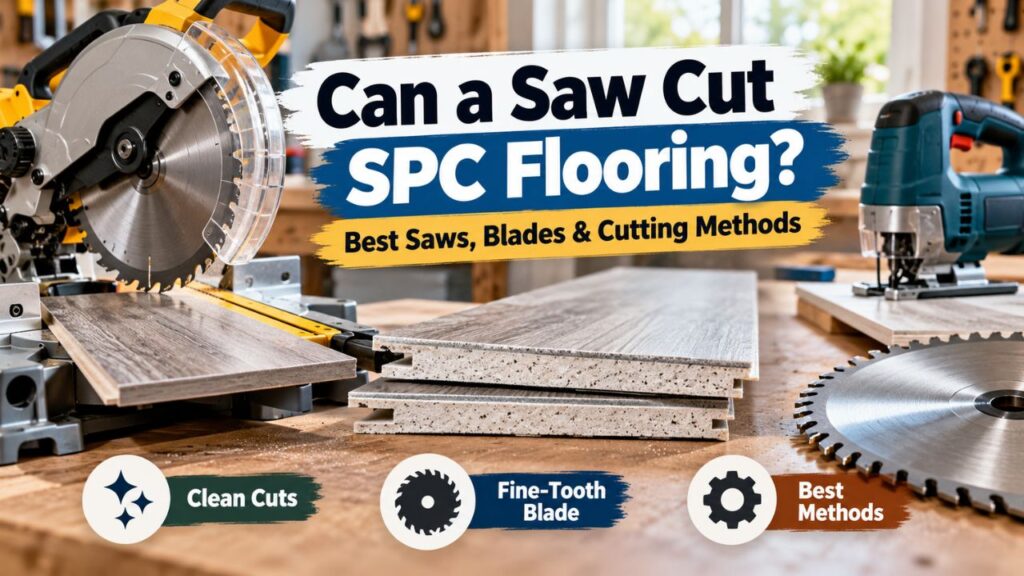
Yes, a saw can cut SPC flooring, and power saws are often the easiest choice for rip cuts, angled cuts, notches, and other shapes that cannot be made cleanly by scoring and snapping. Depending on the specific SPC plank, you can use a miter saw, table saw, circular saw, or jigsaw with a suitable fine-tooth blade. Some rigid-core flooring can also be scored with a utility knife and snapped for simple straight end cuts. Manufacturer instructions vary by product, so check your specific flooring before deciding which cutting method to use.
SPC stands for stone plastic composite or stone polymer composite. It is a type of rigid-core vinyl flooring that combines mineral-filled material with polymer components to create a dense, stable plank. That rigid construction makes SPC more difficult to bend and cut than flexible sheet vinyl, but it is still manageable with ordinary flooring and woodworking tools.
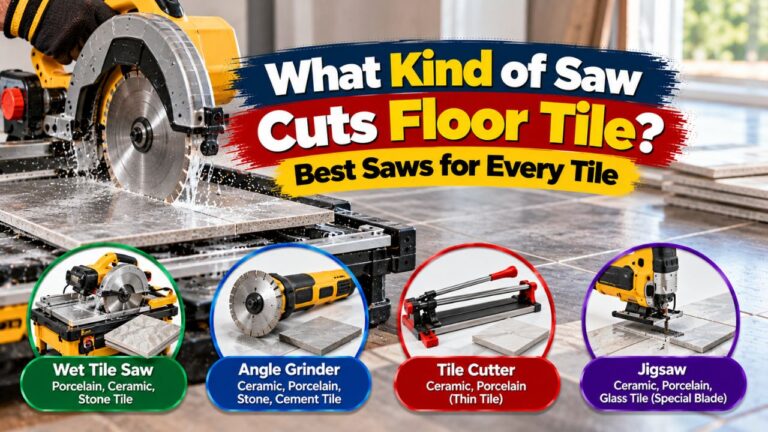
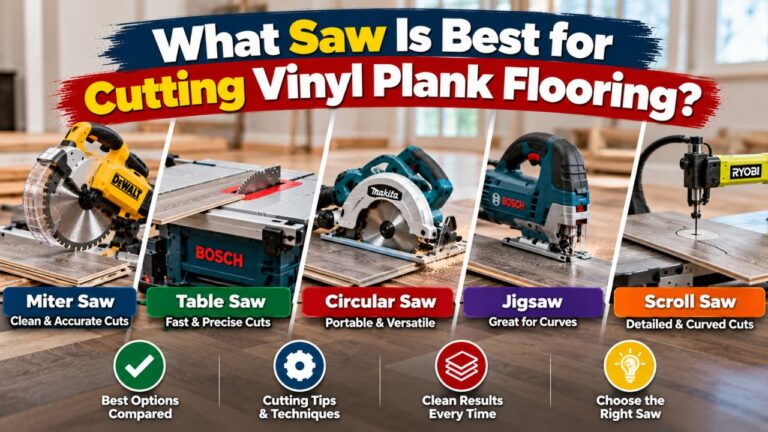
The best cutting method depends on the shape you need. A miter saw is excellent for shortening planks, a table saw is ideal for ripping them lengthwise, a circular saw can handle both straight crosscuts and long rips, and a jigsaw is best for curves and irregular notches. For compatible products, a utility knife can eliminate power-saw dust when you only need a simple straight cut.
In this guide, I’ll explain whether a saw can cut SPC flooring, which saw works best for each type of cut, what blade to use, how to avoid chipped edges, whether you can score and snap SPC, and how to control the fine dust created when sawing rigid-core flooring.
Can a Saw Cut SPC Flooring?
Yes. SPC flooring can generally be cut with a saw, provided the saw and blade are appropriate for the flooring and the type of cut.
Manufacturers of rigid-core flooring commonly identify miter saws, table saws, circular saws, and jigsaws as practical cutting tools. Some rigid vinyl products also allow score-and-snap cutting for end cuts while recommending saws for long rip cuts.
A saw becomes particularly useful when you need to:
Make a long rip for the first or final row, cut a plank at an angle, fit flooring around a door jamb, create an L-shaped notch, or make a cut that cannot be snapped cleanly.
The main disadvantage is dust. Sawing SPC creates much more airborne and surface debris than scoring and snapping.
That is why I would not automatically reach for a power saw for every single cut.
If your specific flooring can be scored and snapped cleanly, that method is often faster, quieter, and considerably cleaner for straight end cuts.
Best Saw for Different SPC Cuts
| Cut You Need | Best Tool | Practical Use |
| Straight end cut | Miter saw or score-and-snap | Shortening planks |
| Long rip cut | Table saw | First or final row |
| Straight portable cut | Circular saw | Crosscuts and rips |
| Curve | Jigsaw | Pipes and irregular shapes |
| L-shaped notch | Jigsaw | Doorways and cabinets |
| Small straight cut | Utility knife if product permits | Dust-free installation |
| Repeated crosscuts | Miter saw | Large flooring projects |
No single saw is best for the entire installation.
If I were installing a room of SPC and had several tools available, I would usually use a miter saw for repeated end cuts, a table saw for long rips, and a jigsaw for irregular shapes.
Key Takeaways:
- SPC flooring can be cut with common woodworking saws.
- Match the saw to the shape of the cut rather than trying to use one tool for everything.
- If your flooring supports score-and-snap cutting, it can be preferable for simple straight cuts because it creates little or no sawdust.
Can You Cut SPC Flooring With a Miter Saw?
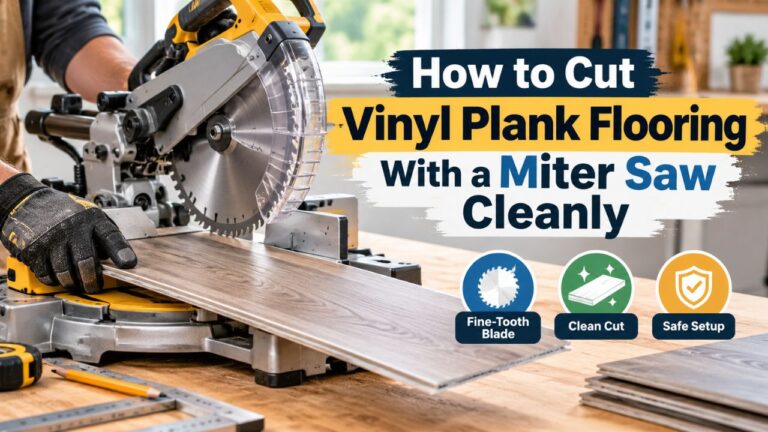
Yes. A miter saw is one of the most useful saws for SPC flooring, particularly when you need to shorten planks.
During a floating-floor installation, nearly every row will eventually reach a wall and require a final plank to be cut to length.
A miter saw makes those repetitive crosscuts quickly.
Measure the remaining space, account for the expansion gap required by the flooring manufacturer, mark the plank, and position it securely against the saw fence.
Use a fine-tooth blade suitable for vinyl, laminate, or composite flooring.
Let the blade reach full speed before lowering it smoothly through the plank.
Do not slam the blade into the material. A steady cut is more likely to leave a clean edge.
Is a Miter Saw Good for Angled SPC Cuts?
Yes.
This is one of its biggest advantages.
If a plank needs to meet an angled wall, set the miter angle according to your measurement and make a test cut on scrap material first.
Rooms that appear perfectly square often are not, so avoid automatically assuming every angled wall is exactly 45 degrees.
What a Miter Saw Cannot Do Well
A miter saw is poor for long lengthwise cuts.
If the final flooring row needs to be reduced from 7 inches wide to 3 inches wide, that is a rip cut running along almost the entire plank.
A table saw or guided circular saw is much better suited to that job.
Can You Cut SPC Flooring With a Table Saw?
Yes. A table saw is arguably the best power tool for long, straight rip cuts in SPC flooring.
This becomes especially useful when you reach the last row.
The remaining gap between the installed floor and wall is rarely exactly the width of a full plank, so every plank in that row may need to be narrowed.
Measure the available width at several points along the wall because walls are not always perfectly straight.
Subtract the expansion gap required by your flooring.
Then set the rip fence to the required width.
Place the plank flat against the table and keep its reference edge firmly against the fence while feeding it through the blade.
Use the Riving Knife
Keep your table saw’s riving knife installed whenever the cutting operation permits it.
The riving knife sits behind the blade and helps keep cut material from closing onto the rear teeth.
That reduces an important source of kickback.
Do not remove normal table-saw safety equipment simply because SPC flooring is thin.
Use a Push Stick for Narrow Pieces
The final row of a room may require a fairly narrow strip.
Your hands should never follow that narrow piece close to the blade.
Use an appropriate push stick or push block.
If your particular cut is too awkward to control safely on your saw, use another method rather than forcing the table-saw setup.
Can You Cut SPC Flooring With a Circular Saw?
Yes. A circular saw is one of the most versatile options, especially for DIY installers who do not own a table saw.
It can make both crosscuts and long rip cuts.
For a clean straight rip, clamp a straightedge or saw guide to the plank rather than trying to follow a pencil line freehand.
Support the flooring fully so it does not flex or move while being cut.
Blade orientation also matters.
Because a typical handheld circular saw cuts upward through the material, the cleanest face may be on the underside of the workpiece.
For many finished panels, installers therefore position the decorative surface downward when using a conventional circular saw.
However, blade designs and flooring products vary, so make a test cut on waste material before processing the room.
Keep the Blade Depth Reasonable
Set the cutting depth only slightly deeper than the plank.
There is no need to expose several inches of blade below relatively thin flooring.
A reasonable blade setting improves control and reduces unnecessary blade exposure.
Follow the circular saw manufacturer’s guidance when adjusting depth.
Can You Cut SPC Flooring With a Jigsaw?
Yes, and the jigsaw is one of the most valuable tools for irregular SPC cuts.
Straight flooring installation rarely remains perfectly straight throughout an entire room.
You may encounter door jambs, pipes, cabinets, columns, vents, and other obstacles.
A jigsaw can follow shapes that a table saw or miter saw cannot.
Use a fine-tooth blade designed for laminate, vinyl, plastic, or similar materials.
The exact blade should match your jigsaw and flooring.
Be Careful With the Locking Edge
SPC click-lock edges can be relatively fragile.
When making a notch close to the tongue or groove, support the plank carefully and avoid letting the jigsaw vibrate it excessively.
The visible cut edge may eventually be covered by trim, but damaging the locking profile can prevent the plank from connecting correctly.
Jigsaw Blade Direction Matters
Many conventional jigsaw blades cut on the upstroke.
That means they can create more chipping on the upper surface.
Reverse-tooth or down-cut blades behave differently.
Instead of following a universal face-up rule, check the blade tooth direction and test it on an offcut.
Key Takeaways:
- Use a miter saw for repeated end cuts and a table saw for straight rips.
- A circular saw is a flexible alternative when you need portability.
- A jigsaw is the best common saw for notches, curves, and other irregular shapes.
What Saw Blade Should You Use for SPC Flooring?
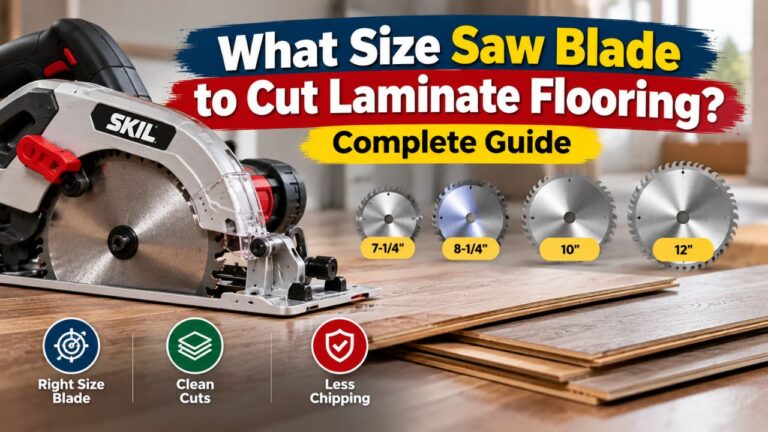
A fine-tooth carbide blade is generally the safest starting point for circular, table, and miter saws.
SPC is dense and can be abrasive, so a coarse construction blade may leave a rougher edge and may not provide the control you want.
For a 10-inch miter or table saw, blades around 60–80 teeth are commonly practical for clean flooring cuts.
However, tooth count should not be your only criterion.
Look for a blade whose manufacturer rates it for materials such as:
Laminate, vinyl flooring, plastics, melamine, composite panels, or other hard-faced manufactured materials.
A blade specifically designed for laminate and composite products can often hold up better than a generic fine-finish woodworking blade.
Does More Teeth Always Mean a Better Cut?
No.
An 80-tooth blade can create very clean cuts, but a quality 60-tooth flooring or composite blade may outperform a poor-quality blade with a higher tooth count.
Tooth geometry, carbide quality, sharpness, blade stiffness, and the intended application all matter.
For a whole flooring project, I would prioritize a blade designed for abrasive composite material over simply selecting the highest tooth count you can find.
What About a TCG Blade?
Triple Chip Grind, commonly abbreviated TCG, is a tooth geometry frequently used for abrasive manufactured materials.
A TCG blade can be a good choice for rigid flooring because it combines durability with clean cutting.
It is not mandatory, but if I were buying a dedicated blade for a substantial SPC or laminate flooring installation, I would strongly consider a laminate/composite blade using TCG teeth.
Can You Score and Snap SPC Flooring Instead of Sawing It?
Sometimes.
Some rigid vinyl and SPC flooring products are specifically designed so simple cuts can be made by scoring the wear surface with a sharp utility knife and snapping the plank along that score.
Manufacturer instructions confirm that certain rigid-core products allow this approach for end cuts while recommending a table saw or miter saw for rip cuts.
The important word is some.
Not every SPC plank scores and snaps equally easily.
Core thickness, construction, attached underlayment, wear layer, temperature, and product design can all affect how well the method works.
How Score-and-Snap Works
Measure and mark your cut.
Place a straightedge along the line and score the finished surface firmly with a sharp utility knife.
You may need more than one pass.
Position the score over an appropriate edge or support and snap the plank along the line.
If the product has an attached pad, you may need to cut the remaining backing with the utility knife after the rigid core breaks.
If the plank refuses to snap cleanly after reasonable scoring, do not continue applying uncontrolled force.
Use a suitable saw instead.
When I Prefer Score-and-Snap
For a straight end cut on compatible flooring, score-and-snap is often my first choice.
There is almost no airborne cutting dust, the setup is minimal, and you do not need to repeatedly walk to a saw station.
For a long rip, curved cut, or complicated notch, a saw is usually more practical.
Why SPC Can Be Harder to Cut Than Regular Vinyl Flooring
Traditional flexible vinyl is comparatively soft.
SPC is intentionally engineered to be much more rigid.
Its mineral-filled core gives the plank dimensional stability and helps resist dents, movement, and temperature-related changes.
That rigidity is useful after installation but makes the material less forgiving while cutting.
A flexible vinyl plank may bend while you score it.
An SPC plank behaves more like a thin rigid panel.
This is why installers frequently use the same types of saws that would be used for laminate flooring and other composite materials.
How to Cut SPC Flooring Without Chipping
The first step is using a sharp blade.
A dull blade produces more heat, requires greater feed pressure, and is more likely to damage the finished edge.
Support the plank well so it does not bounce.
A vibrating plank can chip around the cut even when the blade is otherwise suitable.
Feed the material smoothly rather than aggressively.
Trying to cut as fast as possible rarely saves meaningful time during a flooring installation.
Use Painter’s Tape When Necessary
If a particular product chips easily, painter’s tape across the cut line can sometimes help support the finished surface.
Mark the cut on the tape and saw through it.
This is not a replacement for a sharp blade, but it can improve particularly delicate edges.
Remember That Many Cut Edges Are Hidden
Do not spend ten minutes polishing an end cut that will disappear under baseboard.
The cut still needs to be accurate and should not fracture the plank or locking system, but a tiny cosmetic chip at a concealed wall edge rarely affects the finished installation.
Visible transitions and exposed edges deserve more attention.
Cutting the First and Last Rows of SPC Flooring
The first and last rows sometimes require lengthwise trimming so the flooring layout remains balanced and you avoid an extremely narrow strip on one side of the room.
These are classic table-saw cuts.
Before installing the first row, calculate the width of the final row according to the flooring manufacturer’s layout guidance.
If the last row would become unacceptably narrow, rip some width from the first row so both sides of the room are more balanced.
When cutting the final row, measure the distance to the wall at several points.
Walls can bow or angle.
A perfectly straight rip may not follow an irregular wall.
If the variation is substantial, scribe the wall profile onto the plank and cut the line with a jigsaw.
Always preserve the click-lock edge needed to connect the plank to the previous row.
Cutting the wrong side from a final-row plank is an easy and frustrating mistake.
How to Cut SPC Around Pipes
For a pipe penetration, a jigsaw or appropriately sized hole saw is normally more useful than a miter or table saw.
Measure the pipe location carefully and transfer the center point to the plank.
Remember that floating floors need the required clearance around fixed objects.
Follow your flooring manufacturer’s instructions for the appropriate expansion space.
If the pipe sits too close to an edge for a simple drilled hole, you may need to cut a removable section from the plank, fit the plank around the pipe, and reinstall the small piece according to an appropriate flooring technique.
A decorative pipe collar can then hide the expansion space.
How to Cut SPC Around Door Frames and Corners
Doorways frequently require L-shaped or U-shaped cuts.
Mark the obstacle carefully and use a jigsaw.
Do not attempt to produce an L-shaped cut by feeding the flooring partially into a table-saw blade and stopping midway unless the saw manufacturer specifically supports that operation with a safe setup.
A jigsaw gives far better control.
In many installations, undercutting a wooden door casing so the flooring can slide underneath provides a cleaner finished appearance than trying to cut the plank perfectly around the casing profile.
Use an oscillating multi-tool or appropriate jamb-cutting method where suitable.
SPC Flooring Dust: Should You Be Concerned?
Sawing SPC flooring can create substantial fine dust, and I recommend treating that dust seriously rather than cutting large quantities in an enclosed room without control.
The exact composition of SPC varies by manufacturer, so you should consult the product’s technical or safety information rather than assuming that every rigid-core product contains the same mineral ingredients or presents the same dust hazard.
When cutting mineral-containing materials, fine airborne dust should be minimized. NIOSH notes that cutting and grinding materials containing crystalline silica can make respirable particles airborne, and excessive exposure to respirable crystalline silica can cause serious lung disease.
That does not mean every SPC plank should automatically be treated as having the same silica content as concrete or engineered stone. It means you should check your specific product and control dust instead of guessing about its composition.
Practical Dust Control
Whenever practical, make power-saw cuts outdoors or in a well-ventilated dedicated cutting area rather than beside the installed flooring.
Connect compatible dust extraction to the saw.
A HEPA-filtered vacuum is preferable for collecting fine settled dust where appropriate.
Avoid using compressed air to blow fine cutting dust around the room.
OSHA and NIOSH guidance for silica-containing dust emphasizes source control and HEPA-filtered cleanup rather than dry methods that re-aerosolize fine material.
Wear eye protection and use suitable respiratory protection based on the flooring manufacturer’s safety information and the amount of dust being generated.
Key Takeaways:
- Sawing SPC produces much more fine dust than scoring and snapping.
- Check the specific flooring’s safety documentation rather than assuming all SPC products have identical composition.
- Use dust extraction, good ventilation, and appropriate personal protective equipment during repetitive power-saw cutting.
Is a Flooring Cutter Better Than a Saw for SPC?
It can be.
A manual flooring cutter uses a long lever and cutting blade to shear through compatible flooring without a high-speed motor.
Its biggest advantage is cleanliness.
There is no spinning saw blade creating a cloud of fine dust.
It is also much quieter than a miter or table saw.
However, not every manual flooring cutter is rated for every SPC plank.
Thickness and core hardness matter.
Before purchasing or renting one, confirm that its manufacturer approves it for SPC or rigid-core vinyl in the thickness you are installing.
A flooring cutter also has limited versatility.
It may be excellent for straight crosscuts but unable to make the detailed notch that a jigsaw handles easily.
Which Cutting Method Do I Recommend?
For a small room with SPC that scores and snaps easily, I would use a utility knife for as many simple end cuts as possible.
That keeps the installation quiet and reduces dust.
I would keep a jigsaw available for irregular cuts and use a table saw or circular saw only when long rips are needed.
For a large installation where dozens of repetitive cuts are required, a miter saw makes end cuts considerably faster.
A table saw is then an excellent companion for ripping first- and last-row boards.
The best setup therefore depends on your project.
There is no reason to create power-saw dust for a simple score-and-snap cut, but there is also no reason to fight a utility knife when a dense plank clearly cuts more accurately with a saw.
Common Mistakes When Sawing SPC Flooring
A frequent mistake is using a coarse framing blade simply because it is already installed on the saw.
It may cut the plank, but a fine composite-compatible blade normally provides a cleaner result.
Another mistake is cutting every plank indoors without dust extraction.
A few cuts may not look like much, but dust accumulates quickly during an entire flooring installation.
Do not forget the expansion gap when measuring either. A perfectly cut plank is still wrong if it is cut tightly against the wall when the flooring system requires perimeter clearance.
Finally, pay close attention to the tongue-and-groove or click-lock orientation before making a rip.
You can often shorten either end of a plank according to your layout, but removing the wrong long edge may make the board impossible to connect to the installed row.
FAQs About Can a Saw Cut SPC Flooring
Can a saw cut SPC flooring?
Yes. Miter saws, table saws, circular saws, and jigsaws can all cut SPC flooring when fitted with an appropriate blade.
What is the best saw for cutting SPC flooring?
There is no single best saw for every cut. I recommend a miter saw for crosscuts, table saw for long rips, and jigsaw for curves and notches.
Can you cut SPC flooring with a miter saw?
Yes. A miter saw is particularly useful for shortening planks and making angled end cuts.
Can you cut SPC flooring with a table saw?
Yes. A table saw is one of the best choices for ripping SPC flooring lengthwise, especially for the first or last row.
Can you cut SPC flooring with a circular saw?
Yes. A circular saw equipped with a suitable fine-tooth blade can make both straight crosscuts and rip cuts.
Can you cut SPC flooring with a jigsaw?
Yes. A jigsaw is especially useful for curved cuts, corners, pipe areas, and irregular notches.
Can SPC flooring be cut with a utility knife?
Some SPC and rigid-core vinyl products can be scored and snapped with a utility knife. Check the manufacturer’s instructions because not every plank cuts equally easily.
What blade should I use for SPC flooring?
Use a sharp fine-tooth blade rated for laminate, vinyl, composite panels, or similar materials. Carbide-tipped blades are a practical choice for circular, miter, and table saws.
How many teeth should a saw blade have for SPC flooring?
For a common 10-inch table or miter saw, approximately 60–80 teeth is a useful range. Blade design and material rating are more important than tooth count alone.
Will a wood saw blade cut SPC?
Many fine-tooth carbide woodworking blades can cut SPC, particularly blades designed for laminate or composite panels. A coarse framing blade is generally not my first choice.
Does SPC flooring chip when sawed?
It can. A dull or coarse blade, poor support, vibration, or aggressive cutting can increase chipping. A sharp fine-tooth blade and steady feed usually improve the edge.
Which side should face up when cutting SPC with a miter saw?
For a conventional miter saw, finished-side up is often a good starting point because the blade enters from the upper surface. Test your specific flooring and follow its instructions.
Which side should face up on a table saw?
The decorative surface is generally positioned upward on a conventional table saw so the teeth enter the finished surface first.
Which side should face up with a circular saw?
With a typical handheld circular saw, the finished side is often placed downward because the blade teeth move upward through the material. Make a test cut because blades and products differ.
Can I cut SPC flooring without a power saw?
Yes, if your particular product can be scored and snapped or if you use a manual flooring cutter rated for SPC.
Is score-and-snap better than using a saw?
For a simple straight cut on compatible flooring, I often prefer score-and-snap because it is fast and creates little dust. Saws are more versatile for rips, angles, and irregular shapes.
Can I use a laminate cutter on SPC flooring?
Some manual flooring cutters can cut SPC, but you need to verify the cutter’s maximum thickness and material rating.
Can I use an angle grinder to cut SPC flooring?
It may physically cut the material with an appropriate wheel, but it is usually unnecessary and can generate substantial dust. A jigsaw, circular saw, or other flooring tool normally provides better control.
Does sawing SPC flooring create a lot of dust?
Yes, power saws can generate substantial fine dust. Use appropriate dust collection, ventilation, eye protection, and respiratory protection based on your flooring’s safety information.
Can I cut multiple SPC planks at once?
I prefer cutting planks individually unless both the flooring and saw setup specifically support stacked cutting. Individual cuts are easier to control and measure accurately.
What is the easiest way to cut the final row of SPC?
For a straight final-row rip, a table saw is usually easiest. If the wall is uneven, scribe its shape and use a jigsaw or another controllable cutting method.
Conclusion
So, can a saw cut SPC flooring? Yes. In fact, saws are among the most useful tools for installing rigid-core flooring when you need long rips, angled cuts, notches, and other shapes that a simple utility knife cannot make.
For repeated end cuts, I recommend a miter saw with a sharp fine-tooth blade. For narrowing first- or last-row planks, a table saw provides fast and consistent rip cuts. A circular saw is an excellent portable alternative, while a jigsaw is the clear choice for curves and irregular openings.
That does not mean a power saw should be used for every cut. Some SPC products are specifically designed to be scored and snapped with a utility knife. When that method works cleanly, I prefer it for simple straight end cuts because it creates less mess and almost no cutting dust.
Whatever saw you choose, use a blade suitable for laminate, vinyl, or composite materials, support the plank properly, preserve the locking edge you need, and leave the expansion space required by the flooring manufacturer.
Dust control also deserves attention. Check the technical and safety information for your specific SPC product, use extraction and ventilation when sawing, and avoid unnecessarily creating fine airborne dust indoors.
The practical bottom line is straightforward: a saw can cut SPC flooring very effectively, but the best tool depends on the cut. Use a miter saw for crosscuts, a table saw for rips, a jigsaw for shapes, and score-and-snap whenever your flooring allows it and the cut is simple.