Can a Scroll Saw Cut Vinyl Plank Flooring? Complete Guide
Yes, a scroll saw can cut vinyl plank flooring, especially when you need curved cuts, small notches, irregular shapes, or detailed openings. However, it is usually not the best tool for long straight crosscuts or full-length rip cuts. For those jobs, a utility knife, flooring cutter, circular saw, jigsaw, or table saw is generally faster and easier, depending on the type of vinyl plank.
A scroll saw has a thin reciprocating blade that moves vertically through the material while the workpiece rests on a table. This gives you excellent control when cutting around vents, pipes, door trim, corners, and other obstacles where a straight-cutting saw would be awkward.
The type of vinyl flooring matters. Flexible luxury vinyl plank, or LVP, can often be scored and snapped without using a saw at all. Rigid-core vinyl such as SPC or WPC is harder and may be easier to shape with a powered cutting tool. A scroll saw can handle many of these products when equipped with a suitable fine-tooth blade, but dense rigid-core flooring can wear small scroll-saw blades relatively quickly.
Heat is another consideration. Cutting too slowly with a dull blade can create enough friction to soften or partially melt vinyl around the cut. The goal is to use a sharp blade, reasonable saw speed, and steady feed so the blade cuts rather than rubs.
In this guide, I’ll explain when a scroll saw makes sense for vinyl plank flooring, which blade to use, how to make clean cuts, how to cut around vents and pipes, how rigid SPC compares with flexible LVP, and when another flooring-cutting tool is a better choice.
Can a Scroll Saw Cut Vinyl Plank Flooring Effectively?
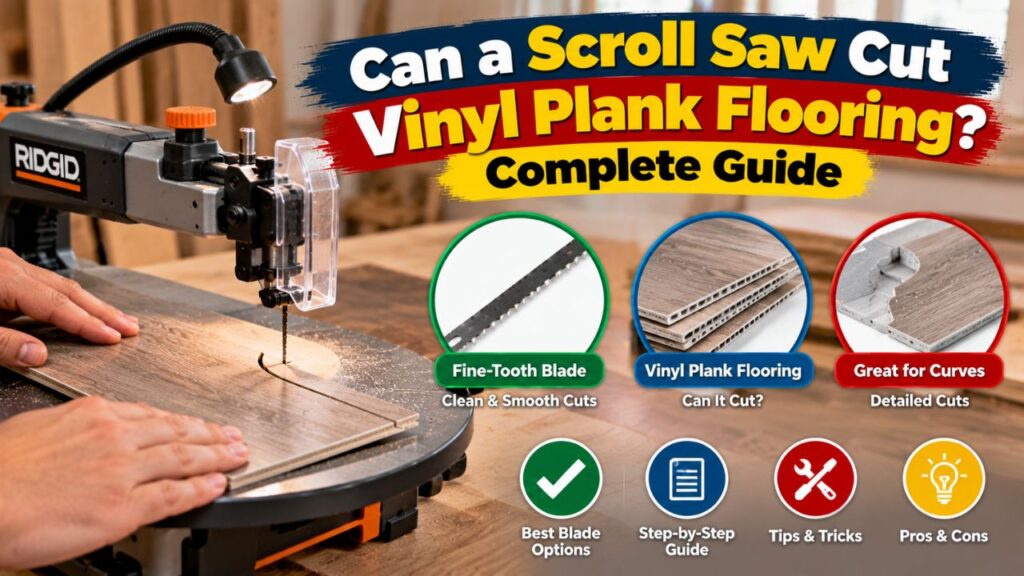
A scroll saw can cut vinyl plank flooring effectively when the cut matches what the machine is designed to do.
Scroll saws excel at controlled curves and intricate shapes.
That makes them useful for flooring pieces that need to fit around an irregular obstacle rather than simply being shortened.
Good examples include cutting a rounded section around a pipe, forming an unusual notch beside a cabinet, cutting a decorative or curved opening, or following the outline of an irregular door-frame area.
The machine becomes less convenient when you simply need to remove 6 inches from the end of a plank.
A scroll saw can make that crosscut, but you must guide the entire plank across a relatively small table while maintaining a straight line. A flooring cutter, miter saw, or score-and-snap method is usually much quicker.
The same issue becomes even more obvious with lengthwise cuts.
Trying to feed a 4- or 5-foot plank through a small scroll-saw table while maintaining an exact parallel cut is unnecessarily difficult.
Where a Scroll Saw Makes the Most Sense
| Flooring Cut | Scroll Saw Suitability | Better Alternative When Appropriate |
| Small curved cut | Excellent | Jigsaw |
| Pipe opening | Very good | Hole saw or jigsaw |
| Vent notch | Very good | Jigsaw |
| L-shaped cut | Good | Jigsaw |
| Short straight crosscut | Acceptable | Flooring cutter or utility knife |
| Long straight crosscut | Acceptable but slow | Miter saw or flooring cutter |
| Full-length rip cut | Poor choice | Circular saw or table saw |
| Flexible LVP score-and-snap cut | Unnecessary | Utility knife |
My recommendation is to treat a scroll saw as a specialty shaping tool during vinyl-floor installation rather than your primary plank-cutting machine.
Key Takeaways:
- A scroll saw works very well for curves, notches, and detailed vinyl-plank cuts.
- It can make straight cuts, but other tools are faster and easier.
- Long rip cuts are one of the least practical uses for a scroll saw.
What Types of Vinyl Plank Flooring Can a Scroll Saw Cut?
“Vinyl plank flooring” covers several different constructions.
Understanding which type you have helps determine both blade choice and cutting method.
Flexible Luxury Vinyl Plank
Traditional flexible LVP is relatively thin and bends noticeably when unsupported.
Many flexible products are designed so they can be scored on the face with a utility knife and snapped along the score line.
A scroll saw can still cut flexible LVP, particularly for shapes that cannot be scored and snapped.
However, using a powered saw for basic straight cuts may create more noise, debris, and setup than necessary.
WPC Vinyl Flooring
WPC stands for wood-plastic composite.
WPC flooring normally has a thicker rigid core and does not behave like thin flexible vinyl.
A scroll saw can cut WPC, especially when making curved and irregular shapes.
Because the plank is thicker, blade selection and feed pressure matter more.
SPC Vinyl Flooring
SPC means stone-plastic composite.
SPC flooring has a dense mineral-filled rigid core and is often considerably harder than flexible LVP.
A scroll saw can cut SPC, but the material can be more demanding on the blade.
It may also produce more fine dust and small chips.
If you need a few curved SPC cuts, a scroll saw can be very effective. If you intend to make dozens of long cuts, I would use a tool better suited to higher-volume flooring work.
Vinyl Plank With Attached Pad
Some vinyl planks have an attached foam or cork underlayment.
The scroll-saw blade normally cuts through this layer along with the plank.
The backing may leave a slightly fuzzy edge depending on its material.
A sharp knife can usually trim loose backing fibers afterward without affecting the structural cut.
What Scroll Saw Blade Should You Use for Vinyl Plank?
Blade selection determines how cleanly the scroll saw cuts.
For most vinyl plank flooring, I recommend a fine-tooth blade capable of cutting plastic, laminate, or fine wood products.
Avoid an extremely coarse blade.
Large widely spaced teeth can grab the wear layer or rigid core and produce a rough edge.
A fine blade keeps multiple teeth engaged in the material, producing a smoother and more controlled cut.
Fine-Tooth Blade
This is the best general choice.
It works well for curved cuts and short straight sections while reducing the chance of aggressive grabbing.
The exact tooth count depends on plank thickness and blade manufacturer, so rather than selecting solely by a universal TPI number, check the blade’s recommended material range.
Reverse-Tooth Blade
A reverse-tooth scroll-saw blade has some lower teeth pointing in the opposite direction.
This design can reduce breakout on the underside of certain materials.
It can be useful when both sides of the plank edge matter, but results depend on the flooring core and blade design.
Test it on scrap before committing to visible cuts.
Skip-Tooth Blade
Skip-tooth blades provide more space between teeth for clearing debris.
They can cut quickly but may leave a rougher edge than a fine standard blade.
For hidden wall-facing cuts, that may be acceptable.
For visible or precision fitting, I generally prefer a finer blade.
Spiral Blade
A spiral scroll-saw blade cuts in multiple directions and lets you turn the workpiece less.
That sounds attractive for complicated flooring shapes, but the kerf is often wider and harder to control accurately.
For most vinyl flooring work, a standard straight blade provides better accuracy.
Can a Scroll Saw Blade Melt Vinyl?
It can if excessive friction develops.
Vinyl contains thermoplastic material, meaning heat can soften it.
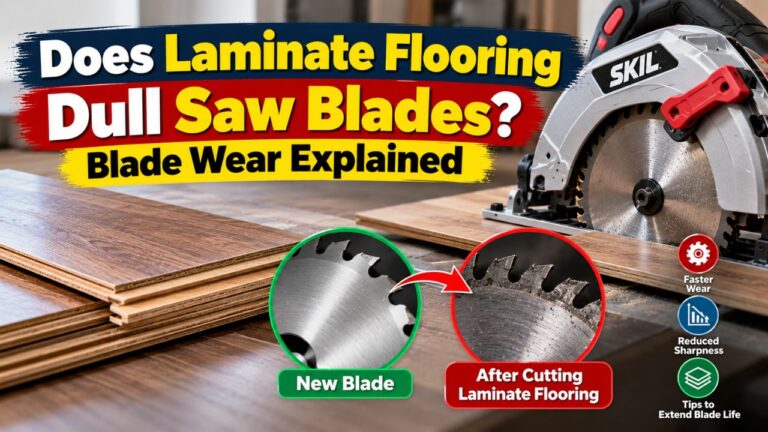
A dull blade that rubs instead of cutting cleanly generates more heat.
Moving the plank extremely slowly can produce the same problem.
You might notice softened material collecting behind the blade, a slightly melted edge, or plastic buildup around the blade teeth.
The solution is not necessarily maximum saw speed.
Instead, focus on a sharp blade and steady feed.
If your scroll saw has variable speed, start in a moderate range and make a test cut.
If the edge begins softening, adjust the feed or speed and try again.
Different vinyl formulations respond differently, so scrap testing is much more useful than assuming one universal speed setting will work for every floor.
Key Takeaways:
- Use a sharp fine-tooth blade intended for plastic, laminate, or similar material.
- Too much friction can soften or melt vinyl along the cut.
- Test the blade and speed on an offcut before cutting an installation plank.
How to Cut Vinyl Plank Flooring With a Scroll Saw
The basic cutting process is simple, but careful layout makes the biggest difference.
1. Confirm the Plank Orientation
Before marking anything, determine how the plank fits into the floor.
Vinyl click-lock planks have specific tongue and groove profiles.
If you cut away the wrong side, you may remove the locking edge needed to connect the plank to the surrounding flooring.
Place the plank near its final position and identify which portion will become waste.
2. Measure the Opening or Obstacle
Measure carefully at more than one point.
Walls, cabinets, door jambs, and other fixed objects are not always perfectly square.
If you are cutting around a vent, measure both the opening itself and its position relative to the plank edges.
If the floor manufacturer requires an expansion gap around fixed objects, include that clearance in your measurements.
3. Transfer the Shape to the Plank
Mark the vinyl with a fine pencil or marker.
For complicated shapes, make a paper or cardboard template first.
Templates are particularly helpful around plumbing pipes and irregular corners because you can test the shape before sacrificing a full flooring plank.
Painter’s tape can also make the cut line easier to see on dark or heavily patterned flooring.
4. Install and Tension the Blade
Fit the appropriate scroll-saw blade according to the saw manufacturer’s instructions.
Make sure the teeth face in the correct direction for your saw.
Apply the specified blade tension.
A blade that is too loose can wander and create a beveled or inaccurate cut.
Do not overtension beyond the tool or blade manufacturer’s recommendations.
5. Set the Hold-Down Foot
Many scroll saws have a hold-down foot that sits close to the workpiece.
Adjust it so it helps control the plank without preventing smooth movement.
Vinyl flooring can sometimes vibrate more than thicker wood, particularly when the plank extends well beyond the saw table.
Supporting the long end reduces that vibration.
6. Start the Saw Before Feeding the Plank
Turn the saw on and let the blade reach operating speed before bringing the cut line into the teeth.
Guide the flooring with both hands positioned well away from the blade.
Do not push aggressively.
Let the teeth perform the cutting.
7. Follow the Line Gradually
For a curved cut, rotate the plank gradually as you feed it.
Trying to make an extremely tight turn faster than the blade can follow may twist the blade or pull the cut outside your line.
For sharp inside corners, approach the corner slowly.
You may need to back out slightly and reorient the plank rather than forcing the blade sideways.
8. Finish and Inspect the Cut
Once the cut is complete, switch the saw off and wait for the blade to stop.
Remove any loose backing material.
Test-fit the plank before locking it permanently into place.
If a small high spot prevents proper fit, mark the interference area and trim only what is necessary.
How to Cut Around a Pipe With a Scroll Saw
Pipes are one of the best reasons to use a scroll saw.
First, measure the pipe diameter.
Then determine the required clearance around the pipe based on your flooring system.
Transfer that opening to the plank.
If the pipe sits near the edge of the plank, you can cut a narrow channel from the plank edge to the circular opening.
The resulting piece can then be installed around the pipe.
Depending on the flooring layout, the small removed section behind the pipe may later be reattached or hidden beneath a pipe collar.
If the pipe passes through the middle of a plank and there is no easy edge access, a drill or hole saw may be more convenient because a conventional scroll saw normally requires an entry path for the blade unless the blade can be disconnected and threaded through a predrilled hole.
Using a Starter Hole
For an enclosed interior opening, drill a starter hole large enough for the scroll-saw blade.
Disconnect the blade according to the saw manufacturer’s procedure, pass it through the hole, reconnect and retension it, then make the internal cut.
This is one of the advantages of a scroll saw for detailed work.
How to Cut a Floor Vent Opening
Another excellent scroll-saw application is a vent or register opening.
Measure the position of the vent relative to the installed flooring.
Transfer the dimensions to the plank.
Check whether the register flange will cover the cut edge.
Drill a starter hole near one corner of the opening.
Thread the scroll-saw blade through and cut along the marked shape.
For a rectangular opening, stop at each corner and rotate the plank carefully rather than pushing the blade sideways.
You do not necessarily need cabinet-grade cut quality if the register covers the edge, but accuracy still matters because an oversized opening may extend beyond the flange.
Can You Make Straight Cuts With a Scroll Saw?
Yes, but this is not where a scroll saw performs best.
The thin blade can wander slightly, particularly when feeding a long plank.
Keeping a perfectly straight line over several feet is much harder than guiding a circular saw along a straightedge or running flooring against a table-saw fence.
For a short notch or several inches of straight cutting, the scroll saw works well.
For repeated plank crosscuts, I would choose another method.
Flexible vinyl can often be scored and snapped.
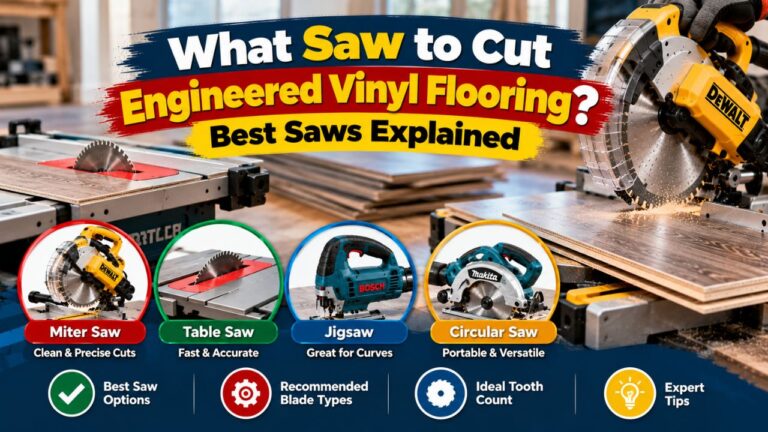
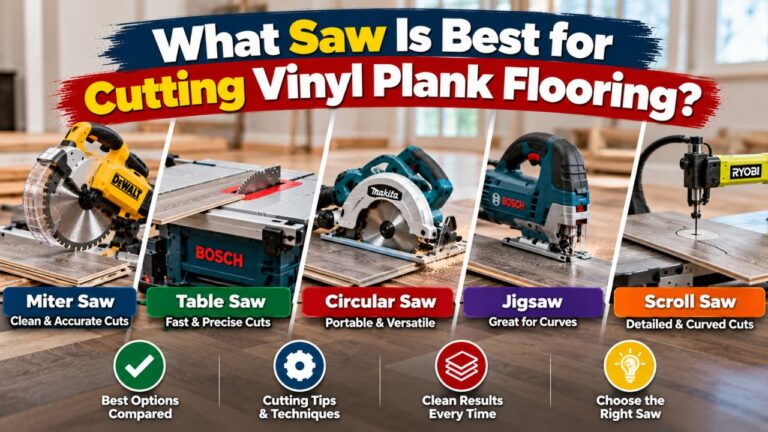
Rigid flooring can be cut with a flooring cutter, miter saw, jigsaw, or circular saw.
Can You Rip Vinyl Plank Lengthwise?
Technically yes, if the saw’s throat depth and table configuration allow the plank to pass through.
Practically, I would avoid it.
A long flooring plank is awkward on a scroll-saw table.
The narrow blade can drift.
You also have to support several feet of material while keeping the rip line perfectly aligned.
A circular saw with a straightedge guide or table saw is much better for this task.
Scroll Saw vs. Jigsaw for Vinyl Plank Flooring
These tools overlap considerably.
Both use narrow reciprocating blades and can make curves.
The difference is how the workpiece and tool move.
With a scroll saw, the machine remains stationary and you move the flooring across the table.
With a jigsaw, the plank remains supported while you move the saw over it.
For large vinyl planks, the jigsaw is often more convenient because you do not need to maneuver the entire plank around a small table.
The scroll saw offers more precise control on small detailed shapes.
Which One Would I Choose?
For a tiny intricate notch, I prefer the scroll saw.
For a long L-shaped cut around a cabinet, I prefer the jigsaw.
For multiple floor-register openings that require precise corners, either can work well.
If I were buying one tool specifically for a flooring project, the jigsaw would usually be more versatile.
If I already owned a scroll saw, I would happily use it for detailed cuts rather than buying another tool unnecessarily.
Scroll Saw vs. Utility Knife
For flexible LVP, the utility knife usually wins on simple cuts.
Score the face along a straightedge and snap the plank according to the manufacturer’s instructions.
This method is quiet, fast, and generates very little debris.
The scroll saw becomes useful when the shape cannot be snapped.
Examples include curves, enclosed holes, and irregular cutouts.
For rigid-core vinyl, a utility knife may only score the wear layer rather than cutting deeply enough to snap the plank cleanly.
In that case, the scroll saw becomes much more useful.
Scroll Saw vs. Circular Saw
These two tools handle very different flooring tasks.
A circular saw is ideal for long, straight cuts.
A scroll saw is ideal for small, curved, and intricate cuts.
Trying to substitute one for the other usually makes the job harder.
If you are ripping the final row along an uneven wall, a circular saw with a guide is usually the better choice.
If you need a small semicircular notch around plumbing, the scroll saw is much easier to control.
For a complete installation, having access to both types of cutting capability is ideal.
Key Takeaways:
- Use a scroll saw for detail work and a circular saw or flooring cutter for long straight cuts.
- A jigsaw is often more convenient than a scroll saw when the flooring plank itself is large or awkward to maneuver.
How to Prevent Chipping and Rough Edges
A sharp blade is the first requirement.
If the decorative surface starts flaking heavily, the blade may be too coarse or dull.
Supporting the plank is equally important.
Long vinyl planks can act like levers and vibrate as they extend beyond the saw table. Place auxiliary support beside the scroll saw so the plank remains approximately level.
Do not press the flooring downward with excessive force.
The goal is simply to prevent vibration while allowing the plank to move smoothly.
If the visible surface chips slightly, try painter’s tape along the cut line or test a finer blade.
A reverse-tooth blade may also improve the underside edge on some materials.
Remember that many perimeter cuts will eventually be hidden by trim, pipe collars, vents, or molding. The cut still needs to fit correctly, but tiny cosmetic imperfections may not matter.
Does SPC Flooring Wear Out Scroll Saw Blades?
SPC can be demanding.
Its rigid mineral-filled core is considerably more abrasive than flexible vinyl.
A small scroll-saw blade has relatively little cutting material compared with the carbide teeth of a circular-saw blade.
As a result, the blade may become dull faster than you expect if you make many SPC cuts.
For one or two detailed openings, this is not a major concern.
For a whole-room project involving dozens of rigid-core cuts, keep spare blades available.
If the cut suddenly requires more pressure or begins wandering, change the blade rather than forcing it.
How to Deal With Vinyl Melting Around the Blade
If the cut edge is melting, stop and let the material and blade cool.
Then inspect the blade.
A clogged or dull blade creates excessive friction.
Clean or replace it if necessary.
Try a slightly different speed if your scroll saw has variable-speed control.
Also increase your feed rate slightly if you have been holding the material nearly stationary against the moving blade.
The ideal setup allows each tooth to remove material rather than repeatedly rubbing the same spot.
Do not spray random lubricants onto vinyl flooring or the blade unless both the saw and flooring manufacturers allow them.
Some chemicals can affect vinyl surfaces, finishes, or adhesives.
Dust and Debris When Scroll-Sawing Vinyl
Flexible vinyl may produce small shavings rather than large quantities of fine dust.
Rigid-core SPC and WPC can create significantly more particulate material.
Keep the saw’s work area clean so debris does not obscure the cut line.
If the scroll saw has a dust blower, position it so it clears the line without blowing debris directly toward you.
Dust extraction is preferable when compatible with the machine.
Wear eye protection.
For dusty rigid-core products, follow the flooring manufacturer’s respiratory-protection recommendations and cut in a well-ventilated or controlled workspace.
Vacuum debris rather than blowing it around the room.
Safety Tips for Cutting Vinyl Plank With a Scroll Saw
A scroll saw is generally easier to control than many larger power saws, but the moving blade can still injure fingers.
Keep both hands to the sides of the cut rather than directly in front of the blade.
Do not push a tiny offcut through with your fingertips.
Use a larger waste section or another safe method to maintain control.
Disconnect the saw from power before changing blades, threading a blade through an internal starter hole, adjusting blade tension, or working around the blade mechanism.
Do not operate with a damaged blade.
If the blade bends, develops missing teeth, or repeatedly slips from its clamps, replace it.
Also support long planks instead of letting them hang several feet beyond the table. A hanging plank can suddenly pivot and pull your hands toward the blade.
Common Mistakes to Avoid
One of the biggest mistakes is using a scroll saw simply because it can technically make every cut.
Use it where it offers an advantage.
There is little benefit in spending several minutes scroll-sawing a perfectly straight crosscut that could have been scored and snapped in seconds.
Another common mistake is using too coarse a blade.
Large teeth can grab the decorative layer and leave a rough edge.
Pushing the plank too aggressively is equally problematic. The thin blade can deflect sideways, making the cut angled through the thickness.
Some installers forget to support the far end of the flooring, which causes vibration and inaccurate cutting.
Finally, do not remove a click-lock edge without first checking how the plank needs to connect to the surrounding floor.
A perfectly shaped plank is useless if the wrong locking profile has been cut away.
When a Scroll Saw Is the Best Tool
A scroll saw becomes particularly useful when accuracy matters more than speed.
Imagine a plank that must wrap around two plumbing penetrations and a narrow cabinet leg.
A circular saw cannot make those curves.
A utility knife cannot easily shape a rigid SPC core.
A jigsaw can do it, but its larger base and handheld movement may make tiny details harder to control.
The scroll saw lets you rotate the plank gradually around a fine blade and follow the marked profile closely.
This is where the tool earns its place in a flooring installation.
When You Should Use Another Tool
Choose another cutting method when the job is primarily straight.
For flexible vinyl crosscuts, use score-and-snap if the flooring instructions allow it.
For repeated rigid-plank crosscuts, a flooring cutter or miter saw is usually faster.
For long rip cuts, use a circular saw with a straightedge guide or a table saw.
For door jamb undercuts, an oscillating multi-tool is often more convenient than bringing the flooring piece to a scroll saw.
For holes around pipes, a hole saw may be faster if the required opening is circular and appropriately sized.
The most efficient flooring installation uses different tools according to the shape of each cut rather than forcing one saw to do everything.
FAQs about Can a Scroll Saw Cut Vinyl Plank Flooring
Can a scroll saw cut luxury vinyl plank?
Yes. It can cut flexible LVP and is particularly useful for curved or irregular shapes. Simple straight cuts may be faster with a utility knife if the flooring supports score-and-snap installation.
Can a scroll saw cut rigid-core vinyl flooring?
Yes. A scroll saw can cut WPC and many SPC planks with an appropriate fine-tooth blade. Dense SPC may wear blades faster than flexible vinyl.
What blade should I use for vinyl plank flooring?
Use a sharp fine-tooth scroll-saw blade suitable for plastic, laminate, or fine composite cutting. Test the blade on scrap before making visible installation cuts.
Will a scroll saw melt vinyl?
It can if the blade becomes hot from excessive friction. Use a sharp blade, steady feed, and suitable speed to reduce heat buildup.
Can a scroll saw cut SPC flooring?
Yes, but SPC is dense and abrasive. Keep spare blades available if you expect to make many cuts.
Can you make straight vinyl-plank cuts with a scroll saw?
Yes, especially short straight cuts. Long straight cuts are harder to maintain accurately and are better handled with a circular saw, table saw, flooring cutter, or utility knife where appropriate.
Can you rip vinyl plank flooring lengthwise with a scroll saw?
Technically, some scroll saws have enough throat capacity, but I do not recommend it. Supporting and guiding a long plank accurately is difficult.
Is a scroll saw or jigsaw better for vinyl flooring?
A scroll saw gives excellent control for small detailed shapes. A jigsaw is usually more versatile for large planks, longer notches, and general flooring installation.
Can I cut a floor vent opening with a scroll saw?
Yes. Drill a starter hole, thread the blade through the opening, reconnect and tension it, and follow the vent outline carefully.
Can a scroll saw cut around plumbing pipes?
Yes. Curved pipe notches are one of the best uses for a scroll saw. Leave any expansion clearance required by the flooring manufacturer.
Should vinyl plank face up or down on a scroll saw?
The best orientation depends on blade type and flooring construction. Make test cuts on an offcut and choose the orientation that leaves the visible surface cleanest.
Why is my vinyl melting while I cut it?
The blade may be dull, clogged, moving too slowly through the plank, or generating too much friction. Stop, inspect the blade, and adjust your speed or feed.
Why does my scroll-saw blade wander in vinyl plank?
Possible causes include insufficient blade tension, a dull blade, excessive feed pressure, an unsuitable blade, or inadequate support of the plank.
Can I cut vinyl flooring indoors with a scroll saw?
Yes, but rigid-core products can create dust and debris. Use appropriate extraction, eye protection, and respiratory precautions according to the flooring and saw manufacturers.
Is a scroll saw better than a flooring cutter?
They perform different jobs. A flooring cutter is faster for repeated straight cuts, while a scroll saw is much better for curves, notches, and detailed openings.
Conclusion
So, can a scroll saw cut vinyl plank flooring? Yes. A scroll saw can be an excellent tool for curved cuts, notches, pipe openings, vent cutouts, and other detailed shapes, especially when working with rigid vinyl flooring that cannot simply be scored and snapped.
Use a sharp fine-tooth blade intended for plastic, laminate, or similar material, support the plank so it does not vibrate, and feed it steadily without forcing the blade. If the vinyl starts melting, the blade is wandering, or the cut requires increasing pressure, stop and check the blade and saw setup.
For flexible luxury vinyl plank, the scroll saw is usually unnecessary for simple straight cuts because a utility knife may be faster. For SPC and WPC flooring, however, a scroll saw can be extremely useful for detailed fitting.
I would not use it for long lengthwise rip cuts or repeated straight crosscuts. A circular saw, table saw, flooring cutter, miter saw, or score-and-snap method will generally be more efficient for those jobs.
The best approach is to use the scroll saw for what it does best: precise, controlled shaping where a straight-cutting flooring tool cannot easily follow the required profile.