What Jigsaw Blade for Laminate Flooring? Best Blade Guide
If you are wondering what jigsaw blade for laminate flooring works best, choose a fine-tooth blade made specifically for laminate or other abrasive finished materials, ideally around 14–20 TPI. For frequent cutting, a carbide-tooth laminate blade is my preferred option because laminate is abrasive and can dull ordinary blades quickly. A quality bi-metal laminate blade is a more affordable alternative and works very well for typical DIY installations.
Tooth direction also matters. A normal up-cut jigsaw blade tends to produce more chipping on the upper face of the plank, so laminate is commonly cut decorative-side down with that type of blade. A reverse-tooth or down-cut blade lets you keep the decorative face up, while specialized counter-directed laminate blades are designed to leave a clean cut on both sides.
Current purpose-built laminate blades illustrate this well. Bosch offers a 14-TPI carbide laminate blade with counter-directed teeth for clean cuts on both surfaces, while its bi-metal laminate blade uses 15 TPI and is intended for laminate up to about 15 mm thick. Diablo also lists a 14-TPI carbide jigsaw blade specifically for laminate and melamine.
The blade is only part of the setup. Reducing orbital action, supporting the flooring properly, controlling feed speed, and choosing the correct face orientation can make the difference between a smooth edge and a badly chipped plank.
In this guide, I’ll explain which jigsaw blade is best for laminate flooring, what TPI to choose, whether carbide or bi-metal is better, which direction the teeth should face, how to minimize chipping, and when a jigsaw is—or is not—the best saw for the cut.
What Jigsaw Blade for Laminate Flooring Is Best?
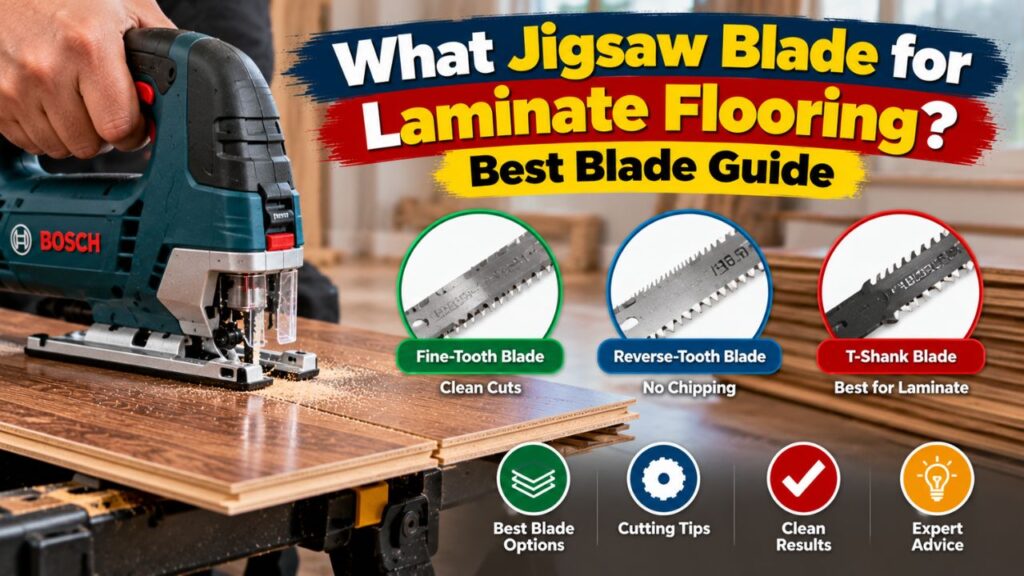
For most laminate flooring, I recommend a fine-tooth T-shank laminate blade in approximately the 14–20 TPI range.
If you are installing one small room, a good bi-metal laminate blade is usually enough. If you are doing several rooms or expect to make many cuts, I would spend more for a carbide blade designed specifically for laminate.
Laminate flooring is harder on cutting edges than ordinary softwood because the wear layer is intentionally abrasion resistant. A general-purpose wood blade may cut it, but it can lose its edge relatively quickly and produce more chipping as it becomes dull.
The ideal blade has several characteristics:
| Feature | Recommended Choice |
| Blade type | Laminate-specific or fine-finish jigsaw blade |
| Tooth count | Around 14–20 TPI for most flooring |
| Blade material | Carbide for longest life; bi-metal for good value |
| Tooth design | Fine ground teeth |
| Shank | T-shank for most modern jigsaws |
| Tooth direction | Up-cut, reverse, or counter-directed depending on face orientation |
| Best use | Notches, curves, irregular cuts, short straight cuts |
The exact flooring thickness should still be checked against the blade manufacturer’s recommended material range. A blade that works beautifully on an 8 mm laminate plank may not be the right choice for a substantially thicker flooring product.
My Recommended Blade Choice
For the cleanest and most durable setup, I would choose a carbide laminate blade with fine teeth and a design intended to control chipping on both sides.
For ordinary DIY use, a 15-TPI bi-metal laminate blade is also an excellent choice.
I would avoid coarse, fast-cutting wood blades unless the cut will be completely hidden and edge quality is unimportant.
Key Takeaways:
- Around 14–20 TPI is a practical range for most laminate flooring jigsaw cuts.
- Carbide lasts longer in abrasive laminate, while bi-metal usually costs less.
- A blade specifically labeled for laminate is preferable to a coarse general-purpose wood blade.
Why Laminate Flooring Needs a Different Jigsaw Blade
Laminate flooring is not simply a thin piece of natural wood.
Most laminate planks combine a dense fiberboard core with a decorative image layer and a hard transparent wear layer. The top surface is specifically engineered to resist scratches and abrasion.
That durable surface can be difficult on saw teeth.
A general wood-cutting blade may initially work well but gradually become dull. As the teeth lose their sharp edges, you may notice more surface chipping, slower cutting, heat, and increased pressure required to move the jigsaw.
Purpose-built laminate blades are designed around those conditions.
For example, Bosch’s dedicated carbide laminate blade uses a carbide tooth strip and 14-TPI fine teeth, while the company’s bi-metal laminate blade combines a high-speed-steel tooth strip with a flexible carbon-steel body. Bosch specifically rates those laminate blades for thin laminate materials up to about 15 mm, depending on the model.
Fine Teeth Reduce Surface Damage
A coarse blade removes larger pieces of material with each tooth.
That is useful when speed is more important than appearance, such as cutting rough framing lumber.
Laminate requires a different priority.
Fine teeth take smaller bites and put less violent force into the brittle decorative surface, reducing the tendency to chip or tear along the edge.
This is why a fast wood blade with large teeth is rarely my first choice for flooring.
What TPI Jigsaw Blade Should You Use for Laminate Flooring?
TPI means teeth per inch.
Higher TPI means more, smaller teeth along the blade. Lower TPI means fewer, larger teeth.
For common laminate flooring, I would start in the 14–20 TPI range.
Dedicated blades around 14–15 TPI are common because they offer a useful balance between clean cutting, chip control, and reasonable cutting speed. Bosch’s current laminate-specific carbide and bi-metal examples use 14 and 15 TPI respectively.
You do not necessarily need the highest TPI blade you can find.
An extremely fine blade can cut slowly and may generate unnecessary heat if you push too hard. What matters more is that the blade is designed for laminate and has sharp, well-ground teeth.
Is 10 TPI Enough?
A 10-TPI blade can physically cut laminate flooring, but I generally would not choose it when clean decorative edges matter.
Ten TPI is relatively coarse compared with laminate-specific fine-cutting blades.
It may be acceptable for a completely hidden rough cut, particularly if the blade is extremely sharp, but I would expect a greater risk of chipping.
Is 14 TPI Good for Laminate?
Yes.
Fourteen TPI is a very sensible choice when the blade itself is designed for laminate. Both carbide laminate blades and other specialty flooring blades are available in this range.
A sharp 14-TPI purpose-built blade can outperform a higher-TPI general-purpose blade because tooth geometry and material matter in addition to tooth count.
Is 20 TPI Better?
A 20-TPI blade can produce a very fine cut, especially on thin material.
However, it is not automatically better than 14 or 15 TPI.
If the blade is not designed for abrasive laminate, it may dull quickly. It can also cut more slowly.
I would prioritize blade purpose and tooth quality before chasing maximum TPI.
Carbide vs Bi-Metal Jigsaw Blades for Laminate
These are the two materials I would consider first.
Carbide Laminate Blades
Carbide is my preferred choice when blade life matters.
Laminate’s abrasive wear surface can wear down conventional tooth materials faster than normal wood. Carbide is much more resistant to that abrasion.
A quality carbide laminate blade can therefore remain sharp through considerably more cutting.
Bosch’s current T128BHM laminate blade, for example, uses a carbide tooth strip, while Diablo offers a dedicated 14-TPI carbide blade categorized specifically for laminate and melamine.
Carbide blades generally cost more, so they make the most sense when you have a large flooring project or want maximum durability.
Bi-Metal Laminate Blades
Bi-metal is the option I would recommend for many DIY users.
A bi-metal blade typically combines harder cutting teeth with a tougher, more flexible blade body.
This gives you good tooth durability without making the entire blade brittle.
Bosch’s 15-TPI laminate blade is an example of this construction and is designed specifically for clean cuts in laminate and hardwood materials up to its stated thickness range.
For installing one bedroom or one living room, a quality bi-metal blade is often the best balance of cost and performance.
High-Carbon Steel Blades
Basic high-carbon-steel wood blades are inexpensive and work well in softer wood.
They can also cut laminate, but I would not make them my first choice.
The abrasive wear layer tends to dull ordinary teeth more quickly, so any initial savings can disappear if you go through several blades during the project.
Key Takeaways:
- Carbide is the best choice for long blade life in abrasive laminate.
- Bi-metal is an excellent balance of durability, flexibility, and price.
- Blade construction matters just as much as TPI.
Should You Use an Up-Cut or Down-Cut Jigsaw Blade?
This is one of the most important choices if you care about chipping.
Most standard jigsaw blades cut on the upstroke.
That means the teeth pull material upward toward the jigsaw shoe.
The surface where the teeth exit tends to experience more splintering.
Standard Up-Cut Blade
With a standard up-cut blade, place the laminate decorative side down if you want the finished face to remain as clean as possible.
The blade enters through the finished side and exits through the back.
This is often convenient for cuts where you can mark the underside accurately.
Reverse-Tooth or Down-Cut Blade
A reverse-tooth blade cuts in the opposite direction.
It is useful when you want to place the flooring decorative side up, because the cutting action can produce a cleaner top face.
This makes it easier to mark directly on the visible surface and follow the line.
However, down-cutting blades tend to push the jigsaw upward away from the workpiece rather than pulling the shoe into it.
Keep the base plate firmly against the laminate and maintain good control.
Counter-Directed Teeth
Some specialty laminate blades use opposing or counter-directed teeth so they can produce a clean edge on both surfaces.
Bosch’s 14-TPI carbide laminate blade uses this approach and is specifically designed for clean cuts on both sides of laminate.
If clean edges on both faces matter, that style is one of the best choices available.
Which Side of Laminate Should Face Up When Using a Jigsaw?
The answer depends on the blade.
For a normal up-cut blade, place the finished decorative side down.
For a reverse or down-cut blade, place the finished decorative side up.
For a specialty counter-directed laminate blade, follow the blade manufacturer’s recommendation because the blade may be engineered to minimize chipping on both sides.
Do not automatically follow advice that says laminate should always face up or always face down. That ignores tooth direction.
The correct orientation is determined by how the blade enters and exits the decorative layer.
Make One Test Cut First
Before cutting a full plank, use an offcut from the same flooring.
Make a short test cut using your intended:
- Blade
- Face orientation
- Jigsaw speed
- Orbital setting
- Feed speed
Look at both sides.
If the visible edge is clean, keep the same setup.
If it chips badly, change one variable before sacrificing another plank.
Should You Use Orbital Action When Cutting Laminate?
Most modern jigsaws have an orbital or pendulum setting.
Orbital action moves the blade slightly forward during the cutting stroke instead of moving it only straight up and down.
This makes wood cutting faster, but it also makes the action more aggressive.
For laminate flooring, I recommend turning orbital action off or using the lowest setting when edge quality matters.
A high orbital setting can increase chipping because the teeth attack the decorative layer more aggressively.
You probably do not need maximum cutting speed for laminate. Planks are relatively thin, so a controlled clean cut is usually more valuable.
When Low Orbital Action May Be Acceptable
For a rough hidden cut where speed matters more than appearance, a low orbital setting may be fine.
But make a test cut.
The relationship between blade, flooring, and saw varies enough that a quick test is better than assuming one setting is universally correct.
What Jigsaw Speed Should You Use?
A moderate to relatively high blade speed generally works well with a sharp fine-tooth blade, but the correct setting depends on the jigsaw and blade.
Do not confuse blade speed with feed pressure.
You can run the motor quickly while still guiding the saw through the material slowly and smoothly.
If you push too hard, the blade can deflect sideways, wander off the line, or heat excessively.
Let the teeth cut at their natural rate.
If the material begins to burn or melt around a synthetic layer, reduce the feed pressure and evaluate the blade condition.
A dull blade usually becomes hotter and requires more force than a sharp one.
How to Cut Laminate Flooring With a Jigsaw Cleanly
Start by measuring the plank carefully and accounting for the expansion gap specified by the flooring manufacturer.
Mark your cut clearly.
Painter’s tape across the cut area can make the line easier to see and may provide some additional support to the decorative surface.
Select the appropriate face orientation based on tooth direction and support the plank close to the cut while leaving enough clearance beneath it for the blade.
Start the jigsaw before the blade contacts the flooring unless your saw manufacturer specifies a different procedure.
Allow it to reach operating speed and then guide it into the cut.
Keep the shoe flat against the plank.
Do not push sideways against the blade to force it back onto the line. A narrow jigsaw blade can deflect, creating a cut that looks straight on top but is angled underneath.
For a tight curve, use a narrower blade designed to turn easily. For a long straight cut, use a wider, stiffer blade if available.
Best Jigsaw Blade for Straight Laminate Cuts
Although jigsaws are best known for curves, they can make straight flooring cuts.
For this job, choose a relatively wide, stiff, fine-tooth laminate blade.
A wider blade resists twisting better than a very narrow scrolling blade.
Keep the orbital action at zero or low and guide the saw steadily.
A straightedge guide can help, but do not force the side of the blade against the guide. The jigsaw’s shoe should follow the guide while the blade cuts naturally.
For a long 4-foot rip cut, however, I would still choose a circular saw, track saw, or table saw over a jigsaw.
The jigsaw is capable of doing it, but maintaining a perfectly straight and square edge is more difficult.
Best Jigsaw Blade for Curves and Notches
This is where a jigsaw is superior to most other flooring saws.
For curves around pipes or irregular wall shapes, choose a blade that is narrow enough to turn without binding while still having fine teeth suitable for laminate.
A wide precision blade that is excellent for straight cutting may resist tight curves.
Conversely, a very narrow scrolling blade can turn easily but may wander more on straight sections.
Match the blade width to the shape you need to cut.
For small pipe penetrations, a hole saw can sometimes create the main circular opening more cleanly, with the jigsaw used only for the connecting cut.
How to Prevent Chipping When Cutting Laminate With a Jigsaw
The first step is using the correct blade.
After that, correct face orientation makes the biggest difference.
Painter’s tape can help support the decorative surface and creates an easy-to-mark area.
You can also lightly score an especially important cut line with a sharp utility knife before sawing, although this is not necessary for most hidden perimeter cuts.
Turn off aggressive orbital action and avoid forcing the jigsaw.
Most importantly, replace the blade when cut quality starts to deteriorate.
Because laminate is abrasive, a blade that produced excellent edges at the start of the room may be noticeably duller later in the installation.
How Long Does a Jigsaw Blade Last on Laminate Flooring?
There is no reliable universal number of cuts.
Blade life depends on the flooring’s wear layer, blade material, tooth geometry, feed pressure, cutting speed, and the length of each cut.
Carbide generally lasts longer than conventional blade materials in abrasive laminate.
Manufacturers specifically promote carbide laminate blades for this reason. Bosch, for example, positions its current carbide laminate blade as a long-life option for abrasive laminate materials.
Instead of counting cuts, monitor performance.
Replace the blade when you notice significantly more chipping, slower cutting, increased heat, wandering, or the need to push harder.
T-Shank vs U-Shank Blades
Most modern jigsaws use T-shank blades.
The T-shaped upper section locks into the saw’s quick-change mechanism.
Older or less common jigsaws may accept U-shank blades.
Before buying a laminate blade, check your jigsaw’s manual or existing blade.
Do not assume that a blade fits simply because the cutting teeth look correct.
Many modern laminate-specific blades are designed as universal-fit T-shank blades for compatible jigsaws. Bosch’s current laminate blade range, for example, includes T-shank models intended for T-shank jigsaws.
Do You Need a Special Laminate Blade?
You do not absolutely need one to make a single hidden cut.
A sharp fine-tooth wood blade can cut laminate.
However, I recommend a laminate-specific blade for a full installation.
The price difference is usually small relative to the cost of the flooring, and the purpose-built blade can provide cleaner edges and better durability.
Using the right blade also makes the jigsaw easier to control because you do not have to force a dull general-purpose blade through the abrasive wear layer.
For several rooms, I would choose carbide.
For a smaller DIY project, a bi-metal laminate blade is usually enough.
Key Takeaways:
- A general fine-tooth blade can work, but a dedicated laminate blade is the better choice.
- Keep orbital action low when clean edges matter.
- Replace the blade when cutting becomes slower, hotter, rougher, or more difficult.
Can You Use a Metal Jigsaw Blade for Laminate Flooring?
A fine-tooth metal-cutting blade can sometimes make a surprisingly clean cut through laminate.
However, I would not select one as my first option.
Metal blades often have extremely fine teeth and can cut slowly in wood-based flooring cores. They may clog or generate more heat than a purpose-built laminate blade.
If you already have one and need a single small cut, test it on scrap.
For a complete flooring installation, use a blade intended for laminate or abrasive wood-based panels.
Can You Use a Wood Jigsaw Blade for Laminate Flooring?
Yes, provided it is a fine-finish blade rather than a coarse fast-cut blade.
A clean-cut hardwood or plywood blade can work adequately.
The disadvantage is durability. Standard wood teeth can become dull more quickly on the hard wear surface.
If your flooring project is small, that may not matter.
For repeated cutting, a carbide or bi-metal laminate-specific blade is the better investment.
Is a Reverse-Tooth Blade Better for Laminate Flooring?
It is better when you want to make the cut with the decorative face up.
That is convenient because you can measure, mark, and watch the visible surface while cutting.
However, reverse-tooth does not automatically mean the blade is more durable or more suitable for laminate.
Look at the complete specification.
A purpose-built laminate blade with standard or counter-directed teeth can outperform a generic reverse-tooth wood blade.
My priority order would be:
Laminate compatibility first, sharp fine teeth second, tooth direction third.
Jigsaw vs Miter Saw for Laminate Flooring
A miter saw is faster and more accurate for repeated straight crosscuts.
A jigsaw is far more flexible for shapes.
If you need to shorten 40 planks to length, I would choose a miter saw.
If you need to fit one plank around a pipe, vent, door casing, or irregular corner, I would choose the jigsaw immediately.
Most complete flooring installations benefit from having both types of capability.
A jigsaw should therefore be considered the detail saw of a laminate-flooring project rather than necessarily the primary saw for every cut.
Jigsaw vs Circular Saw for Laminate Flooring
A circular saw is better for long straight cuts and rip cuts.
The jigsaw is better when the cut changes direction.
If you need to narrow the entire last row along a straight wall, use a circular saw with a guide.
If the wall curves or contains several irregular projections, a jigsaw can follow the scribed line more easily.
For someone buying two inexpensive power saws for a DIY floor, a circular saw plus a jigsaw is one of the most versatile combinations.
Common Mistakes When Choosing a Laminate Jigsaw Blade
The first mistake is choosing the blade purely by tooth count.
TPI matters, but so do tooth geometry and blade material.
A 14-TPI carbide laminate blade may be far more appropriate than a generic 20-TPI blade designed for another material.
Another common mistake is using a coarse “fast wood” blade. It cuts quickly but can leave the decorative surface badly chipped.
Using the wrong face orientation is also common. Standard up-cut and reverse-tooth blades should not necessarily be used with the plank positioned the same way.
Finally, many users blame the blade when excessive orbital action or aggressive feed pressure is actually causing the rough edge.
Start with the right blade and then tune the saw setup.
Safety When Cutting Laminate With a Jigsaw
Disconnect the jigsaw or remove its battery before changing the blade.
Make sure the blade is fully seated and locked before starting the saw.
Support the laminate so it cannot vibrate or pinch the blade.
Keep your hands away from the cutting line and remember that the blade extends below the workpiece where it may not be visible.
Check underneath the plank before cutting.
Eye protection is essential because laminate can produce sharp chips and fine debris.
Repeated cutting also produces fine dust, so use dust extraction where your jigsaw supports it and appropriate respiratory protection as needed.
Do not place the jigsaw down until the blade has stopped moving.
FAQs about What Jigsaw Blade for Laminate Flooring
What TPI jigsaw blade is best for laminate flooring?
For most laminate flooring, approximately 14–20 TPI is a useful range.
Dedicated laminate blades around 14–15 TPI are widely available and provide a good balance between clean cutting and reasonable speed.
Is a 14-TPI blade good for laminate?
Yes.
A sharp 14-TPI blade designed specifically for laminate is an excellent choice. Carbide versions are particularly useful for longer blade life.
Is a 20-TPI blade good for laminate flooring?
Yes, especially for fine cuts in relatively thin flooring.
However, blade material and tooth design are just as important as TPI.
Should I use carbide or bi-metal?
Choose carbide if you want maximum durability and expect to make many cuts.
Choose bi-metal if you want a less expensive blade that still performs well for a typical DIY project.
Which way should the laminate face when using a jigsaw?
With a normal up-cut blade, finished side down generally produces a cleaner visible surface.
With a reverse-tooth blade, finished side up is usually appropriate.
Always test your exact blade first.
What is a reverse-tooth jigsaw blade?
A reverse-tooth blade has teeth oriented to cut primarily on the downstroke rather than the conventional upstroke.
This helps reduce chipping on the upper surface when cutting face up.
Are carbide jigsaw blades worth it for laminate?
Yes, especially for larger projects.
Laminate is abrasive, so the greater wear resistance of carbide can maintain cutting performance longer than standard blade materials.
Can I use a wood blade?
Yes, if it has fine, sharp teeth and produces an acceptable test cut.
A laminate-specific blade is preferable for repeated work because it is better matched to the abrasive surface.
Can I use a metal blade?
A fine metal blade can cut laminate, but it may be unnecessarily slow and is not my preferred option.
A laminate-specific fine-tooth blade provides a better balance of cutting speed and edge quality.
Should I use orbital action?
Use no orbital action or a low setting when clean edges are the priority.
Higher orbital settings cut more aggressively and can increase chipping.
Why does my jigsaw chip laminate?
Common causes include a coarse blade, dull teeth, incorrect face orientation, excessive orbital action, and pushing the jigsaw too quickly.
Start by installing a sharp laminate-specific blade.
Why is my jigsaw blade bending during the cut?
You may be pushing too aggressively, turning too sharply, or using a blade that is too narrow or flexible for the cut.
Let the blade cut at its own pace.
What blade is best for curved laminate cuts?
Use a narrow fine-tooth blade rated for laminate or clean wood cutting.
The narrower body turns more easily through curves than a wide precision blade.
What blade is best for straight laminate cuts?
Use a wider, stiffer fine-tooth laminate blade.
The wider body helps resist wandering and blade deflection.
How many jigsaw blades do I need for one room?
There is no fixed number because laminate abrasiveness and blade construction vary.
Keep at least one spare blade available and replace the active blade when cut quality or speed clearly deteriorates.
Conclusion
If you are asking what jigsaw blade for laminate flooring is best, I recommend a fine-tooth laminate-specific blade around 14–20 TPI, with carbide as the best choice for durability and bi-metal as an excellent lower-cost option.
For frequent flooring work, my preference is a 14- or 15-TPI carbide laminate blade or another purpose-built design that controls chipping on both faces. Current specialty laminate blades in this range are specifically engineered for abrasive laminate materials and clean cuts.
Tooth direction matters just as much as blade material. Use decorative-side down with a conventional up-cut blade, decorative-side up with a reverse-tooth blade, and follow the manufacturer’s orientation guidance for specialized counter-directed designs.
Keep orbital action off or low when edge quality is important, support the plank properly, and guide the jigsaw without forcing it. Replace the blade once cutting becomes noticeably slower or rougher.
For a small DIY project, a quality bi-metal laminate blade is usually all you need. For several rooms or frequent installations, I would spend more for carbide because laminate’s hard wear layer is demanding on cutting edges.
A jigsaw is not the fastest tool for repeated straight flooring crosscuts, but with the right blade it is one of the best tools for notches, curves, vent openings, pipe cutouts, and irregular wall profiles. Match the blade to those demands and you can get clean cuts without sacrificing expensive flooring to unnecessary chipping.