Is a Tenon Saw and Back Saw the Same? Key Differences Explained
If you are wondering is a tenon saw and back saw the same, the answer is not exactly: a tenon saw is a specific type of backsaw, but “backsaw” is a broader category that also includes dovetail saws, carcass saws, sash saws, and similar precision hand saws. Both have a stiff reinforcing back along the top of the blade, but a tenon saw is typically larger and designed for deeper, heavier joinery cuts such as tenon cheeks and shoulders.
The terms are sometimes used interchangeably because tenon saws share the defining feature of all backsaws: a rigid spine that keeps the thin blade from flexing. That reinforced back makes these saws more accurate than many general-purpose hand saws.
However, choosing between a tenon saw and another backsaw depends on what you are cutting. A large tenon may be easier with a tenon saw, while small dovetails and delicate joinery are better suited to a smaller, finer backsaw.
In this guide, I’ll explain the relationship between tenon saws and backsaws, their main differences, how they compare in blade size, tooth pattern, cutting depth, and precision, the different types of backsaws, and which one makes the most sense for common woodworking jobs.
Is a Tenon Saw and Back Saw the Same?
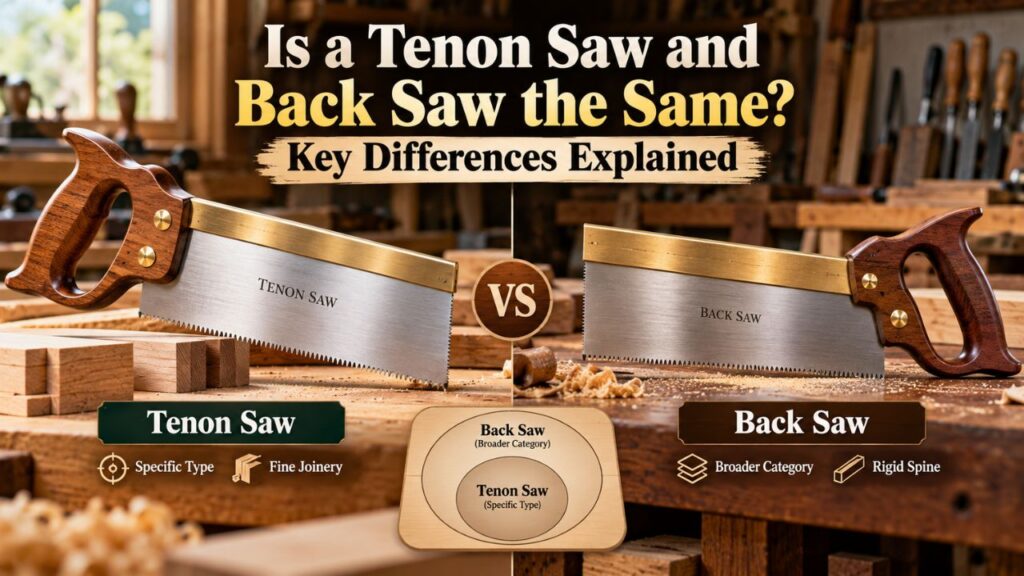
A tenon saw and a backsaw are related, but the names do not mean exactly the same thing.
Backsaw is the general category.
Tenon saw is one particular type within that category.
A backsaw is identified by the rigid spine attached along the upper edge of its blade. This stiff back prevents the relatively thin blade from buckling or flexing excessively while cutting.
A tenon saw uses that same construction, but it is generally sized and toothed for making larger joinery cuts than smaller backsaws.
An easy way to remember the relationship is:
Every tenon saw is a backsaw, but not every backsaw is a tenon saw.
That distinction is similar to saying that every pickup is a truck, but not every truck is a pickup.
Why the Names Get Confused
The confusion is understandable because manufacturers and woodworkers do not always use backsaw terminology in exactly the same way.
In some regions, particularly in general DIY use, “backsaw” may be used loosely for almost any traditional saw with a reinforced spine.
A tenon saw may therefore simply be labeled as a backsaw at a hardware store.
In more specialized woodworking, however, backsaws are divided into several types based on blade length, depth, tooth geometry, and intended joint.
Knowing those differences makes it much easier to choose the right saw.
Key Takeaways:
- A tenon saw belongs to the backsaw family.
- “Backsaw” describes the broader tool category.
- Tenon saws are generally larger and intended for deeper joinery cuts.
- Smaller backsaws may be better for delicate or fine woodworking.
What Is a Backsaw?
A backsaw is a hand saw with a thin blade reinforced along its upper edge by a stiff metal or composite spine.
The stiffening member is often called the back.
Because the blade is supported by this back, manufacturers can make it thinner than many ordinary hand-saw blades without allowing it to flex excessively.
A thinner, rigid blade provides several benefits:
It can create a relatively narrow kerf, follow a layout line precisely, and produce controlled cuts for woodworking joints.
These characteristics make backsaws especially useful for furniture making, cabinetmaking, trim work, and other tasks where accuracy matters more than maximum cutting depth.
What Makes a Backsaw Different From a Regular Hand Saw?
A traditional panel saw or general-purpose hand saw normally has no reinforcing spine.
Its blade can therefore be much deeper from the teeth to the upper edge and can cut through thicker stock without the back limiting depth.
The trade-off is that the blade is more flexible.
A backsaw sacrifices cutting depth in exchange for greater rigidity and control.
That makes it particularly suitable for joinery.
Common Characteristics of Backsaws
Backsaws typically have relatively short blades compared with full-size hand saws, fine to medium-fine teeth, a narrow kerf, and a reinforced top edge.
However, those characteristics vary considerably between different backsaw types.
A dovetail saw, for example, may be much smaller and finer than a tenon saw even though both clearly belong to the same family.
What Is a Tenon Saw?
A tenon saw is a medium-to-large backsaw designed primarily for cutting woodworking joints, particularly mortise-and-tenon joints.
The name comes from the projecting portion of the joint called the tenon.
A tenon has cheeks and shoulders that need to be cut accurately so it fits correctly into a matching mortise.
The tenon saw’s rigid spine helps keep those cuts straight.
Compared with smaller backsaws, a traditional tenon saw usually has a longer and deeper blade, giving it enough capacity for larger furniture components and thicker workpieces.
What Is a Tenon Saw Used For?
Although its name comes from tenon cutting, the saw is useful for many precision woodworking tasks.
You can use one for accurate crosscuts, lap joints, housing-joint work, cutting small stock to length, and other joinery.
The reinforced blade makes it especially useful whenever you need a controlled straight cut rather than rapid removal of material.
Tenon Saw Tooth Configuration
Not every tenon saw uses exactly the same tooth geometry.
Some are filed primarily for crosscutting, while others are filed for ripping along the grain. Certain modern models use hybrid tooth patterns intended to perform reasonably well in both directions.
For traditional tenon cheek cuts, rip-oriented teeth can work especially well because the cut generally follows the grain.
Shoulder cuts cross the grain, so crosscut geometry can be advantageous there.
This is one reason experienced woodworkers sometimes own more than one backsaw rather than expecting a single saw to be ideal for every joinery cut.
Tenon Saw vs. Back Saw: Main Differences
The simplest comparison is that a tenon saw is one specific form of backsaw.
If someone asks you whether a tenon saw differs from “a backsaw,” the real question is usually whether a tenon saw differs from other smaller or general-purpose backsaws.
Here is the practical comparison:
| Feature | Tenon Saw | Backsaw as a General Category |
| Tool category | Specific type | Broad family |
| Reinforced spine | Yes | Yes |
| Typical size | Medium to large | Small to large |
| Cutting depth | Usually deeper than small backsaws | Depends on type |
| Precision | High | High |
| Main use | Tenons and larger joinery | Various precision joints |
| Tooth pattern | Rip, crosscut, or hybrid | Depends on saw type |
| Best for tiny dovetails | Usually not ideal | Dovetail backsaw is better |
| Best for larger tenon cheeks | Excellent | Depends on backsaw |
Blade Length
Tenon saws are usually longer than dovetail saws and many compact backsaws.
A longer blade gives you a more efficient stroke when cutting larger joints.
Typical dimensions vary among manufacturers, but tenon saws commonly occupy the medium-to-large end of the backsaw range.
Blade Depth
The distance between the teeth and the reinforcing spine determines the maximum practical depth of cut.
A tenon saw is generally deeper than a dovetail saw because tenon cheeks can extend farther into a workpiece.
Even so, its cutting depth is still limited by the back.
A conventional panel saw can cut indefinitely deeper because it has no rigid spine blocking the blade.
Tooth Size
Tenon saw teeth are often somewhat coarser than those on a very fine dovetail saw.
That helps the saw remove material efficiently while still maintaining good accuracy.
Fine backsaws may leave an exceptionally smooth kerf but can cut more slowly through larger stock.
Weight
The larger blade and stiff back can make a tenon saw feel heavier than a small dovetail or carcass saw.
That extra mass is not necessarily a disadvantage.
A well-balanced tenon saw can track very smoothly once the kerf is established.
Key Takeaways:
- The main difference is classification: a tenon saw is one kind of backsaw.
- Tenon saws are generally longer, deeper, and heavier than small backsaws.
- Smaller backsaws are often better for delicate joinery.
- Tooth geometry matters just as much as blade size when choosing a saw.
Why Does a Backsaw Have a Reinforced Back?
A thin saw blade can flex during cutting.
That flexibility makes precision work more difficult because the blade can wander away from the layout line.
Adding a stiff spine changes the behavior of the tool.
The back keeps the blade under control, making it easier to guide along a straight kerf.
This allows manufacturers to use a relatively thin saw plate without sacrificing stability.
The Trade-Off: Limited Cutting Depth
The rigid back eventually reaches the top of the workpiece and prevents the teeth from cutting any farther.
This means a backsaw cannot make an infinitely deep cut.
That limitation is usually unimportant for joinery, where the required cuts are relatively shallow.
For thick construction lumber or deep rip cuts, another type of hand saw is generally better.
Types of Backsaws
Understanding the different backsaws makes the tenon saw’s place in the family much clearer.
Tenon Saw
The tenon saw is one of the larger traditional backsaws.
It is well suited to furniture joinery, especially larger tenons and other cuts requiring both accuracy and moderate cutting depth.
If I needed one backsaw for medium-sized general woodworking, a versatile tenon saw would be a strong choice.
Dovetail Saw
A dovetail saw is smaller and usually has fine teeth.
It is intended for delicate joinery such as dovetail joints and other small rip cuts.
Its blade is typically shallower and easier to control in small workpieces.
For cutting narrow dovetail pins and tails, I would choose a dovetail saw over a full-size tenon saw.
Carcass Saw
A carcass saw falls between a small dovetail saw and a larger tenon saw.
It is commonly used for precise crosscuts in furniture components, drawer parts, and cabinet work.
A crosscut-filed carcass saw is especially useful for cutting clean shoulders and trimming small parts to length.
Sash Saw
The sash saw is another traditional backsaw form.
Historically, it was associated with window sash work and occupies a size range between some carcass and larger tenon saws.
Modern terminology varies, so some manufacturers may use overlapping names for similarly sized tools.
Miter Box Saw
Traditional miter saws used with manual miter boxes may also have reinforced backs.
These saws are typically longer because they need enough stroke length to cut molding and trim while guided by the miter box.
The term backsaw therefore describes a much broader family than just the tenon saw.
Tenon Saw vs. Dovetail Saw
This comparison makes the differences within the backsaw family particularly obvious.
A tenon saw is generally larger.
A dovetail saw is generally smaller, lighter, and finer.
The tenon saw is better suited to substantial joinery cuts, while the dovetail saw excels when working with small components where precise control matters more than depth or speed.
For example, if I were cutting a tenon on a furniture rail, I would normally reach for the tenon saw.
If I were cutting fine dovetails for a drawer, I would choose the dovetail saw.
Can You Cut Dovetails With a Tenon Saw?
Yes, technically.
A sharp tenon saw can make many precise cuts.
However, its larger blade may feel unnecessarily cumbersome when working on narrow pins and tails.
A dedicated dovetail saw gives you better visibility and control in that situation.
Tenon Saw vs. Carcass Saw
A carcass saw is another close relative.
The typical carcass saw is shorter and shallower than a tenon saw and is often optimized for crosscuts.
It is particularly useful for cutting small boards to length and making joinery shoulders.
A tenon saw offers more cutting capacity.
For general furniture work, owning both can be useful because one handles larger joinery while the other feels quicker and more maneuverable on small crosscuts.
Which One Is More Versatile?
For small cabinet and furniture components, a carcass saw can be extremely versatile.
For larger joinery, I would favor the tenon saw.
Neither is universally better.
The right tool depends on the scale and grain direction of the cut.
Tenon Saw vs. General Hand Saw
A tenon saw is designed for precision.
A general-purpose hand saw is designed more for speed and cutting capacity.
A typical hand saw has a longer blade and no reinforced back, allowing it to cut through thick boards without depth restrictions.
Its larger teeth can remove material quickly but may leave a rougher cut.
For cutting a 2×4 roughly to length, I would normally choose a general hand saw.
For cutting a tenon shoulder accurately to a knife line, I would choose the tenon saw.
Can a Tenon Saw Replace a Hand Saw?
Not completely.
It can handle many small crosscuts, but the rigid back prevents deep cuts.
Trying to use it for every general lumber-cutting task defeats the design advantage of the tool.
Think of a tenon saw as a precision instrument rather than a universal hand saw.
Is a Tenon Saw a Rip Saw or Crosscut Saw?
It can be either, depending on tooth filing.
This point causes additional confusion because people sometimes assume every tenon saw has one universal tooth configuration.
A saw filed for ripping has teeth shaped to cut primarily along the grain.
A crosscut saw has teeth shaped to sever wood fibers across the grain.
Since tenon construction involves both cheek and shoulder cuts, different tooth configurations can be useful.
Rip-Filed Tenon Saw
A rip-filed tenon saw is particularly effective when cutting the cheeks of a tenon because those cuts often run with the grain.
It can cut efficiently and leave a predictable kerf.
Crosscut Tenon Saw
A crosscut-filed saw works well when cutting shoulders or making general precision crosscuts.
Some woodworkers use a carcass saw for shoulders and reserve the tenon saw for cheeks.
Hybrid Teeth
Some modern backsaws use tooth geometry intended to handle both rip and crosscut work reasonably well.
This can be convenient for beginners who want one saw instead of a collection.
Key Takeaways:
- A tenon saw can be filed for rip, crosscut, or hybrid cutting.
- Rip teeth are useful for tenon cheeks, while crosscut teeth suit shoulders.
- The word “tenon saw” describes the overall tool type, not one universal tooth pattern.
Which Saw Is Better for Beginners?
For a beginner building a basic woodworking kit, I would focus more on the type of work you plan to do than on the label printed on the saw.
If you mainly want to cut medium-sized joints and accurate small boards, a good general-purpose backsaw or tenon saw can be very useful.
If you expect to focus heavily on small dovetails and boxes, a dovetail saw may be easier to control.
If most of your work involves crosscutting small furniture parts, a carcass-style saw may provide the best balance.
If You Only Want One Backsaw
For general woodworking, I would choose a moderately sized backsaw with a tooth pattern suitable for the cuts you make most often.
A traditional large tenon saw may be more saw than necessary for very small projects.
A medium-sized carcass or general-purpose backsaw can sometimes be more versatile for a beginner.
On the other hand, if mortise-and-tenon joinery is a major part of your work, buying an actual tenon saw makes sense.
Can You Use Any Backsaw to Cut a Tenon?
In many cases, yes.
The saw does not suddenly become incapable of cutting a tenon simply because it is called a carcass saw or dovetail saw.
The practical limits are blade depth, blade length, tooth configuration, and the size of the joint.
A small dovetail saw can cut a small tenon.
The problem appears when the joint is deeper than the distance between the teeth and the reinforced spine.
At that point, the saw physically cannot continue the cut.
A larger tenon saw provides the capacity needed for bigger work.
Can You Use a Tenon Saw for Regular Crosscuts?
Yes.
A tenon saw can make very clean, controlled crosscuts in small and medium woodworking stock, particularly when its teeth are suitable for crosscutting.
It works well with a bench hook for trimming pieces to length.
For a large board or deep cut, however, the reinforced back can become a limitation.
I would switch to a panel saw or another suitable hand saw when cutting depth becomes more important than joinery precision.
How to Identify a Tenon Saw
If you have an old backsaw and are not sure whether it is technically a tenon saw, examine its proportions and teeth.
A tenon saw is generally larger than a dovetail saw, with enough blade depth to cut substantial joinery.
It also usually has a traditional closed or open handle sized for a full hand rather than the very compact handle found on some fine joinery saws.
However, there are no universally identical dimensions that separate every tenon saw from every carcass or sash saw.
Manufacturers and woodworking traditions use slightly different classifications.
That is why the practical capabilities of the saw are more important than the name.
Look at These Features
Consider the blade length, usable cutting depth, tooth count, tooth geometry, plate thickness, and handle design.
Those features tell you more about what the saw will do than the product category alone.
Does the Back of a Tenon Saw Do Any Cutting?
No.
The reinforced spine exists to stiffen the blade.
Only the teeth along the lower edge perform the cutting.
The back may be made from brass, steel, or another rigid material depending on the saw design.
Traditional premium saws often use a relatively substantial metal back that also adds useful mass.
That extra weight can help the saw move smoothly through the kerf without requiring heavy downward pressure.
Why Are Tenon Saw Blades So Thin?
A thin blade removes less wood.
That creates a narrow kerf, which is useful for accurate joinery.
However, making a blade thinner normally makes it more flexible.
The rigid back solves that problem by supporting the upper edge of the blade.
This combination—thin plate plus stiff spine—is one of the main reasons backsaws can make such precise cuts.
Are All Backsaws Fine-Tooth Saws?
Most backsaws use relatively fine teeth compared with coarse construction saws, but there is no single tooth count for the entire category.
A large tenon saw intended for efficient ripping may have noticeably coarser teeth than a small dovetail saw.
Tooth size should match the scale and direction of the work.
Very fine teeth can be excellent for thin stock but slow in thick hardwood.
Coarser teeth cut faster but may leave a less refined surface.
Common Mistakes When Choosing Between a Tenon Saw and Back Saw
One of the biggest mistakes is treating “backsaw” as one specific saw size.
It is a category.
If a store lists a product only as a backsaw, check its actual dimensions and tooth pattern before buying it.
Another mistake is assuming that a tenon saw automatically cuts both rip and crosscut joints equally well. Tooth geometry matters.
People also sometimes buy the largest backsaw they can find because they assume larger means more capable.
A large tenon saw offers greater cutting depth, but it can feel cumbersome on delicate work.
Likewise, an extremely small dovetail saw may not have enough blade depth for larger furniture joints.
Choose according to the work rather than the name.
How to Choose the Right Backsaw
Start by identifying the joints you plan to cut most often.
For small dovetails, choose a fine dovetail saw.
For precise crosscuts and furniture components, a carcass saw is an excellent option.
For deeper tenon cheeks and substantial joinery, choose a tenon saw.
Then consider the tooth pattern.
If you mostly cut along the grain, a rip-filed saw may be preferable. If you primarily make precise crosscuts, choose crosscut teeth. A hybrid saw can be a convenient compromise.
Finally, consider comfort.
A saw that fits your hand well and feels balanced is much easier to control than one selected purely from specifications.
Key Takeaways:
- Choose a backsaw based on joint size, cutting depth, and grain direction.
- A large tenon saw is not automatically better for small precision work.
- The tooth pattern and usable blade depth are often more important than the name on the tool.
FAQs about is a tenon saw and back saw the same
Is a tenon saw a backsaw?
Yes. A tenon saw is a specific type of backsaw.
It has the stiff reinforcing spine that defines the backsaw family.
Is every backsaw a tenon saw?
No.
The backsaw category also includes dovetail saws, carcass saws, sash saws, and other precision hand saws.
What is the main difference between a tenon saw and a backsaw?
The main difference is that backsaw is the broad category, while tenon saw refers to one larger type designed primarily for substantial woodworking joints.
Why is it called a backsaw?
It is called a backsaw because a rigid reinforcing back runs along the upper edge of the blade.
This stiffens the thin saw plate and improves cutting accuracy.
Why is it called a tenon saw?
The saw gets its name from its traditional use in cutting tenons for mortise-and-tenon joints.
Is a tenon saw larger than a normal backsaw?
Compared with small backsaws such as dovetail saws, usually yes.
However, backsaws exist in many sizes, so there is no single “normal” backsaw size.
What is the difference between a tenon saw and a dovetail saw?
A tenon saw is generally longer and deeper, making it suitable for larger joinery.
A dovetail saw is smaller and usually finer, providing better control for delicate dovetail work.
What is the difference between a tenon saw and a carcass saw?
A carcass saw is generally smaller and is commonly optimized for accurate crosscuts.
A tenon saw offers greater blade depth for larger joints.
Can you cut dovetails with a tenon saw?
Yes, but a smaller dovetail saw usually provides better control and visibility for fine dovetail joints.
Can you cut tenons with a dovetail saw?
Small tenons can be cut with a dovetail saw if its blade has enough cutting depth.
Larger tenons normally require a deeper saw.
Can I use a tenon saw for normal wood cutting?
Yes.
It works well for accurate small crosscuts and joinery, but its reinforced back limits how deeply it can cut.
Is a tenon saw better than a hand saw?
Neither is universally better.
A tenon saw is better for accurate joinery, while a general hand saw is usually better for quickly cutting larger or thicker boards.
Is a tenon saw a rip saw?
Some tenon saws are rip-filed, particularly those intended for cutting tenon cheeks.
Others are crosscut-filed or use hybrid teeth.
Can a tenon saw cut across the grain?
Yes, especially if it has crosscut or hybrid teeth.
A rip-filed tenon saw can still make certain crosscuts, but a dedicated crosscut backsaw may leave a cleaner result.
What is the metal part on top of a tenon saw?
It is the reinforced back or spine.
It keeps the thin blade stiff and helps the saw track accurately.
Why can’t a tenon saw make a very deep cut?
The reinforced back eventually contacts the workpiece and prevents the blade from moving deeper.
Cutting depth is therefore limited by the distance between the teeth and the spine.
Are backsaws more accurate than regular hand saws?
For precision joinery, generally yes.
Their thin blades and stiff backs make them easier to guide accurately.
General hand saws provide greater cutting depth and may be faster for rough work.
What backsaw should a beginner buy?
For general furniture and small woodworking, a medium backsaw or carcass saw can be very versatile.
If you specifically plan to make larger mortise-and-tenon joints, a tenon saw is a better choice.
Do I need both a tenon saw and a dovetail saw?
Not necessarily when starting.
One well-chosen backsaw can handle many jobs. As your woodworking becomes more specialized, separate saws make it easier to optimize for large tenons and fine dovetails.
Can a tenon saw cut hardwood?
Yes.
A sharp tenon saw can cut both hardwood and softwood. The appropriate tooth geometry makes a significant difference in cutting speed and finish quality.
Conclusion
If you are asking is a tenon saw and back saw the same, the correct answer is that they are related but not identical terms. A tenon saw is a type of backsaw, while backsaw refers to the entire family of precision hand saws that use a rigid spine to reinforce the blade.
Tenon saws are generally among the larger backsaws. Their extra blade length and depth make them well suited to mortise-and-tenon joinery, larger furniture components, and other precise cuts that require more capacity than a small dovetail saw can provide.
Other backsaws are optimized for different work. Dovetail saws are smaller and easier to control for delicate joinery, while carcass saws are particularly useful for precise crosscuts. The best choice therefore depends on the joint, the size of the workpiece, the required cutting depth, and whether you are cutting with or across the grain.
I would not choose a saw based only on whether the package says “tenon saw” or “backsaw.” Look at the blade length, usable depth, tooth pattern, and intended cutting direction.
For larger tenons and general precision joinery, a tenon saw is an excellent tool. For very small dovetails, a smaller backsaw is usually easier to control. If you understand that tenon saw is one member of the wider backsaw family, the terminology—and choosing the right tool—becomes much simpler.