Is a Tenon Saw Rip or Crosscut? Tooth Pattern Explained
If you are asking is a tenon saw rip or crosscut, the traditional answer is that a tenon saw is often filed with rip-cut teeth because one of its main jobs is cutting tenon cheeks along the grain. However, tenon saws can also be made with crosscut or general-purpose teeth, especially modern models intended for broader woodworking tasks. The correct answer therefore depends on the particular saw and the cut you are making.
This distinction causes confusion because “tenon saw” describes the general type and intended use of the backsaw, while “rip” and “crosscut” describe the way its teeth are shaped and sharpened. Two saws can both be called tenon saws while having different tooth geometry.
For traditional mortise-and-tenon joinery, a rip-filed tenon saw makes excellent sense for the cheeks because those cuts generally travel with the grain. The shoulder cuts run across the grain, so a crosscut-filed backsaw—often a carcass saw—is usually cleaner for that part of the joint.
In this guide, I’ll explain why a tenon saw can be rip or crosscut, how the tooth patterns differ, which one is better for tenon cheeks and shoulders, how to identify the teeth on your own saw, and which configuration makes the most sense for beginners.
Is a Tenon Saw Rip or Crosscut Traditionally?
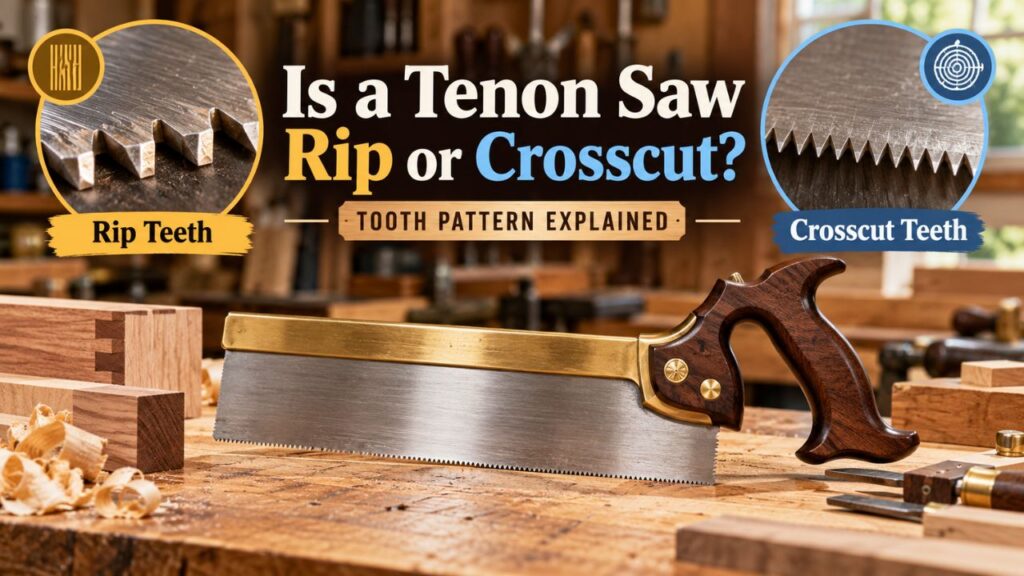
A traditional tenon saw is commonly associated with a rip tooth pattern, particularly when it is designed specifically for cutting the cheeks of tenons.
That makes sense when you consider grain direction.
A tenon consists of a projecting tongue formed on the end of a workpiece. When cutting its cheeks, the saw generally travels from the end of the board downward along the direction of the grain.
That is essentially a ripping operation.
Rip teeth are shaped to cut wood fibers in a way similar to a row of tiny chisels. They work efficiently when the saw moves with the grain.
However, this does not mean that every saw sold as a tenon saw has rip teeth.
Manufacturers may produce tenon saws with crosscut teeth or more versatile tooth geometry because many woodworkers use the saw for general bench work rather than exclusively for cutting tenon cheeks.
That is why the name printed on the saw is not enough to determine the tooth pattern.
The Important Distinction
Think of it this way:
Tenon saw describes the saw category.
Rip or crosscut describes the tooth filing.
A tenon saw normally has a relatively rigid blade reinforced with a metal or composite back. That stiffness helps it produce accurate straight cuts.
Its teeth, however, can be configured differently depending on intended use.
Key Takeaways:
- Traditional tenon saws are often rip-filed because tenon cheeks are cut largely with the grain.
- Modern tenon saws may use rip, crosscut, or general-purpose tooth geometry.
- The saw’s name alone does not always tell you how its teeth are filed.
What Is a Rip-Cut Tenon Saw?
A rip-cut tenon saw has teeth sharpened primarily for cutting parallel to the wood grain.
Instead of slicing fibers from the side, rip teeth tend to remove wood more like tiny chisels.
This makes them efficient for longitudinal cuts.
On a tenon, the classic example is the cheek cut.
Imagine a rectangular piece of wood standing vertically. You mark two lines down from its end to establish the sides of the tenon.
When you saw down those lines, you are mostly cutting along the grain.
That is precisely where a rip-filed backsaw performs well.
Why Rip Teeth Work Well on Tenon Cheeks
A properly sharpened rip saw can remove material quickly while still producing a controlled cut.
The stiff back of a tenon saw reduces blade flex, while the rip teeth make efficient progress through the long-grain cut.
For traditional hand-cut joinery, this combination is highly effective.
You do still need good technique.
A rip saw can wander away from a layout line if you force it. The rigid back helps maintain alignment, but it cannot correct poor body position or an angled starting kerf.
Start carefully and allow the teeth to do the work.
What Is a Crosscut Tenon Saw?
A crosscut-filed tenon saw has teeth designed primarily for cutting across the grain.
Crosscut teeth work more like small knives. They sever wood fibers at the sides of the kerf before removing material between them.
This generally produces a cleaner surface when cutting across grain.
A crosscut tenon saw can therefore be very useful for trimming stock to length, cutting joint shoulders, and performing other precise crosscuts.
Why Some Tenon Saws Are Crosscut
Many woodworkers do not maintain a large collection of specialized hand saws.
A manufacturer may therefore configure a tenon saw as a versatile backsaw capable of performing reasonably well in several situations.
A crosscut tooth pattern can be especially appealing for general furniture and bench work because many everyday operations involve cutting stock across the grain.
It may still make a rip cut.
It will simply not be optimized for ripping in the same way as a dedicated rip-filed saw.
Rip Teeth vs. Crosscut Teeth
Understanding the difference becomes easier when you focus on what happens to the wood fibers.
| Feature | Rip Teeth | Crosscut Teeth |
| Best grain direction | Along the grain | Across the grain |
| Cutting action | Chisel-like | Knife-like |
| Traditional tenon cheek cuts | Excellent | Usable but less specialized |
| Tenon shoulder cuts | Usable | Excellent |
| Crosscut surface quality | Usually rougher | Usually cleaner |
| Rip-cut efficiency | Higher | Lower |
| General-purpose use | Good with practice | Good for many bench cuts |
Neither design is universally better.
The appropriate tooth geometry depends on what you want the saw to do.
A dedicated furniture maker who regularly hand-cuts mortise-and-tenon joints may prefer separate saws for different operations.
A beginner may prefer one well-made backsaw that performs acceptably in several directions.
Why Tenon Cheeks Are Usually Rip Cuts
This is the key reason tenon saws are frequently associated with rip teeth.
The cheeks are the large flat sides of the projecting tenon.
To create them by hand, you normally start at the end grain and saw down toward the shoulder line.
Your saw is traveling roughly parallel to the length of the wood fibers.
That makes it a rip cut.
A rip-filed tenon saw can remove those fibers efficiently while the reinforced back keeps the saw plate stiff.
Cutting a Tenon Cheek Correctly
After laying out the tenon, place the workpiece securely in a vise.
Start at one upper corner and create a shallow kerf on the waste side of your layout line.
Rather than immediately trying to saw the entire width of the tenon perfectly vertically, many woodworkers establish the cut gradually while watching both the face and end-grain layout lines.
Once the kerf is tracking correctly, continue downward toward the shoulder.
Stop at the shoulder line.
Do not deliberately cut below it simply to make waste removal easier. Overcutting can leave visible gaps or weaken the finished joint.
Which Side of the Line Should You Saw?
Stay on the waste side.
Your layout line represents the final dimension.
The saw kerf removes material, so centering the blade directly on the line can make the tenon smaller than intended.
Leaving the line intact gives you material that can be refined afterward if necessary.
Why Tenon Shoulders Are Crosscuts
The shoulder of a tenon runs across the workpiece.
When you saw that shoulder, you are cutting across the grain rather than following it.
That makes it a crosscut operation.
A crosscut-filed saw generally produces a cleaner shoulder because the tooth geometry severs the fibers effectively.
This is why traditional hand-tool kits often separate the tasks.
You might use a rip-filed tenon saw for the cheeks and a finer crosscut backsaw for the shoulders.
A carcass saw is a common choice.
Does That Mean You Need Two Saws?
Not necessarily.
One good saw can perform both operations, especially for occasional woodworking.
The difference is optimization.
A rip-filed saw may leave a slightly rougher crosscut shoulder but still complete the job.
A crosscut saw can cut the cheeks but may work more slowly with the grain.
For a beginner building only a few joints, technique matters more than owning a separate saw for every operation.
Key Takeaways:
- Tenon cheeks are primarily rip cuts because the saw moves with the grain.
- Tenon shoulders are crosscuts because they run across the grain.
- Separate rip and crosscut backsaws offer the best specialization, but one versatile saw can still handle both operations.
Is a Carcass Saw the Same as a Tenon Saw?
No, although both are backsaws and their sizes can overlap.
A tenon saw is generally larger and deeper than a typical carcass saw because it needs enough cutting depth for joinery such as tenon cheeks.
A carcass saw is commonly smaller and often crosscut-filed.
It is particularly useful for accurate crosscuts when sizing components and cutting joinery shoulders.
The reinforced back is common to both.
The major practical differences tend to involve blade dimensions, tooth count, tooth filing, and intended work.
When I Would Use Each One
For cutting large tenon cheeks by hand, I would choose a properly sharpened rip-filed tenon saw.
For shoulder cuts and accurate crosscutting of smaller furniture parts, I would generally prefer a crosscut carcass saw.
For a beginner purchasing only one backsaw, the decision depends on the work.
If you mainly want to learn traditional mortise-and-tenon joinery, a tenon saw is the logical first choice.
If you mainly make general small crosscuts and only occasionally cut tenons, a versatile backsaw may be more useful.
How to Tell Whether Your Tenon Saw Is Rip or Crosscut
If you already own a tenon saw, the easiest solution is to check the manufacturer’s specifications.
Look for words such as:
Rip
Crosscut
Rip-filed
Crosscut-filed
Universal
Hybrid
General purpose
If no information is available, inspect the teeth closely.
Looking at Rip Teeth
Rip teeth tend to appear more chisel-like when viewed from the side and front.
The cutting edges are generally shaped to scrape or chisel fibers when traveling along the grain.
The exact geometry varies depending on rake angle, tooth size, and sharpening style.
Looking at Crosscut Teeth
Traditional crosscut teeth are usually sharpened with fleam.
That means the file is held at an angle across the tooth rather than perpendicular to the saw plate.
This creates angled cutting edges capable of slicing fibers.
From above, the teeth can appear more knife-like than simple rip teeth.
Why Visual Identification Can Be Difficult
Fine backsaw teeth are small.
If you are unfamiliar with hand-saw sharpening, distinguishing a rip tooth from a crosscut tooth visually can be surprisingly difficult.
Modern hybrid filings make the distinction even less obvious.
If the saw is still available from the manufacturer, checking its specifications is usually easier than trying to diagnose the filing with the naked eye.
What Is a Hybrid or General-Purpose Tooth Pattern?
Not every saw fits neatly into a pure rip-versus-crosscut category.
Some sawmakers use tooth geometry intended to provide acceptable performance in both directions.
You may see this described as hybrid, universal, or general-purpose filing.
The idea is compromise.
A pure rip tooth can be extremely effective along the grain but less refined across it.
A fine crosscut tooth excels across grain but is less efficient when ripping.
A hybrid pattern attempts to sit somewhere between the two.
For a woodworker who owns only one backsaw, that compromise can be very practical.
Is Hybrid Better for Beginners?
Often, yes.
A beginner is usually better served by developing accurate layout, starting technique, and saw control than worrying excessively about very specialized tooth geometry.
If one versatile backsaw lets you practice crosscuts, tenon cheeks, shoulders, and small joinery tasks, it can be excellent value.
Once you begin doing more hand-tool joinery, you can add dedicated rip and crosscut saws if their advantages become important to you.
Tooth Count Also Matters
Rip versus crosscut is only one part of saw performance.
The number and size of teeth also affect how a tenon saw behaves.
Fine teeth generally produce a smoother cut and are useful for smaller or more delicate work.
Coarser teeth remove material faster and can be more effective in larger stock.
However, a saw that is too coarse for thin material can be difficult to start and may tear the surface.
A saw that is extremely fine for thick stock can cut unnecessarily slowly.
More Teeth Does Not Automatically Mean Better
A very high tooth count may look like a sign of quality, but the correct pitch depends on the work.
You generally want several teeth engaged in the material during the cut.
If the stock is thin and the teeth are very coarse, the saw may catch aggressively.
If the stock is thick and the teeth are extremely fine, chip clearance and cutting speed may suffer.
Choose the entire saw for the scale of your woodworking, not just one specification.
Does a Rip Tenon Saw Leave a Rough Cut?
It can leave a somewhat rougher surface across the grain than a dedicated crosscut saw, but that does not mean rip-filed tenon saws produce poor joinery.
For tenon cheeks, the important considerations are flatness, alignment, and correct dimensions.
The cheek surfaces are hidden inside the mortise once the joint is assembled.
A perfectly polished surface is less important than a properly fitting tenon.
In fact, aggressively polishing or sanding the cheeks after sawing can accidentally make the tenon loose.
For shoulder cuts, surface quality is more visually important because gaps at the shoulder are easy to see.
That is another reason a fine crosscut saw is attractive for shoulders.
Can You Crosscut With a Rip Tenon Saw?
Yes.
A rip-filed tenon saw can cut across the grain.
It simply may not do it as cleanly or efficiently as a saw specifically filed for crosscutting.
For occasional shoulder cuts, this may be completely acceptable.
Use a sharp marking knife to establish the shoulder line, then carefully start the saw on the waste side.
The knife line helps sever fibers at the boundary and can improve the finished shoulder even when the saw itself is rip-filed.
For fine furniture work where shoulder quality is important, a dedicated crosscut backsaw becomes more valuable.
Can You Rip With a Crosscut Tenon Saw?
Yes.
A crosscut saw will still remove material when used along the grain.
However, its tooth geometry is not optimized for the task.
The cut may progress more slowly than with an equivalent rip saw.
That difference becomes more noticeable with longer or deeper tenon cheek cuts.
For one occasional tenon, a crosscut backsaw may be perfectly workable.
For cutting tenons frequently, I would prefer a dedicated rip-filed saw.
Should a Beginner Buy a Rip or Crosscut Tenon Saw?
For someone specifically buying a tenon saw for mortise-and-tenon joinery, I would lean toward a rip-filed model.
That choice matches the operation that most strongly defines the saw: cutting tenon cheeks.
Shoulder cuts can then be made with another fine crosscut backsaw or carefully with the same tenon saw.
However, if you want one saw for general woodworking, a crosscut or hybrid backsaw may offer greater versatility.
The best answer therefore depends on what you are building.
| Main Type of Work | Tooth Pattern I Would Choose |
| Primarily cutting tenon cheeks | Rip |
| General accurate crosscuts | Crosscut |
| Cutting tenon shoulders | Crosscut |
| One backsaw for mixed work | Hybrid/general purpose |
| Traditional hand-cut joinery set | Separate rip and crosscut saws |
You do not need to buy everything at once.
One sharp, well-controlled saw is far more useful than several poorly maintained saws.
Tenon Saw vs. Dovetail Saw Tooth Filing
A dovetail saw provides another useful comparison.
Dovetail joints require cuts that run predominantly with the grain, so traditional dovetail saws are commonly rip-filed.
A tenon saw may also be rip-filed for essentially the same reason: its key joinery cut follows the grain.
The main difference is scale.
Dovetail saws are generally smaller and finer because dovetails are usually more delicate.
Tenon saws are larger and deeper so they can handle substantial tenon cheeks and thicker components.
Both benefit from a rigid back for accurate joinery.
Tenon Saw vs. Panel Saw
A panel saw is normally larger and does not have the stiff metal back found on a tenon saw.
Panel saws can be either rip or crosscut.
A traditional crosscut panel saw is useful for cutting boards to length, while a rip panel saw is designed for cutting along the board.
This comparison reinforces an important point: the physical saw type and tooth filing are separate characteristics.
A panel saw can be rip or crosscut.
A tenon saw can also be rip or crosscut.
The shape of the saw does not automatically dictate one tooth filing.
Key Takeaways:
- You can crosscut with a rip saw and rip with a crosscut saw, but each works best in its intended grain direction.
- For frequent tenon cheek cutting, a rip-filed tenon saw is the more specialized choice.
- A hybrid saw can make sense when you want one backsaw for several types of work.
How to Get Better Results From Either Tooth Pattern
Whichever tenon saw you use, technique has a major effect on accuracy.
Start with clear layout lines.
A marking knife and square provide more precise guidance than a thick pencil line.
Place the saw on the waste side and start with short, gentle strokes.
Once a kerf is established, extend the stroke naturally.
Do not push downward hard.
A sharp backsaw needs surprisingly little pressure.
Watch More Than One Layout Line
When cutting a tenon cheek, do not stare only at the line facing you.
Look at the end grain as well.
The goal is to keep the kerf aligned in two dimensions.
Some woodworkers begin at one corner, establish the line along the face, then gradually lower the saw until the kerf follows both reference lines.
The exact technique can vary, but constant visual feedback matters.
Keep the Saw Sharp
A dull saw makes every technique harder.
It requires more force, starts poorly, and encourages the user to push or twist.
A properly sharpened backsaw should track predictably once the kerf has been established.
If a saw consistently pulls strongly to one side despite good technique, uneven tooth set or sharpening may be contributing to the problem.
Can You Change a Tenon Saw From Crosscut to Rip?
Many traditional saws with resharpenable teeth can be refiled.
A skilled saw sharpener can change tooth geometry during sharpening.
For example, a crosscut saw can sometimes be converted toward a rip filing by reshaping and sharpening the teeth appropriately.
However, this is not simply a matter of making a few strokes with a file.
To do it correctly, the teeth may need to be jointed, reshaped, set, and sharpened consistently.
Hard-point saws are different.
Many modern handsaws use hardened teeth intended to remain sharp for a long time but not to be conventionally resharpened with an ordinary saw file.
If you are unsure which type you have, check the manufacturer’s information before attempting to file the teeth.
Common Misconceptions About Tenon Saw Teeth
One misconception is that every tenon saw is automatically crosscut because it is a fine-toothed backsaw.
Fine teeth do not determine grain direction.
Another misconception is that the word “tenon” guarantees rip filing.
Traditionally that association makes sense, but modern commercial naming is not always so strict.
A manufacturer may use the name tenon saw primarily to describe blade dimensions and intended joinery use.
Another mistake is assuming that a rip saw cannot crosscut at all.
It can.
The distinction is about optimization and cut quality, not whether the saw physically works.
Finally, beginners sometimes focus so much on tooth filing that they overlook sharpening and technique.
A sharp, well-controlled crosscut saw can produce a better tenon than a dull dedicated rip saw.
Safety When Using a Tenon Saw
Hand saws are simple tools, but they still have sharp teeth.
Secure the workpiece in a vise, bench hook, or suitable jig before sawing.
Keep your supporting hand out of the blade path.
Start with light strokes so the teeth do not jump out of the kerf and across your hand.
If a workpiece is too small to hold safely, use a clamp or another workholding method.
Do not attempt to catch falling waste pieces with a hand directly beneath the saw.
Keep the floor and bench area clear so you can maintain a natural stance.
A comfortable body position contributes to accuracy as well as safety.
FAQs about Is a Tenon Saw Rip or Crosscut
Is a tenon saw a rip saw?
A traditional tenon saw is often rip-filed because one of its primary jobs is cutting tenon cheeks along the grain.
However, not every tenon saw uses rip teeth.
Can a tenon saw be crosscut?
Yes. Some tenon saws are crosscut-filed, especially models intended for general bench work or shoulder cutting.
Check the specifications for the particular saw.
What tooth pattern is best for cutting tenon cheeks?
Rip teeth are generally the better choice because tenon cheeks are primarily cut along the grain.
What saw is best for tenon shoulders?
A fine crosscut backsaw, such as a carcass saw, is an excellent choice because shoulder cuts run across the grain.
Can I cut an entire tenon with one saw?
Yes.
A good backsaw can make both cheek and shoulder cuts.
Separate rip and crosscut saws simply optimize the two operations.
Why are rip teeth better for tenon cheeks?
Rip teeth work like small chisels and efficiently remove fibers when the saw travels with the grain.
That matches the direction of most tenon cheek cuts.
Will a crosscut saw cut with the grain?
Yes.
It will cut along the grain, although it may work more slowly than a comparable rip-filed saw.
Will a rip saw cut across the grain?
Yes.
It can crosscut, although the surface may not be as clean as a cut made with a properly sharpened crosscut saw.
Is a dovetail saw rip or crosscut?
Traditional dovetail saws are commonly rip-filed because dovetail cuts largely follow the grain.
Is a carcass saw rip or crosscut?
Carcass saws are commonly crosscut-filed and are particularly useful for precise crosscuts and joinery shoulders.
How do I know whether my tenon saw is rip or crosscut?
Check the manufacturer’s specifications first.
If that information is unavailable, an experienced woodworker or saw sharpener can often identify the filing by inspecting the tooth geometry.
Are all modern tenon saws rip-filed?
No.
Modern models may use rip, crosscut, hybrid, or general-purpose tooth patterns.
What is a hybrid tenon saw?
A hybrid filing is designed to perform reasonably well both along and across the grain.
It can be a practical option for someone who wants one backsaw for mixed woodworking.
Should beginners buy a rip tenon saw?
If the main goal is learning traditional mortise-and-tenon joinery, a rip-filed tenon saw is a sensible choice.
For broader woodworking, a hybrid or versatile backsaw may be more practical.
Is tooth count more important than rip vs. crosscut filing?
Both matter.
Filing determines how the teeth interact with grain direction, while tooth count affects cutting speed, smoothness, and how well the saw works in different stock thicknesses.
Conclusion
Is a tenon saw rip or crosscut? Traditionally, a tenon saw is often rip-filed because its defining job—cutting tenon cheeks—requires sawing predominantly along the grain. However, a tenon saw can also be crosscut-filed or use a hybrid tooth pattern, so the saw’s name alone does not guarantee one particular filing.
For classic mortise-and-tenon work, I would choose a rip-filed tenon saw for cutting the cheeks. Its chisel-like tooth action is well suited to the grain direction and makes longer cheek cuts efficient.
For cutting tenon shoulders, a fine crosscut backsaw is generally the better specialized tool because the shoulder runs across the grain. A carcass saw is a common choice.
If you are a beginner and do not want to purchase several hand saws, there is nothing wrong with using one versatile backsaw for both operations. A sharp crosscut or hybrid saw can still cut tenon cheeks, and a rip-filed tenon saw can still make shoulder cuts.
The practical bottom line is to choose the tooth pattern based on your main type of work: rip for frequent tenon cheeks, crosscut for frequent across-grain work, and hybrid when you want one saw to handle a mixture of both.