Why Are Circular Saw Blades on the Right? 7 Reasons Explained
If you have ever used a traditional circular saw, you may have noticed that the blade is positioned on the right side of the tool when you hold it in the normal cutting position. This is a common design, but it raises an interesting question: why is the blade on the right instead of the left?
The answer is not simply that circular saws have to be designed this way. Manufacturers can and do build circular saws with the blade on the left. The position is largely influenced by the motor layout, gearing, tool balance, ergonomics, blade visibility, and traditional circular saw design.
Understanding the difference between right-blade and left-blade saws can also help you decide which configuration is more comfortable for your work.
Why Are Circular Saw Blades on the Right?
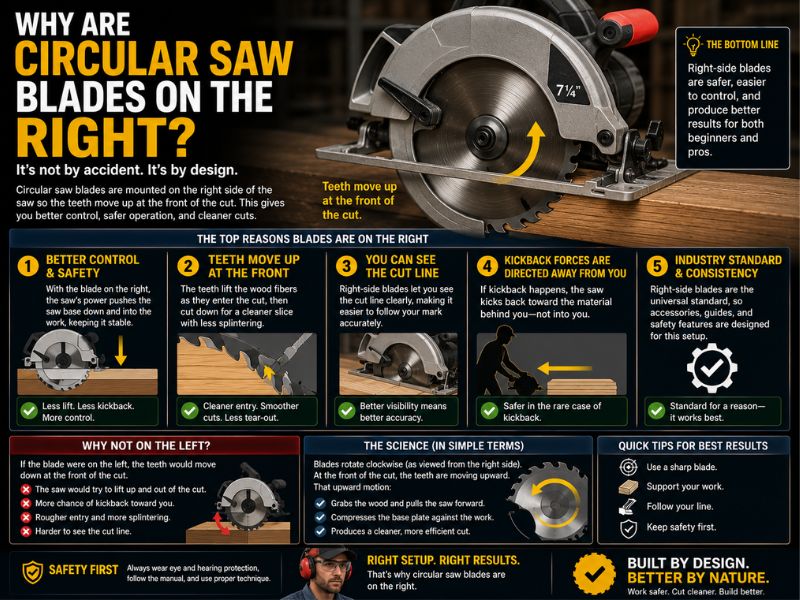
Many traditional circular saws have the blade on the right because of the way the motor and mechanical components are arranged inside the tool.
The motor, arbor, blade, base plate, blade guard, and other components must fit together in a compact housing. A right-side blade configuration became a practical and familiar arrangement for many conventional circular saw designs.
Other factors include:
- Motor and gearbox placement
- Tool balance
- Operator ergonomics
- Manufacturing tradition
- Blade guard design
- Cutting visibility
- Familiarity among users
There is no rule requiring all circular saw blades to be on the right.
1. Motor Placement Affects Blade Position
The motor is one of the largest components inside a circular saw.
Manufacturers need to position the motor, arbor, gearing, blade, and protective components in a way that keeps the tool compact and functional.
On many conventional circular saws, this mechanical arrangement naturally results in the blade being positioned on the right side of the tool.
The exact layout varies between saws. Some use a direct-drive arrangement, while others use gearing to transfer power from the motor to the blade.
Therefore, blade position is partly a consequence of the tool’s mechanical design.
2. Right-Blade Designs Have a Long History
Another major reason is simply tradition.
Right-blade circular saws have been common for decades. As manufacturers developed newer models, they continued using familiar designs that customers already knew how to operate.
This created a strong convention in the power-tool industry.
Even though alternative designs are available today, the traditional right-blade configuration remains extremely common.
3. Blade Position Affects Tool Balance
A circular saw needs to be reasonably balanced so the operator can guide it smoothly through the material.
The position of the motor and blade affects how the tool’s weight is distributed.
Depending on the design, placing the blade on the right can provide a practical balance between the motor, cutting assembly, and operator’s grip.
However, this does not mean every right-blade saw is better balanced than every left-blade saw.
Tool weight and balance depend on the complete design.
4. Blade Visibility Is Different
One of the most noticeable differences between right- and left-blade circular saws is cut-line visibility.
When using a traditional right-blade saw, the motor housing may sit between the operator and the blade.
For some right-handed users, this can make it slightly more difficult to see the blade and the exact cutting line.
This is one reason left-blade circular saws have become popular.
5. Left-Blade Saws Can Improve Visibility for Right-Handed Users
A left-blade circular saw places the blade closer to the operator’s natural line of sight when the saw is held with the right hand.
This can make it easier to monitor:
- Blade position
- Cut line
- Material edge
- Cutting progress
For jobs involving long straight cuts, this improved visibility can be particularly useful.
However, whether the difference is significant depends on the specific saw and the user’s technique.
6. Blade Position Affects Ergonomics and Handling
Changing the blade side also changes the overall feel of the saw.
A right-blade and left-blade saw can have different:
- Weight distribution
- Grip position
- Balance
- Line-of-sight characteristics
- Handling feel
Some users find right-blade saws more natural because they are familiar with them.
Others prefer left-blade models because the blade is easier to see.
Neither configuration is automatically better for everyone.
7. Manufacturing Tradition Helps Explain the Design
Once a particular configuration becomes common, manufacturers have an incentive to continue producing it.
Users become familiar with the controls, blade changes, guards, and general operation.
Manufacturers can also refine existing designs rather than completely redesigning the tool.
This combination of engineering, user familiarity, and manufacturing history helped make right-blade circular saws a standard configuration.
Are All Circular Saw Blades on the Right?
No.
There are two common configurations:
- Right-blade circular saws
- Left-blade circular saws
The terms refer to which side of the tool the blade is located on when the saw is held in its normal operating position.
Left-blade models are particularly popular among some right-handed users because they can provide a clearer view of the cutting area.
Right-Blade vs. Left-Blade Circular Saws
| Feature | Right-Blade | Left-Blade |
| Blade position | Right side | Left side |
| Traditional design | Very common | Less traditional |
| Cut-line visibility | May be less direct for some users | Often easier for right-handed users |
| Balance | Depends on model | Depends on model |
| Handling | User-dependent | User-dependent |
| Safety | Can be equally safe | Can be equally safe |
The table shows why there is no universal winner.
Are Right-Blade Circular Saws Better?
Not necessarily.
Blade position alone does not determine the quality or performance of a circular saw.
When choosing a saw, consider:
- Motor power
- Cutting depth
- Blade diameter
- Weight
- Ergonomics
- Base-plate stability
- Bevel adjustment
- Blade guard
- Visibility
- Overall build quality
A well-designed right-blade saw can perform extremely well.
Likewise, a left-blade saw is not automatically better simply because its blade is easier to see.
Why Do Some Circular Saws Have the Blade on the Left?
Left-blade designs provide an alternative to the traditional configuration.
For many right-handed users, putting the blade on the left can make the cut line easier to see while the saw is being operated.
This can be useful for:
- Long cuts
- Sheet material
- Framing work
- Precise straight cuts
- Repetitive cutting
The trade-off is that the different blade position can change the saw’s balance and handling.
Does Blade Position Matter for Right-Handed Users?
It can.
Many right-handed users prefer left-blade saws because the blade is more visible from their normal operating position.
However, others prefer right-blade saws because they are accustomed to the configuration and like the way the tool balances.
The most important thing is that you can maintain good control and clearly follow your intended cut.
Does Blade Position Matter for Left-Handed Users?
It can also affect left-handed users, although the ideal configuration depends on the individual’s grip, stance, and preferred cutting technique.
Rather than choosing a saw based solely on the blade side, left-handed users should consider the entire ergonomic design of the tool.
A comfortable grip and clear view of the cutting line are more important than simply choosing one side.
Is One Blade Position Safer Than the Other?
Neither blade position is inherently safe or unsafe.
Both right- and left-blade circular saws can be used safely when operated correctly.
Important safety practices include:
- Keep the blade guard functional
- Use the correct blade
- Secure the workpiece
- Keep both hands in safe positions
- Avoid cutting without a stable stance
- Wait for the blade to stop before setting the saw down
- Follow the manufacturer’s instructions
Never remove or disable the blade guard simply to improve visibility.
Frequently Asked Questions
Why are circular saw blades on the right?
Many traditional circular saws use a right-side blade because of the motor and mechanical layout, historical design conventions, and familiar ergonomics. There is no requirement that the blade must be on the right.
Are all circular saw blades on the right?
No. Left-blade circular saws are also widely available.
Why do some circular saws have the blade on the left?
Left-blade designs can provide better blade and cut-line visibility for many right-handed users. They can also have different balance and handling characteristics.
Are left-blade circular saws better?
Not necessarily. Some users prefer left-blade models for visibility, while others prefer right-blade models for their balance and familiarity.
Are right-blade circular saws safe?
Yes. Right-blade circular saws can be used safely when the blade guard is functioning properly and appropriate cutting practices are followed.
Which is better, left-blade or right-blade circular saw?
Neither is universally better. Consider visibility, balance, ergonomics, cutting habits, and personal preference when choosing between them.
Final Thoughts
So, why are circular saw blades on the right? The main reasons are the traditional design of circular saws, the arrangement of the motor and other internal components, tool balance, and manufacturing history.
However, a blade does not have to be on the right. Left-blade circular saws are also available and can provide better cut-line visibility for many users, particularly right-handed operators.
Ultimately, the blade side is only one factor to consider. A good circular saw should provide comfortable handling, clear visibility, stable cutting, appropriate power, and reliable safety features. Choose the configuration that allows you to control the tool confidently and maintain an accurate cutting line.