Are Any Table Saws Made in Usa: What to Know and Why It Matters
Yes, some table saws are made or assembled in the United States, but the label requires careful reading. SawStop is the clearest current example associated with U.S. production, while many competing saws are designed, assembled, or sold by American companies but manufactured largely overseas.
That distinction matters when a buyer is comparing a cabinet saw, contractor saw, or jobsite model. “Made in USA,” “assembled in USA,” and “American company” describe different things, and a saw may contain imported motors, electronics, castings, switches, or hardware even when final assembly occurs domestically. A rushed purchase can therefore mistake brand identity for product origin.
This article explains which claims deserve attention, why domestic manufacturing is limited, how to verify a specific model, and whether U.S. production should change a buying decision. By the end, you should be able to separate genuine origin information from marketing language, compare the practical tradeoffs, and decide whether a U.S.-made or U.S.-assembled table saw is worth prioritizing for your shop.
What “made in USA” means for a table
For a table saw, country of origin can involve several stages: design, component production, machining, painting, final assembly, testing, and packaging. A manufacturer may perform some of those steps in the United States without producing every major part domestically.
The strongest claim is generally an unqualified “Made in USA” statement. Under Federal Trade Commission guidance, an unqualified claim is intended for products assembled in the United States with all or virtually all significant parts and processing of U.S. origin. The exact legal analysis depends on the product and the wording used, so a casual “built here” statement does not automatically mean every component was made here.
Other phrases are narrower:
- Assembled in USA indicates that final assembly takes place domestically, but important parts may come from other countries.
- Designed in USA describes engineering or product development, not manufacturing location.
- American company identifies ownership or headquarters and says nothing conclusive about where the saw is produced.
- Imported components can be present even in a saw with substantial U.S. manufacturing.
Country-of-origin markings can also differ by model and production period. A company may manufacture one table saw line domestically and source another from Asia, so the brand name alone is not enough evidence.
Which table saw brands have U.S. production?
SawStop is the most prominent name associated with table saw manufacturing in the United States. The company has operated manufacturing and assembly in Oregon, and its products are commonly marketed as made in the USA. However, buyers should still verify the exact model and current product wording because manufacturing arrangements, component sourcing, and labeling can change.
SawStop is best known for its patented blade-brake safety system, which detects electrical contact with skin and rapidly stops the blade. Its lineup has included cabinet saws, contractor saws, jobsite saws, and smaller compact models. A U.S. manufacturing claim does not make every SawStop part domestic, nor does it mean the saw is automatically the best choice for every shop, but it places the brand among the strongest options for buyers seeking domestic production.
Other brands may have a meaningful American presence without offering a fully U.S.-made table saw. Some design products in the United States, support them through domestic offices, or perform final assembly here while sourcing cast iron tables, motors, controls, and other parts internationally.
Historically, companies such as Delta, Powermatic, and several industrial tool makers had stronger U.S. manufacturing connections than their current product lines generally do. Product ownership, factory locations, and sourcing have changed over time. A vintage saw marked with a U.S. city or state should not be used as proof that the brand’s current saws are made there.
There are also specialized domestic manufacturers, custom builders, and companies producing industrial woodworking equipment in the United States. These may make machines for commercial or institutional use rather than selling a widely available consumer table saw. Availability, lead time, replacement parts, and pricing can differ substantially from mainstream retail products.
Why most table saws are imported
Table saw production requires more than a motor and a steel frame. A typical saw includes a cast or fabricated table, trunnions, arbor assembly, motor, belt system, fence, handwheels, electrical controls, guarding, dust-collection components, and packaging strong enough to survive freight handling.
Manufacturing in countries with established power-tool supply chains can reduce costs through high-volume casting, machining, motor production, and component sourcing. Suppliers may already produce parts for multiple brands, allowing a manufacturer to spread tooling and engineering expenses across a large production run.
The economics are particularly difficult for large stationary saws. A cabinet saw is heavy, so transportation is expensive, yet its market is much smaller than the market for portable power tools. Domestic production can raise the purchase price through higher labor, facility, compliance, inventory, and distribution costs.
Imported does not automatically mean poorly made. Many overseas factories produce accurate, durable woodworking machinery, and quality depends on engineering, inspection, materials, assembly standards, and after-sale support. Conversely, a domestic assembly claim does not guarantee perfect alignment, a superior fence, or trouble-free electronics.
How to verify a specific saw’s origin
Start with the manufacturer’s product page and owner’s manual for the exact model number. Look for a clear country-of-origin statement rather than relying on phrases such as “American innovation” or “built for professionals.”
Product packaging, the rating plate, and the compliance label may provide additional information. A sticker that says “Made in China,” “Made in Taiwan,” or another country is direct evidence for that unit, while a general company webpage may describe a broader product family.
When the wording is unclear, contact the manufacturer and ask a precise question: “Where is this exact model manufactured, and where does final assembly occur?” Ask whether the answer applies to the current production version, not an older model with a similar name.
A useful verification checklist includes:
- Record the exact model number and revision, if one is shown.
- Check the product page, manual, carton, and machine label for consistent origin information.
- Distinguish manufacturing from design, ownership, and final assembly.
- Ask what “made in USA” means for the particular model.
- Save the manufacturer’s written response if country of origin is important to the purchase.
Retail listings deserve caution. A seller may copy an old description, combine specifications from several models, or use “USA” in a way that refers to the brand rather than the machine. If a claim affects a government purchasing rule, contract requirement, or business certification, obtain formal documentation instead of relying on a retailer’s summary.
Does U.S. manufacturing mean better quality?
Domestic production can offer practical benefits, but country of origin is only one quality signal. A U.S. facility may provide closer engineering feedback, more direct process control, and easier communication between manufacturing and customer service. It may also support domestic jobs and shorten certain supply chains.
The more important question is how the completed saw performs. Examine the table flatness, fence locking action, trunnion adjustment, arbor runout, dust collection, motor performance, guard design, and availability of replacement parts. A well-built imported saw can outperform a domestically assembled saw with weak alignment or an inconvenient fence.
Service is another major consideration. A table saw is a long-term machine, and parts such as belts, switches, bearings, throat plates, riving knives, and safety electronics may eventually need replacement. A manufacturer with clear parts support and responsive technical service can be more valuable than a vague origin claim.
Also consider the type of work. A professional cabinet shop may prioritize a heavy cast-iron table, quiet induction motor, reliable dust collection, and a robust fence. A remodeling contractor may need portability, quick setup, and compatibility with temporary jobsite power.
A hobbyist may value safety technology, footprint, and warranty support more than domestic content.
Safety matters more than country of origin
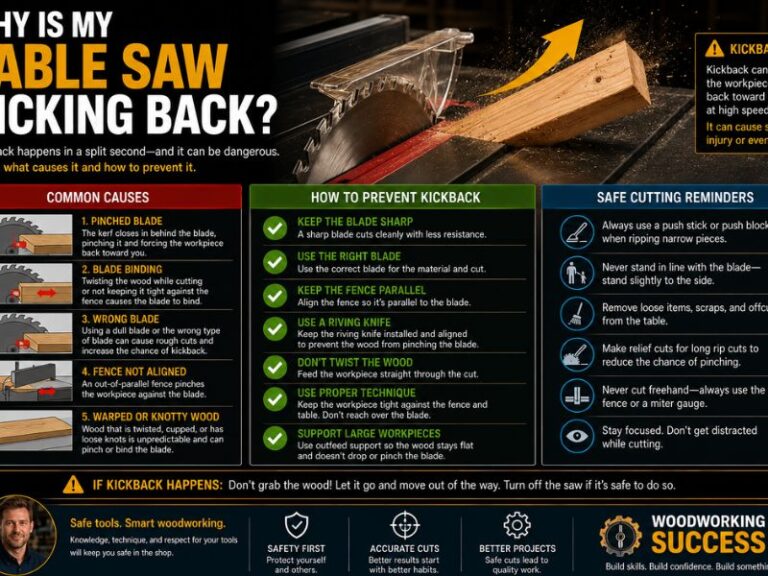
No manufacturing location removes the hazards of a table saw. Kickback, contact with the blade, airborne dust, electrical faults, and unstable workpieces remain risks whether the machine was made in the United States or imported.
Use the manufacturer’s guard, riving knife, or splitter as designed, and keep the blade properly aligned. Disconnect power before changing a blade or making internal adjustments, use a push stick when the work requires one, and support long or heavy stock so it cannot twist or fall.
A reliable saw should have a fence that locks parallel to the blade, a stable base, usable emergency controls, and a guard system that does not encourage unsafe removal. Blade-brake technology can reduce the severity of some blade-contact injuries, but it is not permission to bypass guarding or work carelessly.
Dust collection also matters. Fine wood dust can affect air quality and visibility, so use appropriate extraction and respiratory protection for the material and environment. Follow the manual for electrical connections, extension-cord limits, grounding, and maintenance.
When a U.S.-made saw is worth paying more for
Paying more for domestic production can make sense when origin is part of a business, institutional, or personal purchasing goal. It may also be reasonable if the manufacturer offers strong service, readily available parts, and a design that fits the shop better than lower-priced alternatives.
It is less persuasive when the premium consumes money needed for essential safety equipment, dust collection, a quality blade, proper electrical work, or shop improvements. A safer setup and accurate fence often produce more practical value than a country-of-origin label by itself.
Compare the total ownership cost rather than the sticker price. Include freight, assembly, replacement parts, warranty coverage, service delays, dust collection, mobile bases, electrical requirements, and the cost of correcting alignment problems. A domestic saw may justify its price through durability and support, but that conclusion should come from the complete package.
Common mistakes when comparing origin claims
The first mistake is treating an American brand as an American-made product. Brand ownership and factory location are separate facts, especially in an industry that uses global supply chains.
The second is assuming that “assembled in USA” means all major parts were produced domestically. Assembly can be meaningful, but it is not equivalent to complete domestic manufacturing.
The third is comparing a current saw with a discontinued model. Online forums and older reviews can accurately describe a product’s past production location while being outdated for the saw currently sold.
Finally, some buyers focus so heavily on origin that they overlook fit and safety. Confirm the saw’s electrical requirements, available space, fence capacity, arbor size, blade compatibility, dust port, warranty, and service network before making a final decision.
FAQ about U.S.-made table saws
Are any table saws made in USA?
Yes, some table saws are made or assembled in the United States. SawStop is the best-known current example associated with U.S. production, but the exact claim can vary by model and production period. Verify the model-specific country-of-origin statement before buying.
Are SawStop table saws made in the United States?
SawStop has manufactured and assembled table saws in Oregon and markets its products as made in the USA. That does not necessarily mean every component is domestically produced. Check the current documentation for the precise model because component sourcing and product details can change.
Are American-owned table saw brands made in America?
Not necessarily. An American-owned or American-designed brand may manufacture its saws overseas, use imported major components, or combine domestic assembly with global sourcing. The country-of-origin label for the specific machine is more useful than the company’s headquarters.
Is “assembled in USA” the same as “made in USA”?
No. “Assembled in USA” indicates that final assembly occurs in the United States, while “made in USA” is a broader origin claim subject to applicable labeling standards. An assembled saw can contain imported motors, castings, electronics, and hardware.
Are imported table saws lower quality than U.S.-made saws?
Imported table saws are not automatically lower quality. Accuracy, materials, inspection, design, service, and parts support matter more than location alone. Evaluate the fence, trunnions, table, motor, safety system, warranty, and real-world support.
How can I confirm where a table saw was manufactured?
Check the exact model’s manual, machine label, packaging, and manufacturer statement. If those sources conflict, contact the manufacturer directly and ask where that model is manufactured and where final assembly occurs. Keep written confirmation if the origin is important for purchasing or compliance.
Conclusion: Verify the model before you buy
Yes, U.S.-made or U.S.-assembled table saws are available, with SawStop being the clearest mainstream example, but domestic production is not universal across a brand or product line. The major limitation is that global components and changing manufacturing arrangements can make broad origin claims incomplete.
Before purchasing, verify the exact model’s origin, then compare fence accuracy, safety features, parts support, warranty, dust collection, and total cost. Choose the saw that gives the best combination of verified manufacturing information, reliable service, and safe performance for the work it must do.