Why Are Table Saws So Dangerous — Real Risks and Safer Next Steps
Table saws are so dangerous because they combine a fast, exposed cutting blade with powerful material movement and very little room for a mistake. The most serious hazards are blade contact and kickback, which can cause severe injury in a fraction of a second.
A table saw can look stable and predictable because the workpiece rests on a broad table, but that appearance is misleading. The blade removes material while spinning at high speed, and the portion rising above the table can grab wood, launch it, or pull a hand toward the teeth. A dull blade, poor alignment, a missing guard, or a rushed cut can turn an ordinary operation into a dangerous one.
This article explains why table saw injuries happen, which conditions make a cut especially hazardous, and how guards, push devices, setup checks, and operator positioning reduce risk. You will learn how to recognize kickback conditions, when a cut should not be made, what to do after a jam or near miss, and when a damaged or poorly adjusted saw needs professional attention.
The Main Reasons Table Saws Cause Serious Injuries
A table saw concentrates several hazards in one tool. The operator controls the stock by hand, but the machine controls the blade’s speed, cutting force, and ability to carry a workpiece forward. That imbalance leaves little time to react when something goes wrong.
The blade is exposed above the table
The cutting teeth must extend above the table to cut wood, so an active hazard is always close to the operator’s hands. Unlike a handheld circular saw, the workpiece usually moves toward a fixed blade, which can make the cutting action feel controlled even when a hand is too close.
Contact can happen during a normal cut, while clearing a small offcut, or when reaching across the blade to retrieve material. The danger is not limited to the front of the blade. The sides, rear teeth, and underside area below the table can also injure someone during setup, adjustment, or maintenance.
Kickback can launch the workpiece
Kickback occurs when the workpiece is lifted, pinched, or caught by the rear portion of the blade and thrown back toward the operator. The board may travel quickly and carry enough force to cause blunt-force injuries, while the operator’s instinctive reaction can move a hand into the blade.
Kickback is more likely when a board twists into the blade, the kerf closes behind the cut, the fence is misaligned, or the operator pushes the stock sideways. Wet, warped, bowed, or internally stressed lumber can behave unpredictably even when the feed appears steady.
Cutting forces are difficult to see
The blade’s teeth create pressure that is not always obvious from the operator’s position. A board can bind without making a dramatic sound, then release suddenly. A narrow strip can also rotate between the blade and fence, especially if it is not supported and controlled through the cut.
Because the problem may develop behind the blade or below the workpiece, the operator may not notice it until the board shifts. This is why forcing stock through resistance is dangerous: added pressure does not correct the underlying alignment or binding problem.
The machine can continue moving after a mistake
A table saw blade does not stop simply because the operator loses control of the wood. The motor and arbor continue turning until power is removed and the blade comes to a complete stop. A person who reaches for a falling board or tries to pull back a stuck workpiece can enter the danger zone before the machine has stopped.
Even after switching off the saw, never assume the blade is safe immediately. Keep hands away until the teeth have stopped, then disconnect power before removing a jam, changing a blade, or reaching below the table.
What Makes a Table Saw Cut Especially Risky?
The tool itself is only part of the risk. The type of cut, material, setup, and operator position determine how much control is available and how likely the stock is to bind or move unexpectedly.
Using the wrong setup for the cut
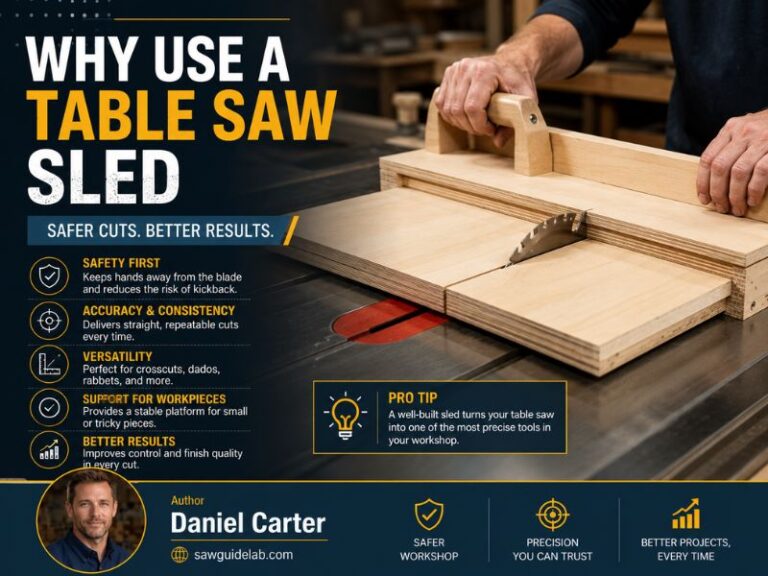
The rip fence is intended to guide material along its length, while a miter gauge or sled supports crosscutting. Using the fence as a crosscut stop can trap the offcut between the blade and fence. That small piece may bind or be thrown, particularly when it cannot move freely away from the blade.
When a board is wider or longer than the table can support, its weight can pull the stock out of alignment. Unstable support behind, beside, or in front of the saw increases the chance of twisting. Support surfaces should be level with the table and positioned so they do not interfere with the cut or the operator’s movement.
Working with warped, damaged, or unstable stock
A board that rocks on the table cannot be guided consistently. Bowed edges, cup, knots, splits, and internal tension can cause the cut to close or the workpiece to rotate. Small pieces can be especially difficult because they leave less room for a safe hand position and may not remain flat.
Inspect the stock before cutting. If it cannot lie reasonably flat against the table or fence, correct the material with an appropriate operation first or choose another method that provides better control.
Standing directly behind the blade
The area in line with the blade is the primary kickback path. Standing there exposes the torso and face to a board that may be expelled from the rear of the saw. A safer stance is slightly to the side, with balanced footing and enough space to move away without stepping over material or cords.
Positioning is not a substitute for proper setup, but it reduces exposure if the workpiece is suddenly thrown. Keep bystanders out of the front and rear paths as well; a person who is not operating the saw may not recognize the danger zone.
Reaching over or behind the blade
Reaching for an offcut, adjusting a guide during operation, or trying to retrieve a board can place a hand near moving teeth. The risk is greater when the operator is focused on saving material or finishing a cut rather than stopping the machine.
If the stock shifts, stalls, or falls, release pressure, turn off the saw, and wait for a complete stop. Do not try to catch a falling workpiece while the blade is turning.
How Guards and Safety Devices Reduce the Danger
A table saw’s safety equipment is designed to prevent contact and control the workpiece, not to make careless operation safe. The blade guard, riving knife or splitter, and anti-kickback components each address different parts of the hazard.
Blade guard
A properly installed guard covers the upper portion of the blade when the workpiece is not passing through it. It should lift smoothly over stock and return to its protective position rather than being tied up, removed, or held open.
Some cuts or accessories may require a different guard arrangement, but removing protection without an appropriate, manufacturer-approved setup increases exposure. A guard that sticks, sits crooked, or fails to lower should be corrected before operating the saw.
Riving knife or splitter
A riving knife keeps the kerf from closing onto the rear teeth after a cut begins. Because it follows the blade, it helps maintain separation between the two sides of the workpiece and reduces one common cause of kickback.
The knife must match the blade and be aligned correctly. If it is bent, too high or low for the intended operation, or positioned out of line, it may fail to provide the expected protection or may interfere with the stock.
Anti-kickback pawls
Anti-kickback pawls are toothed devices intended to catch stock if it begins moving backward. They can add protection during suitable operations, but they do not eliminate the need for correct feeding, alignment, and operator positioning.
Inspect safety devices before use. If a component is missing, damaged, incompatible, or difficult to install correctly, stop and consult the saw’s instructions or a qualified service professional rather than improvising a replacement.
Safer Table Saw Practices Before and During a Cut
Safe operation starts before the motor is switched on. A short inspection can identify problems that would otherwise appear while the blade is moving.
- Confirm that the blade is appropriate for the material and securely installed.
- Check that the blade, fence, miter gauge, riving knife, and guard are aligned and firmly secured.
- Make sure the blade rises only as high as needed for the cut, following the equipment instructions.
- Remove loose clothing, jewelry, and anything that could catch on the machine.
- Use appropriate eye and hearing protection, and keep the work area well lit and free of clutter.
- Plan where the workpiece and offcut will go before starting the cut.
- Use a push stick, push block, or other suitable device when hands would otherwise approach the blade.
- Keep both hands in controlled positions and away from the blade’s path.
- Feed the material steadily without forcing it or pulling it backward through a moving blade.
- Stand out of the direct kickback line and keep other people away from the saw.
A push stick is not a magic shield. It should give the operator control of the stock while keeping the hand away from the blade, but it cannot compensate for a crooked fence, an unstable board, or an unsuitable cut.
For wide or long workpieces, arrange outfeed and side support before beginning. Do not rely on another person to catch the material unless the process is specifically planned and both people understand their roles; an unexpected grab can pull the stock sideways.
What to Do When a Cut Binds or Kickback Starts
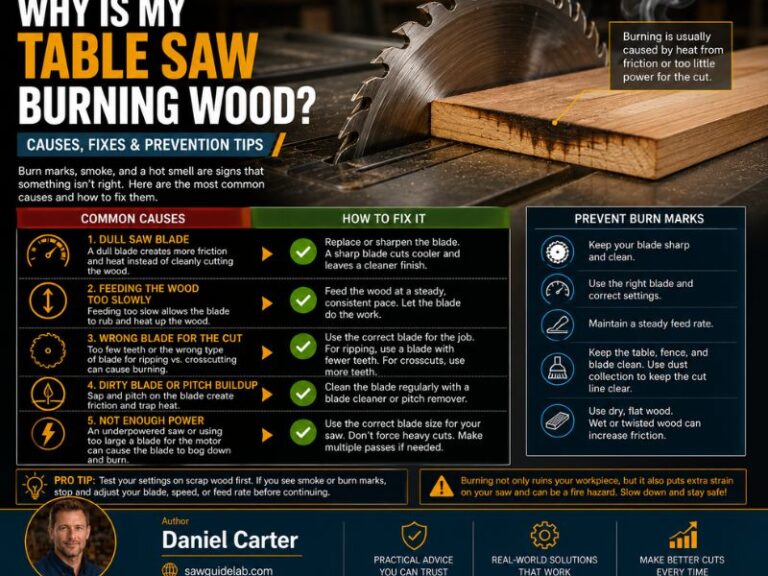
If the workpiece begins to bind, twist, smoke, or make an unusual sound, stop feeding it. Keep your hands still and away from the blade, switch off the saw, and wait for all movement to stop before investigating.
Never pull a partially cut board backward while the blade is turning. The teeth can catch the board during withdrawal, increasing the chance of kickback. Once power is disconnected, identify the cause: fence alignment, board movement, insufficient support, a dull or unsuitable blade, or a cut that the setup cannot safely control.
After any kickback or near miss, inspect the blade, arbor, throat plate, fence, riving knife, guard, and table for damage or displacement. A machine that appears to run normally may still be misaligned, and continuing without checking can repeat the event.
If the blade is bent, the arbor is damaged, the fence will not stay aligned, or a safety device cannot be restored, do not use the saw. Have it evaluated by a qualified technician or follow the manufacturer’s service procedure.
When Another Tool May Be Safer
A table saw is not automatically the best choice for every cut. Very small parts, severely warped boards, awkwardly shaped material, or cuts that require the operator to reach across the blade may be better handled with a different tool and a properly secured workpiece.
The safer choice depends on the material, cut geometry, support, and available control. A track saw, circular saw with suitable support, band saw, jigsaw, miter saw, or hand tool may reduce a particular hazard, but each has its own risks and operating requirements.
Do not choose a tool merely because it appears less intimidating. Choose the method that keeps the material stable, maintains a predictable cutting path, and allows hands to remain outside the danger zone throughout the operation.
Frequently Asked Questions About Table Saw Dangers
Why are table saws so dangerous compared with many other
They combine high-speed blade contact, powerful feed forces, and kickback in one operation. The operator guides the material close to a continuously rotating blade, and a small alignment or control error can move the workpiece or a hand into danger quickly.
Is kickback the most common table saw hazard?
Kickback is one of the most serious hazards, but direct blade contact is also a major concern. Kickback can throw material and provoke a sudden reaction, while reaching near the blade during setup, clearing, or adjustment can cause immediate injury.
Can a blade guard prevent all table saw injuries?
No, a guard reduces exposure but cannot prevent every injury. Safe results still require correct alignment, suitable stock, proper support, controlled feeding, and keeping hands away from the blade and kickback paths.
Should the riving knife always be used?
Use the riving knife whenever the operation and equipment instructions call for it. It helps keep the kerf open and reduces the chance that the rear teeth will pinch the workpiece, but it must be correctly aligned and compatible with the blade and cut.
Is it safe to stand directly behind a table saw?
No, standing directly in line with the blade increases exposure to a kicked-back workpiece. Stand slightly to the side with stable footing, while also keeping the stock properly supported and the work area clear.
What should you do if wood gets stuck
Stop feeding, turn off the saw, disconnect power, and wait until the blade is completely stopped before clearing it. Do not pull the board backward or reach toward the blade while it is moving.
When should a table saw be taken out of service?
Stop using it when a guard, riving knife, fence, arbor, switch, or other critical part is damaged or cannot be adjusted reliably. A persistent vibration, unexplained noise, repeated kickback, or blade that will not remain aligned also warrants inspection before further use.
Conclusion: Respect the Blade and Control the Workpiece
Table saws are dangerous because a fast exposed blade, rigid cutting path, and forceful workpiece movement leave little margin for error. The major limitation is that no guard or accessory can replace sound setup, appropriate material, controlled feeding, and hands kept out of the danger zone.
Before the next cut, inspect the saw, confirm the fence and riving knife are aligned, arrange support, plan the offcut path, and decide whether another tool would provide better control. If the machine or safety equipment is damaged, disconnect it and obtain qualified service before operating it again.