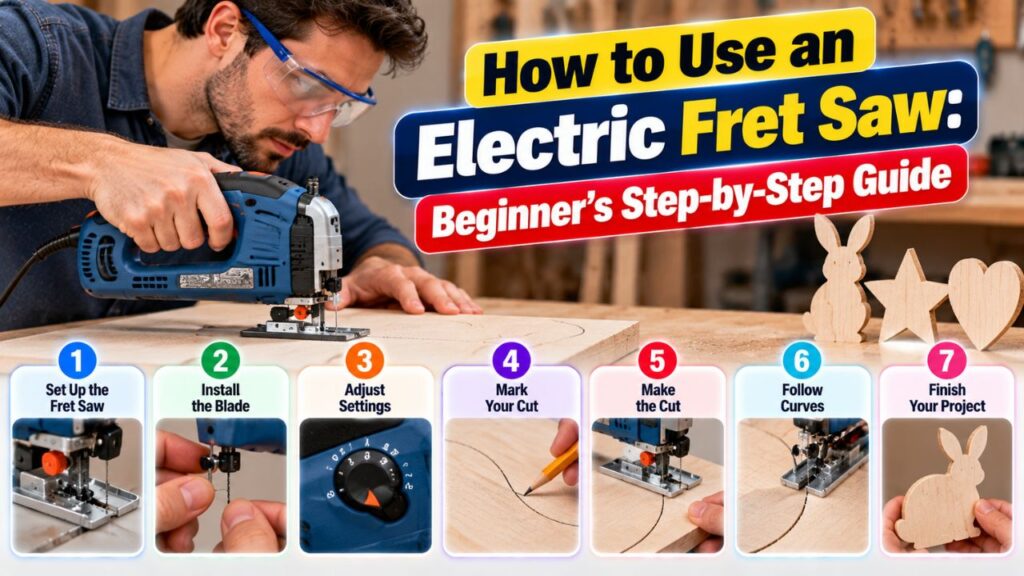
How to Use an Electric Fret Saw: Beginner’s Step-by-Step Guide
To learn how to use an electric fret saw, secure the saw to a stable work surface, install the correct blade with proper tension, mark your cutting line, set an appropriate speed, start the blade before touching the workpiece, and gently guide the material through the moving blade without forcing it. Keep the workpiece flat against the table and your fingers safely away from the blade throughout the cut.
An electric fret saw is designed for detailed cutting rather than fast, heavy stock removal. In the United States, a bench-mounted electric fret saw is more commonly called a scroll saw. Some compact models can also detach from their bases and operate like powered coping or fret saws. These tools excel at curves, intricate patterns, decorative woodworking, and inside cutouts that would be difficult with a circular saw or jigsaw.
Although an electric fret saw is relatively approachable for beginners, its thin reciprocating blade moves quickly. Good results depend more on blade choice, tension, feed pressure, and control than on pushing the material aggressively.
In this guide, I’ll explain how to set up and use an electric fret saw, choose and install blades, make straight and curved cuts, create internal cutouts, adjust cutting speed, and avoid the mistakes that commonly cause rough cuts or broken blades.
What Is an Electric Fret Saw?
An electric fret saw is a powered precision saw that moves a thin blade rapidly up and down to cut detailed shapes.
The stationary version has a small table supporting the material while you guide the workpiece around the blade. This type is usually called a scroll saw in the U.S.
Some compact electric fret saws can also be removed from their stationary bases and used in a handheld configuration. Dremel’s Moto-Saw, for example, is designed to function as both a stationary scroll saw and a detachable powered coping-style saw.
The narrow blade makes an electric fret saw particularly useful for intricate work because it can turn through much tighter curves than most conventional power saws.
Typical projects include decorative wooden signs, puzzles, ornaments, models, toys, fretwork, intarsia components, and detailed craft pieces.
Depending on the saw and blade, you may also be able to cut certain plastics, laminates, and thin nonferrous or light-gauge metals. The manufacturer’s blade recommendations should always determine which materials are suitable for your particular machine.
Electric Fret Saw vs. Scroll Saw
In everyday usage, these terms can overlap.
A traditional hand fret saw uses a thin blade held in a deep U-shaped frame.
A scroll saw performs similar detailed cutting using an electric motor and a vertically reciprocating blade.
Because “electric fret saw” can describe several compact powered designs, always check the manual for your particular machine before applying generic scroll-saw instructions.
Parts You Should Understand Before Starting
You do not need to know every mechanical component before your first cut, but several parts directly affect operation.
The blade does the cutting. Different tooth patterns and blade sizes are intended for different materials and levels of detail.
The table supports the workpiece. On many conventional scroll saws, it can tilt for bevel cuts.
The blade clamps or holders secure the blade at the top and bottom.
The tension system keeps the blade taut. Incorrect tension can contribute to poor tracking, inaccurate cuts, and blade breakage.
The hold-down foot helps keep the workpiece against the table as the blade moves. Manufacturers such as DEWALT specify that the material hold-down should be properly positioned during operation.
Variable-speed models also include a speed control. Slower or faster operation can be selected according to the material, blade, and type of cut.
Understanding these controls before turning the saw on makes the actual cutting process much easier.
Safety Before Using an Electric Fret Saw
Before making your first cut, read the owner’s manual for your particular saw. Blade installation, tension systems, guards, and controls differ between machines.
Wear proper eye protection. If the material creates significant dust, use suitable respiratory protection and dust extraction as appropriate.
Keep loose clothing, jewelry, long hair, and anything else that could become caught in moving parts away from the machine. DEWALT’s scroll-saw safety guidance specifically warns against putting fingers or hands in the blade path and recommends appropriate clothing and eye protection.
Secure a benchtop saw firmly to a stable bench or stand. A saw that moves while you are trying to make a delicate curve becomes difficult to control. Both DEWALT and Dremel instructions emphasize stable mounting for stationary operation.
Always disconnect the saw from its power source before installing or changing the blade, making adjustments that place your hands near the blade mechanism, or performing maintenance.
Never reach underneath the table while the saw is running.
Keep the work area well lit and remove unnecessary tools, scraps, and clutter from the saw table before starting.
Key Takeaways:
- Secure the saw before cutting and wear proper eye protection.
- Keep fingers away from the blade path and never reach under a running saw.
- Disconnect power before blade changes or adjustments.
- Read the manual because blade installation and tensioning differ between models.
How to Use an Electric Fret Saw Step by Step
Once the saw is properly set up, the actual cutting process is straightforward.
1. Choose the Right Blade
Start with the blade rather than the speed control.
A coarse blade generally cuts more aggressively but leaves a rougher surface and cannot turn through extremely tight curves as easily.
A finer blade cuts more slowly but can produce smoother, more detailed work.
Thicker or harder materials normally require a blade appropriate for the additional load, while extremely fine decorative patterns benefit from thinner blades capable of tighter turns.
Blade compatibility also matters. Some machines accept plain-end blades, some accept pin-end blades, and some accept both. Certain compact fret saws use proprietary blades, so do not assume a standard scroll-saw blade will fit every machine. Dremel, for example, specifies dedicated pin-end blades for its Moto-Saw rather than standard 5-inch scroll-saw blades.
2. Disconnect the Saw and Install the Blade
Unplug the saw before working around the blade holders.
Release the tension according to your machine’s instructions and install the blade in the correct orientation.
On most woodworking configurations, the teeth should be positioned according to the manufacturer’s specified cutting direction. Do not guess if the blade or machine design is unfamiliar.
Make sure the blade is fully seated in both holders before tightening them.
A blade that is clamped incorrectly can slip or break after the saw starts.
3. Set the Blade Tension
The blade needs enough tension to remain controlled while cutting, but excessive tension can shorten blade life.
Conventional scroll saws often have a tensioning lever or knob. Compact machines may use an automatic tensioning mechanism. DEWALT specifically instructs operators to make sure scroll-saw blade tension is properly adjusted before use, while Dremel’s Moto-Saw uses an automatic tensioning system.
If your machine requires manual adjustment, follow the manufacturer’s method instead of relying solely on an informal “pluck the blade” test.
4. Mark Your Cutting Line
Draw the design clearly on the workpiece.
For simple cuts, a pencil line may be sufficient. Intricate fretwork is often easier when a printed pattern is temporarily attached to the material.
Make the line easy to see under the saw’s lighting and dust conditions.
If accuracy matters, remember that the blade removes a narrow strip of material called the kerf. Decide which side of your line represents the finished piece before cutting.
5. Adjust the Hold-Down Foot
Position the hold-down close enough to the workpiece to prevent unnecessary bouncing while still allowing the material to move freely.
The goal is not to clamp the workpiece immovably.
You still need to rotate and guide it.
On compact stationary fret saws, keeping the material controlled against the working surface also helps reduce vibration. Dremel instructs users of its stationary Moto-Saw to use the hold-down and keep the workpiece controlled rather than forcing it against the blade.
6. Select the Cutting Speed
There is no single perfect speed for every job.
Variable-speed saws allow you to balance cutting rate, material behavior, blade size, and detail.
Wood can generally tolerate faster settings than materials that are prone to melting or overheating, but blade and machine recommendations should take priority.
For a beginner, starting at a moderate speed is usually easier than immediately selecting maximum speed.
Make a practice cut in scrap from the same material and adjust if necessary.
7. Position the Workpiece Before Cutting
Lay the workpiece flat on the saw table.
Position it so the cut can proceed without your hands crossing in front of the blade.
Think through tight curves before you start. You need enough space to rotate the workpiece without hitting the saw frame or forcing your hands into an awkward position.
Avoid cutting a workpiece that cannot sit safely against the table unless your machine is specifically designed for another operating mode.
8. Turn the Saw On Before Contacting the Material
Start the saw and allow the blade to reach operating speed before feeding the workpiece into it.
Starting with the blade already pressed into the material can create vibration or chatter. Dremel’s operating instructions specifically recommend allowing the blade to reach speed before making contact with the workpiece.
Then begin feeding gently.
9. Let the Blade Do the Cutting
This is one of the most important habits to develop.
Do not shove the material into the blade.
Apply only enough forward pressure to keep the blade cutting steadily.
If you push too hard, the thin blade can bow backward or sideways. That makes the cut less accurate and increases the chance of breaking the blade.
Dremel and DEWALT both advise feeding work at a controlled rate rather than forcing the material through the blade.
For detailed cutting, slower is usually better than forcing the saw to work faster than the blade allows.
How to Make Straight Cuts With an Electric Fret Saw
A fret or scroll saw can make straight cuts, but this is not normally its biggest strength.
The thin blade can naturally wander slightly with grain direction, blade condition, tension, and feed pressure.
For a short straight cut, keep your eyes focused slightly ahead of the blade and make small corrections rather than constantly steering from side to side.
Do not twist the material sharply to force the blade back onto the line.
If your project consists mostly of long straight cuts, another saw may be better suited to the job.
A table saw, circular saw, track saw, or jigsaw with an appropriate guide can often produce long straight cuts more efficiently.
Use the electric fret saw where its precision and maneuverability provide an advantage.
How to Cut Curves With an Electric Fret Saw
Curves are where this tool performs especially well.
Guide the workpiece forward while gradually rotating it around the blade.
For a broad curve, the movement can be smooth and continuous.
For a tighter radius, slow the feed rate and rotate the material more gradually.
Avoid forcing the workpiece sideways against the blade. The blade is designed primarily to cut forward through the material, not to tolerate excessive side pressure.
Use Relief Cuts for Difficult Curves
A relief cut is a temporary cut made into waste material to give the offcut somewhere to separate as you follow a difficult curve.
This can make long or complex curved profiles easier to manage.
DEWALT’s scroll-saw guidance recommends relief cuts before long curves.
For extremely tight turns, you may need to stop forward movement almost completely while carefully rotating the workpiece so the blade can establish the new direction.
If the blade begins bending significantly, reduce pressure.
How to Make Inside Cuts With an Electric Fret Saw
One of the biggest advantages of a fret or scroll saw is its ability to make internal cutouts without cutting through the outside edge of the workpiece.
This is essential for letters, decorative openings, puzzles, and detailed fretwork.
First, mark the shape you want to remove.
Drill a starter hole somewhere inside the waste portion of that shape. The hole must be large enough for the saw blade to pass through.
Disconnect the saw.
Release the upper end of the blade—or whichever end your particular saw is designed to release—and pass the blade through the starter hole.
Reconnect the blade, restore the correct tension, and verify that everything is secure.
You can then turn the saw back on and cut around the internal shape.
When the cut is complete, switch the machine off, wait for the blade to stop, disconnect power as appropriate, release the blade, and remove the workpiece.
This blade-threading technique is a standard advantage of scroll saws; DEWALT’s instructions specifically describe drilling a pilot hole and threading the blade through the workpiece for inside fretwork cuts.
Key Takeaways:
- Internal cutouts require a starter hole through the waste area.
- Disconnect power before releasing or reinstalling the blade.
- Restore proper tension before restarting the saw.
- Inside cutting is one of the main reasons a fret/scroll saw is useful for detailed work.
How to Make Tight Corners
A very tight corner requires patience.
Approach the corner slowly and reduce forward pressure as the blade reaches the turning point.
Rotate the workpiece without forcing the blade sideways.
For certain patterns, it can be easier to approach the corner from two different directions rather than attempting an extremely tight turn in one continuous cut.
You may also make a small relief cut into the waste side.
Blade selection has a major effect here. A smaller blade can typically negotiate tighter curves than a large coarse blade, although it also cuts more slowly and may be more fragile.
How to Cut Different Materials
An electric fret saw is often thought of as a woodworking tool, but some models can cut additional materials when fitted with the correct blade.
Wood
Wood is the most common material.
Plywood, thin hardwood, softwood, and many craft boards can all be suitable depending on the saw’s capacity.
With plywood, use a sufficiently fine blade if minimizing splintering is important.
Plastic
Some fret saws can cut plastics.
Heat is the main issue. Excessive blade speed or feed pressure can cause certain plastics to soften or melt at the cut.
Use the blade and speed recommended for your particular material.
Laminate
Compact powered fret saws may be suitable for some laminates with the correct blade.
Test a scrap piece first because decorative laminate can chip along the cut line.
Metal
Only cut metal if your saw and blade are rated for it.
A wood-cutting blade should not simply be used because it physically fits.
Machines such as the Dremel Moto-Saw offer specific blades for light-gauge metal, illustrating why material-specific blade selection matters.
Metal cutting may also create hot chips and additional blade heat, so follow the saw and blade manufacturer’s safety guidance.
How to Use a Handheld Electric Fret Saw
Not every electric fret saw is a stationary machine.
Some compact tools detach from the table and operate as powered coping saws.
In handheld mode, the workpiece rather than the saw must be securely supported.
Hold the tool firmly and keep the cutting area visible. Never support the material in a way that places your other hand behind or directly in line with the blade.
Dremel specifically describes the detachable Moto-Saw as suitable for handheld coping-style work when a workpiece is too large or fixed in place for stationary operation.
For most small craft pieces, however, I prefer stationary operation. Having the workpiece supported on a table generally gives a beginner better control for intricate patterns.
How to Prevent the Workpiece From Bouncing
If your workpiece repeatedly jumps up and down, first check the hold-down adjustment.
It should help control the stock without preventing you from moving it.
Then check the blade.
An incorrectly installed, damaged, or inappropriate blade can increase vibration.
Excessive feed pressure can also cause the material to bounce because you are pushing against the blade faster than it can cut.
Slow down and let the teeth remove the material at their own rate.
Finally, make sure the saw itself is secured to a stable workbench. Vibration from an unstable machine makes delicate cutting unnecessarily difficult.
Why Electric Fret Saw Blades Keep Breaking
Blade breakage happens occasionally, especially with very fine blades, but frequent breakage usually indicates a problem.
Excessive feed pressure is one common cause. A thin blade that is continuously bent backward or sideways is under much more stress.
Incorrect tension can also contribute.
Another possibility is using the wrong blade for the material or attempting turns tighter than the blade can comfortably make.
Dull or damaged blades should be replaced rather than forced through another project. Dremel specifically warns that dull or damaged blades can bend or break more easily.
If blades repeatedly break in the same area of the machine, inspect the holders and alignment according to the manufacturer’s troubleshooting procedure.
Why the Saw Is Cutting Crooked
A crooked cut does not always mean the machine is defective.
First, reduce your feed pressure. Pushing too hard can deflect the blade.
Then verify blade tension.
Also look at the blade itself. Very fine blades flex more easily than heavier blades.
Wood grain can influence the direction in which a narrow blade wants to travel, so you may need small steering corrections.
If accuracy is particularly important, practice on scrap material before beginning the finished piece.
How to Get Smoother Cuts
Smooth results start with the correct blade.
A finer tooth pattern generally leaves a cleaner edge than a very coarse blade, although cutting takes longer.
Use controlled feed pressure and avoid sudden steering movements.
Make sure the material remains flat against the table.
A worn blade can create rougher results, so replace it when cutting performance deteriorates.
You should also accept that some projects will need light sanding after cutting. A fret saw produces detailed shapes efficiently, but it does not eliminate every finishing operation.
Key Takeaways:
- Excessive feed pressure contributes to wandering and blade breakage.
- Correct tension and an appropriate blade improve accuracy.
- Finer blades generally help with detailed, smoother cuts.
- Practice on scrap before cutting an important finished piece.
Common Mistakes When Using an Electric Fret Saw
The most common beginner mistake is pushing the material too aggressively.
An electric fret saw is not designed like a circular saw. Forcing the stock does not necessarily make the project finish faster; it often causes blade deflection and poor accuracy.
Another mistake is selecting a blade based only on material thickness. The amount of detail and curve radius matter as well.
Using incorrect tension is another frequent problem. Follow your machine’s tensioning system rather than assuming tighter is always better.
Beginners also tend to watch the blade itself instead of the cutting line ahead of it. Looking slightly ahead of the contact point makes it easier to steer smoothly.
Starting the saw with the workpiece already pressed against the blade can create unnecessary chatter. Allow the saw to reach its working speed first.
Finally, do not attempt to pull a jammed workpiece backward while the machine is fighting the material. Switch the saw off and follow the manufacturer’s procedure for safely freeing the work.
How to Maintain an Electric Fret Saw
Maintenance is relatively straightforward.
Keep the table and surrounding blade area free from accumulated sawdust.
Inspect the blade regularly and replace it when it becomes dull, damaged, or distorted.
Check blade clamps and tension components for secure operation.
If your saw has a dust port, use an appropriate vacuum or extraction system where practical.
Keep ventilation openings free from dust because the motor relies on airflow for cooling.
Before cleaning around moving parts, disconnect the saw from power. Dremel’s maintenance instructions specifically require disconnecting the tool before cleaning or service.
Lubrication requirements vary by machine, so follow the manual rather than adding oil wherever you think it might help.
Is an Electric Fret Saw Good for Beginners?
Yes.
For detailed craft woodworking, an electric fret or scroll saw can be one of the easier stationary saws for a beginner to learn because the material moves slowly through a small blade and you can see the cutting line clearly.
That does not make it harmless.
The blade can still cause injury, and poor hand positioning can put fingers directly into its path.
I recommend that beginners spend time making simple straight and curved cuts on scrap before attempting a detailed pattern.
Practice stopping on a line, making gentle curves, turning tighter corners, and controlling feed pressure.
Once those movements feel natural, intricate fretwork becomes much easier.
What Projects Can You Make With an Electric Fret Saw?
The saw is best suited to projects where detail matters more than production speed.
Common examples include wooden letters, name signs, Christmas ornaments, puzzles, silhouettes, decorative wall art, small toys, models, and intricate fretwork panels.
Inside cuts allow you to create designs that would be difficult with a conventional jigsaw.
For example, you can cut the enclosed center of a letter without making a visible cut through its outside edge.
The tool is less suitable for processing large volumes of construction lumber or making long rip cuts.
Choosing a saw according to the job is important. Use the electric fret saw for the fine work it was designed to do rather than trying to make it replace every other saw in the workshop.
FAQs about How to Use an Electric Fret Saw
How do you use an electric fret saw for beginners?
Secure the saw, install and correctly tension the appropriate blade, mark the cut, adjust the hold-down and speed, start the saw, and gently guide the workpiece through the blade. Do not force the material.
Is an electric fret saw the same as a scroll saw?
A stationary powered fret saw is commonly called a scroll saw in the United States. Some compact electric fret saws can also operate in handheld coping-saw-style configurations.
What is an electric fret saw used for?
It is primarily used for detailed curves, decorative patterns, inside cutouts, puzzles, signs, models, and other precision work.
Which way should a fret saw blade face?
Install the blade in the cutting direction specified by the saw and blade manufacturer. Blade systems differ, so verify the orientation in the manual rather than guessing.
How tight should an electric fret saw blade be?
It should have the tension specified for your machine and blade. Too little tension can reduce accuracy, while excessive tension can unnecessarily stress the blade. Some compact electric fret saws tension the blade automatically.
Should I push hard when using a fret saw?
No. Apply gentle, controlled forward pressure and allow the blade teeth to cut at their natural rate. Excessive pressure can bend the blade, make the cut wander, and increase the chance of blade breakage.
How do I make an inside cut with an electric fret saw?
Drill a starter hole inside the section you want to remove, disconnect the saw, release one end of the blade, pass the blade through the hole, reconnect and tension it, then make the cut.
Can an electric fret saw cut straight lines?
Yes, especially over short distances, but it is mainly designed for detailed and curved cutting. Other saws are generally better for long precision straight cuts.
Can an electric fret saw cut plywood?
Yes, provided the thickness is within the saw’s cutting capacity and you use an appropriate blade. A finer blade can help reduce splintering on detailed work.
Can an electric fret saw cut plastic?
Many models can when fitted with the correct blade. Use an appropriate speed because excessive heat can melt some plastics.
Can an electric fret saw cut metal?
Some can cut thin metal with the correct metal-cutting blade. Check your saw’s specifications because not every machine or blade is suitable for metal.
Why does my fret saw blade keep breaking?
Common causes include excessive feed pressure, incorrect tension, overly tight turns, a dull or damaged blade, incorrect blade selection, or improper blade installation.
Why does my wood bounce while using the saw?
The hold-down may need adjustment, the feed pressure may be excessive, or the blade may be incorrectly installed or unsuitable. Make sure the workpiece stays controlled against the table.
Should I wear gloves when using an electric fret saw?
Loose gloves should not be worn near moving machinery because they can create an entanglement hazard. Keep hands clear of the operating blade. If you need hand protection while handling a stopped or hot blade, disconnect the saw first and follow the manufacturer’s guidance.
Do I need eye protection when using an electric fret saw?
Yes. Proper safety glasses help protect against sawdust, chips, and fragments from a damaged blade or workpiece.
Conclusion
Learning how to use an electric fret saw comes down to control rather than force. Install the correct blade, set the proper tension, secure the machine, keep the workpiece flat, start the saw before contacting the material, and feed the work slowly enough for the blade to do its job.
For beginners, I recommend practicing first with inexpensive scrap wood. Start with simple straight cuts and broad curves before attempting intricate patterns or tight corners. This will teach you how quickly the blade cuts and how much steering pressure is actually necessary.
When making detailed work, choose the blade according to both the material and the complexity of the pattern. A blade suitable for quickly cutting a simple outside profile may not be the best choice for tiny internal curves.
For inside cuts, drill a starter hole, disconnect the machine, thread the blade through the opening, reinstall and tension it, and then make the cut. This capability is one of the biggest reasons an electric fret or scroll saw is so useful for decorative woodworking.
Most importantly, never force the workpiece into the blade. Excessive pressure causes many of the problems beginners experience, including wandering cuts, excessive vibration, rough edges, and broken blades.
Keep your fingers away from the blade path, disconnect power before blade changes or adjustments, use appropriate eye protection, and follow the operating instructions for your specific saw.
Used correctly, an electric fret saw is an excellent precision tool for curves, intricate designs, and internal cutouts. Once you learn to guide the material gently and let the blade cut at its own pace, even complicated patterns become much easier to control.