What Is a Fret Saw Used For? Uses, Cuts, and How It Works
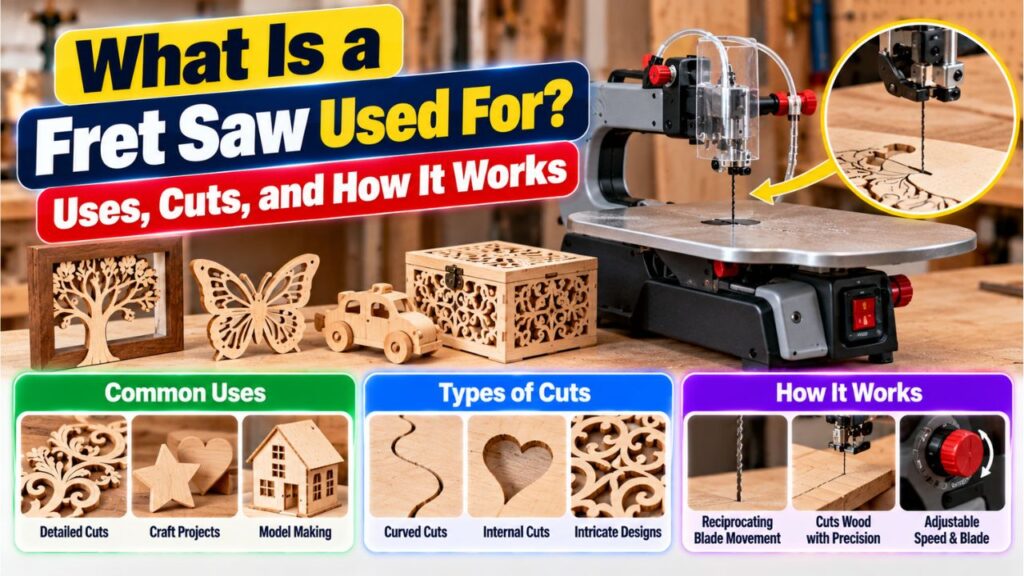
If you are wondering what is a fret saw used for, it is mainly used to make fine, intricate, curved, and internal cuts in thin wood, plywood, plastic, and other relatively soft materials. Its very thin blade and deep U-shaped frame make it especially useful for decorative woodworking, fretwork, marquetry, model making, cutting detailed patterns, and removing material from inside a workpiece without cutting in from an outside edge.
A fret saw is a hand-powered cutting tool that looks somewhat similar to a coping saw, but the two are not identical. The fret saw usually has a much deeper frame and an extremely fine blade held under tension. That combination lets you reach farther into a panel and follow tight curves that would be difficult with a conventional handsaw.
One of its biggest advantages is control. A fret saw removes very little material with each stroke, allowing you to make precise cuts around delicate shapes. The tradeoff is speed. It is designed for detail work rather than quickly cutting large boards or thick lumber.
In this guide, I’ll explain what a fret saw is used for, how it works, the types of cuts it can make, what materials it can handle, how it differs from a coping saw and scroll saw, how to use one correctly, and when another type of saw is the better choice.
What Is a Fret Saw?
A fret saw is a small hand saw designed for precise, intricate cutting.
The most recognizable feature is its deep bow-shaped or U-shaped frame. A very thin replaceable blade stretches across the open end of that frame.
Unlike conventional hand saw blades, a fret saw blade is extremely narrow from front to back. This allows it to turn through tight curves without requiring a large cutting radius.
The word “fret” in fret saw is associated with decorative fretwork—the intricate pierced patterns traditionally cut into wood and other materials.
Although decorative cutting is one of its classic applications, the tool is useful for much more than ornamental work.
It can be used whenever you need to remove a small amount of material accurately and maneuver around shapes that would be difficult to cut using a larger saw.
What Is a Fret Saw Used For Most Often?
The fret saw is primarily a detail-cutting tool.
It is most useful when accuracy and maneuverability matter more than cutting speed.
Common projects include decorative fretwork, small woodworking parts, models, musical-instrument work, marquetry, puzzle making, and detailed craft projects.
Its most important advantage is its ability to cut both external curves and completely enclosed internal shapes.
Cutting Intricate Curves
A fret saw can follow curves much tighter than most general-purpose handsaws.
Because the blade is so thin, you can change direction gradually while cutting without removing a wide strip of material.
This makes the tool particularly useful for:
Decorative profiles
Tight curves
Small rounded openings
Detailed silhouettes
Complex craft patterns
The blade still has a minimum turning radius, and trying to rotate it abruptly while cutting can break it. However, with proper technique, it can follow remarkably detailed shapes.
Making Internal Cutouts
Internal cutting is one of the most valuable fret saw uses.
Imagine that you want to cut a heart-shaped opening in the middle of a wooden panel without cutting through the outer edge.
A conventional handsaw cannot do this easily because its blade cannot be inserted into the enclosed area.
With a fret saw, you can drill a small starter hole inside the section you want to remove. The thin blade is disconnected from one end of the saw frame, threaded through the hole, and then reattached and tensioned.
You can now cut the entire internal shape.
After the cut is complete, release the blade again and remove the saw without cutting through the surrounding material.
This technique is widely used in decorative woodworking.
Decorative Fretwork
Fretwork consists of decorative patterns created by cutting openings through a sheet or board.
The finished design may contain:
Geometric patterns
Flowers
Curves
Scrolls
Letters
Silhouettes
Repeating shapes
Because many of these openings are completely surrounded by material, a fret saw is particularly well suited to the job.
The process can involve drilling many small starter holes and repeatedly threading the blade through different areas of the pattern.
This is slower than powered cutting, but it gives the user excellent control.
Key Takeaways:
• A fret saw is designed mainly for detailed, curved, and internal cuts.
• Its thin blade can turn through much tighter curves than a conventional handsaw.
• The removable blade allows you to cut enclosed shapes without entering from the edge of the workpiece.
Fret Saw Uses in Woodworking
Although fret saws can cut several materials, woodworking remains their most common application.
The tool is especially valuable when working with thin stock where a larger saw would remove too much material or be difficult to control.
Making Wooden Puzzles
Puzzle pieces often contain tight curves, small projections, and complex outlines.
A fret saw allows you to follow these shapes carefully while minimizing the amount of wood removed by the cut.
However, if you plan to produce many puzzles regularly, a powered scroll saw will usually be much faster.
Cutting Decorative Panels
Decorative wooden panels used in furniture, screens, ornaments, and architectural details often contain pierced openings.
The fret saw can cut these openings without damaging the outer edges of the panel.
This is one of the applications for which the tool was traditionally designed.
Model Making
Model makers often work with thin plywood, basswood, balsa, and similar materials.
The small scale of the components makes a fine cutting tool particularly valuable.
A fret saw can shape:
Miniature structural components
Small curved parts
Templates
Decorative pieces
Model-building panels
Because you control the cutting speed manually, it can also be easier to stop precisely at a marked line.
Marquetry and Decorative Inlay
Marquetry involves creating decorative images or patterns using pieces of wood veneer and other thin materials.
Fine saws can be used to cut carefully shaped components for these designs.
The narrow kerf of a fine fret saw blade helps minimize material loss.
For highly specialized marquetry work, however, craftspeople may use dedicated piercing saws, scroll saws, knives, or other techniques depending on the materials and pattern.
Musical Instrument Work
Fine hand saws are useful for certain musical-instrument building and repair tasks where controlled cuts are required.
A fret saw may be used for small decorative components, internal cutouts, templates, or shaping thin wooden pieces.
It should not be confused with a specialized fret-slotting saw, which is used to cut the narrow slots that hold frets in a guitar or similar fingerboard.
Despite the shared word “fret,” the tools serve different purposes.
What Types of Cuts Can a Fret Saw Make?
A fret saw can perform several types of precision cuts, although it is not intended for every sawing task.
Curved Cuts
This is one of its greatest strengths.
The narrow blade allows the saw to follow tight curves without requiring large sweeping turns.
For the best results, move the saw up and down while gradually rotating the frame in the direction of the cut.
Do not try to force the blade sideways.
Straight Cuts
A fret saw can make straight cuts, but it is not the most efficient tool for them.
The thin blade can wander if you apply sideways pressure.
For a long straight cut, a backsaw, handsaw, jigsaw, circular saw, or another appropriate tool will normally be easier and faster.
A fret saw makes more sense when the straight section is part of a detailed pattern containing curves.
Internal Cuts
Internal or pierced cuts are one of the tool’s defining capabilities.
Drill a small entry hole, pass the blade through it, reconnect the blade, and cut the enclosed shape.
This makes the fret saw ideal for detailed decorative openings.
Tight Corners
A fret saw can negotiate tight corners, but sharp direction changes require care.
Rather than twisting the blade aggressively, make several short strokes while gradually turning it.
For an extremely sharp internal corner, you may need to cut into the corner from two directions rather than attempting to rotate the blade instantly.
What Materials Can a Fret Saw Cut?
A fret saw is most commonly associated with wood, but the correct blade can handle several thin materials.
Wood
Thin wood is the most natural application.
The tool performs particularly well with:
Plywood
Basswood
Softwoods
Thin hardwood stock
Wood veneer
Craft boards
Extremely thick hardwood is not a good match because the fine blade cuts slowly and may flex or break.
Plywood
Plywood is excellent for fretwork because it remains relatively stable and is available in many thin sheet sizes.
Fine-tooth blades can produce clean cuts when used carefully.
Very low-quality plywood may splinter more easily, so supporting the work and choosing an appropriate blade are important.
Plastic
Some thin plastics can be cut with a fret saw.
Use a fine blade and controlled strokes.
Cutting too aggressively can create heat, rough edges, or blade binding.
The exact suitability depends on the plastic type and thickness.
Soft Metal
Certain fret saw blades are available for cutting thin nonferrous metals and other relatively soft metal stock.
However, a fret saw used primarily for woodworking should not automatically be expected to cut metal effectively with its existing blade.
Blade material and tooth configuration must match the workpiece.
For frequent fine metalwork, a jeweler’s saw may be more suitable.
Fret Saw vs. Coping Saw: What Is the Difference?
Fret saws and coping saws are often confused because both have narrow replaceable blades stretched across a frame.
Their intended uses overlap, but there are meaningful differences.
| Feature | Fret Saw | Coping Saw |
| Frame depth | Usually very deep | Usually shallower |
| Blade | Extremely thin and fine | Wider and more robust |
| Tight curves | Excellent | Very good |
| Internal fretwork | Excellent | Good |
| Coping molding joints | Possible, but less convenient | Excellent |
| Blade durability | More fragile | Generally stronger |
| Reach into large panels | Excellent | More limited |
| Best use | Intricate detail work | General curved cuts and coping |
A coping saw is usually better for tasks such as fitting molding joints because its stronger blade handles somewhat rougher woodworking.
A fret saw is preferable when the pattern is delicate and requires very tight curves.
Which One Should You Choose?
If your main project involves detailed decorative cutouts, I would choose the fret saw.
If you mostly need to cope trim, make general curved cuts, and perform occasional small cutouts, a coping saw may be more practical.
Many woodworkers own both because they are inexpensive and serve slightly different purposes.
Fret Saw vs. Scroll Saw
A scroll saw performs many of the same types of cuts as a fret saw but uses an electric motor to move the blade rapidly up and down.
You can think of the scroll saw as the powered alternative for much fretwork.
Advantages of a Fret Saw
A hand fret saw is:
Portable
Quiet
Inexpensive
Simple
Easy to use without electricity
Highly controllable
It is excellent for occasional projects and situations where you want maximum manual control.
Advantages of a Scroll Saw
A scroll saw is dramatically faster for repetitive or larger projects.
Because the workpiece rests on a table, you guide the material through the moving blade instead of moving the entire saw frame.
This is especially useful for:
Large fretwork projects
Multiple identical pieces
Puzzle production
Decorative signs
Detailed craft production
A scroll saw also reduces hand fatigue during prolonged work.
Which Is Better?
For occasional detailed cutting, a fret saw is difficult to beat for simplicity and cost.
For regular fretwork or high-volume projects, I would choose a scroll saw.
The two tools are not necessarily competitors. A hand fret saw remains useful even in a workshop that already has a scroll saw.
Fret Saw vs. Jigsaw
A jigsaw is a handheld power saw designed for curved and straight cutting in larger workpieces.
It is much faster and can cut considerably thicker material.
However, it cannot normally follow extremely tight details as easily as a fret saw.
The jigsaw also has a much wider blade and produces a larger kerf.
Choose a jigsaw for:
Large curved cuts
Countertop openings
Plywood panels
General construction work
Thicker materials
Choose a fret saw for:
Fine patterns
Small components
Detailed decorative work
Tight curves
Delicate internal cutouts
Trying to substitute one for the other can make the job unnecessarily difficult.
Parts of a Fret Saw and What They Do
Understanding the basic components makes the saw easier to use.
The frame provides the depth that allows the blade to reach into the workpiece.
The handle gives you control over the cutting motion.
The blade clamps or pins secure the blade at both ends.
A tensioning mechanism keeps the thin blade sufficiently tight for controlled cutting.
The blade performs the cut and is available in different tooth counts and sizes.
The blade is the component that usually requires the most attention.
Too little tension can cause it to flex and wander.
Excessive tension can increase the chance of breakage or damage the saw.
Use the manufacturer’s recommended tensioning procedure for your saw.
How to Use a Fret Saw
Using a fret saw is straightforward, but technique has a major effect on accuracy and blade life.
1. Mark the Cutting Pattern
Transfer the desired pattern to the workpiece using pencil, transfer paper, a template, or another appropriate marking method.
Make sure the cutting line is visible.
2. Secure the Workpiece
Support the material firmly while keeping the area being cut clear.
A fretwork cutting board or V-board can be very useful. It supports the work on both sides of the blade while leaving an opening for the saw.
Avoid holding a small workpiece directly in your hand while cutting.
3. Install and Tension the Blade
Fit the correct blade for the material.
Make sure the teeth point in the intended cutting direction according to the saw’s design.
The blade should be straight and appropriately tensioned.
4. Start With Gentle Strokes
Move the saw vertically using smooth, controlled strokes.
Allow the teeth to do the cutting.
Excessive force is one of the fastest ways to break a thin blade.
5. Turn the Saw, Not the Blade
When following a curve, gradually rotate the frame while continuing the up-and-down motion.
Do not push the blade sideways.
The blade is designed to cut along its teeth, not withstand heavy lateral force.
6. Slow Down Near Corners
Tight corners require shorter, more controlled strokes.
If necessary, approach an extremely sharp corner from two directions.
7. Finish and Clean the Edge
After completing the cut, remove the blade carefully if it is passing through an internal opening.
Small files, fine sandpaper, or specialized sanding tools can then clean the cut edges if necessary.
Key Takeaways:
• Keep the blade correctly tensioned and let its teeth do the work.
• Turn the saw gradually instead of forcing the blade sideways.
• Support thin workpieces well to reduce vibration and breakage.
How to Make an Internal Cut With a Fret Saw
Internal cutting deserves its own explanation because it is one of the main reasons to choose this tool.
Suppose you want to remove a decorative shape from the center of a thin wooden board.
First, draw the shape.
Then drill a small starter hole somewhere inside the waste area. The hole needs to be large enough for the fret saw blade to pass through.
Release one end of the blade from the saw frame.
Feed the blade through the starter hole.
Reconnect it to the saw and restore the correct blade tension.
Now follow the cutting line around the shape.
When you complete the cut, release one end of the blade again, pull it out through the opening, and reconnect the saw.
This process allows you to remove enclosed sections while leaving the surrounding panel intact.
A pattern containing many internal openings may require repeating the process several times.
Choosing the Right Fret Saw Blade
Blade selection has a major effect on the quality and speed of the cut.
A finer blade generally produces a smoother, tighter cut but is also more fragile.
A coarser blade removes material faster and handles thicker stock more easily, but it may not negotiate extremely fine details as well.
For very thin material, choose a fine blade so several teeth remain engaged with the workpiece during cutting.
For thicker wood, a somewhat coarser blade can clear sawdust more effectively.
The blade also needs to match the material.
A woodworking blade is not automatically the best choice for plastic or metal.
If you notice excessive blade breakage, do not immediately blame the blade quality. Incorrect tension, sideways pressure, aggressive cutting, and sharp twisting are common causes.
Why Fret Saw Blades Keep Breaking
Fret saw blades are intentionally thin, so occasional breakage is normal.
Frequent breakage usually indicates a technique or setup problem.
One common cause is excessive blade tension. Another is insufficient tension, which allows the blade to bend and kink.
Forcing the saw through the workpiece can also break the blade.
The most common mistake during curved cuts is twisting the blade sideways instead of rotating the saw gradually.
Blade choice matters as well. A very fine blade pushed through thick hardwood has to work much harder than one appropriately matched to the material.
Keeping a small supply of replacement blades is normal practice when doing detailed fretwork.
Advantages and Limitations of a Fret Saw
The greatest advantage of a fret saw is precision.
Few simple hand tools can make such intricate internal and curved cuts at such a low cost.
The tool is also quiet, portable, easy to store, and requires no electricity.
Its limitations are equally important.
A fret saw is slow compared with power tools. Its blades are fragile, and the deep frame can feel awkward when working on some shapes.
It is not designed for construction lumber, long rip cuts, large crosscuts, or high-volume production.
For those tasks, another saw will be much more efficient.
Safety Tips for Using a Fret Saw
A fret saw is relatively safe compared with many powered saws, but the blade is still sharp.
Secure the workpiece before cutting.
Keep your free hand away from the blade path and avoid placing fingers directly beneath the cut.
Wear eye protection, particularly when cutting brittle materials or when a blade could snap.
Inspect the blade before use. Replace blades that are bent, heavily worn, rusted, or damaged.
Do not test blade sharpness by running a finger along the teeth.
When drilling starter holes for internal cuts, follow appropriate drill safety practices and secure the material.
If you are cutting plastic, metal, or unfamiliar materials, consider whether dust, chips, or fumes require additional protection.
Key Takeaways:
• A fret saw is relatively simple, but its narrow blade is sharp and can break under excessive force.
• Secure the material and keep fingers away from the cutting path.
• Choose the correct blade for both the material and its thickness.
When Should You Use a Different Saw?
A fret saw is excellent within its specialty, but it should not be forced into jobs it was not designed for.
For cutting a 2×4, use an appropriate handsaw, circular saw, or miter saw.
For long straight cuts in plywood, a circular saw or track saw is more efficient.
For large curved cuts, use a jigsaw.
For repeated detailed fretwork, consider a scroll saw.
For coping molding, a coping saw is often easier to control.
For precision metal jewelry work, a jeweler’s saw may be a better fit.
Choosing the correct saw improves both safety and the quality of the finished project.
FAQs about What Is a Fret Saw Used For
What is the main use of a fret saw?
A fret saw is mainly used for making intricate curved cuts and internal cutouts in thin wood and similar materials. It is especially popular for fretwork, crafts, models, decorative panels, and other detailed projects.
Can a fret saw cut straight lines?
Yes, but it is not the best tool for long straight cuts.
Its narrow blade is optimized for curves and detail work. A backsaw or appropriate power saw is usually easier for long straight cuts.
Can a fret saw cut plywood?
Yes.
Thin plywood is one of the most suitable materials for fret sawing, particularly for decorative patterns and craft projects.
Can a fret saw cut hardwood?
Yes, provided the hardwood is reasonably thin and you use an appropriate blade.
Thick, dense hardwood can be slow to cut and may increase blade breakage.
Can a fret saw cut plastic?
Some plastics can be cut successfully using an appropriate fine blade and controlled cutting speed.
Avoid excessive pressure, which can create heat and rough edges.
Can a fret saw cut metal?
With a blade designed for the material, a fret saw can cut certain thin, relatively soft metals.
For dedicated fine metalworking or jewelry work, a jeweler’s saw is often more suitable.
Can you cut internal shapes with a fret saw?
Yes. This is one of its main advantages.
Drill a starter hole inside the desired opening, detach one end of the blade, pass it through the hole, reconnect it, and make the cut.
What is the difference between a fret saw and a coping saw?
A fret saw generally has a much deeper frame and a finer, more delicate blade. It excels at intricate fretwork and internal cuts.
A coping saw has a shallower frame and stronger blade and is commonly used for coping molding and general curved cuts.
Is a fret saw the same as a scroll saw?
No.
A fret saw is a manually operated hand tool. A scroll saw is a powered stationary machine that moves a fine blade rapidly up and down.
Both can perform detailed fretwork.
Which is better, a fret saw or scroll saw?
For occasional detailed cutting, a fret saw is inexpensive, portable, and highly controllable.
For frequent or high-volume fretwork, a scroll saw is much faster and reduces fatigue.
Why does a fret saw have such a deep frame?
The deep frame allows the blade to reach far into a panel without the back of the saw hitting the edge of the workpiece.
This is especially useful for internal decorative cuts near the center of larger pieces.
Why is the fret saw blade so thin?
The narrow blade allows it to turn through small-radius curves and produces a narrow kerf.
The tradeoff is that thin blades are more fragile than ordinary handsaw blades.
Which direction should fret saw teeth face?
Blade orientation depends on the saw configuration and intended cutting stroke. Install the blade according to the manufacturer’s instructions so the teeth cut on the intended stroke.
Why does my fret saw blade wander?
Common causes include insufficient blade tension, using the wrong blade, applying excessive pressure, or pushing sideways while turning.
Keep the saw moving smoothly and rotate the frame rather than forcing the blade.
Why does my fret saw blade keep snapping?
Too much tension, too little tension, sideways pressure, aggressive turning, a blade that is too fine for the material, or excessive cutting force can all cause frequent breakage.
Can beginners use a fret saw?
Yes.
A fret saw is a good tool for learning controlled hand cutting. Beginners should start with thin, relatively soft wood and simple patterns before attempting extremely intricate designs.
Do I need a fret saw if I already have a jigsaw?
Possibly.
A jigsaw is excellent for larger cuts but cannot usually match a fret saw for very small curves and delicate internal details.
The two tools serve different purposes.
What thickness of wood can a fret saw cut?
There is no single maximum thickness because blade size, wood species, saw design, and user technique all matter.
Fret saws perform best on relatively thin material. As thickness increases, cutting becomes slower and blade control becomes more difficult.
Is a fret saw good for furniture making?
It can be useful for decorative furniture components, pierced designs, templates, and detail work.
It is not intended to replace general furniture-making saws used for cutting boards and joinery.
Conclusion
So, what is a fret saw used for? A fret saw is primarily used for precise, intricate, curved, and internal cutting in thin wood and similar materials. Its fine blade and unusually deep frame make it especially useful for fretwork, decorative panels, model making, wooden puzzles, marquetry, craft projects, and other jobs requiring careful detail.
Its greatest advantage is the ability to cut enclosed shapes. By drilling a starter hole and threading the removable blade through it, you can create decorative openings without cutting through the outer edge of the workpiece.
A fret saw can make straight cuts, but that is not where it excels. For long straight lines or thick lumber, another handsaw or power saw is more efficient. Likewise, a jigsaw is better for large curves, while a scroll saw is preferable when you need to produce detailed work quickly and repeatedly.
For occasional detailed woodworking, I consider a fret saw an excellent tool to have because it is inexpensive, quiet, portable, and capable of cuts that many larger saws cannot make easily.
Choose the correct blade, keep it properly tensioned, support the workpiece, and avoid forcing the blade sideways. Used that way, a fret saw gives you exceptional control over the kind of delicate cuts that make decorative and precision woodworking possible.