Why Do Tenon Saws Have a Brass Back? Purpose, Design & Benefits
If you are wondering why do tenon saws have a brass back, the main reason is to stiffen the thin saw blade so it stays straight and controlled during precise joinery cuts. The brass spine also adds useful weight and balance, helping the saw move smoothly through the wood without requiring excessive downward pressure. Brass itself is traditional, dense, easy to machine, corrosion-resistant compared with ordinary steel, and visually distinctive—but the stiffening function matters more than the material being brass.
A tenon saw belongs to the broader family of backsaws, meaning the upper edge of the blade is reinforced by a rigid spine or back. That reinforcement allows manufacturers to use a much thinner saw plate than would be practical on an unsupported Western push saw.
The result is a narrow kerf, better control, and the accuracy needed for cutting tenon cheeks, shoulders, and other joinery. Without the reinforced back, a thin plate could flex or buckle much more easily when pushed through the work.
However, brass is not essential for every tenon saw. Some backsaws use steel or modern composite spines and perform extremely well. Brass became popular because it combines the necessary rigidity and mass with traditional appearance and good workability.
In this guide, I’ll explain what the brass back actually does, why tenon saw blades need reinforcement, why brass became such a common material, whether brass makes a saw more accurate, how it affects balance and cutting depth, and how brass-backed saws compare with steel- and composite-backed alternatives.
Why Do Tenon Saws Have a Brass Back?
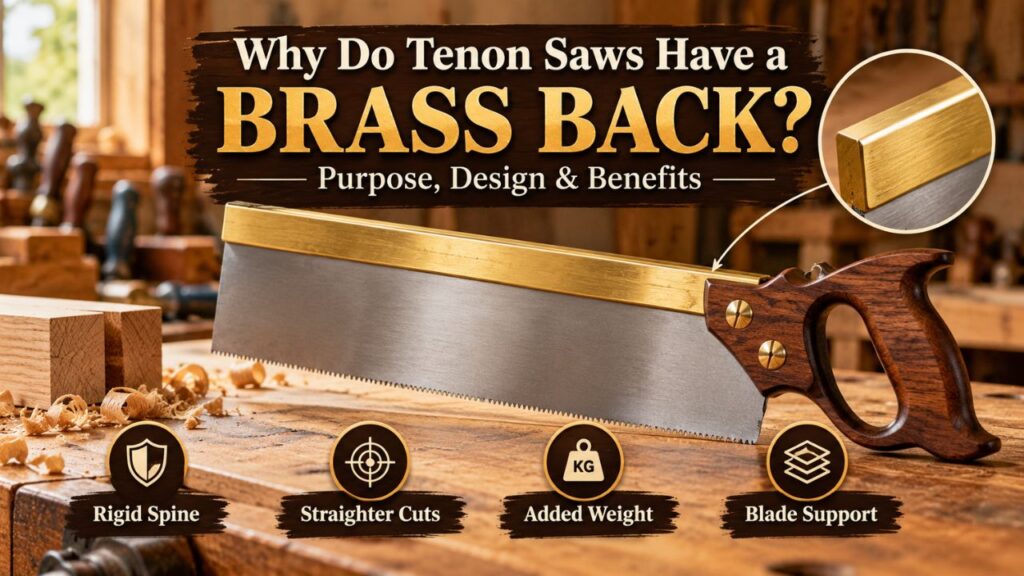
Tenon saws have a rigid back primarily because their blades are thin, deep, and designed for precision.
A Western tenon saw cuts on the push stroke. During that forward stroke, the blade is placed partly under compression. A very thin unsupported blade can flex sideways or buckle if it is pushed incorrectly.
The reinforced spine along the top edge dramatically increases the blade’s stiffness.
That lets a tenon saw use a relatively thin steel plate while still remaining controllable.
The brass back also adds mass near the top of the blade. Rather than forcing the saw downward, the user can let the weight of the tool contribute naturally to the cut.
This combination of a thin plate and heavy rigid spine is one of the reasons a good tenon saw can feel both precise and substantial at the same time.
What the Brass Back Does
The back has several jobs working together:
| Function | Why It Matters |
| Stiffens the blade | Reduces unwanted bending and buckling |
| Supports a thin saw plate | Allows a narrower, more precise kerf |
| Adds weight | Helps the teeth cut without excessive downward force |
| Improves balance | Makes controlled long strokes easier |
| Helps maintain blade geometry | Keeps the plate aligned along the toothline |
| Limits maximum cut depth | The workpiece eventually contacts the back |
The first two functions are the most important.
A tenon saw would not suddenly become useless if its brass back were replaced with another suitably rigid material. What matters structurally is that the blade has an effective spine.
Key Takeaways:
- The back primarily stiffens a thin blade so it can make precise cuts.
- Added weight helps the saw work without excessive downward pressure.
- Brass is traditional and practical, but the saw’s performance comes mainly from having a rigid spine.
Why Does a Tenon Saw Need Such a Stiff Blade?
A tenon saw is intended for controlled joinery rather than rough carpentry.
When cutting a tenon cheek, you may be following a marked line only a small distance from the final surface. A slight wandering cut can make the joint loose, crooked, or difficult to assemble.
A stiff blade helps the saw maintain its plane during the stroke.
That does not mean the brass back automatically forces the saw to cut straight. Your grip, stance, tooth sharpening, saw set, and starting technique still matter.
However, a stiff blade is much easier to guide accurately than an extremely flexible blade being pushed through the work.
The Blade Can Be Thinner Because of the Back
This is a major advantage.
If a saw blade had no supporting spine, it would generally need more plate stiffness of its own to resist bending. One way to obtain that stiffness would be to make the steel thicker.
A thicker blade creates a wider kerf and removes more wood.
For precision joinery, manufacturers usually want the opposite: a thin plate with a relatively narrow kerf.
The back allows them to combine those two apparently conflicting properties:
Thin blade + high stiffness
That is one of the defining characteristics of a backsaw.
Why Is the Back Usually Brass?
Brass became a traditional material for backsaw spines because it offers a useful combination of weight, rigidity, workability, durability, and appearance.
It is not simply decorative.
Brass Adds Useful Mass
Brass is relatively dense, so a brass spine gives the saw noticeable weight without requiring an enormous piece of material.
That mass is positioned along the upper portion of the blade.
When the saw is sharp and properly used, you should not need to press hard into the wood. The mass of the tool helps carry it through the cut while your hand concentrates on guiding the stroke.
This can make a substantial tenon saw feel smoother than its size initially suggests.
Too much downward pressure is actually counterproductive. It can make a backsaw harder to start and easier to steer away from the line.
Brass Is Easy to Work and Machine
Brass can be formed, folded, slotted, milled, filed, and polished relatively easily.
That is useful for traditional saw construction.
Historical-style backs may be formed around the upper edge of the saw plate, while modern premium backs can be machined with a slot that receives the steel blade.
Both designs need close, consistent contact between the spine and plate.
Brass is well suited to that kind of manufacturing.
Brass Resists Red Rust
Brass can tarnish and develop a darker patina over time, but it does not develop red iron rust in the same way ordinary carbon steel does.
That does not mean a brass-backed saw requires no maintenance. The saw plate itself is normally carbon steel and can rust if neglected.
Still, brass makes a durable spine material for a hand tool expected to last for decades.
Brass Looks Traditional
Appearance matters too, particularly on premium hand tools.
A polished or naturally aged brass spine paired with a hardwood handle gives a tenon saw the classic appearance associated with traditional Western joinery saws.
Many woodworkers simply like that aesthetic.
But appearance should be viewed as an additional benefit rather than the main reason for the back.
A saw with a steel or composite spine can perform every bit as seriously as a brass-backed one if the overall design is good.
How the Brass Back Helps a Tenon Saw Cut Straight
It is common to hear that the brass back “keeps the saw straight.”
That statement is broadly correct, but it needs qualification.
The back keeps the blade stiff and in plane. It does not act like a track or fence that mechanically forces the teeth along your layout line.
A badly started cut can still wander.
A poorly sharpened saw can still pull to one side.
And a user twisting the handle can still steer the saw away from the intended line.
What the rigid spine does is remove much of the unwanted flex that would otherwise make precise control more difficult.
Stiffness Makes Steering More Predictable
A flexible blade can bend between your hand and the toothline.
That means movement at the handle does not always translate predictably to the teeth.
With a stiff backsaw, blade and handle behave more like one controlled unit.
When you make a small correction, the entire tool responds more consistently.
For joinery work, that predictability is extremely valuable.
The Back Also Provides a Visual Reference
The long, straight spine gives you another surface to observe while sawing.
When cutting a tenon cheek, for example, you can use the orientation of the saw and spine to help judge whether the blade remains upright.
This does not replace layout lines, but it provides additional visual feedback.
Key Takeaways:
- The brass back improves straight cutting by making the blade rigid and predictable.
- It does not automatically correct a poor start or badly sharpened teeth.
- Good technique and correct saw setup remain just as important as blade stiffness.
Why Tenon Saws Use Thin Blades
Precision is the main reason.
A thinner saw plate normally requires a narrower kerf than a thick carpentry saw, provided the tooth set is also appropriately controlled.
That produces several advantages when cutting joinery.
Less wood is removed, so it is easier to work close to a layout line. A narrower kerf also requires less material removal with each stroke.
For tenons, where two cheeks must often remain parallel and accurately positioned, that can make fitting the joint easier.
The reinforced back makes this thin plate practical on a Western push saw.
Why Not Just Make the Blade Thicker?
You could make the entire blade thick enough to be self-supporting.
Large conventional handsaws do exactly that to varying degrees.
But you would lose some of the qualities desired in a fine joinery saw.
A thicker plate is heavier throughout its entire depth and generally requires a wider kerf. It can also feel less delicate when making small corrections.
The backsaw solution places the reinforcing material where it provides considerable stiffness—the top edge—while leaving the cutting portion of the blade thin.
Does the Brass Back Make the Saw Heavier?
Yes, intentionally.
A substantial brass-backed tenon saw may feel surprisingly heavy when you first pick it up.
That is not necessarily a disadvantage.
The weight contributes to the way a traditional Western backsaw cuts.
With sharp teeth, the tool should require only modest downward pressure. The saw’s own weight helps keep the teeth engaged with the wood.
Your job becomes primarily to guide the blade forward and backward while maintaining the correct line and angle.
Heavy Does Not Mean Harder to Use
Tool weight and user effort are not the same thing.
A light saw that requires you to press hard can be more tiring and difficult to control than a heavier saw that cuts under its own mass.
Balance matters more than the number on a scale.
A properly designed tenon saw positions the handle, blade, and back so the tool feels controllable despite its weight.
This is one reason high-quality traditional tenon saws can feel smoother in use than their substantial appearance suggests.
Why Is the Back at the Top of the Blade?
The back must stay away from the teeth so they can enter the wood while still reinforcing the blade.
Positioning the spine along the top edge also allows the blade beneath it to remain thin.
However, this creates one unavoidable limitation:
The back limits the maximum depth of cut.
Once the workpiece reaches the brass spine, the saw cannot cut any deeper.
That is why tenon saws are designed with different blade depths.
A small dovetail saw may have a relatively shallow plate because dovetails rarely require deep cuts. A large tenon saw has considerably more clearance beneath the back because tenon cheeks can be much deeper.
Blade Depth Is Part of Choosing a Tenon Saw
If you frequently cut large tenons, make sure the distance from the toothline to the back is sufficient for your work.
A beautiful brass-backed saw with insufficient cutting depth will simply bottom out before the cut is finished.
This is not a flaw in backsaw design. It is an inherent tradeoff for the rigidity provided by the spine.
Brass Back vs Steel Back
Not every traditional-looking backsaw uses brass.
Steel is another effective spine material.
From a purely structural perspective, both can provide the necessary blade support when designed correctly.
Advantages of Brass
Brass provides substantial weight, good machinability, resistance to red rust, and the classic appearance many woodworkers prefer.
Its added mass can contribute to the traditional feel of a tenon saw.
Advantages of Steel
Steel can provide excellent rigidity and may allow a manufacturer to achieve a particular balance or construction style without using as much material.
It can also be less expensive depending on manufacturing methods.
A well-designed steel-backed tenon saw should not be considered inferior simply because the back is not brass.
Which One Cuts Better?
I would not choose a saw based on brass versus steel alone.
Tooth geometry, sharpening quality, plate thickness, tooth set, handle comfort, balance, and overall manufacturing quality have a greater influence on how well the saw performs.
If two otherwise excellent saws differ only in back material, personal preference may be the deciding factor.
Can a Tenon Saw Have a Non-Metal Back?
Yes.
Modern sawmakers have demonstrated that a backsaw spine does not have to be made from brass or conventional steel.
Composite materials can be engineered to provide stiffness while incorporating enough mass for proper balance.
That reinforces an important point:
A tenon saw needs an effective spine; it does not specifically require brass.
Modern materials may offer advantages in manufacturing consistency, corrosion resistance, or weight distribution.
Some woodworkers prefer traditional brass because they enjoy the look and feel. Others care only about cutting performance.
Both approaches are reasonable.
Folded Brass Back vs Slotted Brass Back
Brass-backed saws can be constructed in different ways.
Two terms you may encounter are folded back and slotted or milled back.
Folded Back
In a traditional folded design, brass is formed around the upper edge of the saw plate.
The back grips the blade through the way the material is folded and tensioned around it.
This construction is strongly associated with historical Western backsaws.
Slotted or Milled Back
A modern spine can be made from a solid brass bar with a narrow slot machined into it.
The saw plate fits into that slot and can be secured by friction, adhesive, mechanical fastening, or another method depending on the maker.
Both approaches can produce an excellent saw.
For the user, how securely and accurately the back holds the blade matters more than whether the saw follows one construction tradition or another.
Does a Brass Back Prevent the Blade From Bending?
It greatly reduces normal flex, but it cannot make a saw indestructible.
The steel plate beneath the back is still thin.
If you twist the saw aggressively, force it sideways in a kerf, drop it, or try to correct a badly misaligned cut by bending the blade, you can damage the plate.
A large tenon saw can actually have a considerable area of thin unsupported blade between the toothline and the spine.
Treat it as a precision tool rather than a demolition saw.
Let the Saw Cut
A well-sharpened tenon saw should not require forceful pushing.
If you are pressing hard enough that the blade repeatedly buckles or chatters, something is wrong.
Possible causes include dull teeth, poor starting technique, an overly aggressive rake, excessive pressure, or binding in the kerf.
The brass back gives the blade support, but correct technique still matters.
Does Brass Affect the Sharpness of the Saw?
No.
The brass back does not sharpen the teeth and does not directly determine tooth geometry.
The cutting performance at the toothline depends mainly on factors such as tooth pitch, rake, fleam, set, and sharpening quality.
A poorly sharpened saw with an expensive brass spine will still cut poorly.
Likewise, a correctly sharpened saw with another type of rigid spine can perform extremely well.
The back and teeth perform different jobs:
The back controls blade stiffness and contributes to balance.
The teeth do the actual cutting.
Understanding that distinction helps when comparing tenon saws.
Does a Brass Back Improve Accuracy?
Yes, but indirectly.
The increased stiffness makes the tool easier to control accurately, particularly during long joinery cuts.
The narrow plate and predictable tracking also make it easier to follow a marked line.
However, accuracy ultimately depends on the complete saw and the person using it.
A well-tuned tenon saw should have:
- Straight blade alignment
- Consistent tooth set
- Sharp teeth
- Suitable tooth geometry
- Comfortable handle alignment
- Balanced spine weight
If any of these factors are badly wrong, brass alone cannot fix the saw.
Key Takeaways:
- Brass improves accuracy by supporting a thin, rigid, predictable blade.
- The back does not determine tooth sharpness or automatically force the saw along a straight line.
- Overall saw design and sharpening quality matter more than back material alone.
Are All Tenon Saw Backs Made of Brass?
No.
You may encounter tenon saws with:
- Brass backs
- Steel backs
- Composite spines
- Other proprietary reinforcing systems
Brass remains especially common on premium traditional-style Western saws because of its appearance, density, and historical association with quality backsaws.
Modern manufacturers sometimes choose alternative materials to achieve a different weight, balance, production method, or price.
There is nothing technically wrong with that.
When buying a saw, I would pay more attention to how it feels and cuts than whether the spine has the traditional golden color.
Why Do Some Tenon Saws Have a Bigger Brass Back Than Others?
Back dimensions influence both rigidity and weight.
A large tenon saw has a long, relatively deep blade, so the spine has more blade area to stabilize than the back of a small dovetail saw.
The maker also uses spine dimensions to tune the balance of the saw.
A heavier back can make the tool feel more substantial and allow the user to apply very little downward force.
However, a back that is unnecessarily heavy could make the saw feel cumbersome.
Good design is therefore a balance between stiffness, weight, blade dimensions, and intended use.
This is one reason you cannot judge a tenon saw simply by comparing how much brass each one contains.
What Are the Disadvantages of a Brass-Backed Tenon Saw?
The brass back provides important advantages, but the design involves tradeoffs.
The most obvious is cutting depth. You can cut only until the workpiece reaches the back.
Brass also adds weight. Many users consider that weight beneficial, but someone accustomed to lightweight pull saws may initially find a large Western tenon saw heavy.
A brass-backed saw can also cost more to manufacture than a simple stamped saw without a spine.
Finally, brass requires occasional cosmetic care if you want it to remain bright and polished. Untreated brass naturally tarnishes over time.
None of these disadvantages outweighs the structural benefit for a traditional tenon saw, but they explain why different saw styles exist.
Brass-Backed Tenon Saw vs Japanese Joinery Saw
Comparing these tools highlights why blade design matters.
Traditional Western tenon saws cut primarily on the push stroke, while Japanese joinery saws generally cut on the pull stroke.
Pulling naturally places the blade in tension, allowing Japanese saws to use extremely thin plates.
Many Japanese dozuki-style joinery saws still use a rigid spine because additional stiffness is useful for precision work.
The important difference is that the two traditions achieve control through different combinations of blade tension, plate thickness, tooth geometry, and reinforcement.
Neither approach is automatically more accurate.
The better choice depends on which cutting action and handle style you prefer.
Should You Polish a Brass Saw Back?
You can, but you do not have to.
Brass naturally develops a patina as it ages.
That discoloration does not normally affect the saw’s performance.
Some woodworkers prefer a bright polished spine, while others like the aged appearance.
If you decide to clean the brass, avoid aggressive methods that could damage the saw plate, handle, finish, or maker’s markings.
For routine maintenance, I would focus more on keeping the steel blade dry, clean, and rust-free than on maintaining cosmetic shine on the brass.
Can the Brass Back Come Loose?
It can happen, particularly on an old, damaged, or poorly constructed saw.
Symptoms may include visible movement between the blade and spine, rattling, unusual vibration, or a blade that no longer appears properly aligned.
A loose back can affect how the saw tracks because the spine is supposed to support and stabilize the plate.
Repair depends on how the saw was constructed.
A traditional folded back may require different correction from a modern slotted back.
For a valuable vintage saw, I would avoid randomly hammering or clamping the spine without understanding its construction. Improper adjustment can kink the plate or distort the back.
FAQs about Why Do Tenon Saws Have a Brass Back
What is the brass part on a tenon saw called?
It is normally called the back, spine, or saw back.
The reinforced spine is what makes the tenon saw a type of backsaw.
What is the main purpose of the brass back?
Its primary purpose is to stiffen the thin saw blade.
The extra rigidity helps the saw resist flexing and makes precise joinery cuts easier to control.
Does the brass back make a tenon saw cut straighter?
It helps by keeping the blade rigid and predictable.
However, proper sharpening, tooth set, starting technique, and user control are still necessary for a straight cut.
Why not make the entire blade thicker?
A thicker blade could provide more stiffness, but it would generally produce a wider kerf and remove more wood.
A reinforced back lets the cutting portion of the blade remain thin while still providing high overall rigidity.
Does the brass make the saw heavier?
Yes.
That added mass is normally intentional. A properly balanced tenon saw can use its own weight to keep the teeth working, reducing the need for heavy downward pressure.
Is brass better than steel for a saw back?
Not universally.
Both materials can make excellent backsaw spines. Brass offers traditional appearance, useful weight, and good workability, while steel can provide excellent rigidity.
Overall saw design matters more than the back material alone.
Why do some tenon saws have steel backs?
Steel provides the same basic function: reinforcing the blade.
Manufacturers may choose it because of design goals, cost, weight, manufacturing method, or tradition.
Can a tenon saw work without a back?
A saw can certainly cut wood without a back, but it would no longer have the same backsaw design.
An unsupported blade would generally need enough thickness or tension to remain stable during use.
Why is there a limit to how deep a tenon saw can cut?
The rigid back eventually contacts the workpiece.
The distance between the toothline and the spine determines the saw’s maximum cutting depth.
Are brass-backed saws better quality?
Not automatically.
Brass is commonly associated with traditional premium saws, but the material itself does not guarantee quality.
Blade steel, tooth geometry, sharpening, handle design, balance, and manufacturing accuracy are equally important.
Does the brass back stop the blade from buckling?
It greatly increases resistance to bending and buckling, which is particularly useful on a thin Western push saw.
The exposed portion of the blade can still bend if the tool is badly misused.
Do dovetail saws also have brass backs?
Many traditional dovetail saws use brass or steel backs for the same basic reason: a thin precision blade benefits from reinforcement.
Dovetail saws are normally smaller and shallower than tenon saws.
Why is a tenon saw heavier than a regular handsaw?
A tenon saw carries a substantial reinforcing spine along the top of its thin blade.
That spine adds considerable mass, while a conventional handsaw relies more heavily on the stiffness of the blade itself.
Does the brass back need maintenance?
Very little for functional purposes.
Brass can tarnish, but tarnish does not normally affect cutting performance. The carbon-steel blade deserves more attention because it can rust.
Is a heavier tenon saw better?
Not automatically.
A useful amount of weight helps the saw cut smoothly, but balance is more important than maximum weight.
A well-designed saw should feel stable and controllable rather than simply heavy.
Conclusion
So, why do tenon saws have a brass back? The main reason is to reinforce the thin saw plate, giving it the stiffness needed for accurate, controlled joinery cuts. The back allows a tenon saw to use a relatively thin blade and narrow kerf without becoming excessively flexible during the push stroke.
Brass also contributes useful weight. A properly sharpened brass-backed saw can rely partly on its own mass to engage the wood, allowing the user to concentrate on guiding the cut rather than pressing hard on the teeth.
Brass became a traditional choice because it is dense, durable, workable, resistant to red rust, and visually attractive. However, I would not assume that brass automatically makes one saw better than another. Steel and modern composite spines can perform the same structural job extremely well.
The biggest tradeoff is that the rigid back limits how deeply the blade can enter the workpiece. That is why a large tenon saw has more blade depth below the spine than a small dovetail saw.
For most woodworkers, the practical takeaway is simple: the back is what lets a tenon saw combine a thin precision blade with the stiffness and control required for accurate joinery. Brass is the traditional material that also gives the tool its characteristic weight, balance, and classic appearance, but good tooth geometry, sharpening, and overall saw design remain just as important as the material of the spine.