Does Laminate Flooring Dull Saw Blades? Blade Wear Explained
Yes, laminate flooring does dull saw blades, often noticeably faster than ordinary solid wood. Laminate combines a hard, abrasion-resistant wear layer with a dense fiberboard core, so every cut puts considerable wear on the blade’s cutting edges. A good carbide-tipped blade can still handle a substantial flooring project, but you should expect it to lose sharpness faster than it would when cutting normal lumber.
That does not mean laminate flooring will immediately ruin a blade. Blade life depends on the blade material, tooth design, flooring construction, number of cuts, whether you are crosscutting or ripping, and how aggressively you feed the plank through the saw.
For occasional DIY flooring work, I recommend a sharp carbide-tipped finish or laminate blade rather than an inexpensive plain-steel blade. If you regularly install laminate, a purpose-built laminate blade with abrasion-resistant carbide—or even a PCD blade for high-volume professional work—can make much more sense.
In this guide, I’ll explain why laminate is so hard on saw blades, how quickly blades wear, which blade types perform best, how different saws are affected, how to recognize a dull blade, and what you can do to extend blade life during a flooring installation.
Does Laminate Flooring Dull Saw Blades Faster Than Wood?
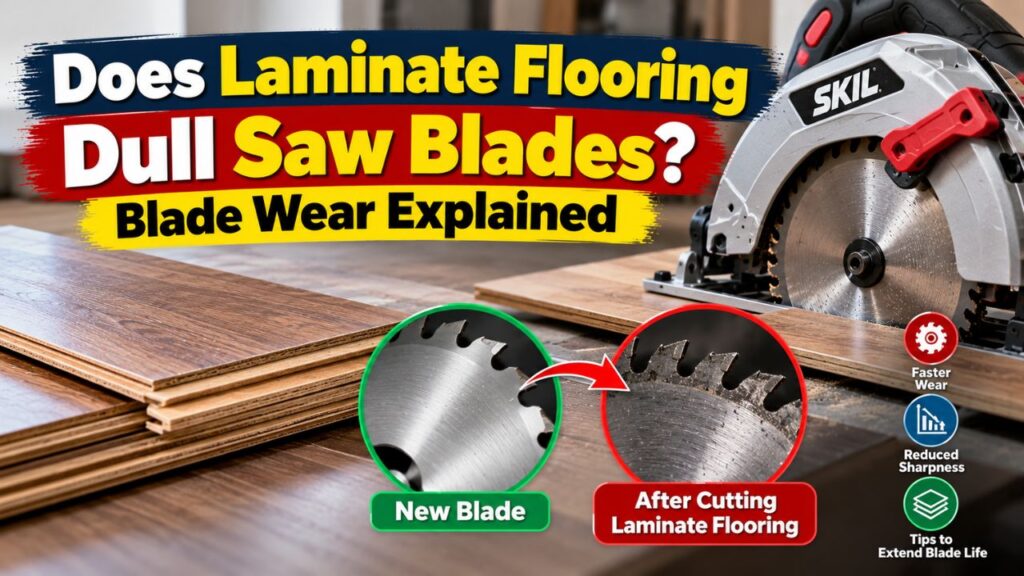
Yes. In most cases, laminate is significantly harder on saw teeth than ordinary softwood and many hardwoods.
The reason is not simply that laminate feels hard.
A laminate plank is an engineered layered product. It normally contains a protective wear layer, decorative surface, dense wood-fiber core, and backing layer. The upper surface is specifically designed to withstand abrasion from foot traffic, dirt, furniture, pets, and repeated cleaning.
That same abrasion resistance also acts against a saw blade.
Many laminate products use extremely hard mineral materials in their wear surfaces. Aluminum oxide, for example, is commonly associated with abrasion-resistant laminate finishes. Materials like this help flooring survive years of wear, but they can also gradually round off the microscopic cutting edges on saw teeth.
The core adds another source of wear.
Most traditional laminate flooring contains a dense HDF or similar fiberboard core made by compressing wood fibers with resin under high pressure. This is much more uniform and abrasive than cutting a piece of ordinary pine.
A saw blade therefore has to cut through both a highly durable surface and a dense manufactured core during every pass.
Why You May Not Notice the Wear Immediately
Blade wear is gradual.
The first several planks may cut beautifully. After dozens or hundreds of cuts, you may begin noticing that the saw requires slightly more pressure or produces a rougher edge.
Because the decline happens slowly, many installers do not realize how dull the blade has become until they replace it and immediately notice how much easier the new blade cuts.
Key Takeaways:
- Laminate flooring generally dulls saw blades faster than ordinary lumber.
- The hard wear surface and dense engineered core are responsible for most of the additional blade wear.
- A good carbide blade can still complete many cuts before performance becomes unacceptable.
Why Laminate Flooring Is So Abrasive
To understand blade life, it helps to understand what the saw tooth actually encounters.
The Wear Layer
The upper wear layer protects the printed decorative surface underneath.
It must resist scratching and abrasion during normal household use. That durability makes it relatively unfriendly to cutting edges.
A saw tooth hits this layer at high speed, cuts through it, enters the dense core, and then passes through the backing.
Multiply that process across dozens of teeth and hundreds of flooring cuts, and edge wear becomes unavoidable.
The Fiberboard Core
HDF is dense and contains both wood fibers and bonding resins.
The compressed structure can generate more friction than normal lumber.
Engineered wood products also tend to wear cutting edges more quickly than clean solid wood because their density and resin content are more consistent across the entire cut.
Surface Contamination
Jobsite dust can make things worse.
Laminate installed or stored on a renovation site may collect small amounts of grit. Dirt and mineral particles on the surface act as additional abrasives when they pass beneath the blade.
Wiping dirty planks before cutting may seem unnecessary, but it can help protect both cut quality and blade life.
How Quickly Does Laminate Flooring Dull a Saw Blade?
There is no reliable answer such as “one blade lasts 500 cuts.”
Blade life varies too much.
A homeowner cutting laminate for one small bedroom may complete the entire installation with one quality carbide blade and still have acceptable cutting performance afterward.
A contractor installing hundreds or thousands of square feet may go through multiple carbide blades or use longer-lasting specialty tooling.
What Determines Blade Life?
The biggest variables are blade quality, flooring construction, cut length, tooth material, and cutting technique.
A short crosscut across a 7-inch plank exposes the blade to relatively little material.
A 4-foot rip cut along the entire plank exposes the blade to several times more flooring.
That is why table-saw and circular-saw blades used for repeated rip cuts may show wear faster than a miter-saw blade used mainly to shorten plank ends.
Small Room vs. Whole-House Installation
For a small bedroom, one decent carbide blade may be enough.
For several rooms, replacing or sharpening the blade during the project becomes more likely.
For professional installation, I would treat blades as normal consumable equipment rather than expecting one general-purpose blade to remain sharp indefinitely.
Flooring Type Also Matters
Not all laminate products have identical wear layers or core densities.
Thickness, AC wear rating, surface formulation, and manufacturing method can all affect how demanding the material is to cut.
However, I would not try to calculate blade life from AC rating alone. Two laminate products with similar wear classifications may still behave differently when cut.
What Type of Saw Blade Is Best for Laminate Flooring?
The best choice for most users is a carbide-tipped blade designed for laminate, melamine, plywood, or fine-finish cutting.
Carbide holds an edge much longer than ordinary steel when exposed to abrasive materials.
Carbide-Tipped Blades
For a typical homeowner, carbide provides the best combination of cost, availability, longevity, and cut quality.
A standard fine-finish carbide blade can work very well.
A blade specifically marketed for laminate or composite materials is even better if you are installing multiple rooms.
Triple-Chip-Grind Blades
A triple-chip grind, commonly called TCG, is especially useful for hard laminated materials.
Instead of every tooth having identical geometry, the blade alternates tooth shapes so the cutting load is shared differently across the teeth.
This tooth design is commonly used for laminate, melamine, plastics, and other hard or abrasive sheet materials.
If I were buying one blade specifically for a substantial laminate installation, a quality carbide TCG blade would be near the top of my list.
PCD Blades
PCD means polycrystalline diamond.
PCD cutting edges are dramatically more wear resistant than conventional carbide when cutting abrasive materials.
The drawback is cost.
For a homeowner installing one room, paying for PCD usually makes little economic sense.
For a professional installer who cuts laminate regularly, the much longer service life can offset the higher initial price.
Blade Types Compared
| Blade Type | Laminate Performance | Wear Resistance | Best Use |
| Plain steel | Poor | Low | Not recommended |
| General carbide | Good | Moderate | Small DIY projects |
| Fine-finish carbide | Very good | Moderate to good | Home flooring installation |
| Laminate-specific TCG | Excellent | Good to very good | Large laminate projects |
| PCD | Excellent | Extremely high | Professional/high-volume work |
Key Takeaways:
- Carbide-tipped blades are the practical minimum I recommend for laminate.
- TCG tooth geometry is particularly well suited to hard laminated materials.
- PCD is usually most economical for professionals who make large numbers of cuts.
Does Tooth Count Matter?
Yes, but more teeth are not automatically better in every situation.
A higher tooth count generally gives you a smoother cut because each tooth removes less material.
A lower tooth count generally cuts faster and clears material more aggressively.
Laminate benefits from relatively fine teeth because the decorative surface can chip.
Circular Saw
For a common 7-1/4-inch circular saw, a blade in roughly the 40- to 60-tooth range is a good starting point for clean laminate cuts.
A dedicated laminate or finish blade is preferable to a coarse 24-tooth framing blade.
Miter Saw
Miter saws are often used for crosscutting laminate planks.
A 60- to 80-tooth or similarly fine finish blade is commonly appropriate depending on blade diameter and manufacturer design.
Because crosscuts are short, a quality miter-saw blade can often make many flooring cuts before becoming unusably dull.
Table Saw
A table saw is especially useful for ripping the first and last rows.
I would choose a fine carbide or TCG laminate blade.
Long rip cuts are demanding, so blade durability matters more here than it does during occasional short crosscuts.
Jigsaw
Jigsaws use smaller, inexpensive blades, so replacing them during the project is normal.
Choose a blade specifically designed for laminate, clean wood cutting, or abrasive flooring.
If your jigsaw starts wandering or tearing the surface, replacing the blade is usually more productive than forcing it through additional planks.
Can You Use a Regular Wood Blade on Laminate?
Yes, as long as it is a suitable carbide blade.
You do not always need to buy a dedicated specialty blade for a few flooring cuts.
A sharp carbide finish blade can cut laminate quite well.
The bigger problem is using a coarse construction blade simply because it happens to be installed on your saw.
A 24-tooth framing blade on a circular saw may cut the plank quickly, but it is more likely to leave chipped edges and a rough surface.
If every cut will be concealed beneath baseboard, that may be acceptable for a small job.
For a full installation, I would switch to a finer blade.
Should You Use Your Best Woodworking Blade?
I usually would not.
If you own an expensive blade reserved for furniture making or cabinet work, laminate flooring is not where I would choose to wear it out.
Buy a separate flooring blade.
The additional cost is small compared with prematurely dulling a high-quality blade that you rely on for precision hardwood cuts.
Does Laminate Flooring Dull Circular Saw Blades?
Yes.
Circular saws are often used for both crosscuts and long rip cuts, making them one of the blades most exposed to laminate during a flooring project.
A circular saw may also be used for tapering the last row along an uneven wall.
Those long cuts add up quickly.
If your project is large, I recommend starting with a fresh or freshly sharpened carbide blade and keeping a spare available.
Once the blade becomes dull, do not compensate by pushing harder.
More feed pressure can increase chipping, heat, and the risk of the saw wandering away from your cut line.
Does Laminate Flooring Dull Miter Saw Blades?
Yes, although a miter saw blade may appear to last longer because it normally makes short crosscuts.
The blade still passes through the same abrasive surface and core.
If you use a miter saw to cut hundreds of boards, blade wear will eventually become obvious.
A dedicated miter-saw flooring blade is worthwhile if you regularly work with laminate.
For a one-room project, a sharp finish blade may be enough.
Does Laminate Flooring Dull Table Saw Blades?
Yes, and repeated ripping can be especially demanding.
A table saw might cut the full 4-foot length of each plank when narrowing the first or last row.
Even if you make relatively few rip cuts, the total amount of laminate passing through the blade can be substantial.
Use a sharp carbide blade and keep the flooring flat against the table and fence.
Do not continue using the blade once you need excessive feed pressure to move the plank through it.
Does Laminate Flooring Dull Jigsaw Blades?
Yes.
Jigsaw blades can wear fairly quickly on laminate because the teeth are relatively small.
A jigsaw is commonly used for notches, vents, corners, door jambs, pipes, and other irregular shapes.
Fortunately, replacement blades are inexpensive.
For a whole-room installation, I recommend keeping several appropriate blades nearby.
A worn blade tends to wander sideways and can produce an angled cut through the thickness of the plank even if you follow the line correctly on top.
How to Tell if Your Laminate Saw Blade Is Dull
One of the clearest signs is increased cutting effort.
A sharp blade should move through laminate with relatively little resistance.
If you suddenly find yourself pushing harder, inspect the blade.
Cut quality also begins to deteriorate.
You may see more chipping along the decorative surface or a rougher fiberboard edge.
Excessive heat is another warning sign. The plank edge may show darkening, melting of certain surface materials, or a slightly burned smell from the core.
The saw itself may also sound different because the motor is working harder.
Dull Blade vs. Dirty Blade
Do not automatically throw the blade away.
Resin, adhesive, and fine composite dust can accumulate around the teeth and make a blade cut poorly even when the carbide edge still has useful life.
Remove the blade and clean it according to the blade manufacturer’s instructions.
If cutting performance returns, buildup was probably the main issue.
If the blade still requires excessive force or produces a poor edge, the carbide is likely worn.
Does a Dull Blade Damage Laminate Flooring?
It can.
As a blade loses sharpness, each tooth stops shearing the surface as cleanly.
Instead, the tooth begins applying more crushing and tearing force.
This can produce chipped decorative edges.
A dull blade also requires more feed pressure, making it easier for the plank or saw to shift during the cut.
On a table saw, excessive pushing can reduce control.
On a circular saw, the blade may wander away from a straight guide if you try to force it.
On a jigsaw, a dull blade can deflect sideways.
The result may be a plank that no longer fits properly even though your original measurement was accurate.
How to Extend Saw Blade Life When Cutting Laminate
You cannot prevent wear, but you can avoid wearing the blade faster than necessary.
Start with a blade designed for abrasive sheet material.
Keep it clean and inspect it periodically instead of waiting until it becomes extremely difficult to cut.
Support each plank properly so it does not vibrate.
Feed the material smoothly. Do not force it through the blade, but do not move so slowly that the teeth spend unnecessary time rubbing and generating heat.
Keep dirt off the planks before cutting.
Finally, do not use a saw for cuts that another tool can make more efficiently.
If your laminate and flooring cutter are compatible, a manual flooring cutter can handle repeated crosscuts without consuming saw-blade life at all.
A jigsaw can handle notches while the table saw handles rips.
Dividing the work across appropriate tools reduces wear on your primary blade.
Key Takeaways:
- Keep the blade sharp, clean, and properly matched to the flooring.
- Smooth feeding and stable plank support reduce unnecessary heat and tooth wear.
- Using a manual flooring cutter for suitable cuts can significantly reduce saw-blade use.
Can You Sharpen a Blade After Cutting Laminate?
Many quality carbide-tipped saw blades can be professionally sharpened.
A sharpening service grinds the carbide teeth back to their proper cutting geometry.
Whether this makes financial sense depends on blade quality.
A premium laminate or table-saw blade is often worth sharpening.
A low-cost circular-saw blade may be cheaper to replace.
Professional sharpening also allows the technician to inspect the blade for chipped carbide teeth, plate distortion, or other damage.
When a Blade Should Be Replaced
A blade should not simply be resharpened indefinitely.
Replace or professionally inspect it if the blade plate is cracked, warped, heavily overheated, or missing damaged carbide teeth.
Never continue using a physically damaged circular blade merely because some teeth still feel sharp.
Can One Saw Blade Cut a Whole Laminate Floor?
Often, yes.
For one average room, a quality carbide blade can commonly provide enough usable life to finish the job.
That does not mean it will be as sharp afterward as it was before the installation.
For several rooms or a complete house, you should be prepared for replacement or sharpening.
I would keep a spare blade on hand for a large project.
There is little benefit in stopping an installation because a 30–60 consumable blade has reached the end of its useful cutting performance.
The best time to change the blade is when cut quality and effort noticeably deteriorate—not after an arbitrary number of square feet.
Is a Laminate-Specific Blade Worth Buying?
For more than a few cuts, yes.
A dedicated laminate blade generally provides cleaner edges and better resistance to abrasive wear than a basic construction blade.
It also protects the other blades in your workshop.
For a homeowner installing one small closet, buying an expensive specialty blade may be unnecessary.
For a living room, hallway, kitchen, or multi-room project, I consider a dedicated laminate blade a sensible purchase.
For professionals, specialty carbide or PCD blades can reduce blade changes and maintain more consistent cutting quality throughout large installations.
How to Reduce Chipping While Preserving Blade Life
Blade sharpness and chipping are closely connected, but technique matters too.
With a handheld circular saw, determine which plank orientation gives you the cleanest decorative edge and remain consistent throughout the project.
On a table saw or miter saw, support the plank firmly so it cannot vibrate.
Painter’s tape over the cut line can sometimes reduce minor surface breakout, although it cannot compensate for a badly dull blade.
When using a circular saw for long rip cuts, use a straightedge guide rather than trying to steer freehand.
A clean, controlled cut requires less correction and puts less side pressure on the blade.
What About Manual Laminate Cutters?
If blade wear is your main concern, a manual flooring cutter is worth considering.
Compatible laminate cutters shear through the plank using a long lever rather than rotating saw teeth.
They produce much less airborne cutting dust and do not consume circular-saw blade life.
Their main limitation is versatility.
Some cutters make excellent crosscuts but cannot handle long lengthwise rips. Others are designed for both.
Complex curves and notches still require another cutting tool.
For a whole-room installation, a combination of manual cutter, jigsaw, and saw can be extremely efficient.
Common Mistakes That Dull Blades Faster
One of the biggest mistakes is forcing a dull blade through the flooring.
Once cutting resistance noticeably increases, pushing harder creates more heat and accelerates deterioration.
Another mistake is using a dirty blade for the entire job without inspecting it. Buildup around the teeth can dramatically increase friction.
Some DIY installers also use the same premium fine-woodworking blade for laminate and then wonder why it no longer leaves flawless cuts in hardwood.
A dedicated flooring blade solves that problem.
Finally, avoid cutting dirty planks. Sand and grit on the surface can be extremely abrasive to a fine cutting edge.
FAQs about Does Laminate Flooring Dull Saw Blades
Does laminate flooring dull saw blades quickly?
It can. Laminate is more abrasive than ordinary solid wood, so saw teeth typically wear faster. Blade quality, flooring construction, and the amount of cutting determine how quickly performance deteriorates.
Why does laminate flooring dull blades?
The hard wear layer and dense fiberboard core are abrasive. Some wear layers contain very hard mineral materials designed specifically to resist scratches and surface wear.
Will laminate ruin a carbide blade?
Usually not immediately. A good carbide blade can make many laminate cuts, but it will wear faster than it would when cutting normal lumber.
What blade lasts longest when cutting laminate?
PCD blades generally provide the greatest wear resistance, but they are expensive. For most DIY users, a quality laminate-specific carbide or TCG blade provides the best value.
Can I cut laminate with a normal circular saw blade?
Yes, if the blade is sharp and carbide tipped. A fine-tooth finish blade is preferable to a coarse framing blade.
How many teeth should a circular saw blade have for laminate?
For a typical 7-1/4-inch circular saw, approximately 40 to 60 teeth is a useful general range for clean laminate cuts.
What blade should I use on a miter saw?
A fine-tooth carbide finish or laminate blade is ideal. Around 60 to 80 teeth or more is common on many 10- and 12-inch blades designed for clean crosscuts.
Does laminate flooring dull table saw blades?
Yes. Long rip cuts expose the blade to a substantial amount of abrasive material, so table-saw blade wear can be noticeable.
Does laminate dull jigsaw blades?
Yes. Jigsaw blades may need replacement several times during a large project, particularly if you make many notches or irregular cuts.
How can I tell when my blade is dull?
Common signs include increased cutting effort, slower cutting, more chipping, excessive heat, rough edges, or a saw motor that sounds more heavily loaded.
Can a dirty saw blade seem dull?
Yes. Resin and composite dust can build up around teeth and increase friction. Cleaning may restore performance if the carbide itself is still reasonably sharp.
Can a laminate blade be sharpened?
Many quality carbide-tipped blades can be professionally sharpened. Cheap circular-saw and jigsaw blades are usually more economical to replace.
Will a higher AC-rated laminate dull the blade faster?
Not necessarily in a predictable way. AC rating measures surface abrasion resistance, but it does not directly tell you how many cuts a particular saw blade will survive.
Should I buy a spare blade for laminate flooring?
For a large room or multi-room project, yes. Keeping a spare prevents delays if cut quality deteriorates before the installation is finished.
Is a flooring cutter better than a saw for laminate?
For compatible straight cuts, a manual flooring cutter can be faster, quieter, and easier on saw blades. You may still need a saw or jigsaw for long rips, curves, and detailed cuts.
Conclusion
So, does laminate flooring dull saw blades? Yes. Laminate is an abrasive engineered flooring material, and its hard wear layer combined with a dense fiberboard core wears cutting edges faster than ordinary solid wood.
That does not mean you should avoid using a saw. A quality carbide-tipped finish or laminate blade can make plenty of clean cuts and may easily complete a normal DIY flooring project. The key is choosing a blade designed for hard laminated materials rather than relying on a coarse construction blade.
For a small project, a good general carbide finish blade may be enough. For several rooms, I recommend a dedicated laminate blade, preferably with abrasion-resistant carbide and suitable tooth geometry such as a triple chip grind. For professional high-volume flooring work, PCD tooling can provide much longer service life.
Watch the way the blade behaves rather than counting cuts. If you notice increased feed pressure, excessive chipping, slower progress, heat, or rough edges, clean and inspect the blade. Replace or sharpen it when performance no longer returns.
My recommendation is to treat laminate blades as consumable flooring equipment. Using the right blade from the beginning gives you cleaner cuts, protects your saw, and prevents you from prematurely wearing out the blades you rely on for fine woodworking.