What Table Saw Blade for Laminate Flooring? Best Blade Options
If you are wondering what table saw blade for laminate flooring you should use, a sharp carbide-tipped blade with roughly 60–80 teeth is the best choice for most 10-inch table saws, with a laminate-specific 72- to 80-tooth blade being my preferred option for clean cuts. A blade using Triple Chip Grind (TCG) tooth geometry is particularly well suited to abrasive materials such as laminate, melamine, and other hard-faced composite panels.
A standard 40-tooth general-purpose blade can physically cut laminate flooring, but it usually produces more chipping and may not stay sharp as long. Very coarse 24-tooth ripping blades are even less desirable when the decorative edge matters.
Laminate flooring is unusually hard on saw blades. Its wear layer is specifically designed to resist abrasion from years of foot traffic, and the dense fiberboard core adds another demanding material for the teeth to pass through. For that reason, blade quality, carbide grade, tooth geometry, and sharpness matter just as much as tooth count.
You also need to match the blade to your actual table saw. A 10-inch saw commonly uses a 10-inch blade with a 5/8-inch arbor, but you should verify blade diameter, arbor size, maximum RPM, kerf, and riving-knife compatibility before installing any blade.
In this guide, I’ll explain which table saw blade works best for laminate flooring, whether 60, 72, or 80 teeth is better, why TCG blades perform so well, which blades to avoid, how to reduce chipping, and how to get longer blade life during an entire flooring installation.
What Table Saw Blade for Laminate Flooring Is Best?
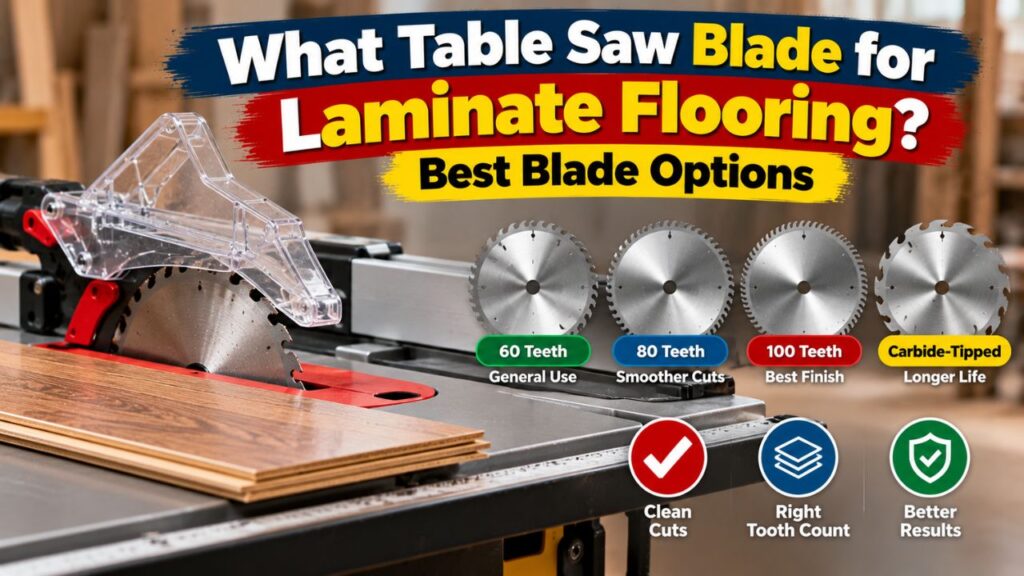
For most laminate-flooring projects, I recommend a carbide-tipped fine-finish or laminate-specific blade with 60–80 teeth on a 10-inch table saw.
If I were buying a blade specifically for a full laminate installation, I would favor a 72- or 80-tooth laminate blade with Triple Chip Grind teeth.
A 60-tooth fine-finish blade is still a very good choice, especially if you want one blade that can also handle plywood, hardwood, and general finish carpentry.
The differences become clearer in this comparison.
| Blade Type | Laminate Flooring Performance | Best Use |
| 24-tooth ripping blade | Poor | Fast ripping of solid lumber |
| 40-tooth general-purpose blade | Acceptable for rough/hidden cuts | Occasional flooring cuts |
| 60-tooth fine-finish carbide blade | Very good | Flooring plus general woodworking |
| 72-tooth laminate/TCG blade | Excellent | Laminate and melamine |
| 80-tooth fine-finish blade | Excellent | Very clean flooring cuts |
| 80-tooth TCG laminate blade | Excellent | Large laminate projects and abrasive panels |
The important point is that you do not need the highest tooth count available.
A purpose-built 72-tooth laminate blade can outperform an inexpensive 100-tooth blade because tooth geometry and carbide quality are better suited to the material.
My Recommendation for Most DIY Installers
For a conventional 10-inch table saw, I would buy either a 72-tooth TCG laminate blade or a high-quality 80-tooth carbide fine-finish blade.
The dedicated laminate blade is my first choice when you expect to cut a large amount of flooring.
The 80-tooth fine-finish blade makes more sense if you want a versatile blade that can remain useful for trim, plywood, and other clean woodworking cuts after the flooring project is finished.
Key Takeaways:
- A 60–80 tooth carbide blade is the practical range for most 10-inch table saws.
- A 72- or 80-tooth laminate-specific TCG blade is my preferred choice for extensive flooring work.
- Blade design and sharpness matter more than simply choosing the highest possible tooth count.
Why Laminate Flooring Needs a Different Blade
Laminate flooring looks like wood, but the material being cut is very different from an ordinary pine or oak board.
Most laminate flooring uses a high-density fiberboard core topped with decorative and protective layers.
The upper wear layer contains materials specifically engineered to resist scratches and abrasion.
That makes the finished floor durable, but it also means the blade teeth are continuously passing through a highly abrasive surface.
Why Ordinary Blades Dull Faster
A general woodworking blade may stay sharp for a long time when cutting soft lumber.
The same blade can lose its edge noticeably faster after cutting dozens or hundreds of laminate planks.
As the carbide becomes dull, several problems appear.
The saw requires more feed pressure. The decorative edge chips more heavily. The cut may begin to burn or discolor. The motor may sound more heavily loaded, and the blade can produce a noticeably rougher edge.
Once you reach that point, increasing feed pressure is not the solution.
A sharp blade is safer and produces better results.
Why Carbide Teeth Are Important
Carbide is considerably harder and more wear-resistant than ordinary steel saw teeth.
That is why virtually every blade I would recommend for laminate flooring uses carbide-tipped teeth.
Even carbide is not immune to laminate wear, but a good carbide blade offers substantially better cutting life.
If you plan to install flooring professionally or frequently, spending more on a high-quality laminate blade can make economic sense because you may get cleaner cuts for longer before sharpening or replacement becomes necessary.
What Does TCG Mean on a Saw Blade?
TCG stands for Triple Chip Grind.
It describes the shape and sequence of the blade teeth.
Rather than every tooth having exactly the same profile, a TCG blade generally alternates between a chamfered tooth that removes material from the center portion of the kerf and a flat-topped tooth that cleans out the remaining material.
This tooth geometry is particularly useful on hard, abrasive manufactured materials.
That is why manufacturers commonly use TCG geometry on blades intended for laminate, melamine, aluminum, plastics, and other demanding panel products.
Why TCG Works Well on Laminate Flooring
A conventional Alternate Top Bevel blade cuts wood fibers extremely well, but the hard surface of laminate can wear the sharp tooth corners relatively quickly.
TCG distributes the cutting work differently and is designed to withstand abrasive materials while maintaining a clean edge.
For a whole-house flooring project, that durability is one of the main reasons I prefer TCG.
Is TCG Required?
No.
You can get excellent laminate cuts from a sharp, high-quality fine-finish blade with another suitable tooth geometry.
An 80-tooth carbide fine-finish blade can work beautifully.
TCG simply gives you an especially good combination of clean finish and durability when laminate is the primary material.
Is a 60-Tooth Blade Good for Laminate Flooring?
Yes. A good 60-tooth carbide blade is one of the most useful options if you need a versatile table-saw blade rather than a dedicated flooring blade.
It provides a cleaner cut than a typical 24- or 40-tooth construction blade while still cutting efficiently.
For many flooring installations, the slight difference in edge quality between a quality 60-tooth blade and an 80-tooth blade will barely matter because the ends of laminate planks are usually hidden under baseboards or molding.
Where an 80-tooth or TCG blade gains an advantage is in particularly chip-prone laminate or where you need the cleanest possible finished edge.
If I already owned a sharp 60-tooth fine-finish blade, I would test it before buying another blade.
If it produces clean cuts, there is no need to change simply because the blade does not have 80 teeth.
Is an 80-Tooth Blade Better for Laminate Flooring?
An 80-tooth carbide blade is an excellent choice for laminate flooring and is often what I recommend for DIY users seeking very clean cuts.
The higher tooth count means each tooth removes a smaller amount of material.
That typically reduces edge breakout and leaves a smoother surface.
An 80-tooth blade is especially attractive for crosscuts and finish-quality work.
For ripping thin laminate flooring, it still performs well because the flooring is not thick enough to create the heat and chip-clearance problems you might encounter when ripping thick hardwood with an ultra-fine blade.
When I Would Choose 80 Teeth
I would choose an 80-tooth blade if the flooring chips easily, if some cut edges will remain visible, or if I also want the blade for fine trim and finish woodworking.
If laminate durability is the overriding priority, I would look beyond tooth count and choose an 80-tooth blade specifically designed for laminates or a comparable 72-tooth TCG model.
Is a 40-Tooth Blade Enough?
A 40-tooth general-purpose blade will cut laminate flooring.
The question is whether you will be satisfied with the result.
For rough end cuts that will disappear underneath baseboard, a sharp 40-tooth carbide blade may be perfectly acceptable.
For example, if you need to rip the first row and the sawn edge will be hidden by trim, minor chipping is primarily cosmetic.
However, I would not choose a 40-tooth blade as my first option for a full flooring project when a finer blade is available.
The harder wear layer can expose the weaknesses of a general-purpose blade quickly.
When a 40-Tooth Blade Makes Sense
If you only need three or four cuts and already have a sharp 40-tooth blade, test it on scrap.
If the edge looks acceptable, use it.
There is no need to purchase a specialty blade for a handful of hidden cuts.
If you are flooring several rooms, the dedicated fine-finish blade becomes a much better investment.
Key Takeaways:
- A 60-tooth blade provides an excellent balance of clean cutting and versatility.
- An 80-tooth blade is preferable when minimizing decorative-surface chipping is the priority.
- A 40-tooth blade works for occasional or hidden cuts but is not my first choice for a large installation.
Should You Use a 100-Tooth Blade?
Not necessarily.
It is tempting to assume that increasing tooth count always creates a better laminate cut.
That is too simplistic.
An extremely high-tooth-count blade may produce a beautiful crosscut when it is designed correctly, but it can also have smaller gullets and clear chips less efficiently.
Blade geometry, hook angle, carbide formulation, body stiffness, and the material for which the blade was designed all matter.
A high-quality 72-tooth TCG laminate blade can easily be a better flooring blade than a cheap 100-tooth blade marketed only for general fine finishing.
I would therefore stop comparing blades solely by tooth count once you reach the normal fine-finish range.
Look for explicit suitability for laminate, melamine, composite panels, or hard-faced sheet goods.
TCG vs. ATB for Laminate Flooring
Two common blade-tooth styles you may encounter are Triple Chip Grind and Alternate Top Bevel.
Triple Chip Grind
TCG is my preferred geometry for extensive laminate work.
Its strengths are durability and consistent cutting performance on abrasive manufactured materials.
This style is frequently found on dedicated laminate and melamine blades.
Alternate Top Bevel
ATB blades alternate the bevel direction of their teeth.
They produce very clean cuts in wood fibers and are extremely common on fine-finish woodworking blades.
A high-quality ATB blade can absolutely cut laminate flooring successfully.
The sharper corners can simply wear faster when subjected to highly abrasive surfaces.
Which Should You Buy?
If you are buying primarily for laminate flooring, I would choose TCG.
If you want a versatile fine-woodworking blade that will occasionally cut flooring, a high-quality ATB fine-finish blade can be a better all-around purchase.
Neither choice is automatically wrong.
What Hook Angle Is Best?
Hook angle describes how aggressively a saw tooth leans forward or backward relative to the blade center.
Table-saw blades frequently use a positive hook angle because the feed direction and machine design allow the teeth to pull through the material efficiently.
Some blades designed for hard laminates use relatively conservative tooth geometry to produce a controlled cut.
You do not need to choose hook angle independently if you buy a reputable blade specifically rated for table-saw use and laminate.
The blade manufacturer has already designed the tooth geometry around the intended application.
What you should avoid is taking a blade designed exclusively for a different type of saw and assuming it is appropriate simply because its diameter and arbor fit.
Blade Diameter and Arbor Size Matter
A blade must physically match your table saw.
A conventional full-size table saw in the United States commonly uses a 10-inch blade with a 5/8-inch arbor, but that is not universal.
Compact and cordless table saws may use 8-1/4-inch or other blade sizes.
Always check the saw manual or the label on the existing blade.
The replacement must match the approved blade diameter and arbor.
Also verify that the blade’s maximum RPM rating is equal to or greater than the saw’s no-load blade speed.
Never modify the arbor hole or install an improperly fitting blade.
What About Blade Kerf?
Kerf is the width of material removed by the blade.
Standard and thin-kerf blades can both be used successfully on many table saws, but riving-knife compatibility is critical.
The blade body must be thinner than the riving knife while the tooth kerf must be wider than the riving knife.
That allows the riving knife to pass through the slot created by the blade without binding.
This is one reason you should not randomly switch to an extremely thin-kerf blade without checking your saw specifications.
A narrow kerf can reduce material waste and cutting resistance, which may be helpful on lower-powered saws, but safety-system compatibility comes first.
Which Side of Laminate Flooring Should Face Up?
When using a conventional table saw, place the finished decorative face upward in most cases.
At the front of the blade, the teeth enter the workpiece from the top and travel downward.
That generally leaves the cleanest edge on the upper surface.
The underside is more likely to experience minor breakout where the teeth exit.
Still, make a test cut.
Some flooring constructions react differently, and the flooring manufacturer’s instructions should override a general rule.
Use a Zero-Clearance Insert
If your table saw accepts one, a zero-clearance throat insert can further reduce chipping.
The insert supports the underside of the laminate directly beside the blade instead of leaving a wide opening around it.
This is especially useful on narrow or delicate pieces.
The insert must be appropriate for your saw and blade setup and should never interfere with the blade, riving knife, or other safety features.
How to Get Chip-Free Laminate Cuts
Start with a sharp blade.
No tape trick or special feed technique can fully compensate for badly worn carbide.
Then make sure the blade is clean. Resin, adhesive residue, and other buildup can increase friction and reduce cutting performance.
Keep the decorative face upward on the table saw, maintain firm contact against the rip fence, and feed the plank at a smooth, consistent rate.
Do not shove the flooring rapidly through the blade, but do not crawl unnecessarily slowly either.
Excessively slow feeding can create heat and burn marks.
If an especially important visible edge still chips slightly, painter’s tape over the cut line can sometimes help hold the surface together during cutting.
A zero-clearance insert provides even better mechanical support close to the teeth.
How High Should the Table Saw Blade Be?
For thin flooring, you normally do not need several inches of blade exposed above the workpiece.
A practical setup is to raise the blade only enough for the teeth and gullets to clear the top surface properly.
Roughly 1/8 to 1/4 inch above thin laminate flooring is commonly used as a working range, although you should follow your table-saw and blade manufacturer’s recommendations.
The exact height is less important than maintaining safe clearance and allowing the blade geometry to work as designed.
Do not remove or lower the riving knife simply because your flooring is thin.
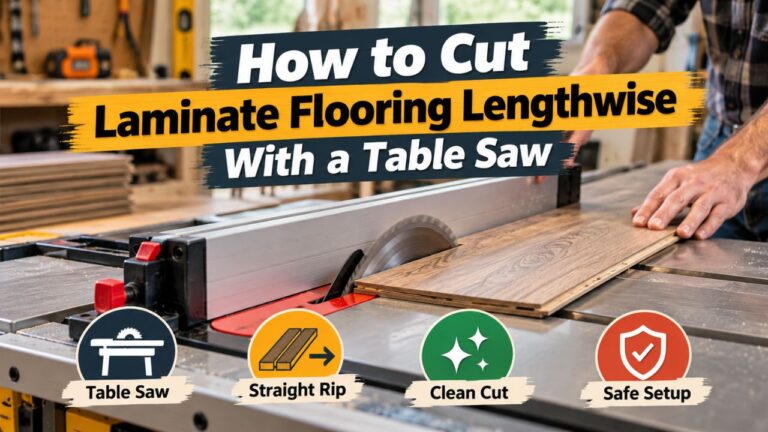
Best Blade for Ripping Laminate Flooring Lengthwise
The table saw is especially useful when you need to narrow the first or final flooring row.
For this application, I would still choose a fine carbide laminate blade rather than switching to a coarse ripping blade.
Traditional woodworking advice favors low-tooth-count blades for ripping thick solid lumber because their large gullets clear chips quickly.
Laminate planks are comparatively thin, and preserving the decorative edge matters.
A 60- to 80-tooth blade can therefore rip laminate flooring very effectively without the chip-clearance problems associated with thick hardwood.
For a large job, the TCG laminate blade remains my preferred option.
Best Blade for Crosscutting Laminate on a Table Saw
If you are crosscutting flooring on the table saw, an 80-tooth fine-finish or laminate blade is an excellent choice.
However, remember that crosscuts should be guided with a miter gauge or crosscut sled, not made by trapping the plank against the rip fence.
A long plank positioned sideways against the fence can bind between the blade and fence and create a kickback hazard.
For repeated flooring crosscuts, I would normally use a miter saw instead.
The table saw is much more valuable for long rips.
Will Laminate Flooring Ruin a Table Saw Blade?
It will not instantly ruin a suitable blade, but laminate flooring does dull carbide faster than normal wood.
How quickly depends on the blade quality, amount of flooring, laminate composition, and cutting technique.
A quality dedicated laminate blade may handle a large installation successfully.
Still, I would not use my most valuable furniture-making blade for hundreds of flooring cuts if I wanted to preserve its edge for fine hardwood work.
Keeping a separate flooring or composite-material blade is a practical approach.
Signs the Blade Is Becoming Dull
The most obvious sign is increased feed resistance.
You may also notice more chipping, a rougher cut, greater noise, excessive heat, or burn marks.
Do not wait until you are forcing the flooring through the blade.
Replace or professionally sharpen a serviceable blade before performance deteriorates severely.
Key Takeaways:
- Laminate flooring is highly abrasive and can dull even carbide blades faster than ordinary lumber.
- A dedicated flooring blade protects your fine woodworking blades from unnecessary wear.
- Increased chipping and feed resistance are good signs that the cutting edge needs attention.
Can You Sharpen a Laminate Flooring Blade?
Many quality carbide-tipped blades can be professionally sharpened.
Whether sharpening makes financial sense depends on the blade’s original quality and replacement cost.
An inexpensive blade may cost nearly as much to sharpen as replace.
A premium blade with substantial carbide teeth can be worth servicing several times.
Do not attempt to reshape carbide teeth casually with a hand file.
The tooth geometry needs to remain consistent around the entire blade for smooth, balanced operation.
Should You Buy a Cheap Blade Just for the Flooring Project?
There are two ways to look at this.
A cheap blade prevents wear on your expensive woodworking blade, but a very inexpensive blade may begin chipping before the flooring project is finished.
A high-quality laminate-specific blade costs more initially but can provide cleaner cuts, require less feed pressure, and stay useful longer.
For one small bedroom, an affordable 60- or 80-tooth carbide blade may be perfectly adequate.
For several rooms or an entire house, I would buy the better TCG laminate blade.
The labor involved in flooring is substantial enough that fighting a poor blade is rarely worth saving a small amount of money.
Can You Use a Melamine Blade for Laminate Flooring?
Yes. A blade designed for melamine or hard-faced composite panels is often an excellent laminate-flooring choice.
Melamine presents many of the same cutting challenges: a hard decorative surface over a composite core that can chip along the edge.
Many dedicated laminate blades are marketed for both materials.
Look for carbide teeth, a fine tooth count, and preferably TCG geometry when choosing among them.
Can You Use a Plywood Blade?
A quality fine-tooth plywood blade can work.
However, older-style extremely thin steel plywood blades without carbide teeth are not what I would choose for a whole flooring installation.
A modern carbide fine-finish blade designed for plywood and laminate is much more durable.
Again, the blade’s material rating matters more than the marketing name alone.
Table Saw Safety When Cutting Laminate Flooring
Laminate planks look small and manageable, but table-saw safety rules still apply fully.
Keep the riving knife installed whenever the operation allows it. Use the blade guard and anti-kickback devices according to your saw’s instructions.
Keep your hands away from the blade and use a push stick or push block whenever the remaining width makes direct hand feeding unsafe.
Stand slightly out of the blade’s direct kickback line.
Long flooring planks need stable outfeed support so their weight does not pull or twist the material as it passes the blade.
Control the Dust
Laminate cutting creates significant fine dust.
Use your saw’s dust-collection port when available, and cut in a well-ventilated location.
Eye and hearing protection are essential, and suitable respiratory protection is sensible when cutting substantial amounts of composite flooring.
Do not assume that because flooring resembles wood, its dust should be casually ignored.
Never Freehand a Rip Cut
Use the rip fence.
A freehand cut on a table saw allows the workpiece to rotate toward the blade, increasing the risk of binding and kickback.
If the cut is curved or significantly tapered and cannot be made safely with your normal table-saw setup, use another tool such as a jigsaw or guided circular saw.
Common Blade-Selection Mistakes
One of the biggest mistakes is believing more teeth automatically means a better blade.
A purpose-designed 72-tooth TCG blade can outperform a generic blade with a much higher tooth count.
Another mistake is using a 24-tooth construction blade and accepting heavy chipping simply because all of the cuts will be hidden. It may work, but the coarse blade can still create unnecessary tear-out and rough handling.
Do not ignore arbor and riving-knife compatibility either. A blade that physically fits over the arbor may still have an inappropriate kerf or body thickness.
Finally, avoid continuing with a badly dull blade simply to finish the last room. Excessive feed pressure reduces cut quality and makes the saw less pleasant and potentially less safe to control.
FAQs About What Table Saw Blade for Laminate Flooring
What table saw blade for laminate flooring should I buy?
For most 10-inch table saws, I recommend a 60- to 80-tooth carbide blade, preferably a 72- or 80-tooth laminate-specific blade with TCG tooth geometry.
Is a 60-tooth blade good for laminate flooring?
Yes. A quality 60-tooth fine-finish carbide blade provides clean cuts and is a versatile option if you also cut plywood and hardwood.
Is an 80-tooth blade good for laminate flooring?
Yes. An 80-tooth carbide blade is one of the best choices when minimizing chipping is important.
Is a 72-tooth blade good for laminate flooring?
Yes, especially when it is specifically designed for laminate and uses Triple Chip Grind teeth. Tooth geometry can matter more than having eight additional teeth.
Is a 40-tooth blade good enough?
It can be adequate for occasional or hidden cuts, but a 60- to 80-tooth blade normally leaves a cleaner decorative edge.
Can I use a 24-tooth blade?
It will probably cut the flooring, but I would avoid it unless finish quality is unimportant. A coarse ripping blade is much more likely to chip laminate.
Is a 100-tooth blade better than an 80-tooth blade?
Not automatically. Blade design, carbide quality, tooth geometry, and intended material matter more than simply maximizing tooth count.
What is TCG on a saw blade?
TCG means Triple Chip Grind. Its alternating tooth geometry is durable and well suited to abrasive materials such as laminate and melamine.
Is TCG better than ATB for laminate flooring?
For repeated laminate cutting, I generally prefer TCG because of its durability on hard composite materials. A high-quality ATB fine-finish blade can still produce excellent cuts.
Can I use a melamine blade for laminate flooring?
Yes. Many blades designed for melamine and laminated panels are excellent choices for laminate flooring.
Should laminate flooring face up on a table saw?
Generally, yes. On a conventional table saw, the teeth enter the upper surface at the front of the blade, which usually leaves the finished face cleaner.
Why does my table saw chip laminate flooring?
Common causes include a dull blade, low tooth count, unsuitable tooth geometry, excessive feed speed, poor support, or too much clearance around the throat plate.
Will a zero-clearance insert reduce chipping?
Yes. Supporting the material close to the blade can reduce underside breakout, provided the insert is compatible with your saw and safety equipment.
Does laminate flooring dull carbide blades?
Yes. The abrasive wear layer can dull carbide faster than normal wood.
Can a laminate table-saw blade be sharpened?
Many quality carbide blades can be professionally sharpened. Whether it is economical depends on the blade’s value and condition.
What blade size does my table saw need?
Use the blade diameter and arbor size specified by the table-saw manufacturer. Ten-inch blades with 5/8-inch arbors are common, but compact saws may use different sizes.
Is a thin-kerf blade good for laminate flooring?
It can be, particularly on lower-powered saws, but only if its plate and kerf dimensions are compatible with your saw’s riving knife.
What blade should I use to rip laminate flooring?
A 60- to 80-tooth carbide fine-finish or laminate-specific blade works well because laminate flooring is thin and edge quality matters.
Do I need a special blade if all the cut edges will be hidden?
Not necessarily. A sharp 40- or 60-tooth carbide blade may be adequate for a few hidden cuts. For an entire flooring project, a laminate-specific blade still offers better cutting life and smoother operation.
Is a table saw the best tool for cutting laminate flooring?
It is one of the best tools for long rip cuts, particularly when narrowing the first or final row. A miter saw is usually more convenient for repeated crosscuts, and a jigsaw is better for curved or irregular cuts.
Conclusion
Choosing what table saw blade for laminate flooring comes down to balancing clean edges, blade durability, and compatibility with your saw.
For most 10-inch table saws, a 60- to 80-tooth carbide blade is the right range. If I were purchasing specifically for laminate flooring, I would choose a 72- or 80-tooth laminate-specific blade with Triple Chip Grind tooth geometry. TCG is particularly well suited to the abrasive wear surface and dense composite core found in laminate products.
An 80-tooth fine-finish blade is also an excellent option, especially if you want a blade that can continue serving for plywood, trim, and other finish work. A 60-tooth blade offers slightly more versatility and still produces very good flooring cuts.
A 40-tooth blade can get the job done when cuts are hidden, but I would avoid a coarse 24-tooth ripping blade for a full laminate installation because chipping and edge quality are likely to be worse.
Do not choose by tooth count alone. Make sure the blade has the correct diameter and arbor, is rated for your table saw’s RPM, and has a kerf compatible with the riving knife. Keep the blade sharp, position the decorative face upward for a normal table-saw cut, and use a zero-clearance insert when appropriate if chipping is a concern.
My practical recommendation is simple: for a full laminate-flooring project, use a quality carbide 72- to 80-tooth laminate blade, preferably with TCG teeth. It gives you the combination of clean cuts and abrasion resistance that laminate flooring demands while making the installation noticeably easier.