What Saw Is Best for Cutting Vinyl Plank Flooring?
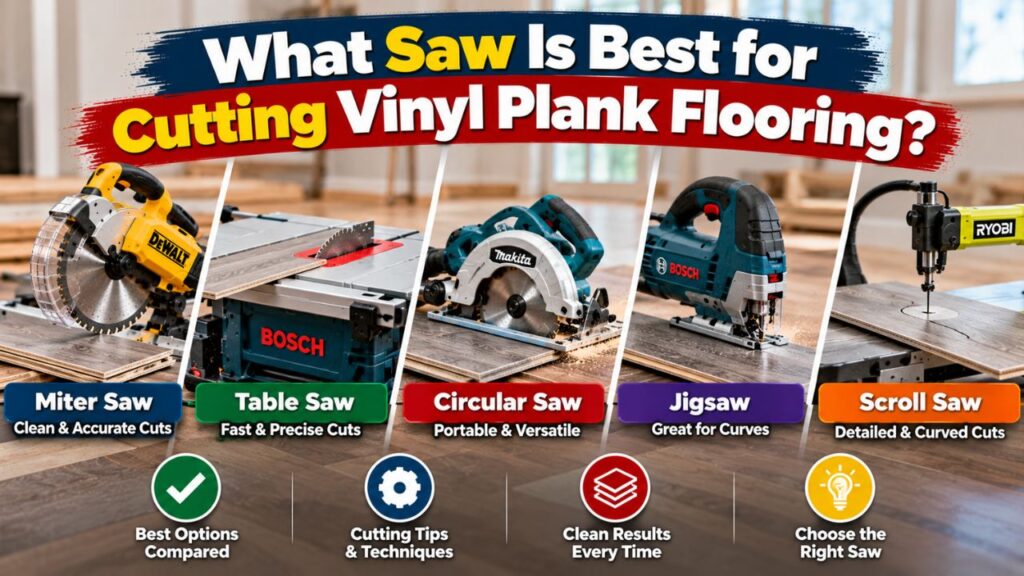
If you are wondering what saw is best for cutting vinyl plank flooring, a jigsaw is usually the best all-around choice for DIY work because it can make straight cuts, curves, notches, and cutouts with one compact tool. However, a miter saw is better for fast repetitive crosscuts, while a circular saw is better for long rip cuts. For a large flooring project, the best setup is often a miter saw or flooring cutter for crosscuts plus a jigsaw for detailed cuts.
The right tool also depends on the flooring itself. Thin flexible luxury vinyl plank may be easy enough to score and snap without a saw, while thick rigid-core SPC or WPC flooring is often much easier to cut with a power saw.
That is why there is no single saw that wins every category.
A jigsaw is the most versatile. A miter saw is the fastest for shortening planks. A circular saw is excellent for cutting planks lengthwise. A dedicated flooring saw can handle several operations in one compact machine. A table saw is highly accurate for rip cuts but is usually unnecessary for a small DIY installation.
In this guide, I’ll explain what saw is best for cutting vinyl plank flooring, compare the most useful options, recommend blades for different cuts, and help you choose the simplest tool setup for your project.
What Saw Is Best for Cutting Vinyl Plank Flooring?
For most homeowners, I recommend a jigsaw as the best single saw for vinyl plank flooring.
A jigsaw can make the straight end cuts needed at walls, cut around door jambs and vents, create L-shaped notches, and follow curved lines around pipes or other obstacles.
That versatility is difficult to match with one other saw.
The downside is that a jigsaw is not the fastest tool for repeated straight cuts, and long rip cuts require more care.
If you are installing an entire house or several rooms, I would not rely on the jigsaw alone.
For a larger project, the most practical combination is usually:
Miter saw for routine crosscuts + jigsaw for irregular cuts + circular saw for long rips when necessary.
You may not need all three if your room layout is simple.
Best Saw by Cutting Task
| Cutting Task | Best Saw |
| General DIY flooring work | Jigsaw |
| Fast repeated crosscuts | Miter saw |
| Long rip cuts | Circular saw |
| Detailed notches and curves | Jigsaw |
| First and last row rip cuts | Circular saw or table saw |
| One-machine flooring setup | Dedicated flooring saw |
| High-volume precise rip cuts | Table saw |
This distinction is more useful than asking which saw is universally “best.”
Key Takeaways:
- A jigsaw is the most versatile single saw for vinyl plank flooring.
- A miter saw is best for fast, repetitive end cuts.
- A circular saw is better for long rip cuts.
- Large projects often benefit from using more than one cutting tool.
Why Vinyl Plank Flooring Needs Different Cutting Tools
Vinyl plank flooring installation involves more than one kind of cut.
Most rows require a crosscut at the wall.
The first and last rows may need to be ripped narrower.
Doorways, floor vents, pipes, cabinets, and irregular walls can require notches or curved cuts.
No single traditional saw is equally good at all three jobs.
A miter saw makes exceptionally fast crosscuts but cannot rip a full plank lengthwise.
A circular saw handles rip cuts well but is awkward for small inside corners.
A jigsaw can do almost everything, but it works more slowly on long straight cuts.
That is why the “best” saw depends largely on which cuts dominate your project.
Best Overall: Jigsaw
If I could choose only one electric saw for a typical vinyl plank installation, I would choose a jigsaw.
Its narrow reciprocating blade allows it to cut in several directions and follow irregular shapes.
This is especially useful when flooring around:
- Doorways
- Floor vents
- Cabinets
- Pipes
- Wall projections
- Corners
It can also make regular crosscuts at the ends of rows.
Why a Jigsaw Is So Useful
Vinyl plank flooring frequently requires small custom cuts rather than only perfectly straight boards.
A jigsaw allows you to mark the shape directly on the plank and follow it with the blade.
For L-shaped notches, you can cut one line, turn, and make another.
For a rounded pipe cutout, you can drill a starter hole and follow the curved line.
This flexibility means you do not need to change saws every time the room layout becomes complicated.
Jigsaw Limitations
The main weakness is straight-line accuracy.
A jigsaw blade can flex slightly, especially during long cuts or when cutting thick rigid-core material.
You can improve accuracy by using a straightedge guide, but a circular saw is usually easier for a several-foot rip cut.
A jigsaw is also slower than a miter saw when you need to shorten dozens of planks.
So while it is my best single-tool choice, it is not necessarily the fastest option for a large installation.
Best Saw for Crosscuts: Miter Saw
A miter saw is excellent for shortening vinyl flooring at the end of each row.
This is probably the most repetitive cut during a flooring installation.
You measure the plank, mark the required length, place it flat against the fence, align the blade, and lower the saw.
The whole process takes seconds.
Why a Miter Saw Is So Efficient
The saw already provides a square fence and controlled blade path.
You do not need to clamp a straightedge for each cut.
That makes it especially valuable when installing several rooms.
A sliding miter saw can also handle relatively wide flooring planks.
What Blade Should You Use?
For rigid vinyl plank flooring, I prefer a fine-tooth carbide blade rather than a coarse framing blade.
On a typical 10-inch miter saw, approximately 60 to 80 teeth works well for many products.
On a 12-inch saw, approximately 80 to 100 teeth may provide a similarly fine finish.
The exact blade should be compatible with both your saw and flooring material.
Finished Side Up or Down?
With a conventional miter saw, I normally keep the finished decorative face up.
The blade typically enters through the top surface first, which tends to place the cleaner edge on the visible side.
Make a test cut because flooring formulations vary.
Miter Saw Limitation
A miter saw cannot make a several-foot rip cut along the length of a plank.
That means it cannot handle every flooring cut by itself.
You will still need another tool for narrowing the first or last row.
Best Saw for Rip Cuts: Circular Saw
A circular saw is my preferred portable saw for cutting vinyl plank flooring lengthwise.
This is particularly useful when the final row must be narrowed to fit against a wall.
With a clamped straightedge guide, a circular saw can create a long, straight rip quickly and accurately.
Why a Circular Saw Works Well
Unlike a miter saw, a circular saw moves along the plank.
That means there is essentially no practical limit to the length of the cut.
You can rip a full plank from end to end.
It is also much easier to transport than a table saw.
Use a Guide
I would not recommend freehanding a long rip if accuracy matters.
Clamp a straightedge parallel to the cut line and let the saw shoe ride against it.
This keeps the blade from wandering.
Which Side Should Face Up?
With a conventional handheld circular saw, the finished side is usually placed face down because the blade enters from underneath and exits through the top.
The exit side is generally more prone to minor chipping.
Again, test your exact flooring before committing to a large batch of cuts.
Circular Saw Limitation
A circular saw is poor at tight curves and inside corners.
For detailed shapes, a jigsaw remains much easier.
Dedicated Flooring Saw: Best All-in-One Machine
A flooring saw is designed specifically for plank flooring.
Depending on the model, it can make crosscuts, rip cuts, and angled cuts.
That makes it a compelling option if you want one machine dedicated to the installation.
Why Flooring Saws Are Convenient
They are usually compact.
You can set one up near the room instead of walking repeatedly to a garage-mounted table saw or miter saw.
Many are designed specifically around flooring dimensions.
Some can switch between crosscutting and ripping without requiring a major setup change.
Is a Flooring Saw Better Than a Jigsaw?
For repetitive straight work, yes.
For complicated curves and notches, no.
A dedicated flooring saw may replace both a miter saw and table saw for many straight cuts, but you may still want a jigsaw for detailed work.
Is It Worth Buying?
For one small room, probably not unless you can rent one cheaply.
For contractors or homeowners installing several rooms, it can save a lot of setup time.
Table Saw: Excellent for Rip Cuts but Usually Optional
A table saw can produce exceptionally straight rip cuts in vinyl plank flooring.
If you need to narrow many planks to the same width, a table saw is difficult to beat.
Set the fence to the required dimension and feed each plank through.
The results are fast and repeatable.
Why It Is Often Overkill
Most flooring projects require relatively few long rip cuts.
Usually the first and last rows are the main ones.
Bringing a full-size table saw into the workflow simply for those cuts can be unnecessary.
A circular saw with a guide can handle the same job with much less equipment.
If you already own a table saw and have a suitable workspace, use it.
If you do not, I would not purchase one solely for vinyl flooring.
Can You Use a Flooring Cutter Instead of a Saw?
Yes, and in many cases this is one of the best options.
A manual vinyl or laminate flooring cutter uses a long blade to shear through the plank rather than grinding through it with a motorized saw.
This creates very little airborne dust.
It is also much quieter.
For straightforward crosscuts, a good flooring cutter can actually be more convenient than a miter saw.
Where a Flooring Cutter Falls Short
Not every cutter works with every rigid-core flooring product.
Some are limited by plank width or thickness.
Some can make only straight cuts.
Others may support limited rip cutting but cannot create detailed notches.
For a basic rectangular room, though, a flooring cutter plus jigsaw is an excellent combination.
Key Takeaways:
- A flooring cutter is a strong saw-free alternative for straight cuts.
- It creates less dust than power saws.
- A jigsaw is still useful for irregular shapes.
- Always confirm that the cutter is rated for your specific flooring.
Best Blade for Cutting Vinyl Plank Flooring
Blade choice matters more with rigid-core flooring than with flexible vinyl.
For most saws, a sharp fine-tooth carbide blade is a good starting point.
Rigid-core vinyl products may contain dense mineral fillers, which can be abrasive.
A dull blade increases chipping, heat, and cutting effort.
Jigsaw Blade
For a jigsaw, use a fine-tooth blade intended for laminate, plastics, or clean finish cuts.
A reverse-tooth blade can be useful when you need the cleanest possible upper surface, but it may change the way the saw pulls against the workpiece.
Make a test cut first.
Miter Saw Blade
A fine-finish carbide blade works well.
For a 10-inch miter saw, approximately 60 to 80 teeth is a practical range.
Circular Saw Blade
For a typical 7 1/4-inch circular saw, approximately 40 to 60 teeth is a useful general range.
Table Saw Blade
A fine-finish or laminate-compatible carbide blade is usually preferable to a coarse ripping blade when surface quality matters.
Is a Jigsaw Better Than a Circular Saw for Vinyl Plank Flooring?
It depends on the cut.
For overall versatility, yes.
For long straight cuts, no.
The jigsaw wins when you need curves, notches, or small detailed cuts.
The circular saw wins when you need to rip several feet along the plank.
If you are buying only one tool for a small installation, I would choose the jigsaw.
If the project contains many long rip cuts, the circular saw becomes more valuable.
Miter Saw vs. Jigsaw for Vinyl Plank Flooring
A miter saw is faster for routine end cuts.
A jigsaw is much more versatile.
If your room is rectangular and most cuts are simple crosscuts, the miter saw may do 90% of the work.
If the room contains several doorways, corners, vents, and obstacles, the jigsaw becomes essential.
For a larger flooring project, the two complement each other extremely well.
Miter Saw vs. Circular Saw
The miter saw is best for cutting planks shorter.
The circular saw is best for cutting them narrower.
That is the simplest way to remember the difference.
If you already own both, use each for the task it handles naturally.
Trying to make a miter saw perform a long rip is impractical, while setting up a circular saw for dozens of simple crosscuts can be unnecessarily slow.
Can a Hand Saw Cut Vinyl Plank Flooring?
Yes.
For occasional cuts, a fine-tooth hand saw can work well.
This is especially practical if you have only a small room and do not want to purchase another power tool.
A hand saw is slower, but it creates less dust and noise.
For long rip cuts, however, keeping the blade perfectly straight can be challenging.
A manual flooring cutter is often more convenient for a saw-free installation.
Can an Oscillating Multi-Tool Cut Vinyl Plank Flooring?
Yes, but it should not be your main plank-cutting saw.
An oscillating tool is extremely useful around door jambs and difficult corners.
It can also make small plunge cuts that are difficult with a jigsaw.
Its narrow cutting width and relatively slow cutting speed make it inefficient for routine crosscuts.
I consider it a specialty support tool rather than the best primary saw.
Can You Cut Vinyl Plank Flooring With a Utility Knife?
Some vinyl plank flooring can be scored and snapped.
This is particularly common with thinner flexible products.
Rigid SPC and similar cores may be much more difficult or impossible to snap cleanly.
The flooring manufacturer should indicate whether score-and-snap cutting is appropriate.
If it works, it is one of the cleanest methods available because it creates almost no sawdust.
Do not assume every product called LVP cuts the same way.
What Saw Is Best for SPC Vinyl Flooring?
For rigid SPC flooring, I particularly like a miter saw for crosscuts and a jigsaw for details.
SPC is hard and relatively brittle compared with flexible vinyl.
A sharp carbide blade can produce quick clean cuts.
For long rip cuts, a circular saw or table saw works well.
Because many SPC products contain mineral-filled cores, cutting may produce significant fine dust.
Use appropriate dust control and respiratory protection.
What Saw Is Best for WPC Flooring?
WPC flooring tends to be somewhat softer than SPC, although products vary.
A jigsaw performs very well for general cutting.
A miter saw remains excellent for crosscuts, and a circular saw works for long rips.
Blade selection is still important because the decorative wear layer can chip even if the underlying core is relatively easy to cut.
How to Cut Vinyl Plank Flooring Without Chipping
The most important step is using a sharp blade.
A dull blade creates heat, vibration, and tearing.
Next, orient the plank according to the direction of the blade.
With a miter saw, finished-side-up is generally a good starting point.
With a conventional circular saw, finished-side-down is generally better.
With a jigsaw, the correct orientation depends on whether your blade cuts primarily on the upstroke or uses reverse teeth.
Painter’s Tape Can Help
Place painter’s tape over the cut line and mark on the tape.
This can help support the decorative surface.
It is not a substitute for a sharp blade, but it can improve results on brittle rigid-core flooring.
Support the Plank Properly
A plank that vibrates or flexes while cutting is more likely to chip.
Keep it flat and supported close to the cutting area.
This is particularly important with rigid SPC flooring.
Best Saw for Cutting Vinyl Plank Around Doors
Use a jigsaw for the flooring plank itself.
Its narrow blade can create L-shaped cuts and detailed notches.
For the actual door casing or jamb, an oscillating multi-tool is usually more convenient.
Undercutting the trim allows the flooring to slide underneath it and often creates a cleaner appearance than attempting to trace every contour around the molding.
Best Saw for Cutting Vinyl Plank Around Pipes
A jigsaw is the best power-saw option.
Mark the pipe position accurately.
Drill an appropriate starter hole if necessary, then insert the jigsaw blade and make the required circular or U-shaped cut.
Remember to leave any clearance required by the flooring manufacturer.
The decorative cover or pipe escutcheon can usually hide the expansion space afterward.
Best Saw for Cutting the Last Row
For the final row, the flooring usually needs to be ripped narrower.
A circular saw with a straightedge guide is one of the best portable choices.
A table saw is excellent if you already own one.
A flooring saw with rip capability can also work very well.
A jigsaw can make the cut, but keeping a long line perfectly straight is more difficult.
What Saw Should a Beginner Use?
For a beginner, I recommend a jigsaw if you want an electric saw.
It is compact, affordable, and handles most flooring cuts.
The blade is relatively easy to control, and you can see the cutting line clearly.
However, beginners should still practice on scrap flooring before starting on finished pieces.
Learn how quickly the material cuts and how easily the blade follows a line.
If you want an even simpler setup with less dust, consider using a manual flooring cutter for straight cuts and a jigsaw only for details.
Key Takeaways:
- A jigsaw is the easiest all-around power-saw choice for many beginners.
- A flooring cutter can handle routine crosscuts with almost no dust.
- Circular and table saws are best when long rip cuts need high accuracy.
- Practice on scrap before cutting expensive finished planks.
Best Saw Setup for a Small Room
For one small bedroom or office, I would keep the tool setup simple.
Use either a manual flooring cutter or jigsaw for most cuts.
If you have a few long rip cuts, you can make them carefully with the jigsaw and straightedge or borrow a circular saw.
There is little reason to set up multiple large machines for a simple room.
Best Saw Setup for a Whole House
For several rooms, efficiency becomes much more important.
I would use a miter saw or flooring cutter as the primary crosscut station.
Keep a jigsaw nearby for notches.
Use a circular saw with a guide for the first and final rows.
This three-tool setup covers nearly every flooring cut without requiring a full-size table saw.
Cutting Vinyl Flooring Safely
Regardless of the saw you choose, protect your eyes.
Power saws can throw small chips and particles from rigid flooring.
Hearing protection is also sensible when making repeated cuts.
Fine flooring dust is another concern, especially with rigid composite cores.
Use appropriate respiratory protection and dust extraction when required by the flooring manufacturer or cutting conditions.
Keep Hands Clear
Vinyl planks are relatively narrow, which can tempt you to hold your hand close to the blade.
Do not.
Use the saw’s fence, clamps, guides, or other workholding methods so your hands remain outside the manufacturer’s designated blade-clearance area.
Support Long Planks
Do not allow a long plank to hang from a miter saw or table saw unsupported.
The weight can pull the flooring away from the fence or pinch the blade.
Use a stand or table extension.
Common Mistakes When Choosing a Saw for Vinyl Flooring
One mistake is assuming a miter saw can do every cut.
It cannot make a full-length rip.
Another is assuming a circular saw is ideal for notches.
Its round blade makes it difficult to stop precisely at internal corners.
Some people use a coarse framing blade simply because it is already installed on the saw. That may produce rougher edges than necessary.
Another mistake is buying several expensive saws for one small room when a flooring cutter and jigsaw would be enough.
Finally, do not overlook the flooring manufacturer’s recommendations. Some products are designed specifically for score-and-snap cutting, while others are intended to be sawed.
FAQs about What Saw Is Best for Cutting Vinyl Plank Flooring
What saw is best for cutting vinyl plank flooring?
A jigsaw is the best all-around saw for most DIY vinyl plank flooring because it can make crosscuts, curves, notches, and other irregular cuts.
What saw is best for straight crosscuts?
A miter saw is the fastest and most accurate choice for repeated straight crosscuts.
What saw is best for cutting vinyl flooring lengthwise?
A circular saw with a straightedge guide or a table saw is best for long rip cuts.
Can you cut vinyl plank flooring with a jigsaw?
Yes. A jigsaw is excellent for LVP, especially when cutting notches, curves, and irregular shapes.
Can you use a miter saw for vinyl plank flooring?
Yes. A miter saw is one of the best tools for shortening vinyl planks at the ends of rows.
Can a circular saw cut vinyl plank flooring?
Yes. It works especially well for long rip cuts and can also make crosscuts.
Can a table saw cut vinyl plank flooring?
Yes. A table saw produces accurate rip cuts and is useful when many planks need to be narrowed consistently.
Can a flooring saw cut vinyl plank?
Many dedicated flooring saws are designed to cut laminate and rigid vinyl flooring. Check your particular model and blade specifications.
What blade should I use for vinyl plank flooring?
A sharp fine-tooth carbide blade is a good choice for most rigid-core vinyl products. Jigsaws should use a fine blade suitable for laminate, plastic, or clean cutting.
How many teeth should a miter saw blade have for vinyl flooring?
Approximately 60–80 teeth on a 10-inch blade works well for many products, while a 12-inch saw may use approximately 80–100 teeth.
Can vinyl plank flooring be cut with a utility knife?
Some thinner flexible products can be scored and snapped, but thick rigid-core flooring may require a saw.
What tool is best for cutting around doorways?
Use a jigsaw to shape the flooring plank and an oscillating multi-tool to undercut door jambs and casing when appropriate.
What is the best tool for the last row of vinyl flooring?
A circular saw with a straightedge guide, table saw, or flooring saw with rip capability is ideal for narrowing the final row.
Is a jigsaw or circular saw better for vinyl flooring?
A jigsaw is more versatile, while a circular saw is better for long straight rip cuts.
Do I need more than one saw to install vinyl plank flooring?
Not necessarily. A jigsaw can handle most cuts in a small project. For larger installations, combining it with a miter saw or circular saw saves time.
Conclusion
If you are deciding what saw is best for cutting vinyl plank flooring, the best answer depends on the type of cut you need to make.
For one versatile tool, I recommend a jigsaw. It handles straight cuts, notches, curves, pipe cutouts, and awkward doorway shapes, making it particularly useful for DIY installation.
For repeated crosscuts, a miter saw is faster and more convenient. It is ideal for shortening planks at the end of each row.
For long lengthwise rip cuts, especially along the first or last row, a circular saw with a straightedge guide is the better choice.
A dedicated flooring saw can also be an excellent all-in-one option when you are installing several rooms and want one compact machine that can perform both crosscuts and rip cuts.
If I were setting up tools for an entire house, I would use a miter saw or manual flooring cutter for routine crosscuts, a jigsaw for irregular cuts, and a circular saw for long rips.
For one small room, a jigsaw alone may be enough.
Whatever saw you choose, use a blade suited to the flooring material. A sharp fine-tooth blade generally produces cleaner results and is especially important with rigid SPC and other composite products.
Support the plank properly, keep your hands away from the blade path, control fine flooring dust, and make a test cut before cutting your first finished plank.
So the practical bottom line is simple: choose a jigsaw for versatility, a miter saw for crosscut speed, and a circular saw for rip-cut accuracy. Match the tool to the cut instead of expecting one saw to be perfect for every part of the flooring installation.