What Saw Is Best for Cutting Wood Flooring? Complete Guide
If you are wondering what saw is best for cutting wood flooring, a miter saw is usually the best choice for repeated crosscuts, while a table saw is best for long rip cuts and a jigsaw is best for curves and notches. If you want only one versatile saw, a circular saw is often the best all-around option. The right choice depends on whether you are cutting solid hardwood, engineered wood, straight board ends, narrow rip strips, or irregular shapes.
There is no single saw that performs every flooring cut better than every other tool. Hardwood-floor installation usually requires several different types of cuts, and each saw has a particular strength.
A miter saw makes fast, accurate cuts across the width of boards. A table saw excels when you need to reduce a plank’s width along its length. A circular saw can perform both jobs with the right guide. A jigsaw handles pipes, curves, and irregular walls. An oscillating multi-tool is useful for door jambs and other areas where a conventional saw cannot easily reach.
Blade choice matters almost as much as the saw itself. A powerful machine fitted with a coarse framing blade can splinter factory-finished hardwood, while a more modest saw equipped with a sharp fine-tooth carbide blade can produce an excellent flooring cut.
In this guide, I’ll explain which saw is best for cutting wood flooring, compare the major options, recommend the right tool for each type of cut, explain blade selection, and help you choose a practical setup for solid hardwood and engineered wood flooring.
What Saw Is Best for Cutting Wood Flooring?
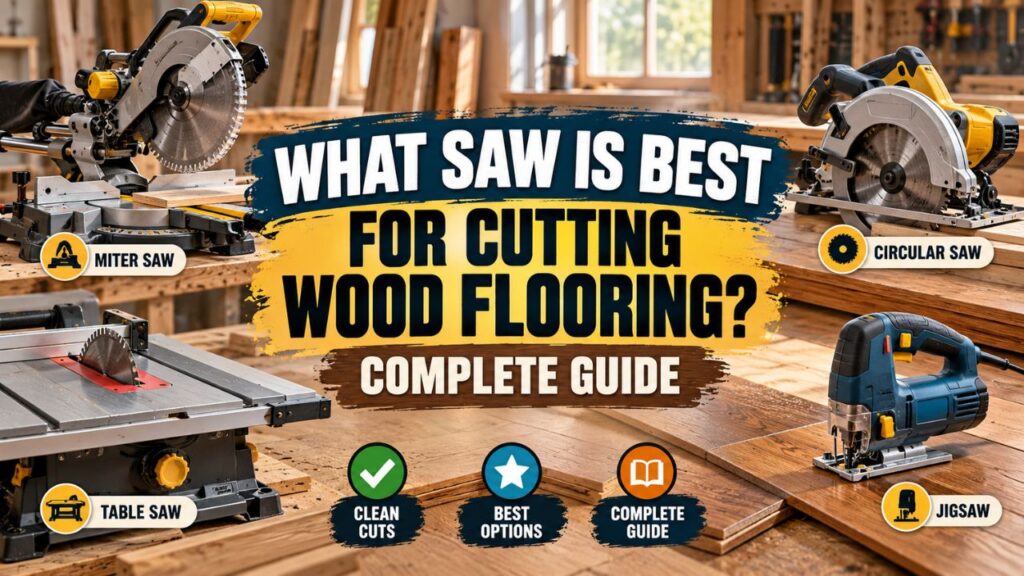
For most hardwood-flooring projects, I recommend thinking in terms of the cut rather than choosing one universal winner.
A miter saw is the best tool for repeated straight crosscuts.
A table saw is the best tool for long, accurate rip cuts.
A circular saw is the best all-around choice if you want one portable power saw.
A jigsaw is the best tool for curves, notches, and irregular cutouts.
An oscillating multi-tool is one of the best tools for trimming door jambs and making short flush cuts.
A flooring saw can combine some crosscutting and ripping functions in one compact machine, but it is less common among DIY installers and is not essential for most projects.
Best Saw by Flooring Cut
| Flooring Task | Best Saw |
| Repeated crosscuts | Miter saw |
| Long straight rip cuts | Table saw |
| One-tool DIY setup | Circular saw |
| Curves and notches | Jigsaw |
| Door jamb undercuts | Oscillating multi-tool |
| Angled crosscuts | Miter saw |
| Last-row irregular rip | Jigsaw or guided circular saw |
| Cutting installed flooring | Circular saw or oscillating tool, depending on access |
| High-volume flooring work | Miter saw + table saw combination |
If I were equipping a typical DIY hardwood-flooring project, I would prioritize a miter saw plus jigsaw, then add a table saw or circular saw if extensive ripping is required.
Key Takeaways:
- No single saw is best for every flooring cut.
- A miter saw is usually the best tool for the large number of crosscuts made during installation.
- A table saw handles long rips better, while a jigsaw handles irregular shapes.
- A circular saw is the strongest one-saw option for many DIY installers.
Why a Miter Saw Is Often the Best Saw for Wood Flooring
A miter saw is probably the tool you will use most frequently during a traditional hardwood-floor installation.
Most flooring rows end at a wall. You measure the required length, mark the board, and shorten it before installing it.
That is exactly what a miter saw is designed to do.
Fast, Accurate Crosscuts
A miter saw holds the workpiece against a fence while the blade moves down through it.
Once the saw is correctly adjusted, you can make highly repeatable 90-degree crosscuts without manually steering the blade along a long line.
This makes installation much faster when dozens of planks need to be shortened.
Easy Angle Cuts
Miter saws can also rotate to make angled cuts.
This is useful around angled walls, hearths, unusual transitions, or flooring patterns that require something other than a square board end.
A compound miter saw can additionally tilt the blade, although bevel cuts are less common for ordinary hardwood-floor installation.
Sliding Miter Saw for Wider Flooring
A non-sliding saw has limited crosscut capacity.
A sliding miter saw allows the blade assembly to travel across a wider board, making it especially useful for modern wide-plank flooring.
If your hardwood planks are particularly wide, check the saw’s stated crosscut capacity before assuming it can cut them in one pass.
Best Miter Saw Blade for Hardwood Flooring
Use a sharp carbide-tipped finish blade.
For a 10-inch miter saw, roughly 60–80 teeth works well for many flooring crosscuts.
For a 12-inch saw, around 80–100 teeth can provide a similarly smooth finish.
You do not necessarily need the maximum possible tooth count. A quality 60- or 80-tooth blade can leave an excellent cut.
When a Table Saw Is Better
A miter saw is excellent across the width of the board, but it is not designed to cut the full length of a flooring plank.
That is where the table saw becomes the better tool.
Best for Rip Cuts
A rip cut runs parallel to the length of the board.
Hardwood flooring commonly needs rip cuts on the first and last rows because a full-width plank may not fit the remaining space.
A table saw’s fence keeps the board at a consistent width throughout the cut.
That makes it significantly easier to produce straight, repeatable rips than trying to follow a pencil line freehand.
Ideal for Multiple Boards at the Same Width
Suppose the final row requires six boards cut to 2-3/4 inches wide.
Once the table saw fence is correctly set, you can rip each board to the same width quickly.
This is much more efficient than measuring and guiding a circular saw for every plank.
Table Saw Blade Choice
For hardwood flooring, use a quality carbide blade appropriate for both the wood species and the cut.
A 40- to 60-tooth combination blade can be an excellent choice when you need both reasonable rip efficiency and clean edges.
If you are doing mostly crosscut-style finish work, a higher tooth count may be useful, but excessive tooth count can slow long rips and increase heat.
For dense hardwood, chip clearance matters.
Table Saw Limitations
A table saw cannot make curved cuts.
It also takes up more space and is less portable than a circular saw.
Long flooring boards require good infeed and outfeed support so they remain flat and controlled.
For a small room, the setup may be more than you need. For a whole-house flooring job, it can save a great deal of time.
Circular Saw: Best All-Around Choice for Many DIY Installers
If you want to buy only one saw for cutting wood flooring, I would seriously consider a circular saw.
It can make crosscuts, rip cuts, and angle cuts.
With a straightedge guide, it can produce very accurate results.
Why a Circular Saw Is So Versatile
Unlike a miter saw, it is not limited by board width.
Unlike a table saw, it is portable and easy to store.
You can take it directly to long flooring planks rather than moving the boards through a large stationary machine.
For occasional DIY installation, this flexibility is extremely valuable.
Crosscutting With a Circular Saw
Use a square to mark the line.
For extra accuracy, clamp a speed square or straightedge to the flooring and run the saw base against it.
A sharp fine-tooth blade can make a very clean crosscut.
Ripping With a Circular Saw
For long cuts, use a guide.
A straightedge clamped parallel to the cut can transform a normal circular saw into a surprisingly precise ripping tool.
Measure the offset between the blade and the edge of the saw’s shoe before positioning the guide.
A dedicated track system can make the setup even easier.
What Blade Should You Use?
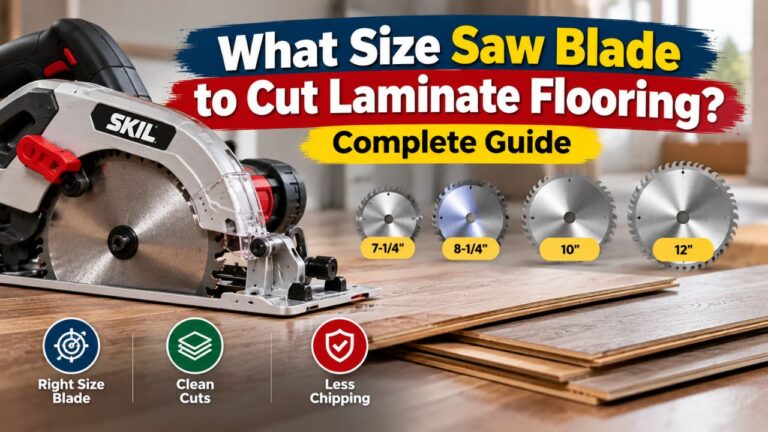
For a common 7-1/4-inch circular saw, a carbide blade in roughly the 40–60-tooth range is a good flooring choice.
A 40-tooth blade balances clean cutting with chip removal.
A 60-tooth blade favors a smoother finish.
For solid hardwood, I generally prefer a quality blade rather than an extremely cheap high-tooth-count blade.
Main Circular Saw Drawback
A handheld circular saw requires more skill to guide accurately than a miter saw.
If you are making 50 nearly identical crosscuts, a miter saw is faster and more repeatable.
For a few cuts or a portable setup, the circular saw is hard to beat.
Key Takeaways:
- Choose a miter saw when most of your work is crosscutting.
- Choose a table saw when long, repeated rip cuts are the priority.
- Choose a circular saw when you need one portable tool capable of both types of cuts.
Why a Jigsaw Is Essential for Irregular Flooring Cuts
A jigsaw is not the best primary saw for cutting every hardwood plank, but it is one of the most useful secondary tools on a flooring job.
Its narrow blade can turn through curves that circular blades cannot.
Cutting Around Pipes
If a plank needs to fit around a pipe, a jigsaw can connect an opening to the plank edge or shape a larger irregular cutout.
A hole saw may handle a perfectly round opening, while the jigsaw handles the surrounding detail.
Cutting Around Columns and Odd Walls
Older rooms are rarely perfectly square.
A jigsaw can follow scribed lines and irregular wall profiles much more naturally than a table saw or miter saw.
Notches
Jigsaws are excellent for L-shaped notches around vents, door areas, cabinets, and other obstacles.
A circular saw cannot create a sharp inside corner without overcutting because its blade is round.
A jigsaw’s narrow blade gives you far better control in these situations.
Jigsaw Blade for Wood Flooring
Use a sharp, fine-tooth blade designed for hardwood or clean wood cuts.
If cutting factory-finished flooring, pay attention to tooth direction.
A conventional up-cut jigsaw blade may produce a cleaner decorative face when the board is positioned finished-side down. A reverse-tooth blade generally allows the finished surface to face up.
Make a test cut on scrap if edge quality matters.
Oscillating Multi-Tool for Door Jambs and Trim
The oscillating multi-tool is not the fastest way to cut an entire plank, but it solves several flooring problems exceptionally well.
Door Jamb Undercuts
Instead of trying to shape a hardwood plank perfectly around decorative door casing, installers often undercut the casing so the flooring can slide underneath.
Place a scrap piece of flooring and any required underlayment beside the jamb to establish the final floor height.
Use the oscillating tool to cut the bottom of the casing at that height.
This creates a much cleaner finished appearance than attempting to jigsaw around every molding contour.
Flush and Detail Cuts
An oscillating tool is also useful where a circular saw or jigsaw cannot physically reach.
Its small blade can work close to walls and inside corners.
The disadvantage is cutting speed.
It is a detail tool, not a replacement for a miter saw or circular saw.
What About a Flooring Saw?
A dedicated flooring saw is designed to make both crosscuts and rip cuts while sitting relatively close to the work area.
This can reduce trips between separate cutting stations.
Some models function somewhat like a compact combination of a table saw and miter-style flooring cutter.
Advantages
A flooring saw can be convenient for professional installers or anyone doing a large flooring project.
It handles several common flooring cuts without taking up as much space as multiple stationary saws.
Disadvantages
It is a specialty tool.
If you already own a miter saw, table saw, circular saw, or jigsaw, you may not need one.
A standard circular saw or miter-and-table-saw combination is usually more useful for general woodworking after the flooring job is finished.
For most DIY homeowners, I would invest in more versatile tools first.
What Saw Is Best for Solid Hardwood Flooring?
For solid hardwood, I consider a miter saw the best primary cutting tool if you are doing a conventional installation.
You will make many crosscuts, and the saw handles them quickly.
Pair it with a table saw or circular saw for rips.
Use a jigsaw for irregular cuts.
Solid hardwood species such as oak, hickory, and maple can be dense, so a sharp carbide blade is particularly important.
A dull blade generates more heat and makes the saw harder to control.
What Saw Is Best for Engineered Wood Flooring?
The same general tools work for engineered hardwood.
A miter saw handles crosscuts.
A table or circular saw handles rips.
A jigsaw handles curves and notches.
The biggest difference is that engineered wood flooring contains multiple layers. The decorative wear layer may be thin, while the core consists of plywood or another engineered material.
Use a fine, sharp blade to avoid splintering the top veneer.
Protect click-lock edges carefully. If a tongue or groove is damaged, the plank may no longer connect correctly even if the visible face still looks good.
How to Choose the Best Saw Based on Your Project
The size of the project should influence your tool choice.
Small DIY Repair
If you are replacing only a few boards, buying a full table saw and miter saw setup makes little sense.
A circular saw plus jigsaw can handle most repair cuts.
A handsaw may even be sufficient for a very small repair.
One-Room Installation
For a normal bedroom or office, a miter saw and jigsaw make an excellent combination.
Add a circular saw if the first or final rows require long rips.
Whole-House Installation
For a large flooring project, efficiency becomes much more important.
I would use a miter saw for crosscuts, table saw for rips, jigsaw for irregular cuts, and oscillating tool for jambs.
The time savings can be substantial compared with trying to make every cut with one tool.
Professional Flooring Work
A professional installer may add a dedicated flooring saw, track saw, specialized dust extraction, and premium carbide or PCD blades.
Durability and workflow become more important when hundreds or thousands of boards are cut regularly.
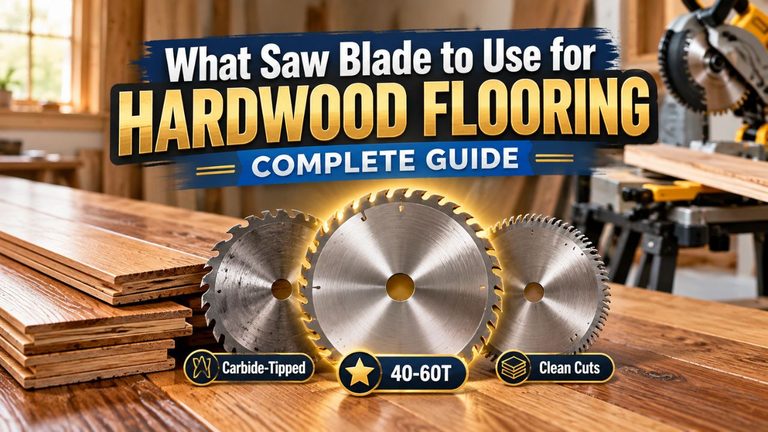
What Saw Blade Is Best for Wood Flooring?
A sharp carbide-tipped finish blade is the best general recommendation.
Carbide stays sharp longer than ordinary steel and performs well in hardwood.
The ideal tooth count depends on blade diameter and cutting direction.
| Saw | Practical Flooring Blade |
| 7-1/4″ circular saw | 40–60T carbide |
| 10″ miter saw | 60–80T carbide |
| 12″ miter saw | 80–100T carbide |
| 10″ table saw | 40–60T combination or finish blade |
| Jigsaw | Fine-tooth hardwood/clean-cut blade |
Do not treat these as rigid requirements.
A premium 40-tooth blade can outperform a dull or poorly made 80-tooth blade.
Blade geometry, sharpness, material, and saw setup all matter.
How to Prevent Splintering When Cutting Wood Flooring
Factory-finished flooring can chip along the cut line if the blade tears fibers rather than slicing them cleanly.
The first solution is a sharp blade.
The second is correct board orientation.
With a standard handheld circular saw, the finished surface generally goes down because the blade exits through the top.
With a conventional miter saw, the finished surface generally goes up because the blade enters from above.
With a table saw, the top surface is often more vulnerable because the blade exits upward through it.
The exact behavior can vary with blade geometry, so test a scrap board if appearance is important.
Score the Line for Visible Cuts
If a cut edge will remain visible, lightly scoring the finish with a sharp utility knife can reduce surface tear-out.
Use a straightedge and keep the blade on the waste side.
Painter’s Tape
Painter’s tape can support fragile fibers and make lines easier to see.
It is helpful, but it cannot rescue a dull saw blade.
Support the Board
A vibrating board produces poorer cuts.
Support both the main board and offcut properly.
Do not let a long plank hang unsupported from the saw table.
Key Takeaways:
- Blade sharpness has a major effect on hardwood-flooring cut quality.
- Different saws may require different finished-face orientation.
- Good support and moderate feed pressure help reduce splintering.
Which Saw Is Best for Rip Cutting Wood Flooring?
For pure ripping performance, the table saw wins.
Its fence produces consistent widths and keeps the board aligned throughout the cut.
For occasional or irregular rips, a circular saw with a guide may be more practical.
For the final row against a wall that is not straight, a jigsaw may actually work better because it can follow a scribed line.
Do not use a miter saw for long rip cuts.
Miter saws are not designed to feed a plank lengthwise through the blade.
Which Saw Is Best for Cutting Flooring Across the Width?
The miter saw is the clear choice for repeated crosscuts.
It is fast, accurate, and easy to use.
A circular saw is a good alternative if you do not own a miter saw.
A jigsaw can make crosscuts, but the flexible blade makes maintaining a perfectly square edge more difficult.
For large flooring projects, the miter saw saves the most time on this type of cut.
Which Saw Is Best for Cutting Flooring Already Installed?
Cutting installed hardwood is a different task.
A circular saw can make long straight cuts if you carefully set the blade depth.
An oscillating multi-tool is better for short, precise cuts near walls or obstacles.
Before cutting, determine the flooring thickness and identify what lies below.
The subfloor may contain radiant-heating components, electrical wiring, plumbing, or other services.
Do not simply set the blade deep and assume everything underneath is safe.
Set the Blade Depth Carefully
For installed-floor repair work, the blade should generally penetrate only as deeply as the material you intend to remove.
A circular saw set too deep can damage the subfloor or concealed building systems.
If you do not know what lies underneath, investigate before cutting.
Can You Use a Hand Saw for Wood Flooring?
Yes.
A fine-tooth handsaw or backsaw can cut hardwood flooring, especially for occasional crosscuts.
It is slower but produces less noise and airborne dust than a power saw.
A handsaw can be a sensible option for a small repair where only a few boards need cutting.
For an entire room, however, power tools dramatically improve efficiency.
A miter box paired with a fine saw can help maintain square cuts when working manually.
Do You Need More Than One Saw?
Not necessarily.
For a small DIY project, one versatile saw plus a few secondary tools may be enough.
If I had to choose only one power saw, I would choose a circular saw because it can perform both crosscuts and rip cuts.
I would then add a jigsaw if the room contains pipes, complex corners, or irregular wall shapes.
For a larger project, two or three specialized tools will make the work much easier.
The goal is not owning every saw. It is using the right tool when the cut demands it.
Common Mistakes When Choosing a Flooring Saw
A common mistake is assuming the largest saw is automatically the best.
A 12-inch miter saw is powerful, but it may be unnecessary for narrow flooring.
Another mistake is focusing entirely on the saw and ignoring the blade.
A good saw with a coarse framing blade can produce worse flooring cuts than a basic saw with the correct finish blade.
Some installers also try to make every cut with a miter saw because it is already set up. That becomes problematic when they reach long rip cuts or irregular shapes.
Use the tool according to its design.
Finally, do not forget dust control. Hardwood and engineered flooring produce substantial fine dust when cut. Use extraction where available and make cuts in a suitable work area.
Safety When Cutting Wood Flooring
Wear eye and hearing protection when using power saws.
Use suitable respiratory protection when generating significant wood or composite dust.
Disconnect power or remove the battery before changing blades.
Inspect guards before cutting.
Keep the workpiece stable and hands away from the blade path.
Do not support a board with your hand directly under the area where the blade will exit.
Allow the blade to reach operating speed before entering the material.
If a blade binds, release the trigger and let it stop before repositioning the workpiece.
When using a table saw, use appropriate push devices and follow the saw manufacturer’s instructions for fence, guard, riving knife, and workpiece control.
FAQs about what saw is best for cutting wood flooring
What saw is best for cutting wood flooring?
A miter saw is usually best for repeated crosscuts, while a table saw is best for rips.
If you want one versatile tool, a circular saw is the best all-around option.
What saw is best for hardwood flooring?
For most hardwood installations, I recommend a miter saw for primary crosscuts, a table or circular saw for rips, and a jigsaw for irregular cuts.
Can I cut hardwood flooring with a circular saw?
Yes.
A circular saw fitted with a fine-tooth carbide blade can make both crosscuts and rip cuts.
Is a miter saw good for hardwood flooring?
Yes.
It is one of the best tools for fast, square crosscuts and angled cuts.
Can a miter saw rip hardwood flooring?
No.
Use a table saw, circular saw, track saw, or jigsaw for lengthwise cuts.
Is a table saw good for flooring?
Yes, particularly for long rip cuts and cutting multiple boards to the same width.
Can I cut flooring with a jigsaw?
Yes.
A jigsaw is particularly useful for notches, curves, irregular walls, and pipe cutouts.
What is the best saw for the final row of hardwood flooring?
A table saw is ideal when the rip is straight.
A circular saw with a guide also works well.
If the wall is irregular, a jigsaw may be easier.
What saw should I use around pipes?
A jigsaw is usually best for irregular pipe cutouts.
A hole saw can create round openings when appropriate.
What saw should I use for door jambs?
An oscillating multi-tool is one of the easiest options for undercutting door jambs and casing.
Can I use a hand saw for hardwood flooring?
Yes.
A fine-tooth hand saw can make accurate flooring cuts, but it is much slower than powered alternatives for a large installation.
What size circular saw blade is best?
A common 7-1/4-inch circular saw works very well for flooring.
Use a compatible 40- to 60-tooth carbide blade for clean cuts.
What blade should I use on a 10-inch miter saw?
A 60- to 80-tooth carbide finish blade is a strong choice for hardwood-flooring crosscuts.
Should wood flooring face up or down when cutting?
It depends on the saw.
For a conventional circular saw, the finished face generally goes down. On a miter saw, it generally goes up.
Make a scrap test when finish quality is critical.
How do I stop hardwood flooring from splintering?
Use a sharp fine-tooth blade, support the board, cut from the correct face, and avoid forcing the saw.
Scoring the line or using painter’s tape can help further.
Can I cut engineered hardwood with the same saw?
Yes.
Miter, table, circular, and jigsaws all work on engineered hardwood when equipped with appropriate blades.
What is the best saw if I only want to buy one?
I recommend a circular saw because it can perform both crosscuts and long rip cuts and is easy to store and transport.
Is a flooring saw worth buying?
It can be worthwhile for high-volume flooring installation, but most homeowners can complete the same work with more general-purpose tools.
Is a track saw good for hardwood flooring?
Yes.
A track saw is excellent for long straight rips and produces highly accurate guided cuts, although it is usually more expensive than a basic circular-saw setup.
Can I cut installed hardwood flooring with a circular saw?
Yes, but set the blade depth carefully and know what lies beneath the floor before cutting.
Do I need a table saw to install hardwood flooring?
No.
A circular saw with a straightedge can handle rip cuts effectively.
A table saw simply makes repeated rips faster and easier.
Conclusion
If you are asking what saw is best for cutting wood flooring, the most useful answer is that the best saw depends on the type of cut.
For repeated crosscuts, a miter saw is my first choice. It is fast, accurate, and particularly efficient during a full-room hardwood installation.
For long rip cuts, a table saw is better because its fence makes it easy to maintain a consistent plank width.
For a homeowner who wants only one versatile power saw, a circular saw is the best all-around option. With a straightedge guide, it can handle crosscuts, rips, and angled cuts without requiring a large stationary setup.
A jigsaw remains essential when flooring has to fit around pipes, irregular walls, columns, vents, and other obstacles. An oscillating multi-tool is also extremely useful for undercutting door jambs and making detail cuts close to walls.
Whatever saw you choose, do not overlook the blade. A sharp carbide finish blade has a major effect on cut quality and can reduce chipping in both solid and engineered hardwood.
For a typical DIY flooring project, I would choose a miter saw for everyday crosscuts, a jigsaw for detail work, and a circular saw or table saw for rips. That combination covers nearly every cut you are likely to encounter and gives you clean, efficient results without trying to force one saw to do a job it was never designed to perform.