What Is the Difference Between a Fret Saw and Coping Saw?
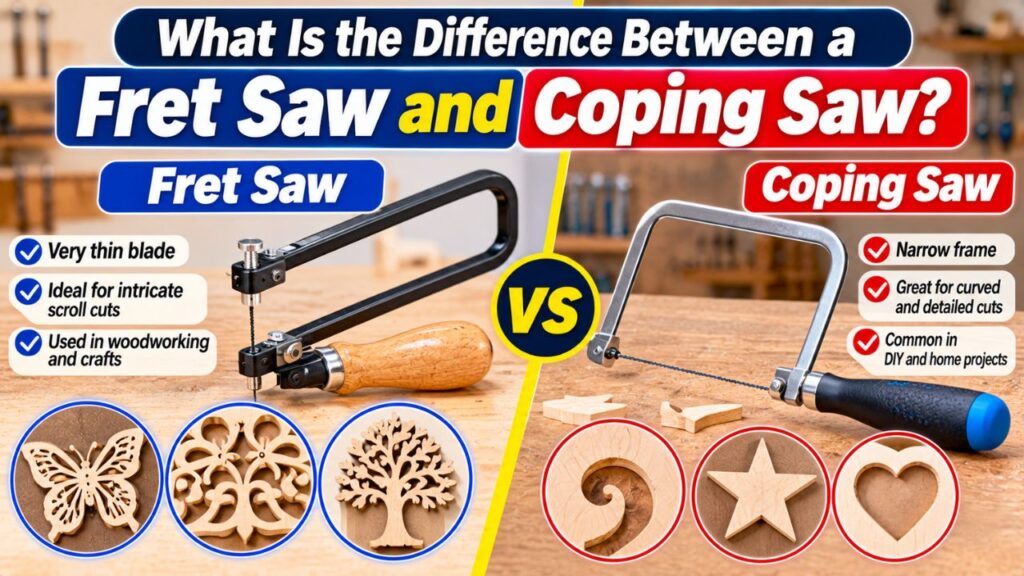
What is the difference between a fret saw and coping saw? A fret saw has a much deeper frame and typically uses a finer, thinner blade, making it better for intricate curves, delicate patterns, and interior cutouts. A coping saw has a shallower frame and generally uses a stronger, coarser blade, making it better for coping molding, cutting tighter curves in wood, and handling general workshop tasks.
At first glance, the two tools look almost identical. Both are small hand saws built around a U-shaped or bow-shaped frame, both hold a narrow replaceable blade under tension, and both can cut curves that would be difficult to make with an ordinary handsaw. This similarity often leads beginners to assume that a fret saw and coping saw are simply two names for the same tool.
They are not.
The biggest difference is the depth of the frame and the type of work each saw is designed to perform. The deep throat of a fret saw lets its blade travel much farther into a workpiece, which is especially useful for decorative fretwork and complex internal patterns. A coping saw has a much shallower throat but is usually more practical for everyday woodworking, especially when fitting molding and trim.
Blade size also matters. Fret-saw blades are typically extremely fine and delicate, which allows more precise cuts but makes them easier to break. Coping-saw blades are usually wider, thicker, and more durable, making the saw easier to control during less delicate woodworking.
In this guide, I’ll explain the fret saw vs. coping saw differences in detail, including frame depth, blade design, cutting capacity, accuracy, materials, common uses, blade orientation, inside cuts, molding work, and which saw makes the most sense for different projects.
Fret Saw vs. Coping Saw: Quick Comparison
The easiest way to understand the difference is to compare the basic design of the two saws.
| Feature | Fret Saw | Coping Saw |
| Frame depth | Very deep | Relatively shallow |
| Blade | Very thin and fine | Wider and more robust |
| Main purpose | Intricate decorative cutting | Coping, curves, and general woodworking |
| Internal cutouts | Excellent | Good |
| Tight curves | Excellent | Very good |
| Long interior reach | Excellent | Limited |
| Blade durability | More delicate | Usually more durable |
| Beginner friendliness | Requires more control | Generally easier |
| Typical materials | Thin wood, plywood, plastic, soft metal with proper blade | Wood, plastic, and some soft metal with proper blade |
| Best-known use | Fretwork and decorative patterns | Coping molding joints |
Neither tool is automatically better. Their designs simply favor different types of cuts.
What Is a Fret Saw?
A fret saw is a fine-toothed hand saw designed for intricate curved cuts, decorative patterns, and internal openings.
Its most recognizable feature is its extremely deep U-shaped frame.
The distance between the blade and the back of the frame is called the throat depth. On a fret saw, this throat can be much deeper than on a coping saw.
That extra clearance allows the saw to reach far into a panel without the frame bumping against the edge of the workpiece.
This is exactly what makes it so useful for fretwork.
Why Is It Called a Fret Saw?
The name comes from fretwork, a decorative woodworking technique involving intricate open patterns cut through relatively thin material.
Think of decorative wooden panels containing scrolls, curves, geometric shapes, or complex cutouts.
A shallow saw frame would quickly hit the outside edge of a large panel while following these patterns. A fret saw’s deep frame provides the necessary clearance.
What Does a Fret Saw Blade Look Like?
Fret-saw blades are typically very narrow and fine.
Because the blade is so thin, it can turn through extremely small radii.
That makes it excellent for:
- Detailed curves
- Intricate shapes
- Fine internal cutouts
The tradeoff is fragility.
A thin blade can break if it is twisted aggressively, pushed too hard, or tensioned incorrectly.
The tool rewards controlled technique rather than speed or force.
What Is a Coping Saw?
A coping saw is a small hand saw with a narrow replaceable blade stretched across a relatively shallow U-shaped metal frame.
It is one of the most common hand tools for making curved cuts in wood.
Its name comes from one of its traditional jobs: making coped joints in molding.
A coped joint allows the shaped end of one molding piece to follow the decorative profile of another piece. This technique is widely used when installing baseboard, crown molding, chair rail, and similar trim.
What Makes a Coping Saw Different?
Compared with a fret saw, the coping saw generally has a:
- Shallower frame
- Wider blade
- More durable blade
- More rigid feel during ordinary woodworking
That makes it less specialized but often more practical for everyday DIY work.
You can use a coping saw to cut curves in boards, trim plastic components, create internal openings, remove waste from joinery, and shape molding.
The shallow frame is the main limitation.
If you need to make a cut several inches into the middle of a large panel, the frame may eventually hit the outer edge and prevent you from continuing.
Key Takeaways:
- A fret saw has a much deeper frame and finer blade for detailed work.
- A coping saw has a shallower frame and tougher blade for general curved cutting.
- Fret saws specialize in intricate patterns, while coping saws are particularly useful for trim and molding.
The Biggest Difference: Frame Depth
If you remember only one distinction, remember the frame.
A coping saw has a relatively shallow U-shaped frame. Its throat is deep enough for many ordinary woodworking cuts but limits how far the blade can travel into a wide panel.
A fret saw has a dramatically deeper frame.
Imagine making an internal decorative cut in the center of a broad wooden panel.
The blade may be able to follow the pattern perfectly, but the saw’s frame also has to move around the outside of the cut.
With a coping saw, the frame can reach the panel’s edge and stop your progress.
With a fret saw, the much deeper throat gives you substantially more room.
This is why fret saws remain useful even though both tools are capable of cutting curves.
Fret Saw Blade vs. Coping Saw Blade
Blade design creates another major difference between these saws.
Fret Saw Blades
Fret-saw blades are generally very thin and fine-toothed.
The narrow blade produces a small kerf, meaning it removes relatively little material as it travels through the workpiece.
Because there is less blade width to resist turning, you can navigate intricate curves and very small corners.
The downside is that the blade is delicate.
Too much sideways force can bend or snap it.
Coping Saw Blades
Coping-saw blades are typically somewhat wider and stronger.
They can still cut relatively tight curves, but they are better suited to more aggressive manual woodworking.
A coping-saw blade is therefore usually easier for a beginner to manage.
Various tooth counts and blade types are available, allowing a coping saw to cut different materials.
Are Fret Saw and Coping Saw Blades Interchangeable?
You should not assume they are.
Fret saws and coping saws can use different blade lengths and attachment systems, and some fret saws use blades similar to those found in hand-powered or powered scroll-saw work.
Blade compatibility varies among manufacturers and saw designs.
Always verify the required blade length, pin configuration, and attachment style for the specific saw.
Which Saw Makes Tighter Curves?
The fret saw generally wins when extremely tight, intricate curves are required.
Its blade is thinner and narrower, so it can change direction with less material removal.
This advantage becomes particularly noticeable in:
- Decorative fretwork
- Miniature woodworking
- Fine scroll patterns
- Complex interior designs
A coping saw can still make surprisingly tight turns.
For normal trim work, furniture components, basic shapes, and DIY woodworking, its curve-cutting capability is usually more than sufficient.
In fact, the slightly stronger blade can make the coping saw easier to control when extreme delicacy is unnecessary.
Which Saw Makes More Accurate Cuts?
The answer depends on what you mean by accuracy.
For intricate patterns and very small radii, a fret saw offers greater precision because its fine blade can follow detailed lines closely.
For an ordinary curved cut through thicker wood, a coping saw may actually be easier for many users to control.
A fret saw’s long frame and delicate blade make it somewhat less forgiving.
Accuracy with either saw depends heavily on technique. These are manual tools, so forcing the blade or twisting it sideways can cause the cut to wander.
Let the Teeth Do the Cutting
One of the easiest mistakes is applying too much forward pressure.
Both saws work better when the blade is allowed to cut gradually.
Excessive pressure can make the blade flex away from your cut line.
With a fret saw, aggressive pressure also increases the chance of breaking the blade.
What Is a Fret Saw Used For?
The fret saw is most valuable when detail and interior reach matter more than cutting speed.
Traditional fretwork is the obvious example. The saw can create elaborate openings in wooden panels because its deep frame does not interfere with the pattern as quickly as a coping saw frame would.
It can also be useful for model making, fine woodworking, thin craft material, and other detailed work.
Depending on the installed blade, some fret saws can work with thin plastic or soft metal as well.
However, the exact material capability should always be matched to the blade.
I would not choose a fret saw for cutting ordinary boards to length or making fast rough cuts. That is not what the tool is designed to do.
Its strengths are precision, maneuverability, and reach.
What Is a Coping Saw Used For?
A coping saw has a broader range of common woodworking uses.
It is particularly valuable for trim carpentry.
When installing molding at an inside corner, one piece can be cut so its end follows the exact decorative profile of the adjoining molding. The coping saw’s thin blade and maneuverability make it excellent for removing the waste behind that profile.
It can also cut curved shapes in relatively thin boards and sheet materials.
Woodworkers may use one to remove waste from joints when precision is required but a power tool would be unnecessary.
For a general home workshop, I consider the coping saw more versatile than a fret saw because its jobs are more common.
Key Takeaways:
- Choose a fret saw when intricate detail and deep interior reach are the priorities.
- Choose a coping saw for molding, trim, general curves, and routine woodworking.
- For most homeowners buying only one of the two, the coping saw is usually more versatile.
Why Is a Coping Saw Called a Coping Saw?
The name comes from the woodworking technique known as coping.
Consider two decorative molding pieces meeting in an inside corner.
A simple approach would be to miter both pieces, but real walls and corners are not always perfectly square.
A coped joint takes another approach.
One molding piece runs directly into the corner. The end of the second piece is shaped so that it fits over the decorative profile of the first.
A coping saw follows the contour and removes the waste behind it.
This method can produce excellent inside joints and allows the fit to tolerate small variations in the corner better than some simple miter joints.
That traditional use became so closely associated with the tool that it gave the saw its name.
Why Does a Fret Saw Have Such a Deep Frame?
The deep frame solves a clearance problem.
Imagine drawing an intricate pattern in the center of a 16-inch-wide panel.
You drill a small starting hole, thread the blade through it, reconnect the blade to the frame, and begin cutting.
As you follow the design, the frame moves around the outside of the workpiece.
With a shallow frame, it quickly contacts the panel edge.
A fret saw moves the back of the frame much farther away from the blade, providing room for the workpiece between them.
The result is greater throat capacity.
This does not necessarily mean a fret saw can cut thicker material. Throat depth refers to how far inward it can reach, not the thickness of material the blade can efficiently cut.
Can Both Saws Make Interior Cuts?
Yes.
This is a useful feature shared by both saws.
Suppose you need to cut a hole shaped like a star in the center of a board without cutting through the outside edge.
You can drill a starting hole inside the waste area.
Then disconnect one end of the saw blade, pass the blade through the hole, and reconnect and tension it in the frame.
Now you can make the interior cut without cutting a path from the outside edge.
The process works with both fret saws and coping saws when their blade-holding systems permit it.
The fret saw becomes more useful when the interior pattern extends far from the edges of a relatively wide panel.
Which Way Should the Teeth Face?
Blade orientation can vary with the tool and cutting technique, so follow the saw and blade manufacturer’s instructions.
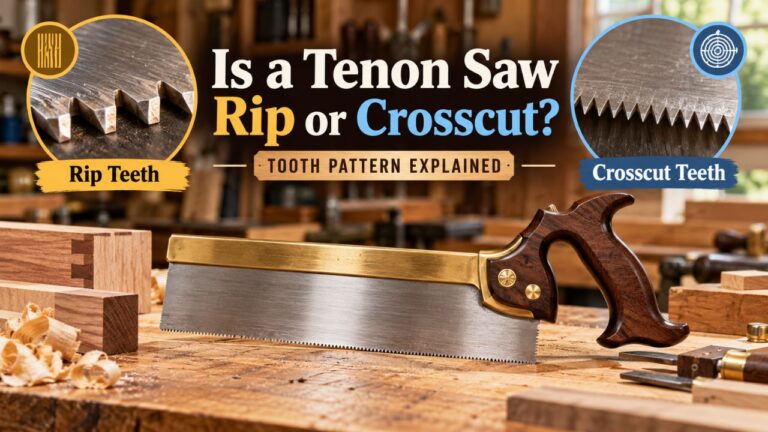
Traditional coping saws are commonly set so they cut on the pull stroke, with the teeth pointing toward the handle.
Pull-stroke cutting can help keep a thin blade under tension during the cutting stroke.
However, some users and applications configure blades differently.
Rather than relying solely on a visual assumption, look at the tooth direction and confirm how the particular blade is intended to cut.
Fret-saw blade orientation likewise depends on the specific frame and technique being used.
Correct installation matters because a backwards blade can dramatically reduce cutting efficiency.
Fret Saw vs. Coping Saw for Molding
For coping molding, choose the coping saw.
It is specifically suited to this job.
After making the initial miter cut that exposes the molding profile, the coping saw can follow the visible contour and remove material behind it.
Its shallow frame is not a disadvantage because the cut normally occurs near the end of the molding.
The stronger blade can also be easier to control while working through common wood and composite trim materials.
A fret saw could technically perform some similar cuts, but its delicate blade and oversized frame usually provide no advantage.
Fret Saw vs. Coping Saw for Fretwork
For traditional decorative fretwork, choose the fret saw.
This is exactly where its deep frame becomes valuable.
Complex interior patterns can extend far into a panel, and the fret saw provides clearance that a coping saw cannot.
The very fine blade also handles the small radii found in decorative designs.
For extensive fretwork, a powered scroll saw may be much faster, but the manual fret saw remains useful when you want precise hand control or do not have a powered machine.
Fret Saw vs. Coping Saw for Cutting Wood
Both can cut wood.
The better option depends on the cut.
For relatively straightforward curves in ordinary wood, I would choose a coping saw.
Its stronger blade generally handles the material more comfortably and is less prone to breaking.
For thin wood requiring delicate patterns or highly intricate turns, I would choose a fret saw.
Neither saw is intended to replace a normal handsaw, jigsaw, circular saw, or bandsaw for long straight cuts or heavy stock removal.
Can a Fret Saw Cut Metal?
Yes, when equipped with a blade designed for the particular metal and thickness.
Fine blades can cut thin sheets of certain soft or relatively workable metals.
However, the saw’s frame and blade are designed for relatively delicate manual cutting.
Do not expect a fret saw to be an efficient substitute for a hacksaw when cutting thick steel stock.
For metalworking, choose the blade according to both the material and its thickness.
Fine teeth are particularly important with thin stock because several teeth should remain engaged in the material instead of catching aggressively.
Can a Coping Saw Cut Metal?
A coping saw can cut some thin, relatively soft metals when fitted with an appropriate blade.
Its primary role, however, is woodworking and related general-purpose curved cutting.
For ordinary metal bars, rods, bolts, and similar stock, a hacksaw is usually the more appropriate hand tool.
Again, the blade—not simply the frame—determines much of what the saw can cut effectively.
Can These Saws Cut Plastic?
Yes, both can cut many plastics when equipped with an appropriate blade.
Plastic introduces two challenges.
If the tooth spacing is too aggressive for a thin piece, the blade can catch and chip the work.
If you cut too quickly, friction may generate enough heat to soften or melt some thermoplastics.
A controlled cutting speed and suitable fine-tooth blade generally produce better results.
Support thin plastic adequately so that it does not vibrate while cutting.
Which Saw Is Better for Beginners?
For general woodworking, I recommend starting with a coping saw.
Its blade is generally less fragile, the frame is easier to maneuver, and its common applications are more likely to appear in household DIY work.
You can learn:
- Following curves
- Controlling a narrow blade
- Making internal cuts
without dealing with quite as much blade fragility as a fret saw.
The fret saw is not exceptionally difficult to use, but it rewards a lighter touch.
For someone interested specifically in decorative fretwork, model making, or highly intricate hand-cut designs, there is no reason not to start directly with a fret saw.
Which Saw Is Easier to Control?
The coping saw generally feels easier to control during ordinary cutting.
Its compact frame places less mass far away from the blade, and the stronger blade tolerates minor mistakes more readily.
A fret saw’s deep frame can feel somewhat awkward until you become accustomed to it.
The delicate blade also requires careful alignment.
When making intricate patterns, however, the fret saw’s blade can actually provide better directional control because its narrow profile turns through extremely tight curves.
So control depends on the type of work.
Do Fret Saw and Coping Saw Blades Rotate?
Many coping saws allow the blade to be rotated in the frame.
This is extremely useful.
Because the frame can interfere with the workpiece, rotating the blade lets you change the direction of the cut while keeping the frame in a more convenient position.
Fret-saw blade mounting varies with design, but some frames likewise allow adjustment that helps manage the large bow around the workpiece.
If blade rotation is important for your project, verify the feature before buying a particular saw.
How to Use a Coping Saw Correctly
Secure the workpiece so it cannot move while you cut.
Mark the cut line clearly.
Install the correct blade and make sure it is properly tensioned.
Start with short, controlled strokes until the blade establishes a kerf. Then use smooth strokes while following the line.
Turn gradually rather than forcing the blade sideways.
For a sharp change in direction, reduce cutting pressure and rotate the frame as the blade moves.
The blade should do the cutting. Excessive force usually makes accuracy worse.
If you are coping molding, many woodworkers angle the cut slightly behind the visible profile. This small back-cut can help the front edge fit tightly against the adjoining molding.
How to Use a Fret Saw Correctly
The basic technique is similar, but blade control becomes even more important.
Secure the workpiece and clearly mark the design.
For an enclosed interior cut, drill an appropriately sized access hole inside the waste area.
Release one end of the fret-saw blade and pass it through the hole.
Reconnect the blade and apply proper tension.
Begin cutting with gentle strokes.
Keep the frame aligned so the blade is not subjected to unnecessary side loading.
When approaching a tight turn, slow down.
Allow the blade to cut while gradually rotating the workpiece or saw rather than forcing the blade around the corner.
If the blade repeatedly breaks, excessive sideways pressure, incorrect tension, improper blade selection, or overly aggressive cutting may be responsible.
Key Takeaways:
- Both saws can make internal cuts by threading the blade through a starter hole.
- A coping saw is generally easier to learn, while a fret saw allows finer and tighter detail.
- Correct blade tension and light cutting pressure improve accuracy and reduce blade breakage.
Fret Saw vs. Scroll Saw
A fret saw is a manual hand tool.
A scroll saw is a stationary powered machine that moves a fine blade rapidly up and down.
Both can perform intricate fretwork and internal cutouts, but the working experience is very different.
A scroll saw keeps the machine stationary while you guide the workpiece around the blade. This makes repetitive or extensive decorative cutting much faster.
A fret saw requires manual strokes.
For occasional fine work, a fret saw is inexpensive, portable, quiet, and does not require electricity.
For frequent decorative woodworking, I would choose a scroll saw because it dramatically increases productivity.
Coping Saw vs. Hacksaw
These tools are sometimes confused because both use replaceable tensioned blades.
A hacksaw generally has a stronger frame and a wider, sturdier blade intended mainly for cutting metal, plastic pipe, and similar materials.
A coping saw uses a much narrower blade designed for curved cutting.
If you need to cut a steel bolt, choose the hacksaw.
If you need to follow a curved line in a wooden board, choose the coping saw.
Fret Saw vs. Jeweler’s Saw
A jeweler’s saw resembles a miniature fret saw and uses extremely fine blades.
It is designed primarily for detailed work in materials such as precious metals and very thin stock.
The frame may allow depth adjustment so the saw can accommodate different blade lengths or broken blades.
While fret saws and jeweler’s saws overlap in concept, the jeweler’s saw is optimized for much finer metalworking.
For woodworking fret patterns, a fret saw is generally the more appropriate choice.
Advantages and Disadvantages of a Fret Saw
A fret saw excels when no other simple hand saw can follow the required pattern.
Its deep throat and narrow blade provide outstanding access and maneuverability.
The disadvantages come directly from those strengths.
The large frame can be awkward, the blade is relatively fragile, and cutting large amounts of material manually can be slow.
A fret saw is therefore a specialist tool.
It is excellent when the project actually requires its capabilities but unnecessary for many ordinary woodworking jobs.
Advantages and Disadvantages of a Coping Saw
A coping saw is more compact and versatile.
It is inexpensive, easy to store, simple to maintain, and useful for many everyday woodworking tasks.
Replacement blades are readily available, and different blade types can expand the materials it handles.
The primary disadvantage is throat depth.
Its shallow frame limits how far a cut can extend into a large panel.
The blade also cannot usually match a fret saw when the project involves extremely delicate curves and miniature details.
Which One Should You Buy?
If you only want one general-purpose curved-cutting hand saw, I recommend a coping saw.
It handles the tasks most homeowners, DIY users, and trim carpenters are likely to encounter.
Choose it for molding, irregular wood shapes, small interior openings, and general curved cutting.
Choose a fret saw when your work specifically involves intricate patterns or large panels with interior cuts located far from the outside edges.
For serious decorative fretwork, owning both can make sense.
The coping saw handles rougher preparation and general cuts, while the fret saw takes over when fine detail or extra throat clearance becomes necessary.
Common Mistakes When Using Either Saw
One frequent mistake is installing the blade without enough tension.
A loose blade wanders and makes clean curves difficult.
Another is applying too much pressure. Thin blades cut more accurately when you let the teeth work gradually.
Twisting the blade sideways is another common reason for breakage.
When you need to turn, keep the blade moving and gradually rotate through the curve.
Using the wrong blade is equally problematic. A blade that is too coarse can tear delicate material, while an extremely fine blade may cut frustratingly slowly in thick stock.
Finally, do not use either tool as a substitute for a saw designed for heavy straight cutting. Their narrow blades are optimized for maneuverability rather than rapid material removal.
Safety When Using a Fret Saw or Coping Saw
These are relatively simple hand tools, but basic safety still matters.
Clamp or otherwise secure the workpiece rather than trying to control it loosely with one hand while sawing with the other.
Keep your supporting hand away from the blade path.
Wear appropriate eye protection, particularly when cutting materials that may chip or when a highly tensioned blade could break.
Inspect blades before use. Replace a blade that is heavily rusted, bent, missing teeth, or damaged at the attachment points.
When installing or tensioning a blade, keep your fingers clear of the tooth line.
Most importantly, do not force the saw. Controlled cutting is both safer and more accurate.
FAQs about What Is the Difference Between a Fret Saw and Coping Saw
Is a fret saw the same as a coping saw?
No. They look similar, but a fret saw normally has a much deeper frame and finer blade.
A coping saw has a shallower frame and more robust blade intended for coping molding and general curved cuts.
Which is better, a fret saw or coping saw?
Neither is universally better.
For intricate fretwork and detailed interior cuts, a fret saw is better. For molding and general DIY woodworking, I recommend a coping saw.
Can I use a coping saw instead of a fret saw?
Sometimes.
A coping saw can handle many curved and interior cuts, but its shallow throat limits how far it can reach into a large workpiece.
It also may not handle extremely fine curves as easily as a fret saw.
Can I use a fret saw instead of a coping saw?
Technically, a fret saw can perform many small curved cuts, but it is usually less convenient for normal coping and general woodworking.
Its large frame and delicate blade make it more specialized.
Which saw is best for cutting curves?
For extremely tight, delicate curves, a fret saw is usually better.
For normal curved woodworking cuts, a coping saw offers an excellent balance of maneuverability and blade strength.
Which saw is best for cutting crown molding?
A coping saw is the traditional and practical choice for coping crown molding and similar trim.
Its blade can follow the decorative profile while removing the waste behind it.
Which saw is best for baseboards?
A coping saw is generally the better choice when creating coped inside joints in profiled baseboard.
Can a fret saw cut straight lines?
Yes, but it is not the ideal tool.
Its very narrow blade can wander, making a straight line harder to maintain than with a saw designed specifically for straight cutting.
Can a coping saw cut straight?
It can make short straight cuts, but this is not its main strength.
A conventional handsaw or another appropriate straight-cutting saw will usually be faster and easier.
Can a coping saw cut metal?
Yes, with an appropriate blade, a coping saw can cut some thin or relatively soft metal.
A hacksaw is generally better for ordinary metal-cutting tasks.
Can a fret saw cut metal?
Yes, certain fine blades can cut thin metal.
Use a blade specifically suitable for the material and thickness.
Can a fret saw cut plywood?
Yes. It can be particularly useful for decorative patterns and internal openings in relatively thin plywood.
Use an appropriate blade to reduce splintering.
Can a coping saw cut plywood?
Yes, especially for curved shapes and small openings.
For long or rapid plywood cuts, a jigsaw or other suitable saw is generally more efficient.
Why are fret-saw blades so thin?
A very thin blade can turn through tight curves and produces a narrow kerf, which is important when cutting intricate patterns.
The tradeoff is reduced blade strength.
Why does a coping saw have a rotating blade?
Rotating the blade allows you to change the cutting direction without forcing the saw frame into the workpiece.
This is especially useful when following complex shapes.
What is the main disadvantage of a fret saw?
Its fine blade is fragile, and the deep frame can feel cumbersome.
It is also relatively slow for ordinary cuts where fine detail is unnecessary.
What is the main disadvantage of a coping saw?
Its shallow throat limits how far the blade can reach into a broad workpiece.
For large decorative interior patterns, a fret saw provides much better clearance.
Is a fret saw good for beginners?
Yes, but it requires patience and light pressure.
A coping saw is generally easier for someone learning basic hand-saw techniques.
Do I need both a coping saw and a fret saw?
Not necessarily.
For general household and woodworking tasks, a coping saw is usually sufficient.
Buy a fret saw if you regularly make detailed decorative or deep internal cuts that exceed the coping saw’s capabilities.
Conclusion
So, what is the difference between a fret saw and coping saw? The fundamental difference is that a fret saw has a much deeper frame and usually a finer, more delicate blade, while a coping saw has a shallower frame and a somewhat stronger blade designed for more general curved cutting.
The fret saw’s deep throat allows it to reach far into wide workpieces, making it the better choice for decorative fretwork, intricate patterns, and complex internal openings. Its extremely narrow blade also handles very tight curves, although it requires careful control and can break more easily.
The coping saw is more versatile for ordinary woodworking. It is particularly useful for coping baseboard, crown molding, and other trim, but it can also handle curved shapes, small interior cutouts, and general DIY work.
If you are buying only one tool for a typical home workshop, I would choose a coping saw first. It is easier to handle and useful for a wider range of everyday projects.
If intricate decorative cutting is your priority, choose the fret saw. And if your projects involve both trim work and detailed fretwork, the two tools complement each other well rather than serving as exact substitutes.