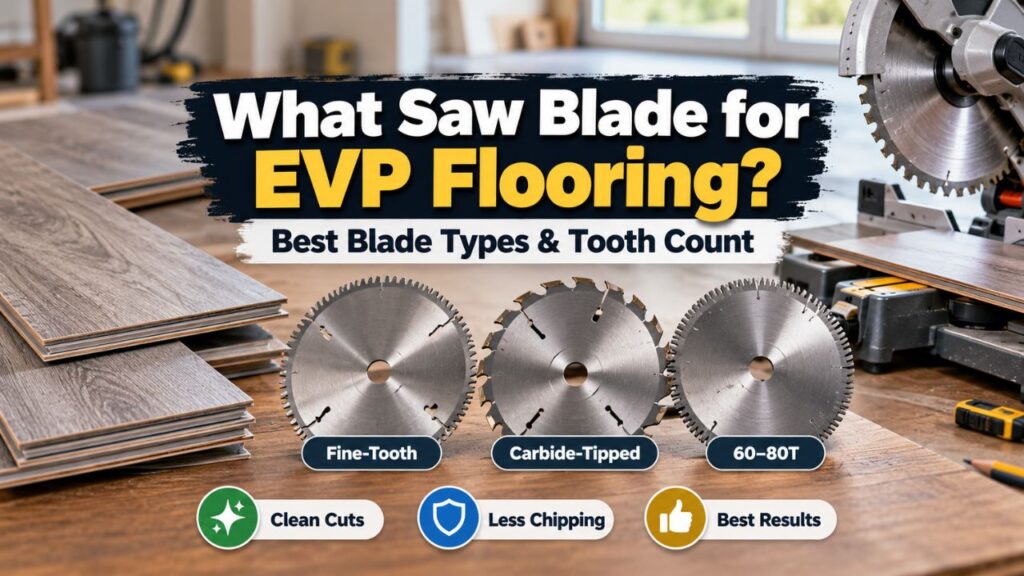
What Saw Blade for EVP Flooring? Best Blade Types & Tooth Count
What saw blade for EVP flooring should you use? For most engineered vinyl plank flooring, use a sharp fine-tooth carbide-tipped blade designed for laminate, plywood, plastic, or finish cutting. On a miter saw or circular saw, a fine blade generally produces the cleanest edge, while a fine-tooth jigsaw blade works better for curves, notches, and irregular cuts.
EVP, or engineered vinyl plank flooring, often combines a durable vinyl wear layer with a rigid composite core. Depending on the product, that core may be made from stone-plastic composite, wood-plastic composite, or another dense material. These layers can be harder on saw teeth than ordinary softwood, so blade quality matters.
A coarse framing blade can physically cut many EVP planks, but it tends to create rougher edges and may chip or fracture brittle rigid-core flooring. A finer carbide blade removes smaller amounts of material with each tooth and gives you greater control.
The ideal blade also depends on the saw. A miter saw, circular saw, jigsaw, table saw, and oscillating tool all require different blade styles. Some EVP products can even be scored and snapped, so a saw may not be necessary for every straight cut.
In this guide, I’ll explain the best saw blade for EVP flooring, recommended tooth counts for common saws, how to cut rigid-core vinyl without chipping, which blade works for SPC and WPC flooring, and when another cutting tool may be better.
What Is EVP Flooring?
EVP generally stands for engineered vinyl plank.
It is a broad flooring category that usually consists of multiple layers engineered into a rigid or semi-rigid plank.
A typical product may contain a protective wear layer, printed decorative vinyl layer, rigid structural core, and attached underlayment.
The core is what matters most when choosing a saw blade.
Many modern EVP floors use SPC, or stone-plastic composite, which can be quite dense and relatively brittle.
Others use WPC, or wood-plastic composite, which tends to be somewhat softer and easier to cut.
Some manufacturers use proprietary composite cores that behave differently from either.
Because EVP is not one universal material, there is no single blade specification that is perfect for every product. However, a sharp fine-tooth carbide blade is the safest general starting point for powered straight cuts.
What Saw Blade for EVP Flooring Is Best?
For most straight cuts, I recommend a fine-finish carbide-tipped blade.
The blade should be designed for one or more materials such as laminate, melamine, plywood, plastic, or finish woodworking.
These blades generally have smaller teeth and more teeth around the circumference than rough framing blades.
That allows them to cut the hard decorative surface and composite core with less impact.
Best General Blade Characteristics
The ideal EVP blade usually has:
A high tooth count, carbide-tipped teeth, sharp cutting edges, and a tooth geometry intended for smooth crosscuts or manufactured sheet materials.
On a 10-inch miter saw, something around 60 to 80 teeth is a practical starting range.
For a 12-inch miter saw, roughly 80 to 100 teeth can provide clean results.
For a common 7-1/4-inch circular saw, a 40- to 60-tooth finish blade is usually more appropriate than a 24-tooth framing blade.
These are general ranges rather than mandatory numbers.
A high-quality blade with proper tooth geometry can outperform a cheaper blade simply because it has more teeth.
Why Carbide-Tipped Blades Are Better for EVP
EVP flooring can be abrasive.
SPC flooring in particular contains mineral material in its rigid core. Repeated cutting can wear ordinary steel teeth quickly.
Carbide is much harder and maintains a usable cutting edge longer.
This has several advantages.
The saw requires less force, the cut edge stays cleaner, and the blade is less likely to tear or fracture the plank surface.
A dull blade can also generate more heat, which is undesirable with vinyl-based flooring.
For anything more than a handful of cuts, carbide is worth using.
Key Takeaways:
- A fine-tooth carbide blade is the best general choice for powered EVP flooring cuts.
- Coarse framing blades work poorly when clean edges matter.
- SPC flooring can be especially abrasive, so blade sharpness and carbide quality are important.
What Tooth Count Is Best for EVP Flooring?
Higher tooth counts generally produce smoother cuts, but more is not always better.
If the blade has too few teeth, each tooth removes a relatively large amount of material. This can produce chipped edges and rough cuts.
If the blade has an extremely high tooth count and you feed it too slowly, the blade can generate excess heat and wear faster.
You want a reasonable balance.
10-Inch Miter Saw
For a 10-inch miter saw, I would normally start with a 60- to 80-tooth carbide finish blade.
A 60-tooth blade cuts relatively quickly while still providing a smooth result.
An 80-tooth blade is useful when the decorative surface is particularly prone to chipping.
12-Inch Miter Saw
For a 12-inch miter saw, an 80- to 100-tooth blade is a common fine-finish range.
Because a 12-inch blade has a larger circumference, it needs more teeth to produce a similar tooth spacing to a smaller blade.
7-1/4-Inch Circular Saw
For a standard circular saw, a 40- to 60-tooth carbide blade works well for many EVP products.
Avoid the typical 24-tooth framing blade if appearance matters.
A framing blade can cut the flooring, but its large teeth are more likely to break away small chips from rigid-core material.
Table Saw
A table saw fitted with a fine combination, laminate, melamine, or finish blade can work very well.
Something in the general 60- to 80-tooth range on a 10-inch blade is a useful starting point.
A dedicated laminate or melamine blade may leave an even cleaner edge on brittle flooring.
What Blade for SPC Flooring?
SPC stands for stone-plastic composite.
It is one of the most common rigid cores used in EVP flooring.
SPC tends to be hard, dense, and relatively brittle compared with softer vinyl flooring.
Because of that, I recommend using a sharp carbide blade with a relatively fine tooth pattern.
The main goal is to minimize impact on the edge.
An aggressive coarse blade can cause tiny fractures or chips along the cut.
Does SPC Dull Saw Blades?
Yes, it can.
The mineral content in SPC is abrasive, so repeated cutting may dull a woodworking blade faster than cutting pine or ordinary plywood.
If you are installing a large room or entire house, it may make sense to dedicate a blade to the flooring project.
Monitor the quality of the cut.
If you notice increasing resistance, melting, roughness, or chipping, inspect the blade.
A blade that worked perfectly at the start of the job may no longer be sharp enough after hundreds of cuts.
What Blade for WPC Flooring?
WPC stands for wood-plastic composite.
It tends to be somewhat softer and less brittle than SPC.
A standard fine-finish carbide blade is usually sufficient.
WPC can still produce rough edges if the blade is dull or very coarse, but it is often easier to cut cleanly than highly mineralized SPC.
A 60- to 80-tooth blade on a 10-inch miter saw or 40- to 60-tooth blade on a 7-1/4-inch circular saw is generally a practical place to start.
Always test on a scrap piece because different manufacturers use different core formulations.
What Blade for a Miter Saw Cutting EVP?
For a miter saw, use a fine crosscut or finish blade with carbide teeth.
This is the best setup for shortening planks at the end of flooring rows.
A miter saw makes controlled downward cuts while the flooring remains stationary against the fence.
That makes it one of the easiest tools for clean repeated crosscuts.
Which Side Should Face Up?
On a conventional miter saw, place the finished decorative surface upward.
The blade generally enters the top surface as it moves downward.
This usually reduces visible chipping.
Make a test cut first, though, because blade geometry and flooring construction vary.
Let the Blade Reach Full Speed
Do not lower the blade into the flooring before the saw reaches full operating speed.
A full-speed blade enters the surface more smoothly.
Lower the blade at a controlled pace and avoid forcing it through the plank.
After the cut is complete, keep the saw head lowered until the blade stops.
This helps prevent the spinning blade from catching the freshly cut edge on the way back up.
What Blade for a Circular Saw Cutting EVP?
A circular saw is useful for both crosscuts and longer rip cuts.
Use a fine-tooth carbide finish blade.
For a 7-1/4-inch saw, around 40 to 60 teeth is typically appropriate.
Which Side Faces Up With a Circular Saw?
Unlike a miter saw, most handheld circular saw blades enter the material from the bottom and exit through the top.
That means the cleaner side is often the bottom face.
For many circular saw cuts, placing the decorative face downward helps reduce visible chipping.
However, make a scrap test before committing to the orientation because blade type and saw design can change the result.
Use a Guide for Long Cuts
A circular saw can make long rip cuts in EVP, but the cut can wander without a guide.
Clamp a straightedge to the plank or use a compatible guide rail.
Measure the offset between the blade and edge of the saw base before positioning the guide.
This is particularly useful when cutting the final flooring row lengthwise.
What Jigsaw Blade for EVP Flooring?
A jigsaw is the better tool for curves, notches, vents, door jamb areas, and pipe cutouts.
Use a fine-tooth blade designed for laminate, plastic, or clean wood cutting.
A blade with roughly 10 to 20 TPI can work depending on the flooring thickness and core material.
Finer blades generally leave smoother edges but cut more slowly.
Standard vs. Reverse-Tooth Jigsaw Blade
Most standard jigsaw blades cut on the upstroke.
That can create more chipping on the top surface.
If you are using a standard up-cut blade, placing the finished face downward may produce a cleaner visible surface.
A reverse-tooth blade cuts primarily on the downstroke, allowing you to keep the decorative side upward while still reducing surface chipping.
Reverse-tooth blades require controlled feeding because the cutting force acts differently.
Follow your jigsaw manufacturer’s instructions.
Use a Shorter Blade When Possible
The blade only needs to extend far enough through the flooring.
An unnecessarily long jigsaw blade can flex more easily and produce an angled edge.
For a typical thin EVP plank, a relatively short fine blade often gives better control.
Key Takeaways:
- Use a fine carbide blade for miter, circular, and table saw cuts.
- For a jigsaw, use a fine laminate/plastic blade rather than an aggressive wood blade.
- Blade orientation changes which face of the flooring should be positioned upward or downward.
Can You Use a Laminate Flooring Blade on EVP?
Yes, in many cases.
Blades marketed for laminate or melamine are designed to cut hard, brittle surface materials cleanly.
Those characteristics also make them useful for many EVP products.
A dedicated laminate blade can be especially helpful with rigid SPC flooring because it reduces edge impact.
However, do not assume a blade labeled “laminate” automatically fits every saw.
Check diameter, arbor size, maximum RPM rating, kerf, and manufacturer compatibility first.
Can You Use a Plywood Blade?
Yes.
A fine plywood blade can produce good results on EVP flooring.
Plywood blades are designed to minimize splintering across thin surface veneers, so their fine tooth count is well suited to controlled flooring cuts.
A carbide plywood blade is preferable if you have many planks to cut.
A very thin inexpensive steel plywood blade may dull quickly on abrasive SPC.
Can You Use a Framing Blade?
Technically yes, but I would avoid it when possible.
A 24-tooth framing blade is designed for fast construction cuts, not clean flooring edges.
The large teeth remove material aggressively and can fracture the decorative layer or rigid core.
If the cut edge will be completely hidden under baseboard, minor chipping may not matter aesthetically.
Even then, a fine blade produces a smoother, easier cut and is less likely to break a brittle plank corner.
Can You Use a Diamond Blade on EVP Flooring?
Usually, you do not need one.
Diamond blades are used for very abrasive materials such as tile, concrete, or masonry.
Although SPC contains stone powder, it is still a manufactured flooring product rather than ceramic tile.
A quality carbide blade normally provides a better balance of speed, cleanliness, and compatibility.
Using a masonry blade can generate excessive dust or heat and may leave an unnecessarily rough edge.
If a particular flooring manufacturer specifically recommends a different blade technology, follow that recommendation.
Can You Score and Snap EVP Flooring Instead?
Sometimes.
Certain EVP or luxury vinyl plank products are specifically designed to be scored with a utility knife and snapped.
This can be much faster and produces far less airborne dust.
However, not every rigid-core plank snaps cleanly.
Thick SPC, thick attached pads, or certain locking systems may be difficult to score and break.
How to Check
Look at the flooring installation instructions.
If the manufacturer specifically permits score-and-snap cutting, use a sharp utility knife and straightedge.
Score the wear layer deeply enough to establish a clean line, then snap the plank as directed.
Do not repeatedly force a plank that clearly is not designed to snap.
For products that resist scoring, use a suitable saw or flooring cutter.
How to Prevent Chipping When Cutting EVP Flooring
Blade choice is the first step.
The second is keeping the flooring stable.
Rigid-core planks can crack if they vibrate while the blade enters them.
Support both sides of the cut and avoid leaving a long unsupported section hanging from the saw.
Use Painter’s Tape
Painter’s tape across the cut can help on chip-prone surfaces.
Mark your line on the tape and remove it carefully afterward.
This does not compensate for a dull blade, but it can provide extra support around the decorative layer.
Cut on the Waste Side
Every blade creates a kerf.
Align the blade so the kerf falls on the waste side of your pencil line.
This helps preserve the finished plank dimension.
Slow Down, but Not Too Much
Feed the blade smoothly.
Forcing it can fracture the core.
Moving excessively slowly can create heat and possibly soften or melt vinyl components.
A sharp blade should cut without either extreme.
Does EVP Flooring Melt When Cut?
It can soften if enough heat builds up.
Vinyl is thermoplastic, so excessive friction can produce melting or a rough fused edge.
This usually happens because the blade is dull, contaminated, unsuitable, or fed too slowly.
Use a sharp blade and steady cutting speed.
If you see melted material accumulating on the teeth, stop and inspect the blade.
Do not continue forcing the saw through increasingly hot material.
Why Is My EVP Flooring Chipping?
A coarse or dull blade is the most common cause.
Improper support is another.
If the plank vibrates or snaps near the end of a cut, the rigid core can fracture.
Check the surface orientation as well.
If the blade is exiting through the decorative face, that side may show more damage.
Finally, some SPC products are inherently more brittle than others.
When working with particularly brittle flooring, a laminate-specific blade and slow controlled cutting can make a noticeable difference.
Best Blade for Crosscuts vs. Rip Cuts
Crosscuts and rip cuts place different demands on a saw, but manufactured flooring does not behave exactly like solid wood grain.
Because EVP has a composite core rather than continuous natural grain, tooth count and edge quality are often more important than traditional rip-versus-crosscut tooth geometry.
For crosscuts, use a fine-finish blade.
For long rip cuts, a table saw or guided circular saw with a carbide combination or laminate blade works well.
The most important goal is keeping the plank stable and cutting without excessive impact.
Saw Blade vs. Flooring Cutter
A manual or powered flooring cutter can be extremely convenient for EVP.
Many cutters are designed specifically for laminate, vinyl, SPC, or WPC flooring.
They produce relatively little airborne dust and operate quietly.
The limitation is that not every cutter works with every plank thickness or core composition.
A saw offers more flexibility.
If you already own a miter saw and table saw, you may not need a dedicated flooring cutter.
For professional flooring work, a cutter can save considerable cleanup time.
What Saw Is Best for EVP Flooring Overall?
No single saw handles every flooring cut perfectly.
A practical setup uses different tools for different tasks.
| Cut Type | Best Tool | Recommended Blade |
| Straight crosscut | Miter saw | Fine carbide finish blade |
| Angled crosscut | Miter saw | Fine carbide finish blade |
| Long rip cut | Table or circular saw | Fine carbide/laminate blade |
| Curve | Jigsaw | Fine laminate/plastic blade |
| Small notch | Jigsaw | Fine clean-cut blade |
| Pipe opening | Jigsaw or hole saw | Appropriate fine blade |
| Score-and-snap compatible plank | Utility knife | Sharp knife blade |
For an entire room, I would use a miter saw for most end cuts and a table saw or circular saw for the final row.
A jigsaw handles the detailed work that neither can do easily.
How Often Should You Change the Blade?
There is no fixed number of EVP planks one blade can cut.
Blade life depends on the core material, carbide quality, cutting speed, blade diameter, and amount of flooring.
SPC may shorten blade life considerably compared with soft WPC.
Replace or sharpen the blade when you notice a clear decline in performance.
Typical signs include greater cutting effort, rougher edges, more chipping, unusual heat, and visible dullness.
Do not wait until the blade barely cuts.
A dull saw blade creates worse results and encourages you to push harder, which reduces control.
Key Takeaways:
- EVP can dull blades faster than ordinary lumber, especially when it has an SPC core.
- Replace or sharpen a blade when cut quality noticeably declines.
- A clean, sharp medium-to-fine blade is better than simply choosing the highest tooth count available.
How to Cut EVP Flooring Safely
EVP cutting produces small chips and fine composite dust.
Wear eye protection.
When using powered saws, hearing protection is also appropriate.
Use the saw’s dust collection system whenever available and work in a well-ventilated area.
Avoid placing your hands near the cutting path simply because flooring planks are thin.
Thin stock can be harder to hold securely than dimensional lumber.
Use clamps, fences, and proper support when appropriate.
Never install an incorrect-diameter blade or exceed its maximum RPM rating.
Also inspect flooring for hidden fasteners before cutting reused or previously installed material.
A blade striking metal unexpectedly can damage carbide teeth.
Common Blade-Selection Mistakes
One mistake is choosing a blade solely by tooth count.
Tooth geometry, sharpness, carbide quality, and material compatibility also matter.
Another is using a framing blade because it was already installed on the saw.
It may save a few minutes of setup but produce chipped flooring throughout the project.
Using an excessively dull “fine” blade is another problem. A sharp 40-tooth finish blade can sometimes cut cleaner than a dull 80-tooth blade.
Finally, do not assume every EVP product cuts the same way.
Always make one or two trial cuts with scrap material before deciding that your setup is ready for the room.
FAQs about What Saw Blade for EVP Flooring
What saw blade for EVP flooring is best?
A sharp fine-tooth carbide-tipped blade designed for laminate, plywood, plastic, or finish cutting is the best general option.
Choose the tooth count according to blade diameter and saw type.
What blade should I use for SPC flooring?
Use a fine carbide blade.
SPC is relatively hard and abrasive, so carbide stays sharp longer and produces cleaner edges than ordinary steel teeth.
What blade should I use for WPC flooring?
A fine-finish carbide woodworking blade works well.
WPC is generally easier to cut than SPC but still benefits from a sharp blade.
How many teeth for a 10-inch miter saw?
A 60- to 80-tooth carbide blade is a useful starting range for clean EVP crosscuts.
A finer blade may help with particularly brittle material.
How many teeth for a 12-inch miter saw?
Approximately 80 to 100 teeth is a common finish-cutting range for a 12-inch blade.
Blade quality and tooth geometry also matter.
What blade for a 7-1/4-inch circular saw?
A 40- to 60-tooth carbide finish blade usually works well for EVP.
Avoid a coarse 24-tooth framing blade if clean edges matter.
What jigsaw blade should I use?
Use a fine-tooth blade designed for laminate, plastic, or clean wood cuts.
Roughly 10 to 20 TPI is a practical general range, depending on plank thickness.
Can I use a laminate blade for vinyl plank flooring?
Yes. Laminate-specific blades are often excellent for rigid vinyl flooring because they are designed to cut hard, brittle surfaces cleanly.
Can I use a plywood blade?
Yes. A fine carbide plywood blade can make clean EVP cuts.
It may dull relatively quickly if you are cutting large amounts of abrasive SPC.
Can I use a framing blade?
You can, but I do not recommend it.
Large coarse teeth are more likely to chip or fracture the flooring edge.
Can I use a metal blade?
Generally, no.
A standard metal-cutting blade is not optimized for EVP flooring and may cut too slowly or generate excess heat.
Use a blade intended for laminate, plastic, or woodworking instead.
Can I use a diamond blade?
Usually not necessary.
A carbide laminate or finish blade is better suited to most EVP products.
Does EVP flooring dull saw blades?
Yes.
Rigid SPC flooring can be especially abrasive because of its mineral-filled core.
Should EVP face up or down on a miter saw?
Normally face up.
The blade enters the decorative surface from above, helping reduce visible chipping.
Should EVP face up or down with a circular saw?
With most handheld circular saws, finished-side-down often produces the cleaner visible edge because the blade enters from underneath.
Test on scrap first.
Can I score and snap EVP flooring?
Some products can be scored and snapped, while others are too thick or rigid.
Check the manufacturer’s installation instructions.
Why is my EVP melting when I cut it?
The blade may be dull, contaminated, or moving too slowly through the plank.
Excessive friction generates heat that can soften vinyl components.
Why does my EVP crack during cutting?
The plank may be poorly supported, the blade may be too coarse, or the rigid core may be particularly brittle.
Use a sharp fine blade and support both sides of the cut.
What saw is best for EVP flooring?
A miter saw is best for repeated crosscuts, a table or circular saw is best for rip cuts, and a jigsaw is best for curves and notches.
A flooring cutter can also be very useful when compatible with the plank.
Conclusion
So, what saw blade for EVP flooring should you choose? For most engineered vinyl plank installations, the best general option is a sharp fine-tooth carbide-tipped blade designed for laminate, plywood, plastic, or finish woodworking.
For a 10-inch miter saw, around 60 to 80 teeth is a practical starting range. For a 12-inch miter saw, approximately 80 to 100 teeth can provide a smooth finish. On a 7-1/4-inch circular saw, a 40- to 60-tooth carbide blade is usually much better than a coarse framing blade.
If you are cutting SPC flooring, blade quality becomes particularly important because the mineral-filled core can be abrasive and relatively brittle. WPC flooring is usually somewhat easier to cut, but it still benefits from a fine carbide blade.
For detailed shapes, use a fine jigsaw blade intended for laminate or plastic. A reverse-tooth blade can be especially useful when you need to protect the top decorative surface.
Before cutting an entire room, make one test cut through a scrap plank. Check both faces for chipping, watch for melting or excessive resistance, and adjust the blade or plank orientation if necessary.
The practical rule is simple: use a sharp carbide blade with enough teeth to cut smoothly but not so many that the blade overheats. Match the blade to the saw, support the flooring properly, and replace or sharpen the blade when the edge quality begins to decline. With the right setup, EVP flooring can be cut quickly and cleanly without damaging the decorative surface or rigid core.