How to Use a Vertical Panel Saw Safely and Accurately
If you want to know how to use a vertical panel saw, place the sheet flat against the saw’s vertical frame, set the material stops or measurement scale, position the saw carriage for the required cut, keep your hands clear of the blade path, start the saw, and move the carriage or material according to the machine’s cutting mode. For crosscuts, most vertical panel saws move the saw carriage through the sheet. For rip cuts, many models require rotating or repositioning the saw head and moving the sheet horizontally through the cutting line.
A vertical panel saw is designed to make large sheet goods easier and safer to handle than they would be on a conventional table saw. Instead of supporting a full 4 × 8-foot plywood panel horizontally, you stand the material nearly upright against the machine’s frame.
This dramatically reduces the floor space needed and makes sizing plywood, MDF, particleboard, melamine, laminated panels, and similar materials much more manageable.
However, a vertical panel saw is still a powerful circular saw mounted in a specialized frame. The blade can cause serious injury, and different manufacturers use different carriage locks, rip mechanisms, blade rotation directions, and operating procedures.
Always follow the manual and safety labels for your exact machine.
In this guide, I’ll explain how to use a vertical panel saw step by step, how to make both crosscuts and rip cuts, how to position large panels, how to prevent chipped edges, and which mistakes to avoid.
What Is a Vertical Panel Saw?
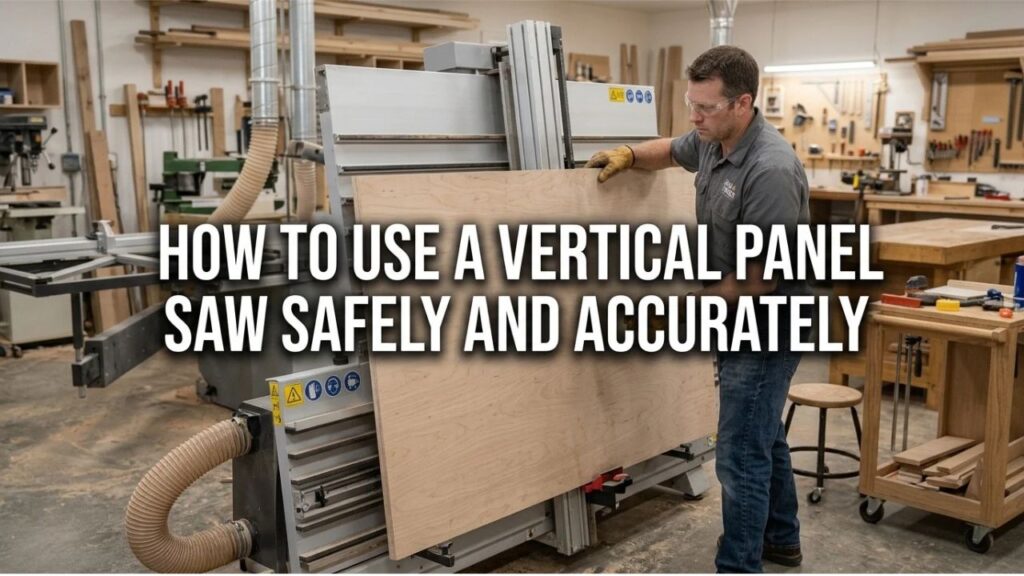
A vertical panel saw is a cutting machine designed primarily for large sheet materials.
The machine has a tall frame that supports the workpiece in an almost vertical position.
A circular saw is mounted on a guided carriage.
Depending on the cut you need, either the saw carriage moves through the stationary panel or the panel moves past a fixed saw position.
This arrangement gives the machine two important advantages.
First, it requires far less floor space than laying a full-size panel flat on a large sliding table.
Second, the frame supports the weight of the sheet, making large panels easier for one person to position.
Vertical panel saws are common in:
Cabinet shops.
Furniture shops.
Home improvement stores.
Sign shops.
Millwork businesses.
Construction material suppliers.
Professional woodworking shops.
They are especially useful when many full-size sheets need to be broken down quickly into accurately sized pieces.
What Materials Can You Cut With a Vertical Panel Saw?
The exact capabilities depend on the machine and blade.
Typical woodworking vertical panel saws can cut materials such as:
Plywood.
MDF.
Particleboard.
OSB.
Melamine panels.
Hardboard.
Some laminated panels.
Certain plastic sheets when the machine and blade are rated for them.
Do not assume that a standard woodworking panel saw can cut aluminum, steel, masonry panels, or cement board.
Those materials may require a different machine, blade, dust-control system, or cutting process.
Always confirm the machine and blade ratings first.
Vertical Panel Saw Crosscut vs. Rip Cut
Understanding these two cutting modes is essential.
Crosscutting a Panel
On most vertical panel saws, a crosscut is made by placing the panel against the frame and moving the saw carriage vertically through it.
The material stays stationary while the saw travels along its guide.
For a typical full-size sheet, this is often the easiest operation.
Rip Cutting a Panel
Rip cutting generally involves cutting along the longer direction of the sheet.
On many vertical panel saws, the saw head is rotated into a horizontal cutting orientation and locked at the required height.
The operator then moves the sheet horizontally through the blade.
Some models work differently, so do not assume that every vertical saw uses this exact procedure.
Check your machine’s rip-cut instructions before repositioning the saw head.
Key Takeaways:
- Crosscuts commonly use a moving saw carriage and stationary panel.
- Rip cuts commonly use a fixed saw position while the panel moves horizontally.
- The exact setup varies by machine, so use the manufacturer’s procedure.
Before Using a Vertical Panel Saw
Preparation matters just as much as the actual cut.
Do not load a large panel and immediately start cutting.
Inspect the machine first.
Make sure the saw is securely installed on its frame and that the carriage moves smoothly.
Check the blade guard.
Inspect the power cord and switches.
Make sure the blade is appropriate for the material.
Verify that the support rollers or material ledge are clean.
Check that measurement scales, stops, and carriage locks operate properly.
If the machine has a dust collector, connect it before cutting.
Wear Appropriate PPE
Use eye protection.
Hearing protection is also strongly recommended.
Sheet materials such as MDF can create a significant amount of fine dust, so appropriate respiratory protection and dust extraction may be necessary.
Avoid loose clothing, jewelry, dangling drawstrings, or anything that could approach the blade.
Keep long hair secured.
Inspect the Blade Before Cutting
A sharp blade is critical for both safety and cut quality.
Look for:
Missing carbide teeth.
Cracked teeth.
Heavy resin buildup.
Warping.
Excessive wear.
Damage around the arbor hole.
A dull blade requires greater cutting force and can produce more heat, burning, chipping, and vibration.
Do not continue using a damaged blade simply because it still rotates.
Use the Right Blade for the Material
For general plywood cutting, a quality carbide-tipped blade with an appropriate tooth count works well.
For melamine or finished cabinet panels, a finer-tooth blade designed for clean sheet-good cuts generally produces better edges.
For MDF, use a blade rated for composite sheet material and maintain good dust extraction.
The blade diameter and arbor must exactly match the machine requirements.
Step 1: Clear the Work Area
A vertical panel saw may have a compact footprint, but you still need significant space around it.
Clear the area on both sides of the machine.
A full sheet may extend several feet beyond the frame during loading or rip cutting.
Remove cords, scrap material, tools, and other trip hazards.
Also make sure there is enough room for the finished offcut.
Do not allow a cut piece to become trapped against a wall, bench, or another machine.
Step 2: Load the Panel Onto the Saw
Lift the sheet onto the lower support or rollers.
Keep the broad face of the sheet against the vertical frame.
The panel should sit flat rather than leaning away from the supports.
For a large, heavy, or flexible sheet, use another person or an appropriate lifting aid.
Do not risk losing control of a full-size MDF or plywood sheet simply to make the job a one-person operation.
Make Sure the Panel Is Stable
Before measuring, verify that the lower edge is properly supported.
If the material rocks or bows significantly, the cut may not remain square.
Remove debris from behind the sheet.
A small wood chip trapped between the frame and panel can tilt the material enough to affect accuracy.
Step 3: Decide Which Cut to Make First
If you are breaking down a full sheet into several smaller parts, plan the sequence before cutting.
A good cut order reduces handling.
For example, you may first make a crosscut that divides an 8-foot sheet into two manageable sections, then rip those smaller sections to final widths.
Or you may make rip cuts first if your cut list makes that more efficient.
There is no universal sequence.
The best approach is the one that keeps the largest pieces supported and minimizes repeated repositioning.
Step 4: Measure and Set the Cut
Use the saw’s built-in scale if it is properly calibrated.
Many vertical panel saws have measurement systems along the frame that let you position material or the saw head quickly.
However, check the scale against a tape measure before relying on it for precision cabinetry.
If the saw has recently been moved, adjusted, or fitted with a new blade, recalibration may be necessary.
Account for Blade Kerf
The blade removes material.
That removed width is called the kerf.
Make sure the blade cuts on the waste side of your layout line.
If you place the blade directly on the wrong side of the mark, the finished piece can be undersized by one blade kerf.
For repetitive work, calibrated stops are much faster and more consistent than measuring every piece individually.
How to Crosscut With a Vertical Panel Saw
Crosscutting is one of the main advantages of a vertical panel saw.
On many machines, the panel stays stationary while the saw carriage travels vertically.
Step 5: Position the Panel for the Crosscut
Slide the panel horizontally along the lower supports until the desired cut line is directly beneath the saw carriage path.
Use the measuring scale, stop, or your own marked line to position it.
Make sure the panel remains flat against the frame.
If the sheet shifts while you are positioning it, verify the measurement again.
Step 6: Lock or Stabilize the Material as Required
Some panel saws use material clamps.
Others rely on the frame and rollers.
Use any factory hold-downs or clamping systems provided by the manufacturer.
Never place your hand in the projected blade path to keep a panel from moving.
Your hands should remain well away from the cutting line.
Step 7: Position the Saw Carriage
Move the saw carriage to its starting position.
Depending on the machine, the starting point may be above or below the panel.
Follow the manufacturer’s specified cutting direction.
Do not assume that moving the carriage in either direction is equally safe.
Blade rotation and guard design can make one direction the intended feed direction.
Make sure any carriage lock is released only when you are ready to cut.
Step 8: Start the Saw
Keep both hands in their designated operating positions.
Turn the motor on and allow the blade to reach full speed before entering the material.
Do not start the blade while it is already buried in the panel.
Listen for abnormal vibration or noise.
If anything sounds wrong, turn the machine off and investigate.
Step 9: Move the Carriage Smoothly Through the Sheet
Feed the saw at a steady, controlled rate.
Do not force it.
The correct feed rate allows the teeth to cut without bogging down the motor.
If the blade begins slowing dramatically, you may be feeding too quickly or using a dull or unsuitable blade.
At the same time, feeding extremely slowly can create heat and burning.
Maintain consistent movement through the entire cut.
Step 10: Finish the Cut Completely
Continue until the blade has fully cleared the material.
Do not reverse direction with the blade still partially engaged unless the manufacturer’s procedure specifically permits it.
After the cut is complete, allow the blade to stop as required and return the carriage to its safe resting position.
Secure the carriage lock if the machine has one.
Only then remove or reposition the workpieces.
How to Rip Cut With a Vertical Panel Saw
Rip cutting is handled differently on many machines.
The exact procedure is highly model-dependent, so use this as a general explanation rather than a substitute for your saw’s manual.
Step 11: Set the Saw for Rip Mode
Turn the machine off and wait until the blade is completely stopped.
Disconnect power if your machine requires it before repositioning the head.
Rotate the saw assembly into its approved rip-cut orientation.
Lock it firmly.
Never attempt to rotate or adjust the saw while the blade is spinning.
Position the saw head at the height required for your desired rip width.
Use the built-in scale or measure manually.
Double-check the lock before starting the motor.
Step 12: Position the Panel
Place the panel on the lower rollers or support ledge.
The sheet will usually move horizontally during a rip cut.
Make sure you have enough clear space for the full panel to travel from one side of the machine to the other.
Plan where your hands will be before switching the saw on.
Never push the sheet with your fingers approaching the blade path.
Step 13: Start the Saw and Let It Reach Full Speed
Start the motor with the material clear of the blade.
Wait for full blade speed.
Then begin moving the panel at a controlled rate through the cutting area in the manufacturer-specified direction.
Do not feed the material backward simply because it appears easier.
The correct direction matters because the rotating blade can pull or lift the panel if fed incorrectly.
Step 14: Keep the Sheet Flat Against the Frame
During the entire rip cut, maintain contact between the sheet and the vertical supports.
Do not allow the panel to twist or lean away from the frame.
A twisted panel can bind the blade and create an inaccurate cut.
Use smooth horizontal pressure rather than pushing the panel aggressively into the saw.
Step 15: Support the Offcut
As the rip cut nears completion, both parts of the panel need support.
A narrow offcut can shift once the final fibers are cut.
Do not reach near the blade to catch it.
Instead, arrange supports or have a second person assist from a safe position when handling very large pieces.
Once the material has completely cleared the blade, turn off the saw and wait for full blade stop before making adjustments.
How to Get Straight Cuts With a Vertical Panel Saw
A vertical panel saw should produce very straight cuts when it is properly calibrated.
If it does not, there are several possible causes.
The frame may not be square.
The carriage guides may need adjustment.
The panel supports may be dirty.
The blade may be warped.
The measurement scale may be incorrectly calibrated.
The sheet itself may also have a factory edge that is not perfectly straight.
For high-precision cabinet work, periodically check the machine with a large framing square or other accurate reference.
Check Crosscut Squareness
Make a test cut on a reasonably wide scrap panel.
Measure the diagonal or check the cut with an accurate square.
If the cut consistently drifts out of square, consult the machine’s alignment procedure.
Do not compensate permanently by holding panels crooked.
Fix the machine alignment.
How to Reduce Chipping on Plywood
Plywood veneer can chip as blade teeth exit the surface.
A sharp, fine-tooth carbide blade is the first defense.
Maintain the correct feed rate.
Do not use a construction blade with very few teeth when appearance matters.
You can also support delicate surfaces with painter’s tape along the cut line in some applications.
For high-end cabinet plywood, a blade specifically designed for plywood or laminate is usually worth the cost.
Know Which Face Should Be Toward the Blade
Chipping depends on the direction in which the blade teeth enter and exit the material.
Because vertical panel saw designs differ, you should confirm your machine’s blade rotation before deciding which face should be toward or away from the blade.
If one face is more important cosmetically, make a test cut first.
How to Cut Melamine on a Vertical Panel Saw
Melamine is especially prone to chipping.
Use a sharp blade intended for laminate or melamine.
Keep the machine well aligned.
Feed the panel smoothly without stopping midway if possible.
Some professional panel saws use scoring systems specifically to reduce chipping on laminated panels.
A standard vertical panel saw without a scoring blade may not produce the same edge quality as a commercial sliding panel saw with scoring.
If the finished edge will be highly visible, test your setup on scrap before cutting expensive material.
How to Cut MDF Safely
MDF is easy to machine but produces extremely fine dust.
Use effective dust collection and suitable respiratory protection.
Make sure the dust port is connected properly before starting.
Fine MDF dust can spread throughout a shop quickly and should not be treated like ordinary large wood chips.
A sharp carbide blade also reduces heat and cutting resistance.
Can You Cut a Full 4 × 8 Sheet Alone?
One of the major advantages of a vertical panel saw is easier handling of full sheets.
Many operators can manage a standard plywood sheet alone.
However, that does not mean every full sheet should be handled by one person.
Thick MDF and particleboard can be very heavy.
Oversized sheets can also be awkward.
If you cannot load and control the panel comfortably without straining or losing balance, use a second person or lifting equipment.
Machine capability does not replace safe material handling.
Proper Hand Position on a Vertical Panel Saw
Keep your hands completely outside the blade path.
For crosscuts, your hands should normally remain on the saw carriage handles or approved controls rather than holding the sheet near the cut.
For rip cuts, position your hands far enough from the cutting line that they never approach the blade during feed.
Do not reach behind the blade for an offcut.
Do not attempt to pull material through from the exit side if that places your hands close to the blade.
Think through the entire movement before switching the saw on.
What If the Blade Binds?
Stop feeding immediately.
Keep control of the material.
Turn the saw off.
Wait until the blade stops completely.
Do not yank the material backward while the blade is running.
Binding can happen because:
The sheet is twisted.
The blade is dull.
The blade is inappropriate for the material.
The frame is out of alignment.
The material is not flat.
The offcut is closing on the blade.
Find the cause before continuing.
Should You Push Hard on a Vertical Panel Saw?
No.
A properly sharpened blade should cut without excessive force.
If you need to lean heavily into the carriage or sheet, something is wrong.
The most likely causes are a dull blade, wrong blade, excessive material thickness, or incorrect feed direction.
Forcing the cut reduces accuracy and increases the chance of binding or losing control.
Common Vertical Panel Saw Mistakes
One common mistake is assuming the built-in measuring scale is automatically accurate.
Always calibrate it before precision work.
Another is feeding too fast.
A vertical saw may cut quickly, but the motor and blade still have limits.
A third mistake is placing hands near the kerf to keep the panel stable.
Use factory supports and clamps rather than your hands.
Another problem is changing from crosscut to rip mode without locking the saw assembly correctly.
Never begin a rip cut until all required locks are fully engaged.
Operators also sometimes forget to support the finished pieces.
A large offcut can suddenly shift after the blade exits the panel.
Finally, do not use the machine for material it was never designed to cut.
Vertical Panel Saw vs. Table Saw
Both tools can size sheet goods, but they approach the job differently.
A table saw keeps the blade relatively stationary while you push a large sheet horizontally across the table.
A vertical panel saw supports the sheet upright.
This makes a vertical saw particularly convenient for breaking down large panels.
A cabinet table saw may provide more versatility for solid lumber, dadoes, joinery, and smaller components.
A vertical panel saw is much more specialized.
Its strength is fast, repeatable sheet-material cutting.
Vertical Panel Saw vs. Track Saw
A track saw is portable.
You place the panel horizontally on a bench, floor, or foam support and guide the saw along a track.
It can produce excellent finish-quality cuts and is convenient on job sites.
A vertical panel saw is stationary.
It is much faster when a shop regularly processes many full-size sheets.
If you only break down plywood occasionally, a track saw may be more practical.
If sheet processing is a daily task, a vertical panel saw can save considerable time.
Maintenance Tips for a Vertical Panel Saw
Keep the guide rails clean.
Dust and resin can interfere with smooth carriage movement.
Inspect the blade regularly.
Check the power cord and switches.
Keep rollers free of debris.
Verify that locks remain secure.
Periodically check the machine for square.
Clean dust from the motor ventilation areas according to manufacturer instructions.
Do not lubricate guide systems randomly.
Some bearings or rails require a specific lubricant, while others are designed to operate dry.
Follow the maintenance manual.
Key Takeaways:
- Clean guides and a sharp blade improve both safety and accuracy.
- Check squareness and measuring scales periodically.
- Use the exact lubrication and adjustment procedures specified for your machine.
FAQs About How to Use a Vertical Panel Saw
How do you use a vertical panel saw?
Load the sheet against the vertical frame, measure and position the cut, set the saw for crosscut or rip mode, start the blade, and make the cut using the machine’s approved feed direction.
What is a vertical panel saw used for?
It is mainly used to break down large sheet goods such as plywood, MDF, particleboard, OSB, and laminated panels.
Can a vertical panel saw rip plywood?
Yes.
Most full-featured vertical panel saws can make both rip cuts and crosscuts.
How do you crosscut on a vertical panel saw?
Typically, the sheet remains stationary while the saw carriage moves vertically through the material.
How do you rip on a vertical panel saw?
On many machines, the saw head is rotated and locked horizontally, then the panel is moved through the blade.
Check the exact machine instructions because designs vary.
Can you cut a 4 × 8 sheet on a vertical panel saw?
Yes. Full 4 × 8-foot sheet goods are one of the primary materials vertical panel saws are designed to handle.
Can you cut MDF on a vertical panel saw?
Yes, when the saw and blade are rated for MDF.
Use strong dust extraction because MDF produces very fine dust.
Can you cut melamine?
Yes.
Use a sharp fine-tooth or laminate-rated blade to reduce edge chipping.
Can you cut OSB?
Yes, provided the machine and blade are suitable for wood-based sheet goods.
Can a vertical panel saw cut solid wood?
Some models can cut certain solid-wood pieces, but vertical panel saws are primarily designed for sheet materials.
Use the manufacturer’s material and size limits.
Can you cut aluminum on a vertical panel saw?
Only if the particular saw, blade, speed, guarding, and manufacturer instructions specifically permit it.
Do not put a metal-cutting blade on a woodworking panel saw without confirming compatibility.
Which direction should you feed material?
Use the direction specified by the manufacturer.
Correct feed direction depends on blade rotation and machine design.
How do you prevent plywood from chipping?
Use a sharp fine-tooth blade, maintain steady feed, support the panel properly, and test which face orientation gives the cleanest edge on your machine.
Why is my panel saw cutting crooked?
Possible causes include poor alignment, dirty guides, an incorrectly positioned panel, worn carriage components, or a damaged blade.
Why does the blade burn MDF or plywood?
The blade may be dull or dirty, the feed may be too slow, or the blade may not be appropriate for the material.
Should the blade be running before touching the panel?
Yes. Normally, allow the blade to reach full speed before entering the material.
Can one person operate a vertical panel saw?
Often, yes.
However, heavy or oversized panels may require a second person or mechanical lifting assistance.
Is a vertical panel saw safer than a table saw?
It can make large sheet handling easier because the machine supports the panel, but it still contains an exposed cutting system capable of serious injury.
Safe operating procedures remain essential.
Do you need dust collection?
It is strongly recommended, especially for MDF and composite panels.
Can you use a vertical panel saw without the blade guard?
No. Use the machine with its manufacturer-supplied guarding correctly installed and functioning.
Can you freehand a cut?
No.
Use the guided carriage and machine support system as intended.
Should you force the saw through thick material?
No.
Use steady pressure. If the saw requires excessive force, stop and check the blade, feed direction, material thickness, and machine setup.
Conclusion
Learning how to use a vertical panel saw is relatively straightforward once you understand that crosscuts and rip cuts are handled differently.
For a typical crosscut, load the sheet flat against the vertical frame, measure and position it accurately, keep your hands away from the blade path, start the saw, allow it to reach full speed, and move the saw carriage smoothly through the panel.
For a typical rip cut, the saw head is repositioned and locked in its approved horizontal orientation, and the panel is moved through the blade in the manufacturer-specified direction.
The exact mechanism varies between brands and models, so your machine’s operating manual should always take priority over a generic procedure.
The biggest advantages of a vertical panel saw are sheet support, small floor-space requirements, and fast repetitive cutting. A full plywood or MDF sheet that can be awkward on a table saw becomes much easier to control when most of its weight is carried by the vertical frame.
Accuracy depends on more than simply following the scale.
Keep the frame square, guides clean, blade sharp, and measuring system calibrated. Use the correct blade for plywood, MDF, melamine, or whatever sheet material you are cutting.
Most importantly, never compromise on safety to make a cut faster.
Keep your hands out of the blade path, use the guards and locks supplied with the machine, support large offcuts, wait for the blade to stop before adjusting the saw, and never force a binding panel.
Used correctly, a vertical panel saw is one of the fastest and most efficient tools available for turning large sheet goods into accurate, manageable components.