What Saw to Use for Cutting Tenons in Long Stock? Best Choices
If you are deciding what saw to use for cutting tenons in long stock, a 12- to 16-inch rip-filed tenon saw is usually the best hand-saw choice for cutting the tenon cheeks. Its long plate, stiff back, and rip-oriented teeth make it efficient for cutting along the grain while giving you enough control for accurate joinery. For the shoulder cuts, a crosscut carcass saw or other fine crosscut backsaw is usually the better tool because the shoulders cut across the wood grain.
The fact that the stock is long does not fundamentally change how a tenon is cut, but it can change how you support the work and which saw feels comfortable. Long rails, table aprons, bed components, door parts, and similar pieces can be awkward to place on a conventional bench hook. In many cases, it is easier to clamp the stock vertically or at an angle in a sturdy face vise and bring the saw to the work.
A small dovetail saw may technically make the cut, but it is usually too short and fine for efficiently cutting large tenon cheeks. At the other extreme, an ordinary coarse hand saw can remove material quickly but provides less control around carefully marked joinery lines.
The ideal setup separates the two different cuts that make a tenon: use rip-oriented teeth for the cheeks and crosscut teeth for the shoulders. If you want to work with only one saw, a well-sharpened tenon saw with a moderately fine tooth pattern can handle both, although it will normally be optimized more for one direction of grain than the other.
In this guide, I’ll explain which saw works best for cutting tenons in long stock, why tenon cheeks and shoulders benefit from different tooth geometry, how saw length and tooth count affect the cut, and how to support long workpieces so you can cut large tenons accurately by hand.
What Saw to Use for Cutting Tenons in Long Stock?
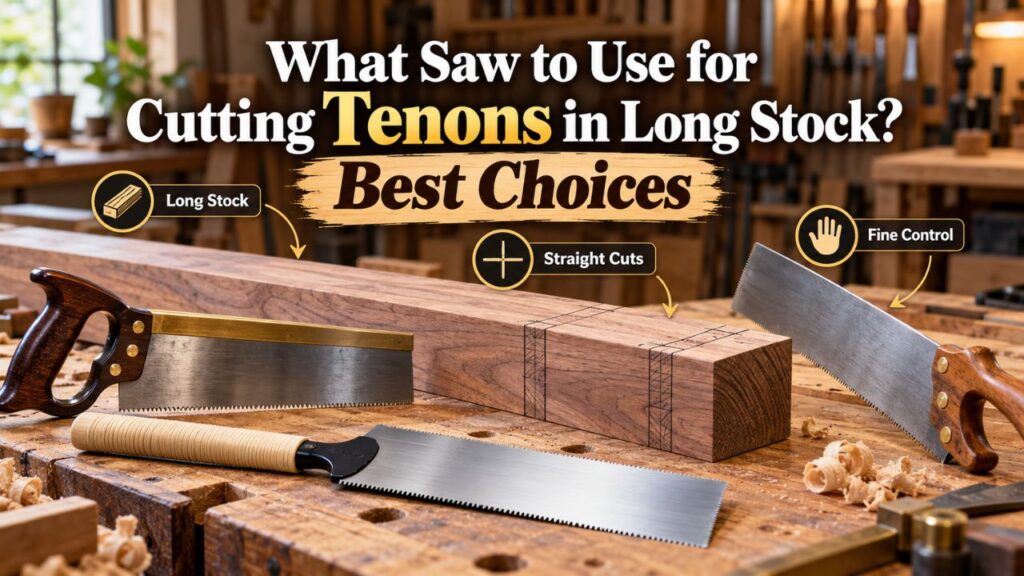
For traditional hand-tool woodworking, my first choice is a large rip-filed tenon saw, typically around 12 to 16 inches long.
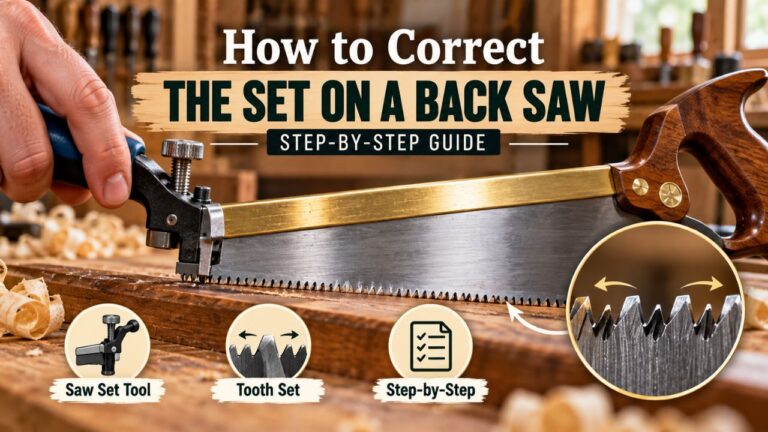
A tenon saw is a backsaw, meaning a rigid brass or steel spine reinforces the upper edge of the saw plate. That reinforcement keeps the thin blade stiff and helps it track accurately through a long joinery cut.
The larger size is particularly useful when cutting tenons on substantial stock.
A short dovetail saw can make a very precise cut, but its limited blade length and fine teeth make it inefficient for deep cheeks. A larger tenon saw gives you a longer stroke, more cutting teeth engaged in the work, and enough depth below the back to reach the base of a typical tenon.
For large furniture or architectural work, a traditional tenon saw around 14 or 16 inches long is often particularly comfortable.
Use Rip Teeth for the Tenon Cheeks
The cheeks are the large flat faces of the tenon.
When you cut them from the end of a board toward the shoulder, the saw is primarily cutting with the grain.
That is a ripping operation.
A rip-filed saw tooth acts more like a tiny chisel, severing wood fibers along their length. This makes it efficient for long cheek cuts.
For that reason, if I were buying one dedicated saw specifically for cutting tenons, I would choose a rip-filed tenon saw.
Use a Crosscut Saw for the Shoulders
The shoulder cut runs across the width or thickness of the board.
That means the saw is cutting across the grain.
Crosscut teeth are shaped to slice across wood fibers cleanly rather than chisel along them.
A carcass saw, small crosscut backsaw, or crosscut-filed tenon saw works well for this part of the joint.
You can cut both cheeks and shoulders with one saw if necessary, but using the correct tooth geometry for each cut generally improves both speed and surface quality.
Key Takeaways:
- A 12- to 16-inch rip-filed tenon saw is my preferred tool for large tenon cheeks.
- Tenon cheeks are rip cuts because they run with the grain.
- Tenon shoulders are crosscuts and are cleaner with a crosscut backsaw.
- Long stock changes how you support the work more than it changes the basic saw choice.
Why a Tenon Saw Is Better Than a Smaller Backsaw
Tenon saws are specifically designed for relatively deep, accurate joinery cuts.
Several features make them well suited to this work.
The first is blade length.
A longer saw allows you to use smooth, full strokes instead of short movements. This improves cutting speed and can make it easier to maintain a straight line.
The second is the reinforced back.
A thin unsupported blade can flex or buckle if your stroke is imperfect. The rigid spine of a tenon saw keeps the plate straight and makes the saw feel more predictable.
The third advantage is depth of cut.
A tenon saw generally has more distance between the teeth and the reinforced back than a small dovetail saw.
This matters because once the back contacts the end of your workpiece, the saw cannot cut any deeper.
Why a Dovetail Saw Is Usually Too Small
A dovetail saw is an excellent precision tool, but it is optimized for much smaller joinery.
Its short plate and shallow cutting depth are perfect for dovetails, small tenons, and delicate work.
For a large table-leg tenon or the end of a wide rail, however, it can be unnecessarily slow.
The fine teeth also remove less material per stroke.
If the tenon is small, a dovetail saw can certainly work. But if you regularly cut large tenons, a proper tenon saw is considerably more efficient.
What Size Tenon Saw Is Best for Long Stock?
The fact that the stock is long does not necessarily require an unusually long saw.
What matters more is the size of the tenon itself.
For general furniture work, a tenon saw between approximately 12 and 14 inches is highly versatile.
For larger tenons in thick legs, doors, benches, or heavy furniture, a 14- to 16-inch saw can be more efficient.
A larger saw has more mass and a longer tooth line, which helps it move smoothly through substantial stock.
Here is a practical comparison:
| Saw Size | Best Use | Typical Tenon Work |
| 8–10 inches | Small joinery | Small tenons and delicate work |
| 10–12 inches | Light furniture work | Small to medium tenons |
| 12–14 inches | General furniture making | Medium and large tenons |
| 14–16 inches | Heavy joinery | Large rails, doors, benches, thick stock |
| 16+ inches | Specialized large work | Timber-sized or unusually deep tenons |
I would choose approximately 14 inches as a versatile starting point for someone who regularly cuts traditional furniture-sized tenons.
A 16-inch saw becomes attractive if your work frequently involves large stock.
How Many TPI Should a Tenon Saw Have?
TPI means teeth per inch.
A lower TPI gives you larger, more aggressive teeth that remove material quickly. A higher TPI gives you smaller teeth and generally provides a finer, slower cut.
For a general-purpose tenon saw, somewhere around 10–14 TPI is a useful range.
Very large tenon saws can be somewhat coarser, while saws intended for smaller furniture joinery may be finer.
The ideal tooth count also depends on the thickness of the material.
You want several teeth engaged in the work during the cut. A very coarse tooth pattern can feel rough in thin stock, while an extremely fine saw can feel unnecessarily slow in thick hardwood.
My Preference for General Furniture Tenons
For typical furniture work, I like a rip-filed tenon saw in roughly the 11–13 TPI range.
That gives a useful balance of speed and control.
I would go coarser for consistently large work and finer for small, delicate joinery.
Do not focus on TPI so much that you overlook sharpening quality. A properly sharpened saw with sensible tooth geometry usually performs better than a poorly sharpened saw with the theoretically perfect tooth count.
Rip Saw vs. Crosscut Saw for Tenons
Understanding this distinction makes saw selection much easier.
A tenon contains cuts running in two grain directions.
The cheeks follow the grain.
The shoulders cross the grain.
Rip Saw for Cheeks
Rip teeth have cutting edges arranged more like small chisels.
As the saw moves forward, they remove fibers in the same general direction as the grain.
This makes a rip-filed tenon saw fast and controllable when cutting from the end of the board toward the shoulder.
Crosscut Saw for Shoulders
Crosscut teeth are shaped more like tiny knives.
They sever wood fibers cleanly across the grain.
This produces a cleaner shoulder and reduces tearing around the visible edge of the joint.
A clean shoulder is particularly important because it often remains visible when the tenon is assembled.
Can One Saw Do Both?
Yes.
Woodworkers have been making joints with limited tool kits for centuries.
A fine rip saw can make a shoulder cut, and a fine crosscut saw can cut a cheek.
The question is efficiency rather than possibility.
If you cut tenons frequently, having separate rip and crosscut backsaws makes the process faster and more predictable.
Key Takeaways:
- Rip teeth are optimized for tenon cheeks.
- Crosscut teeth are optimized for shoulders.
- One saw can make both cuts, but two appropriately filed saws perform better.
- Tooth sharpness and technique matter at least as much as small differences in TPI.
Is a Carcass Saw Good for Cutting Tenons?
A carcass saw is excellent for certain parts of the tenon.
It is usually a medium-size backsaw with crosscut-oriented teeth, making it ideal for cutting the shoulders.
It can also handle relatively small tenon cheeks if you only have one backsaw.
For deep cheeks, however, the carcass saw may not have enough blade depth below its spine.
A tenon saw generally provides a deeper cutting capacity and a longer stroke.
If you are building a traditional hand-tool saw kit, a very useful combination is:
Rip-filed tenon saw for cheeks + crosscut carcass saw for shoulders.
That pair covers a broad range of furniture joinery.
Is a Sash Saw Good for Tenons?
A sash saw sits somewhere between a smaller carcass saw and a large traditional tenon saw.
Historically, saw names and dimensions varied considerably between makers, so there is no perfect modern boundary between categories.
A medium-size sash saw can be an excellent choice for moderate tenons.
If its plate is deep enough for your joint and the tooth geometry suits the direction you are cutting, there is no reason it cannot produce accurate results.
For very large tenons, I still prefer the additional capacity of a full-size tenon saw.
Can You Use a Japanese Saw for Cutting Tenons?
Yes, and Japanese saws are excellent options for many woodworkers.
Japanese saws cut on the pull stroke, which allows them to use a relatively thin blade.
A ryoba is particularly useful because it normally has rip teeth on one edge and crosscut teeth on the other.
That means one saw can handle both:
- Tenon cheeks with the rip edge
- Tenon shoulders with the crosscut edge
This makes a ryoba an attractive alternative if you do not want to purchase two Western backsaws.
Advantages of a Ryoba
The thin kerf means you remove less wood.
Many people also find a pull saw easy to start accurately.
Having both tooth patterns on one blade makes it versatile.
Limitations for Large Tenons
A ryoba has no rigid back.
That gives it excellent cutting depth but requires a different technique from a Western tenon saw.
The thin blade can also be damaged if you twist it while it is inside the kerf.
For large traditional furniture tenons, I personally prefer the controlled feel of a substantial Western tenon saw, but a good ryoba is absolutely capable of doing excellent work.
Why Long Stock Makes Tenon Cutting Awkward
A long board may not fit comfortably on a bench hook or across the top of a small workbench.
This is usually the real issue behind the question.
The solution is not necessarily a different saw.
It is better workholding.
You need the end of the stock positioned where the saw can move freely without the opposite end of the board bouncing or acting as a lever.
Clamp the Long Stock Vertically
A sturdy face vise is one of the best ways to hold long stock.
Clamp the workpiece vertically with the tenon end above the bench.
The amount projecting above the vise should be enough to give the saw clearance while keeping the workpiece stable.
If the stock is very long, support its lower end or distant end so its weight does not twist the board in the vise.
This arrangement works particularly well for cheek cuts because you can stand over the work and see both the end-grain layout and the face line.
Clamp the Stock at an Angle
Some woodworkers prefer angling the workpiece slightly.
This can put the cheek line in a more comfortable visual position and let you use a natural full-arm sawing motion.
The exact setup is personal.
The important thing is that the workpiece remains rigid.
Support the Far End
A long rail can create considerable leverage on a vise.
Use a support stand, bench, stool, or other stable support if necessary.
Do not let the unsupported end swing around while you are trying to make a precision cut.
How to Mark a Tenon Before Sawing
Accurate sawing starts with accurate layout.
First establish the shoulder line using a marking knife or marking gauge.
For repeated tenons, a marking gauge helps keep every shoulder the same distance from the end.
Then lay out the cheeks using a mortise gauge, cutting gauge, or other appropriate marking method.
A knife or gauge line is better than a thick pencil line for precision joinery because it gives you an exact physical boundary.
Mark All Four Faces
Do not mark only the face you expect to watch while cutting.
Extend the shoulder line around all four sides.
Mark the cheek positions on both the end grain and the relevant faces.
These additional lines give you references as you change your viewing angle.
How to Start a Tenon Cheek Cut
The beginning of the cut is where accuracy matters most.
Place the saw so the teeth are just on the waste side of your layout line.
Do not start directly on the finished side.
Use light pressure and a few short strokes to establish the kerf.
Once the saw has created a stable track, lengthen your strokes.
Watch Two Lines
A useful technique is to watch both the line on the end grain and the line running down the face of the stock.
Do not attempt to cut the entire cheek perfectly from one viewing position.
Some woodworkers begin by creating a shallow kerf across the end, then angle the saw so they can follow one face line, and finally level the saw to complete the cut.
The exact technique varies, but the principle is consistent: establish accurate reference kerfs before committing to the full-depth cut.
Saw on the Waste Side of the Line
Your layout line represents the finished tenon dimension.
The saw kerf should remain in the waste.
Do not split the line unless your particular fitting technique intentionally calls for it.
Leaving a tiny amount of material gives you the option to refine the tenon afterward with a shoulder plane, router plane, chisel, or other fitting tool.
A tenon that starts slightly too fat can be adjusted.
A tenon that has been sawn too thin cannot be made thicker again.
How to Cut the Tenon Shoulders
Once the cheek cuts are established, use a crosscut backsaw for the shoulder.
A knife line is particularly useful here.
If you have created a small knife wall with a chisel, the saw has a precise ledge against which to start.
Position the saw on the waste side and use light initial strokes.
Then cut toward the cheek kerf.
Do not saw beyond the cheek line because an overcut can weaken the shoulder and leave a visible defect.
For a four-shouldered tenon, rotate the workpiece as necessary and repeat.
Should You Cut the Shoulders or Cheeks First?
Both methods are used successfully.
I generally prefer establishing the shoulders carefully and then cutting the cheeks, or at least ensuring the shoulder kerfs are well defined before removing waste.
A clear shoulder kerf provides an obvious stopping point for cheek cuts.
Other woodworkers prefer cutting cheeks first because the main long cuts are easier to see while the end remains intact.
There is no universal requirement.
Consistency and accurate layout matter more than the order.
Choose a sequence that gives you the clearest references and best control.
How to Cut Large Tenons in Long Stock Accurately
Large tenons exaggerate small errors.
If the saw begins only slightly out of vertical, a long cheek cut can end significantly away from the layout line.
The best solution is not to steer aggressively halfway through the cut.
Instead, establish the start accurately.
Use light pressure and let the saw track in the kerf.
A sharp, properly set saw naturally wants to continue along the path you establish.
Check Both Faces Frequently
Pause occasionally and inspect the line on the opposite face.
If one side is advancing faster, adjust gradually.
Do not twist the saw plate inside the cut.
Small corrections made early are much easier than trying to rescue a badly wandering kerf near the shoulder.
Use the Full Saw Stroke
A large tenon saw is designed to use long, smooth strokes.
Short, rapid strokes waste much of the blade length and can make your motion less consistent.
Relax your grip.
The saw should move forward because of the motion of your arm and the sharpness of the teeth—not because you are forcing it downward.
Key Takeaways:
- Stable workholding is essential when the stock is long.
- Establish the kerf accurately before using full strokes.
- Saw on the waste side and leave a little material for final fitting when necessary.
- Correct small deviations early instead of twisting the blade aggressively.
What About Cutting Tenons With a Bandsaw?
A bandsaw is an excellent powered option for tenon cheeks.
For long stock, however, the workpiece may require substantial support as it passes across the bandsaw table.
A properly set fence or tenoning jig can make repeatable cheek cuts.
You can also cut close to the layout line and refine the cheeks afterward.
The bandsaw is especially attractive when you need to cut many similar tenons.
For one or two traditional furniture joints, setting up the machine may take longer than using a hand saw.
Bandsaw Advantages
A bandsaw removes cheek waste quickly and can handle substantial stock.
Its thin kerf also wastes relatively little material.
For repeated production work, it is considerably faster than hand sawing.
Bandsaw Limitations With Long Stock
Long rails can be awkward to balance on a small bandsaw table.
Use appropriate infeed and outfeed support.
Never allow the weight of the stock to twist the workpiece or pull it sideways into the blade.
The shoulder still normally requires a separate crosscut operation.
Can You Cut Tenons With a Table Saw?
Yes.
A table saw can produce accurate, repeatable tenons using several methods.
The cheeks can be cut with a dado stack where appropriate, repeated passes with a standard blade, or a properly designed tenoning jig.
For long stock, however, upright tenoning jigs can become awkward because the workpiece extends high above the table.
Supporting and controlling a very long vertical workpiece safely may be difficult.
For this reason, I generally prefer a hand saw or bandsaw when the stock is especially long and only a few tenons are required.
If you use a table saw, follow the saw and jig manufacturer’s safety requirements and ensure the workpiece can be controlled throughout the cut.
Can You Use a Circular Saw for Tenons?
A circular saw can be used in certain large-scale carpentry situations, but it is not my preferred tool for fine furniture tenons.
It is better suited to large structural timber joinery where the joint dimensions and cleanup method make it practical.
For precision furniture-scale tenons, a backsaw, bandsaw, router, or table-saw method generally offers better control.
Hand Saw vs. Power Saw for Long-Stock Tenons
The best choice depends on how many joints you need to make.
For a single table rail or furniture component, a hand-cut tenon can be surprisingly efficient. There is little setup, and the workpiece remains stationary.
For a batch of identical parts, machine methods become attractive because they provide repeatability.
| Method | Best For | Long Stock |
| Tenon saw | One-off and traditional joinery | Excellent |
| Ryoba | Versatile hand-tool work | Excellent |
| Bandsaw | Fast cheek cutting and batches | Good with support |
| Table saw | Repeatable production joinery | Can be awkward |
| Router | Repeatable, precise work | Good with proper setup |
| Circular saw | Large carpentry joints | Specialized use |
For an unusually long rail, the stationary-workpiece advantage of a hand saw is significant.
Rather than moving a six- or eight-foot board across a machine table, you clamp the board securely and move only the saw.
Which Saw Would I Choose?
If I were cutting a large mortise-and-tenon joint in a long furniture rail by hand, I would use:
A 14-inch or similar rip-filed tenon saw for the cheeks and a crosscut carcass saw for the shoulders.
That combination provides excellent control without making the long stock difficult to manage.
If I wanted to own only one saw for the job, I would still choose the tenon saw and accept that its shoulder cuts might not be quite as clean or effortless as those from a dedicated crosscut saw.
If I preferred Japanese tools, a suitable ryoba would be an extremely practical one-saw alternative because both rip and crosscut tooth patterns are available on the same blade.
Common Mistakes When Sawing Tenons in Long Stock
One of the most common mistakes is choosing a saw that is too small.
A small fine backsaw can eventually complete the cut, but deep cheeks become unnecessarily slow.
Another is clamping a long workpiece without supporting the far end. The stock can twist or vibrate, making an accurate cut much harder.
Forcing the saw is another major problem. A properly sharpened tenon saw should cut with relatively little downward pressure.
Some beginners also try to correct a wandering cut by twisting the blade. This can bend the plate or make the error worse.
Finally, do not saw away your layout lines. Leave your finished surfaces intact and remove waste incrementally.
FAQs about What Saw to Use for Cutting Tenons in Long Stock
What saw should I use to cut tenons in long stock?
A 12- to 16-inch rip-filed tenon saw is an excellent hand-tool choice for the cheeks. Use a crosscut carcass saw or other crosscut backsaw for the shoulders.
Is a tenon saw rip or crosscut?
A tenon saw can be filed either way, but a saw dedicated to cutting tenon cheeks is commonly rip-filed because the cheeks run with the grain. Crosscut filing is more appropriate for shoulder cuts.
What size tenon saw should I use?
For general furniture work, approximately 12 to 14 inches is versatile. A 14- to 16-inch saw can be more efficient for larger tenons and heavier joinery.
How many TPI should a tenon saw have?
Approximately 10–14 TPI is a useful general range for many tenon saws, with coarser teeth favoring speed and finer teeth favoring smoother, more controlled cuts.
Can I cut a tenon with a dovetail saw?
Yes, particularly a small tenon. For large cheeks, a dovetail saw is usually slower and may not provide enough cutting depth below its back.
Can I use a carcass saw to cut tenons?
Yes. A carcass saw is particularly good for cutting tenon shoulders. It can also cut smaller cheeks, although a deeper rip-filed tenon saw is generally better for large cheeks.
Is a Japanese saw good for tenons?
Yes. A ryoba is especially useful because it has separate rip and crosscut tooth edges, allowing one saw to cut both cheeks and shoulders.
Should I use a rip saw or crosscut saw for tenon cheeks?
Use a rip-filed saw for the cheeks because the cut follows the grain.
What saw should I use for tenon shoulders?
A fine crosscut backsaw, such as a carcass saw, is ideal because the shoulder runs across the grain.
How do I hold long stock while cutting a tenon?
Clamp it securely in a sturdy face vise with the tenon end accessible. Support the far or lower end if necessary so the stock cannot twist, bounce, or place excessive leverage on the vise.
Is a bandsaw good for cutting tenons?
Yes. A bandsaw is excellent for quickly cutting cheeks, especially when making multiple joints. Long stock needs adequate support around the bandsaw table.
Is a table saw good for tenons in long stock?
It can produce accurate tenons, but very long workpieces can be awkward to control with some table-saw tenoning methods. Hand sawing or bandsawing may be more convenient for long rails.
Should I cut tenon cheeks exactly on the line?
Keep the saw kerf on the waste side of the layout line. Leaving a tiny amount of material gives you the opportunity to fine-tune the fit afterward.
What is the best one-saw option for cutting an entire tenon?
A moderately fine tenon saw can perform both operations, although its tooth filing will favor either rip or crosscut work. A Japanese ryoba is another excellent one-saw option because it provides dedicated rip and crosscut teeth on opposite edges.
Why does my tenon saw wander during long cheek cuts?
Common causes include starting the kerf inaccurately, pushing too hard, improper tooth set, a dull saw, poor workholding, or trying to twist the saw to correct the cut. Establish the initial kerf carefully and use smooth, light strokes.
Conclusion
If you are wondering what saw to use for cutting tenons in long stock, my first choice is a 12- to 16-inch rip-filed tenon saw, with around 14 inches being an excellent general-purpose size for furniture joinery.
The rip-filed tenon saw is primarily for the cheeks because those cuts travel with the grain. For the shoulders, I recommend a fine crosscut carcass saw or another crosscut backsaw. Using the correct tooth geometry for each part of the joint produces faster cuts and cleaner results.
A long workpiece does not necessarily require a special saw. The more important challenge is supporting the stock properly. Clamp the piece firmly in a face vise and support the opposite end so it cannot move or place excessive leverage on the bench.
For particularly large tenons, a longer 14- or 16-inch tenon saw gives you a smooth full stroke and enough plate depth to reach the shoulder. A small dovetail saw can work, but it is generally slower and less efficient for deep joinery cuts.
If you want a single hand saw capable of handling both grain directions, a Japanese ryoba is a strong alternative because one edge is designed for rip cuts and the other for crosscuts.
Power tools are also options. A bandsaw is particularly effective for cutting tenon cheeks and makes sense when you have numerous joints to produce. A table saw can produce repeatable results as well, although manipulating very long stock around a machine can be more awkward than leaving the workpiece stationary and using a hand saw.
For most traditional hand-tool work, I would keep the setup simple: use a large, sharp rip-filed tenon saw for the cheeks, a fine crosscut backsaw for the shoulders, and secure the long stock firmly before beginning the cut. That combination provides the speed, control, and accuracy needed for clean mortise-and-tenon joinery.