What Saw Blade to Cut Bamboo Flooring? Best Blade Types Explained
If you are wondering what saw blade to cut bamboo flooring, use a sharp carbide-tipped, fine-tooth blade designed for finish cuts, hardwood, laminate, or other dense materials. For a 7 1/4-inch circular saw, a 40- to 60-tooth carbide blade is a good general choice. For a 10-inch miter or table saw, roughly 60 to 80 teeth works well for clean crosscuts, while a lower-tooth-count ripping or combination blade may be more efficient for long rip cuts.
Bamboo flooring can be much harder on saw blades than ordinary softwood. Strand-woven bamboo in particular is extremely dense and contains adhesives and compressed fibers that can dull cutting edges relatively quickly.
That means blade quality matters just as much as tooth count.
A cheap high-tooth-count blade can perform worse than a high-quality carbide blade with fewer, sharper teeth. The goal is to get enough teeth for a clean edge without creating excessive heat, burning, or slow cutting.
The best blade also depends on how you are cutting the flooring. A miter saw making crosscuts benefits from a fine finish blade, while a table saw making repeated rip cuts may perform better with a lower-tooth-count blade that clears chips more efficiently.
In this guide, I’ll explain what saw blade to cut bamboo flooring, the best tooth counts for circular, miter, table, and jigsaws, how strand-woven bamboo affects blade choice, and how to minimize chipping and burning.
What Saw Blade to Cut Bamboo Flooring?

For most bamboo flooring, I recommend a fine-tooth carbide-tipped blade intended for hardwood, laminate, plywood, or finish cutting.
Carbide is important because bamboo flooring can be highly abrasive.
The appropriate tooth count depends mainly on the saw and type of cut.
| Saw | Good General Blade Choice | Best Use |
| 7 1/4-inch circular saw | 40–60 tooth carbide | Crosscuts and occasional rips |
| 10-inch miter saw | 60–80 tooth carbide | Clean crosscuts |
| 12-inch miter saw | 80–100 tooth carbide | Clean crosscuts |
| 10-inch table saw | 40–50 tooth combination or 60–80 tooth finish blade | Rips and crosscuts |
| Jigsaw | Fine-tooth carbide or bi-metal blade | Notches and curved cuts |
These are practical ranges, not rigid rules.
A high-quality 40-tooth blade designed for dense hardwood may cut better than a dull 80-tooth finish blade.
The flooring manufacturer may also recommend a particular blade type, especially for strand-woven products.
My General Recommendation
If you want one blade for occasional bamboo flooring cuts with a circular saw, I would choose a sharp 40- to 60-tooth carbide finish blade.
For a miter saw, I would use a fine-finish blade with approximately 60 to 80 teeth on a 10-inch blade.
For repeated table-saw ripping, I would not automatically choose the highest tooth count. A good combination or ripping blade can cut faster and run cooler.
Key Takeaways:
- Use carbide rather than a cheap plain-steel blade.
- Fine teeth generally reduce chipping on crosscuts.
- Lower tooth counts can be better for long rip cuts.
- Strand-woven bamboo is particularly demanding on blades.
Why Bamboo Flooring Is Hard on Saw Blades
Bamboo is technically a grass rather than conventional wood, but flooring products are manufactured into dense boards that can be extremely hard.
Natural and engineered bamboo flooring may already be tougher to cut than ordinary pine or other softwoods.
Strand-woven bamboo takes this further.
It is produced by compressing bamboo fibers with adhesives under high pressure, creating a dense composite material.
That density provides excellent durability underfoot, but it also creates more resistance at the saw blade.
Bamboo Can Be Abrasive
Hard fibers and manufacturing adhesives can wear down cutting edges.
A blade that performs well through ordinary construction lumber may lose sharpness much faster during a large bamboo flooring installation.
As the blade becomes dull, several problems appear:
The saw requires more force.
The flooring may burn.
The cut edge becomes rougher.
Chipping increases.
The blade and workpiece generate more heat.
If your first few cuts look excellent but later cuts become progressively worse, inspect the blade before changing your cutting technique.
Carbide-Tipped Blades Are the Best Starting Point
For bamboo flooring, carbide-tipped teeth are the practical standard.
Carbide is much harder and more wear-resistant than ordinary steel.
That makes it well suited to dense hardwoods, engineered products, laminate, and abrasive flooring.
A carbide blade also stays sharp longer during repeated cuts.
Do You Need a Specialty Bamboo Blade?
Usually not.
A good hardwood, laminate, melamine, or fine-finish carbide blade can work very well.
Specialty blades marketed for bamboo or flooring may offer tooth geometry designed specifically for dense composite products, but they are not mandatory for every installation.
The important considerations are:
Blade quality.
Correct diameter.
Correct arbor size.
Suitable tooth geometry.
Appropriate tooth count.
Compatibility with the saw’s maximum RPM.
Do not install a blade simply because the packaging says “flooring” if it does not match your saw.
Best Circular Saw Blade for Bamboo Flooring
A circular saw is one of the most useful tools for flooring because it can make both crosscuts and rip cuts.
For a standard 7 1/4-inch circular saw, a 40- to 60-tooth carbide blade works well for many bamboo flooring products.
40-Tooth Blade
A quality 40-tooth blade is a good general-purpose option.
It cuts relatively quickly and still leaves a reasonably clean finish.
I particularly like this range if you need to make both crosscuts and rip cuts with the same saw.
60-Tooth Blade
A 60-tooth finish blade can produce a cleaner crosscut.
It is useful when the decorative edge may remain somewhat visible or when the bamboo surface tends to chip.
The tradeoff is slower cutting and potentially more heat during long rip cuts.
Which Would I Choose?
If I were installing an entire room and wanted one circular-saw blade, I would lean toward a quality 40- or 50-tooth carbide finish/combination blade.
If I were making only short crosscuts and wanted the cleanest possible edge, I would move toward 60 teeth.
Best Miter Saw Blade for Bamboo Flooring
A miter saw is excellent for shortening bamboo planks at the end of each flooring row.
Because crosscuts run across the grain or fiber structure, a fine blade helps prevent surface tear-out.
For a 10-inch miter saw, approximately 60 to 80 teeth is a practical range.
For a 12-inch miter saw, approximately 80 to 100 teeth can provide a similarly fine cutting action.
Why Miter Saws Benefit From More Teeth
Miter saw cuts are usually short.
The blade does not need to travel several feet through the flooring as it does during a rip cut.
That means you can prioritize edge quality over fast chip removal.
A fine-tooth blade slices the surface with smaller bites, which can reduce chipping.
Finished Face Up or Down?
On a conventional miter saw, I generally place bamboo flooring with the finished face up.
The blade normally enters the upper surface first.
The entry side generally receives the cleaner edge.
Make a test cut because blade design and flooring construction can affect the result.
Best Table Saw Blade for Bamboo Flooring
A table saw can make both crosscuts and rip cuts, but the best blade depends on which operation you are doing.
For crosscuts, a 60- to 80-tooth finish blade can produce a very clean edge.
For long rip cuts, that many teeth may be unnecessary and can create more heat.
A 40- to 50-tooth combination blade is often an excellent compromise for flooring work.
If you have many long rip cuts in dense strand-woven bamboo, a dedicated lower-tooth-count rip blade may cut more efficiently.
Why Too Many Teeth Can Be a Problem When Ripping
Each tooth creates a chip.
During a long rip cut, those chips need somewhere to go.
A high-tooth-count blade has smaller spaces, or gullets, between teeth.
If chip clearance is poor, friction and heat can increase.
This can lead to burning and greater strain on the saw.
So while “more teeth equals a cleaner cut” is often true for crosscuts, it is not a universal rule.
Key Takeaways:
- Use finer blades for crosscuts.
- A combination blade is excellent if the table saw must both rip and crosscut.
- Very high tooth counts can create excess heat during long rip cuts.
- Match tooth count to the cut instead of always choosing the finest blade available.
Best Jigsaw Blade for Bamboo Flooring
A jigsaw is useful for doorways, vents, corners, and irregular shapes.
Bamboo flooring is challenging for jigsaw blades because the narrow blade can flex and heat quickly.
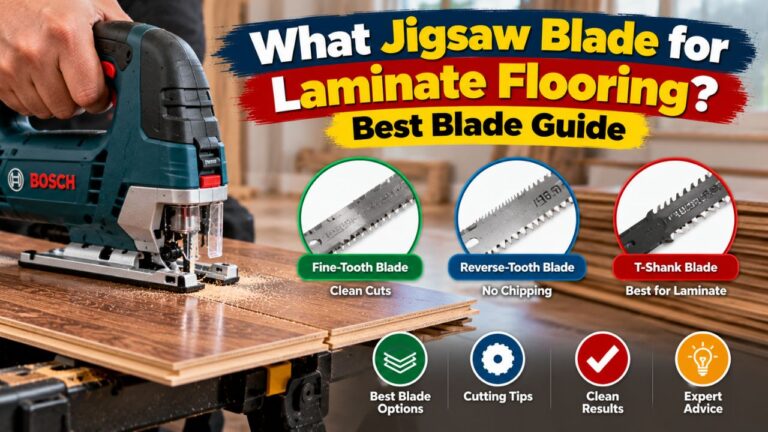
Use a fine-tooth carbide or high-quality bi-metal blade rated for hardwood, laminate, or abrasive materials.
Carbide jigsaw blades typically last longer in dense bamboo.
Choose the Correct Tooth Direction
Traditional jigsaw blades cut on the upstroke.
That means chipping is often more noticeable on the top surface.
You can place the finished surface face down, or use a reverse-tooth blade designed to provide a cleaner top surface.
Reverse-tooth blades change how the saw reacts to the workpiece, so keep the saw firmly controlled.
Avoid Extremely Fine Blades in Thick Bamboo
A very fine blade may look like the best option for a clean edge, but if it cannot clear material effectively, cutting becomes slow and hot.
Use a blade fine enough for the finish you need but robust enough for the flooring thickness.
What Blade Is Best for Strand-Woven Bamboo Flooring?
Strand-woven bamboo deserves special attention because it is generally the most demanding bamboo flooring to cut.
The compressed material is dense and can quickly expose weaknesses in a cheap blade.
I recommend a premium carbide blade intended for hard, abrasive materials.
For crosscutting, use a fine-tooth finish blade.
For long ripping, consider a quality combination or rip blade rather than an extremely high-tooth-count crosscut blade.
Expect Faster Blade Wear
Even a good carbide blade may dull faster in strand-woven bamboo than in conventional hardwood.
If you have an entire house to install, having a replacement blade available can prevent downtime.
Do not continue forcing a dull blade simply because it still rotates.
A dull blade increases heat and can make both the cut and the saw less controlled.
Can You Use a Laminate Blade on Bamboo Flooring?
Yes, in many cases.
A blade designed for laminate or melamine is typically made to produce clean cuts in hard, brittle, abrasive surfaces.
That makes it a good candidate for bamboo flooring.
However, some laminate blades have extremely high tooth counts.
They can be excellent for crosscuts but slower during long ripping operations.
If your bamboo project requires both cutting directions, a combination blade may be more practical for general use.
Can You Use a Plywood Blade?
A fine-tooth plywood blade can cut bamboo flooring, especially for occasional crosscuts.
However, inexpensive plywood blades may not stay sharp for long in dense strand-woven material.
If the blade is carbide-tipped and designed for finish cuts, it is a much better option than a basic thin steel plywood blade.
For a large installation, I would choose a more durable carbide blade.
Can You Use a Framing Blade on Bamboo Flooring?
Technically, yes.
A coarse 24-tooth framing blade can physically cut bamboo.
But it is not my preferred choice.
Large aggressive teeth are designed for fast cuts in construction lumber, not for producing a clean finished edge.
You may see more chipping, roughness, and surface damage.
If the cut will be completely hidden beneath baseboard, that may be acceptable in an emergency.
For normal installation work, switching to a finer carbide blade is worthwhile.
Can You Use a 40-Tooth Blade for Bamboo Flooring?
Yes.
A quality 40-tooth carbide blade is one of the best general-purpose choices for a 7 1/4-inch circular saw.
It balances speed and finish quality.
It is also a good option for a table saw when you need a combination of ripping and crosscutting, although the appropriate tooth count depends on blade diameter.
If your priority is an extremely clean crosscut, a higher-tooth-count blade may perform better.
Can You Use a 60-Tooth Blade?
Yes.
A 60-tooth carbide blade is an excellent choice for clean bamboo flooring crosscuts.
On a circular saw, it gives a fine finish.
On a 10-inch miter saw, 60 teeth is a solid starting point, although 80 teeth can provide an even finer cut.
For long ripping, I would compare cutting speed and heat before using a 60-tooth blade for an entire project.
Can You Use an 80-Tooth Blade?
An 80-tooth carbide blade is excellent on many 10-inch miter saws when you want clean bamboo flooring crosscuts.
It is also useful on a table saw for fine crosscut work.
I would not automatically choose it for long ripping in dense strand-woven bamboo.
The high tooth count can increase heat and slow chip removal.
Again, the best blade depends on the operation rather than simply choosing the largest tooth number.
How to Prevent Bamboo Flooring From Chipping
Blade choice is the first defense against chipping.
Use a sharp carbide blade.
Next, orient the flooring so the decorative face receives the cleaner side of the cutting action.
With a conventional circular saw, that usually means finished face down.
With a miter saw, it usually means finished face up.
Use Painter’s Tape
Painter’s tape across the cut can help support the surface layer.
Mark your cutting line on top of the tape and cut through it.
This is particularly useful if your flooring’s finish is brittle.
Support the Plank
Vibration contributes to rough cuts.
Support the board close to the cutting area and make sure it cannot move while the blade passes through it.
Score the Surface When Necessary
For highly visible cuts, lightly scoring the finished layer with a sharp utility knife along a straightedge can reduce breakout.
This is usually unnecessary for cut ends hidden beneath trim.
Do not create extra risk with a utility knife for a cut that does not need cabinet-grade edge quality.
How to Prevent Burning When Cutting Bamboo
Burning is common when cutting dense materials with a dull or inappropriate blade.
If you see dark marks along the cut, first inspect the blade.
A sharp blade should not require excessive pressure.
Common Causes of Burning
A dull blade increases friction.
A blade with too many teeth can run hot during long rip cuts.
Feeding too slowly can allow the same teeth to rub against the material repeatedly.
A misaligned fence on a table saw can pinch the flooring against the blade.
Resin or adhesive buildup on the blade can also increase friction.
Clean or replace the blade when necessary.
Do Not Solve Burning by Pushing Harder
Forcing the flooring faster through a struggling saw can reduce control and overload the blade.
Fix the cause instead.
Which Side of Bamboo Flooring Should Face Up When Cutting?
The answer depends on the saw.
Circular Saw
For a conventional handheld circular saw, put the finished surface face down.
The blade enters from underneath and tends to create more breakout at the upper surface.
Miter Saw
Put the finished surface face up.
The blade normally enters from above.
Table Saw
A table-saw blade rotates upward through the front of the table, so the teeth usually enter the bottom surface and exit the top.
For many cuts, this means the visible upper face may be more vulnerable to chipping.
A high-quality blade and a zero-clearance insert can help.
Because flooring construction differs, make a test cut before processing a large batch.
Jigsaw
For a conventional up-cut blade, finished side down generally gives the cleaner decorative surface.
If using a reverse-tooth blade, finished side up may be preferable.
How to Make Clean Crosscuts in Bamboo Flooring
Crosscuts are common at the ends of flooring rows.
A miter saw is ideal because it provides a fence and fixed cutting path.
Measure the board and mark the waste side.
Place the finished face up.
Hold the flooring firmly against the fence while keeping your hands outside the manufacturer’s safety zone.
Allow the blade to reach full speed before contacting the material.
Lower it smoothly.
Do not slam the blade through dense strand-woven bamboo.
Once the cut is complete, let the blade slow or stop before raising it through the fresh edge when appropriate for your saw and workpiece.
How to Rip Bamboo Flooring Lengthwise
Long rip cuts are typically required along the first and final rows.
A table saw or circular saw with a guide works well.
If using a table saw, set the fence to the required width.
Make sure the plank can be supported before, during, and after the cut.
For narrow rip cuts, use appropriate push sticks or push blocks according to the saw manufacturer’s recommendations.
If using a circular saw, clamp a straightedge guide to the plank.
Make sure the guide is offset by the distance from the edge of the saw shoe to the blade.
Then make one smooth continuous cut.
For long rips in strand-woven bamboo, a combination or ripping-oriented blade may perform better than an extremely fine crosscut blade.
Key Takeaways:
- Put bamboo face down with a conventional circular saw and face up with a miter saw.
- Use a guide for long circular-saw rips.
- Do not force the blade through dense strand-woven bamboo.
- A clean cut depends on sharpness, support, and feed rate as well as tooth count.
Do You Need a Diamond Blade for Bamboo Flooring?
Generally, no.
A diamond masonry blade is not the standard choice for bamboo flooring.
Bamboo is cut with toothed woodworking blades, preferably carbide-tipped.
There are specialty polycrystalline diamond, or PCD, woodworking blades designed for extremely abrasive materials, but these are very different from ordinary abrasive masonry diamond blades.
PCD blades can provide exceptional life in high-volume industrial cutting of composite materials.
For a normal DIY flooring project, a good carbide blade is more practical and affordable.
Is PCD Worth It for Bamboo Flooring?
Usually not for one room.
PCD blades cost significantly more than ordinary carbide blades.
Their advantage is exceptionally long wear life in abrasive materials.
For a contractor installing large quantities of strand-woven bamboo or other composite flooring, the longer blade life may justify the cost.
For a homeowner installing one bedroom or living room, a premium carbide blade normally provides better value.
Should You Use a Thin-Kerf Blade?
A thin-kerf blade removes less material and requires less power.
This can be helpful on cordless or lower-powered circular saws.
It also reduces waste slightly.
However, a very thin blade may flex more easily if pushed hard through dense bamboo.
Choose a quality thin-kerf blade designed for the saw rather than selecting the thinnest blade you can find.
For high-powered table saws, a full-kerf blade can provide additional stiffness.
Do You Need a New Blade for Bamboo Flooring?
Not necessarily.
If your existing carbide finish blade is clean, sharp, undamaged, and appropriate for the saw, it may be perfectly suitable.
Inspect it before beginning.
Look for chipped carbide teeth, heavy buildup, obvious dullness, or damage.
Make a test cut.
If the bamboo cuts easily and the edge is clean, continue using it.
If the saw struggles or the surface chips badly, install a sharper or more appropriate blade.
How Often Should You Change the Blade?
There is no fixed number of flooring planks a blade should cut.
Blade life depends on:
The blade quality.
The type of bamboo.
The thickness of the flooring.
How much ripping versus crosscutting you do.
Whether the blade stays clean.
How aggressively the saw is fed.
Strand-woven bamboo may reduce blade life considerably compared with ordinary wood flooring.
Change or sharpen the blade when performance declines rather than following an arbitrary plank count.
Safety When Cutting Bamboo Flooring
Bamboo flooring cutting produces fine dust.
Use appropriate eye protection and respiratory protection, particularly when cutting repeatedly.
Whenever possible, use effective dust extraction or cut in a well-ventilated location.
Hearing protection is also sensible around miter saws, circular saws, and table saws.
Keep Hands Out of the Cutting Path
Flooring planks are relatively narrow, which can tempt you to hold the material close to the blade.
Do not.
Use fences, clamps, push sticks, and other workholding methods as appropriate for the saw.
Support Long Planks
An unsupported plank can tip or twist during cutting.
This can pinch the blade and contribute to kickback.
Use extension supports or a stable workbench when necessary.
Disconnect Power Before Blade Changes
Unplug corded saws or remove the battery before installing or changing blades.
Do not rely only on the trigger switch.
Common Mistakes When Choosing a Blade for Bamboo Flooring
The biggest mistake is assuming more teeth are always better.
More teeth usually improve crosscut quality, but an extremely fine blade can overheat during a long rip cut.
Another mistake is using a dull blade because it still technically cuts.
A dull blade requires more force and can produce burning and chipping.
Using a cheap framing blade is another common problem.
It may work for hidden cuts, but the edge quality is generally inferior.
Some users also buy a specialty blade without checking diameter, arbor size, or maximum speed.
Blade compatibility always comes first.
Finally, do not ignore strand-woven bamboo’s density. If the saw is struggling badly, do not simply push harder.
Best Blade Setup for an Entire Bamboo Flooring Project
If I were installing an entire room and had several saws available, I would use a dedicated blade for each major operation.
For the miter saw, I would use a fine-finish carbide blade.
For the circular or table saw making long rips, I would use a quality combination blade or suitable ripping blade.
For the jigsaw, I would use a fine carbide or durable bi-metal blade for detailed cuts.
This gives each saw a blade suited to the task.
If I wanted to minimize purchases, I would choose quality combination blades that balance clean cutting with adequate chip removal.
FAQs about What Saw Blade to Cut Bamboo Flooring
What saw blade should I use to cut bamboo flooring?
Use a sharp carbide-tipped blade designed for hardwood, laminate, plywood, or finish cutting. The appropriate tooth count depends on the saw and whether you are crosscutting or ripping.
How many teeth should a circular saw blade have for bamboo flooring?
For a standard 7 1/4-inch circular saw, approximately 40 to 60 teeth works well for many bamboo flooring cuts.
How many teeth should a 10-inch miter saw blade have?
Approximately 60 to 80 teeth is a practical range for clean bamboo flooring crosscuts.
Can I use an 80-tooth blade for bamboo flooring?
Yes. An 80-tooth carbide blade is excellent for fine crosscuts on a 10-inch miter or table saw. It may not be ideal for long, demanding rip cuts.
Is a 40-tooth blade good for bamboo flooring?
Yes. A quality 40-tooth carbide blade is a versatile choice, especially on a circular saw or for general ripping and crosscutting.
Is a 60-tooth blade good for bamboo flooring?
Yes. A 60-tooth carbide blade provides a clean finish and works particularly well for crosscuts.
Can I use a framing blade on bamboo flooring?
A framing blade can cut bamboo, but its coarse teeth may leave more chipping. A finer carbide blade is usually preferable.
Can I use a laminate blade on bamboo flooring?
Yes. Many laminate blades work very well on bamboo because they are designed for dense, abrasive materials and clean surface cuts.
What blade is best for strand-woven bamboo?
Use a premium carbide blade designed for dense hardwood or abrasive composite materials. For high-volume professional cutting, PCD blades may also be worth considering.
Does bamboo flooring dull saw blades?
Yes. Dense bamboo, particularly strand-woven flooring, can dull saw blades faster than ordinary softwood. Adhesives and compressed fibers contribute to blade wear.
Should bamboo flooring face up or down when cutting?
With a conventional circular saw, finished face down is usually best. With a miter saw, finished face up is generally preferable.
What jigsaw blade cuts bamboo flooring?
Use a fine-tooth carbide or high-quality bi-metal blade designed for clean cuts in hardwood, laminate, or abrasive materials.
Can a table saw cut bamboo flooring?
Yes. A table saw is excellent for long rip cuts and repeated sizing when fitted with an appropriate sharp carbide blade.
Why does bamboo burn when I cut it?
The blade may be dull, dirty, too fine for a long rip, or feeding too slowly. Poor fence alignment can also create friction.
How do I keep bamboo flooring from chipping?
Use a sharp fine-tooth carbide blade, orient the finished face correctly for your saw, support the plank well, and consider painter’s tape for particularly brittle surfaces.
Conclusion
If you are deciding what saw blade to cut bamboo flooring, the best general answer is a sharp carbide-tipped blade with relatively fine teeth.
For a typical 7 1/4-inch circular saw, a 40- to 60-tooth carbide blade provides a good balance of speed and edge quality.
For a 10-inch miter saw, I would generally choose a 60- to 80-tooth finish blade for clean crosscuts.
For a 12-inch miter saw, an 80- to 100-tooth blade can provide similarly smooth results.
Table-saw blade selection depends more heavily on the operation. A fine 60- to 80-tooth blade is excellent for crosscuts, but a 40- to 50-tooth combination blade is often more practical if you need to make long rip cuts as well.
Strand-woven bamboo deserves extra attention because it is very dense and abrasive. Use a premium carbide blade, expect faster blade wear than with ordinary lumber, and replace or sharpen the blade when cutting performance declines.
Do not assume the highest tooth count is automatically best. Fine blades excel at crosscuts, while long rip cuts benefit from larger gullets and better chip clearance.
For clean results, blade choice is only part of the equation. Support the plank properly, orient the decorative surface according to the saw’s cutting direction, maintain a steady feed rate, and never force a dull blade through dense bamboo.
For most DIY installations, the simplest recommendation is this: use a quality carbide finish blade for crosscuts and a carbide combination or ripping blade when you need long lengthwise cuts. That setup gives you clean edges, reasonable cutting speed, and much better blade life than a coarse general-purpose construction blade.